Required Reading
This week, net neutrality, photographic muzak, naïve techno-utopianism, Frank Lloyd Wright's photographer, professional video game player superstars, crappy design, and more.


This week, net neutrality, photographic muzak, naïve techno-utopianism, Frank Lloyd Wright’s photographer, professional video game player superstars, crappy design, and more.

President Obama has come out in favor of net neutrality, aka a free and open internet. Which is great news! Last month, the creator of the World Wide Web, Tim Berners-Lee, came out in favor of net neutrality:
“It’s all predicated on a neutral network,” said Mr. Berners-Lee, in a reference to the heated debate around so-called net neutrality, a principle according to which everyone should have equal access to online content.
“Net neutrality is really, really important,” he added. “Never before have you had something in the system that could throttle your app.”
Tim Wu, the man who coined the term net neutrality, has applauded Obama’s position:
I think it was bold and courageous and, in some ways, just obvious. But sometimes, it takes someone who’s not deeply embedded in the game to say this is the obvious thing to do to.
Carolina Miranda looks at the dangers of celebrating extreme and destructive narco-culture in the Spanish-speaking world:
But the massive protests in Mexico City make me wonder if we are facing a tipping point. One in which the celebrations of relentless violence in some corridos might come to feel like the wretched excess it is. Perhaps the protesters who have grown tired of the narco-state might also be growing tired of the trappings of the more extreme aspects of narco-culture.
This is good. Ekaterina Degot explores the uneasy relationship between photography and contemporary art:
In this blog, I will explore — in a necessarily fragmented way — some of the paradoxes inherent to the complex relations between photography and so-called contemporary art, as seen through the eyes of a curator, a writer, and, in the first place, a teacher, since for almost a decade I have been teaching at a school that educates both photographers and artists.
Photographers-to-be often seem naïve and, literally, artless. Typically, they use the rhetoric of “bringing beauty and happiness into people’s lives,” and it breaks my heart to tell them that this will not really contribute to their careers, and that they should rather adopt a very different vocabulary. I suggest that they make a promise to “disturb” and “frustrate” some innocent people — without necessarily changing the type of images they are producing (cats and flowers can be veryfrustrating, as artists like Fischli/Weiss have shown us). Others, who have already tasted the blood of contemporary art, know they must exude a certain nonchalant disdain of the uneducated public, while claiming to be socially useful—and this particular claim is best expressed in an extremely complicated language. Contemporary art then appears as some sort of rhetorical skill, a tool to interpret what you are doing in a right way — something photographers-to-be do not always master, while what they actually do more or less fits with the ever-expanding frame of contemporary art.
Possible related to the above: Colin Pantall explores photographic muzak (h/t Jörg Colberg):
That’s the visible photographic culture that we live in and it’s terrible. It’s everywhere and it has its own festivals, celebrations and manufactured happenings. Its blandness is offensive in the extreme. It’s more than offensive. It has an effect on us all because it is so ubiquitous. We cannot escape it. It’s Stepford photography that serves the needs of consumption. It kills emotion, opinions and social values. It’s normal.
This week Sheikh Saud Al-Thani died mysteriously, and writing for The Daily Beast Lizzie Crocker takes a look at the “Mysterious Death of the Art World’s Favorite Sheikh”:
He acquired $1 billion worth of art and tangled scandalously with the authorities. Will his family continue in Sheikh Saud Al-Thani of Qatar’s high-spending tradition?
Some context:
Al-Thani officially entered the art world to great fanfare in 2000, when he spent more than $15 million on 136 photographs by masters like Man Ray and Alfred Stieglitz.
He quickly earned a reputation for driving up bidding prices and shelling out exorbitant amounts of money on an eclectic range of art, from Islamic ceramics to 18th century French furniture and vintage cars.
Among his purchases: a $9.57 million Fabergé egg bought at Christie’s in 2002, a complete set of Audubon’s Birds of America for $8.8 million, and a Roman marble statue known as the Jenkins Venus for nearly $13 million from Christie’s in London.
Adrian Chen takes a careful look at the naïve techno-utopianism of Anonymous:
Anonymous came to be known as the “Internet Hate Machine.” But, Coleman tells us, everything changed when Anonymous decided to take on the controversial Church of Scientology in 2008. Angered by Scientology’s attempt at suppressing an embarrassing recruitment video starring Tom Cruise that leaked online, Anonymous launched an anti-Scientology campaign called ”Chanology,” which hacked Scientology websites, spread anti-Scientology propaganda and even organized real-life protests, one of which, Coleman tells us, attracted “a whopping one thousand people.” With Chanology, Anonymous “emerged from its online sanctuary and set out to improve the world.” Since then, Anonymous’s members have undertaken a series of “ops,” protesting everything from Internet censorship by dictatorships during the Arab Spring, to PayPal’s refusal to process payments to WikiLeaks, to the rape of a high-school girl in Steubenville, Ohio. In its decade of existence, Coleman claims, Anonymous has evolved from profane pranksters into “one of the most politically active, morally fascinating, and subversively salient activist groups operating today,” as well as a “force for good in the world.”
How anime has changed in the last few decades:

The story of how a 22-year-old art school drop-out Pedro E. Guerrero became Frank Lloyd Wright’s trusted photographer for the last 20 years of the architect’s life:
Young Guerrero had the chutzpah to introduce himself to the famous architect as a “photographer.” In truth, he hadn’t earned a nickel. “I had the world’s worst portfolio, including a shot of a dead pelican,” Guerrero said later. “But I also had nudes taken on the beach in Malibu. This seemed to capture Wright’s interest.”
As it happened, Wright had just lost a photographer. It was another in a series of coincidences that catapulted Guerrero into modern architectural history: when he’d tried to enroll at Los Angeles’s Art Center School on his 20th birthday, he’d been told it was too late—all the classes were filled except photography. When Wright and Guerrero met two years later, Wright hired the young photographer on the spot. “Photograph anything and everything,” Wright instructed. The pay was minimal. Guerrero was thrilled.
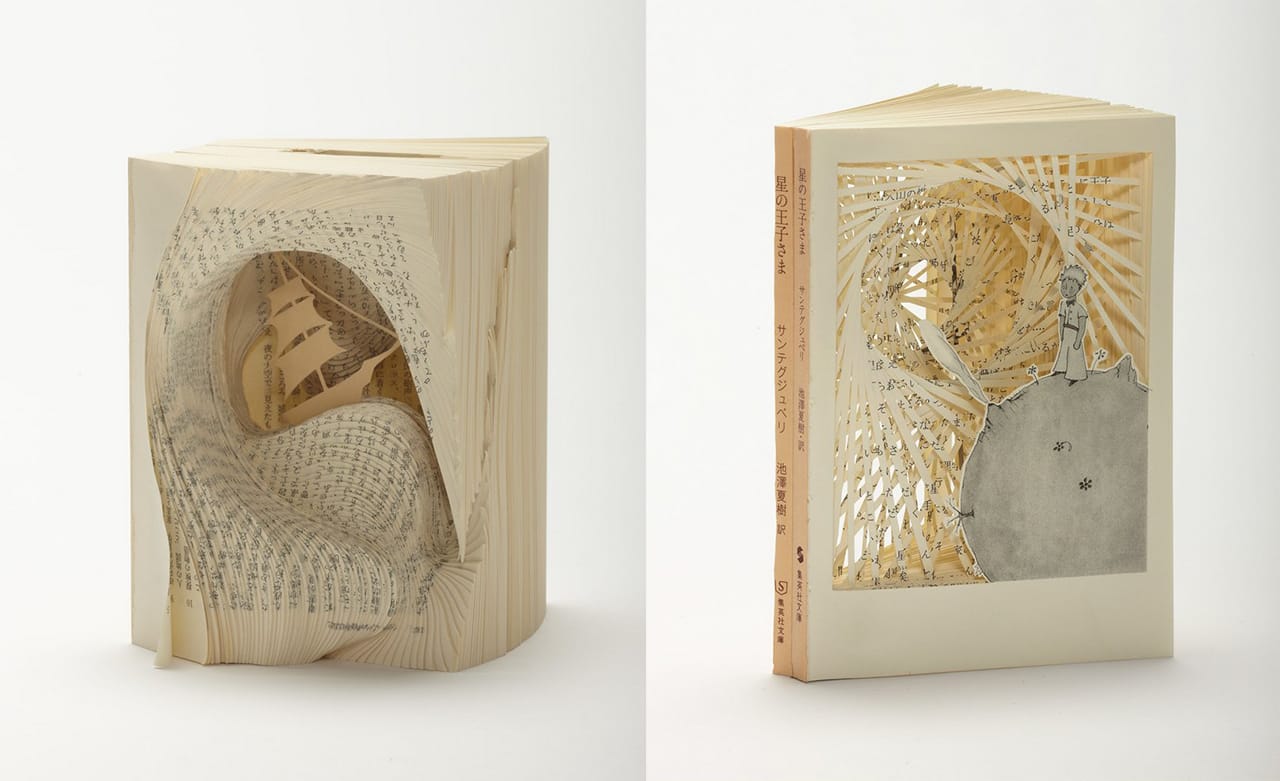
Spoon and Tomago points us in the direction of Tomoko Takeda’s latest project monogatari no danpen (fragments of stories), which distills books into one visual image, like Jules Verne’s Two Years’ Vacation and Antoine de Saint-Exupéry’s The Little Prince below:
The rise of video gamers as “stars” is fascinating, and the New York Times has an insightful profile of Matt Haag, a professional video game player:
Three years ago, he was flipping burgers at McDonald’s. Today Mr. Haag, 22, skinny and blindingly pale, makes his living playing Call of Duty, a popular series of war games where players run around trying to shoot one another.
Mr. Haag has 1.5 million YouTube subscribers along with a lucrative contract to live-stream his daily game sessions online. Known as Nadeshot (shorthand for “grenade shot”), he travels the world playing tournaments as spectators pack arenas to see him. At home near Chicago, he has a problem with fans showing up at his house.
In case you need proof that some people in the art auction world are out of touch, there is this quote in Kelly Crow’s “Christie’s Makes History With $853 Million Sale of Contemporary Art” article in the WSJ:
Christie’s Chief Executive Steven Murphy said the sale “proves that enjoying works of art has become a universal pursuit in our time.”
SHOCKING: FBI’s “Suicide Letter” to Dr. Martin Luther King, Jr., and the Dangers of Unchecked Surveillance:
The anonymous letter was the result of the FBI’s comprehensive surveillance and harassment strategy against Dr. King, which included bugging his hotel rooms, photographic surveillance, and physical observation of King’s movements by FBI agents. The agency also attempted to break up his marriage by sending selectively edited “personal moments he shared with friends and women” to his wife.
Portions of the letter had been previously redacted. One of these portions contains a claim that the letter was written by another African-American: “King, look into your heart. You know you are a complete fraud and a great liability to all us Negroes.” It goes on to say “We will now have to depend on our older leaders like Wilkins, a man of character and thank God we have others like him. But you are done.” This line is key, because part of the FBI’s strategy was to try to fracture movements and pit leaders against one another.
The story of Wikipedia’s greatest sex illustrator:
Meanwhile, outside the insular Wikipedia community, a cultish fascination with Seedfeeder was budding. In 2009, a popular online-art newsletter called B3ta devoted a section to the the “particularly prolific contributor of sex-related drawings.” The Polish magazine Przegląd used his anal-oral image on its cover in July 2010, and the next year, a popular Reddit thread dubbed him “Wikipedia’s great artist.” At around the same time, journalists, a grad student writing a research paper, and a company looking to hire Seedfeeder began littering his talk page with requests — from the looks of it, none of them were successful — and last year, several of his works were immortalized on a Cracked.com list called “The 6 Most Terrifying Sex Illustrations on Wikipedia.”
Here is the sound recording of the ESA landing on the Rosetta comet, which they’re titled “Singing Comet.” KQED explains that “The chirping is thought to be generated by oscillations in the comet’s magnetic field. The sound wave is below the frequency that can be heard by a human ear, but ESA boosted the frequency in the track.”:
24 examples of really crappy design:

Required Reading is published every Sunday morning ET, and is comprised of a short list of art-related links to long-form articles, videos, blog posts, or photo essays worth a second look.