Required Reading
This week, photographing the oldest trees on earth, considering Cuban freedom, gay tours of the Vatican, the art world's patron "Satan," death of the artist (again), making the internet more global, autotuning John Cage, and more.


This week, photographing the oldest trees on earth, considering Cuban freedom, gay tours of the Vatican, the art world’s patron “Satan,” death of the artist (again), making the internet more global, autotuning John Cage, and more.
Artist Coco Fusco has been writing extensively about recent issues, including the #BlackLivesMatter protests and the detention of Tania Bruguera by the Cuban authorities.
First, about #BlackLivesMater, she makes comparisons with the Occupy Movement:
Occupy Wall Street was a revolt led by white middle-class young adults against the predatory practices of high finance and the failure of government to punish the bankers adequately. The protagonists of the current protests are young African-Americans who are indignant about institutional racism in our criminal justice system. In both cases, young Americans are expressing their frustration with the oppressive power structures that are destroying their lives and their dreams of a better future. They believe that our government is more inclined to protect the interests of ruling elites than the rest of us. They are joined by a multiracial coalition of social justice and faith-based groups that share their frustration.
And about the situation in Cuba:
Cuban National Arts Prize winner Lázaro Saavedra issued the lengthiest public statement so far via his Galería I-mail on December 30, in which he critiqued Bruguera’s performance as a miscalculated attempt at “aRtivist action” that preaches to Cubans about something they already know too well, i.e. the limits on their freedom of expression, and allows the artist to advance herself professionally with minimal risk, since she resides abroad and enjoys a kind of media coverage that serves as a protective shield. Saavedra claims he would have preferred that Bruguera create a temporary autonomous zone in which the voices of Cubans who live in Cuba and are not well-known artists could actually have been heard. It seems that Saavedra presumes that Bruguera’s performance was supposed to reveal something unknown, or that placing the mechanism of repression under scrutiny in a performance is unnecessary if the Cuban people are already aware of how their government exerts control of them. There are too many examples of artworks that have called upon viewers to review the already known so as to see and understand it differently for such presumptions to be unquestionably sustainable.
Unless you live under a rock, you’ve probably heard someone discussing the recent profile of Stefan Simchowitz in the New York Times Magazine today. Provocatively titled “The Art World’s Patron Satan,” it profiles a man who sees himself as a disruptor, but whom others see as a potentially dangerous opportunist preying on young artists:
Since 2007, Simchowitz has sponsored and promoted roughly two dozen young artists. In addition to arranging sales for their work, Simchowitz often provides them with a studio, purchases their materials, covers their rent and subsidizes their living expenses. Perhaps most consequentially, he also posts photos of them and their work on his influential Instagram account, thereby creating what he calls “heat” and “velocity” for the artists he supports, who have included market darlings like the Colombian Oscar Murillo, the Japanese-American Parker Ito and the Brazilian Christian Rosa, all under the age of 35. But Simchowitz’s methods call down the opprobrium of art-world stalwarts, who are contemptuous of his taste, suspicious of his motives and fearful of his network’s potential to subvert the intricate hierarchies that have regulated art for centuries.
Are we witnessing the death of the artist as we know it?
As art was institutionalized, so, inevitably, was the artist. The genius became the professional. Now you didn’t go off to Paris and hole up in a garret to produce your masterpiece, your “Les Demoiselles d’Avignon” or Ulysses, and wait for the world to catch up with you. Like a doctor or lawyer, you went to graduate school—M.F.A. programs were also proliferating—and then tried to find a position. That often meant a job, typically at a college or university—writers in English departments, painters in art schools (higher ed was also booming)—but it sometimes simply meant an affiliation, as with an orchestra or theater troupe. Saul Bellow went to Paris in 1948, where he began The Adventures of Augie March, but he went on a Guggenheim grant, and he came from an assistant professorship.
Not everyone agrees, and another piece refutes the original article, calling it just another millennial thinkpiece (ouch):
His hypothesis requires us to accept some broad and far-reaching stories about the progress of art in Western history. In sweeping paragraphs, he acquaints us with the early-modern artistic craftsman, the Romantic ideal of the lone genius, and the recent turn toward professionalization. In the late 20th century, he concludes, artists—and novelists, and composers—hid out in the academy, where grants and staff meetings rendered them “just another set of knowledge workers.” (O, what a sad life they led.)
The MIT Innovations journal has a few articles that explore what needs to happen to make the “Western internet” into a more indigenous service for those living around the world (h/t @katypearce):
Kul Wadhwa and Howie Fung, “Converting Western Internet to Indigenous Internet: Lessons from Wikipedia”
It is understandable that English is the most dominant language in Wikipedia; the project started in the US and then expanded to Europe, and many people around the world can read and write in English. Today, Wikipedia content in such languages as Swedish and Dutch continue to be ranked the second and third largest Wikipedias by number of articles. Why haven’t there been more contributors from other languages with much larger populations? For example, Thai, Hindi, and Bahasa Indonesia have anywhere between five and seven times as many native speakers as Swedish, but Swedish-language content on Wikipedia is five times all those languages combined.
If you look at the numbers of articles and contributors for languages from the Indian subcontinent, such as Hindi, Bengali, Tamil, and Gujarati, there are millions of native users and consumers of content generated from old existing content ecosystems, including newspaper and book publishers. Yet most of these users are missing from Wikipedia’s universe. Hindi Wikipedia is the largest Indiclanguage Wikipedia, yet it has only about 110 thousand articles.
Mark Graham, “Inequitable Distributions in Internet Geographies: The Global South Is Gaining Access, but Lags in Local Content”
The Internet is not an amorphous, spaceless, and placeless cloud. It is characterized by distinct geographies. Internet users, servers, websites, scripts, and even bits of information all exist somewhere. These geographies of information shape both what we know and the ways we are able to enact, produce, and reproduce social, economic, and political processes and practices.
The most telling image in the article is this graphic of “The Location of Academic Knowledge” — the five biggest blocks (in order) are the US, UK, the Netherlands, Germany, and Switzerland:

Michael Gould-Wartofsky considers rioting and in what instances it could be considered “natural” as a response to structural oppression:
The recent revival of urban protest has prompted a revival of that hoary urban legend, in which property owners and officers of the peace are the hapless victims, while targets of state terror are the aggressors. The riot is made out to be the root of all evils, the rioter the source of all maladies. But the legend quickly unravels in the face of the facts.
… But the “riot effect” narrative contains a fatal flaw betrayed in the terminology itself: it rests on the assumption that “riots” are essentially random occurrences. For those who blame black America for black poverty, riots are distinguished not by their contingency or their spontaneity or their political cast, but by their irrationality. On this misreading of history, civil resistance has nothing to do with the underlying conditions that make it rational to rebel, or with the relations of power that make other avenues of action unavailable to the urban poor.
What you need today is to listen to John Cage’s iconic 4’33” in autotune (h/t Verge):
How much has the Vatican changed? Well, you can get a gay tour of its art nowadays, and the New York Times interviews the tour guide:
NY Times: What are some of the secrets people learn?
Alessio Virgilli: To understand heroes of antiquity or works of artists it is necessary to know them thoroughly, omitting nothing of their private life. For example, we tell of Michelangelo. He was a devout Catholic and at the same time a homosexual, with a constant feeling of guilt and inner conflicts reflected in his works. When we look at the Sistine Chapel’s “Last Judgment,” our guides do not fail to show at the top right two male figures who kiss to celebrate the ascent into heaven. In Milan, we retrace Leonardo da Vinci’s affair with his disciple Salai, who maybe inspired the depiction of St. John the Baptist alongside Jesus in “The Last Supper.”
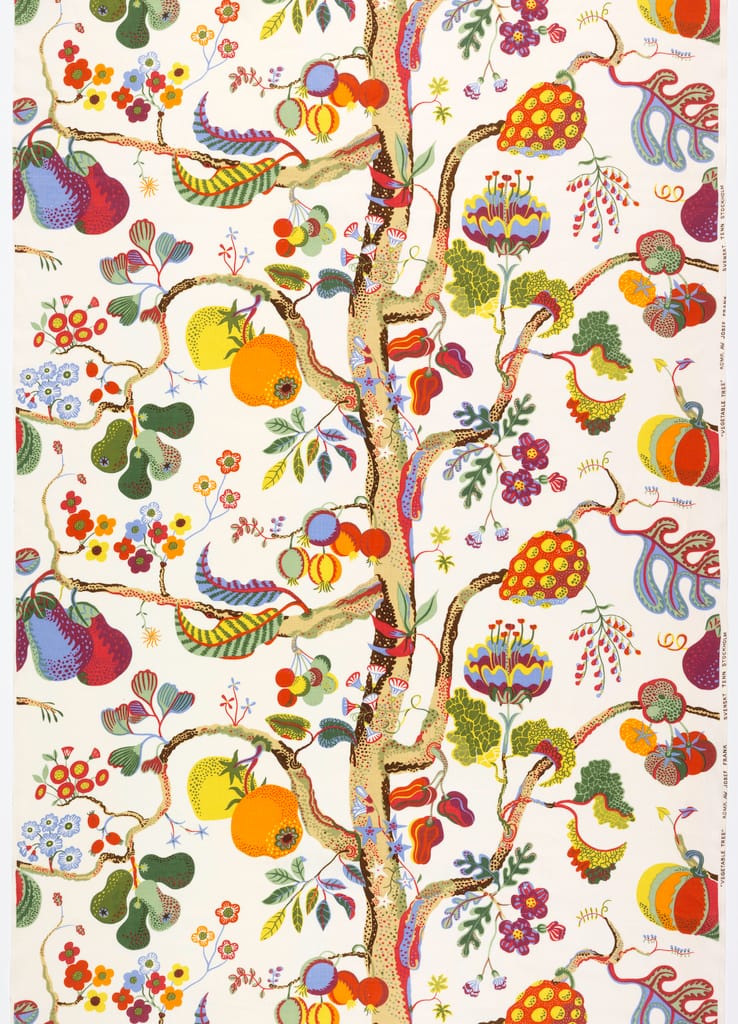
The Cooper-Hewitt listed the most-visited objects online in its collection, and this colorful textile by manufactured by Svenskt Tenn and designed by Josef Frank came out on top:
Hollywood Reporter wrote that box office attendance in 2014 was the lowest it has been in two decades:
Overall revenue for the North American box office in 2014 is expected to finish at roughly $10.36 billion, down 5 percent over 2013 and marking the biggest year-over-year decline in nine years.
… A number of summer tentpoles underperformed compared to previous installments, including Sony’s The Amazing Spider-Man 2 (May 2) and Paramount’s Transformers: Age of Extinction (June 27). And while November’s The Hunger Games: Mockingjay — Part 1, from Lionsgate, is only the second release of 2014 to cross $300 million after Disney and Marvel’s Guardians of the Galaxy (Aug. 1), it still won’t match its predecessors, both of which earned north of $400 million domestically. (So far, Guardians is the top earner of 2014 domestically at $332 million, although Mockingjay isn’t far behind, grossing north of $306 million to date.)
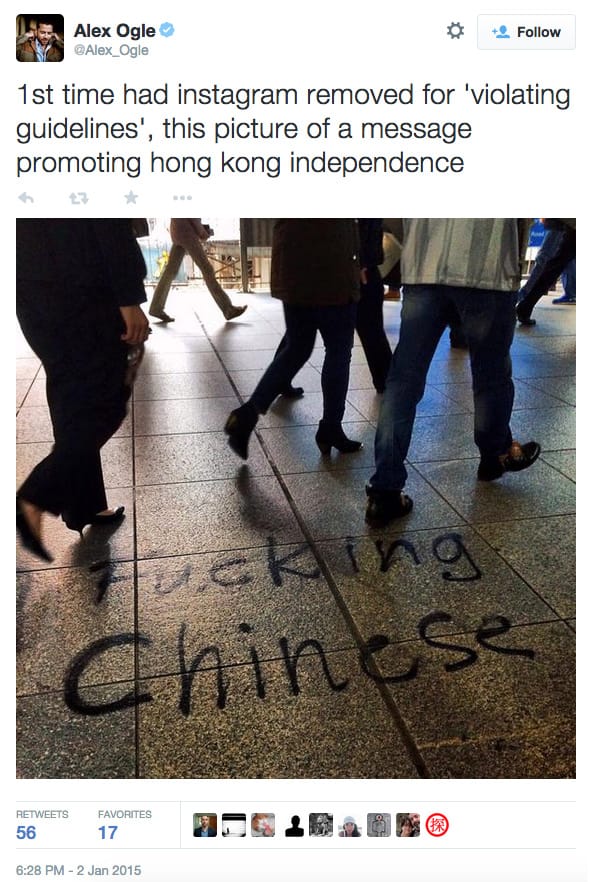
Hong Kong–based photojournalist Alex Ogle had the following image removed from Instagram for violating community guidelines. It raises disturbing possibilities that the Chinese authorities are reigning in more control over social networks than ever before:
I know the holidays are over for most people, but this list of “7 New Carols to Sing This Christmas” is too good not to share, including “The Wreck of the HMS Christmas” and “Holy Shit, The Manger Is Glowing.”
Required Reading is published every Sunday morning ET, and is comprised of a short list of art-related links to long-form articles, videos, blog posts, or photo essays worth a second look.