Required Reading
This week: how to make art with a full-time job, portraits of Black marronage, artists vs. algorithms, US men’s hockey team acts up (again), snow sculptures in NYC, and more.
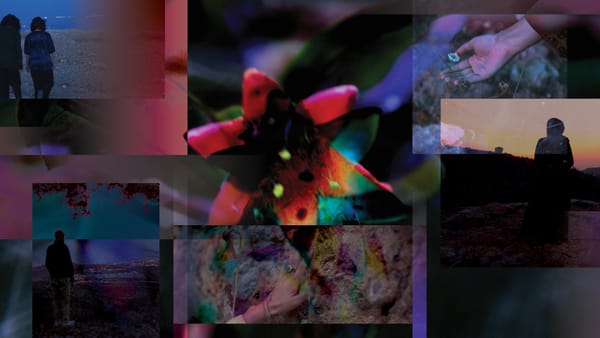
The ever astute Colony Little considers the ecological portraits of Claire Alexandre, who uses natural materials to explore Black diasporic history. In Burnaway, she reviews the artist's show in Raleigh:
Harriet Jacobs was an enslaved woman from Edenton, North Carolina, who fled her abusive enslaver in 1835. After hiding within a small garret in the attic of her grandmother’s home for seven years, Jacobs escaped north and lived in fugitivity as a writer and abolitionist until she was manumitted in 1852. When she first fled, she sought temporary refuge in the southern flank of the Great Dismal Swamp, likely with the aid of maroons living in the region.
Alexandre, in her exhibition, also evokes the concept of marronage—a form of survivalist self-emancipation where enslaved Africans escaped plantations and sought refuge in remote environments, including swamps and wetlands that were notoriously inaccessible due to the terrain and dangerous wildlife. Maroons developed communities built on the subsistence of the land, using their knowledge of the terrain to facilitate the escape and refuge of other enslaved people. The artist represents these liberatory practices in many of her pieces through plant materials known in Indigenous cultures for their medicinal and healing properties.
In the Los Angeles Review of Books, Scholar Sarah Brouillette considers a new release by Sophie Bishop, who explores how social media and algorithmic appeal influence the way artists do (or don't) engage online:
Bishop is working in the tradition of Howard S. Becker, who argued that making art is always shaped by “art worlds,” the networks and institutions involved in artworks’ production, distribution, and evaluation. She is not interested in moralizing or claiming that influencers are ruining art; her goal instead is to understand how “influencer creep affects artistic production and how art becomes visible to audiences.” But a chasm clearly separates a Jen Stark from a newly emerging artist trying to make her Instagram account discoverable, and Bishop’s interviews with artists reveal that many judge influencer culture as beneath them and only reluctantly participate due to economic exigency. Their own ambivalence about social media is important information and grounds for a more pointed critique—not of what people do because they feel they have little choice, but of the very circumscription of their options and the nature of required compliance.
Madeleine Schwartz recounts her visit to a show in Paris composed of artifacts and treasures from Gaza, whose ancient history is routinely overlooked and understudied, in the New York Review of Books:
In the basement of the Institut du Monde Arabe, the displaced pieces of this centuries-long history sat on wheeled tables that resembled storage carts; even the benches had wheels. The labels were simple, with no translation from the French and relatively little information. The first time I went I found it hard to see what I was looking at amid the dark lighting and large crowds. Only when I returned one morning did I feel I could take in the objects and understand the history that connected them.
It’s frustrating how little we know about some of these artifacts. As the curator Élodie Bouffard notes in the catalog she coedited with the archaeologist René Elter for the exhibition, Gaza’s ancient heritage has long been understudied. Archaeological efforts started there in 1879 with a “happy accident,” Bouffard writes, when a peasant found a thirteen-foot-tall statue of Zeus peeping out of a pile of sand. (Now the statue looms over visitors to the Istanbul Archaeological Museum.) But the nineteenth-century rush of archaeologists in the Middle East mainly ignored Gaza, which preserved few relics of Biblical history.
Dr. Nasser Mohamed, the only publicly gay person in Qatar, describes the intrusive interview process he had to endure to get asylum in the US to Greg Owen of LGBTQ Nation:
What did that process involve?
When you file for asylum, there’s just so many steps. They include going in to have your biometric data collected. You get fingerprinted and have photos taken, and then you go in and turn in some documents some other day, and so on — it was all a blur. And then one of the steps was my interview, which was like three years later. I had to wait three years for them to even process my case.
What was the interview like?
Yeah, it was rough. It was really rough. It was long, and it was rough. And it was very intrusive, because it was based on my sexuality. And I’m pretty okay engaging in difficult conversations. But that one was like really trying to prove I’m gay. But it was also kind of funny, because I’m pretty sure my asylum officer was gay.
Lauren Theisen writes in Defector about the homophobia and misogyny of the US men's hockey team and how it exposes the fantasy of the Olympics:
Coming off Heated Rivalry, with the massive exposure of the Olympics spotlighting the most talented group of American men ever assembled for this particular tournament, the timing was perfect for new frontiers in hockey fandom. All that these attractive, gold-winning players had to do was not say or do anything that would make a bunch of fans believe that they didn't respect women. They lasted just a few minutes into the off-ice celebration.
If letting Kash Patel film his own personal segment for "My Wish" wasn't embarrassing enough, the team was also caught on camera laughing at a joke from a speakerphoned President Trump that basically stated that it would be a drag to have to invite the women's team along with them to D.C. Lest one think that this crack-up was just an awkward faux pas brought on by the inherent weirdness of listening to a demented world leader ramble at you from another continent, the vast majority of the team accompanied Trump in the White House and appeared as his guests at the State Of The Union speech on Tuesday, where Trump said he'd give the Presidential Medal of Freedom to Winnipeg Jets goaltender Connor Hellebuyck. The ones who returned to their teams on time got some social media cred for avoiding the speech, but they've had nothing of substance to say about the experience.
It's difficult for me to imagine a life without music, but there is a rare neurological condition that prevents people from enjoying it. The New Yorker's Shayla Love explains:
Over the years, Bill Weiss has continued to try out the occasional concert. Years ago, he went to a performance of Handel’s “Messiah.” It sounded to me like he could recognize the two-dimensionality that Andres had described to me. He just didn’t find it rewarding. “I did it more to check it off my bucket list than to say, ‘I’m going to have this joyous musical response,’ ” he said. He still feels confused when he sees strangers dancing to music—for example, when a cashier dances to the beat of whatever’s playing in a grocery store. “It always takes me aback, and just amazes me, because that thought would never, ever have entered my mind,” he told me. Still, his wife played music at their wedding. (They have a son who also seems indifferent to music.)
But Weiss was quick to mention other things that do give him pleasure. “I love walking around cities, admiring architecture,” he said. “I am kind of a foodie.” The chills that some people get from music, he’s felt while reading. He also has an unusually strong connection to visual art. When we spoke, over Zoom, he showed me an image of one of his favorite paintings: an early-seventeenth-century portrait by Peter Paul Rubens, of the artist’s young daughter Clara Serena. Her wispy blond hair filled my screen; her big blue eyes stared out at me.
If your New Year's resolution to do more things alone has fallen to the wayside, Rainesford Stauffer is here to encourage you to give it another shot. For Time, she reports on its psychological and social benefits:
To Addie Tsai, 46, solo outings are a way of cultivating a relationship with oneself. In their twenties, Tsai would go alone to an 80s music club to dance all night, drink bottles of water, and enjoy the freedom of not having to take care of or entertain others. Tsai still loves going to bookstores or going out to eat alone. “When you decide to partake in activities alone,” she told me, “you are connecting to them in a completely different way than you would when someone is there.”
None of this is an argument against community. Relationships are central to wellbeing, and many stressed it’s not a matter of choosing between company and solo activities. They’re different experiences, with different feelings. Access matters, too. Time, money, mobility, and safety shape what kinds of solo experiences are possible.
A smart take on the BAFTA discourse:
@kbs_flix At the BAFTAs, John Davidson, who has Tourrette’s, yelled out a racial slur while Delroy Lindo and Michael B Jordan were on stage. The BAFTAs editorial decisions are very telling, and they only made the situation worse. #baftas #michaelbjordan #delroylindo #johndavidson ♬ original sound - KB’s Flix
Alice, an artist based in New York, shares tips on how to make art every day when you have a full-time job:
@alohvera building structure into ur life to prioritize making art! #howto #art ♬ original sound - alice
@matthewdeanstewart I LOVE BROOKLYN! This was the most magical thing I’ve ever seen. Which one was your favorite!?!? #nycsnow #snowman #brooklyn #blizzard #nycparks ♬ original sound - Matthew Dean Stewart
Required Reading is published every Thursday afternoon and comprises a short list of art-related links to long-form articles, videos, blog posts, or photo essays worth a second look.