Required Reading
This week, the secrets of late Barnett Newman paintings, Parviz Tanavoli in the spotlight, Asian-American poetry and visual art, glitch art, old US infographics, dinosaurs at MoMA, and more.

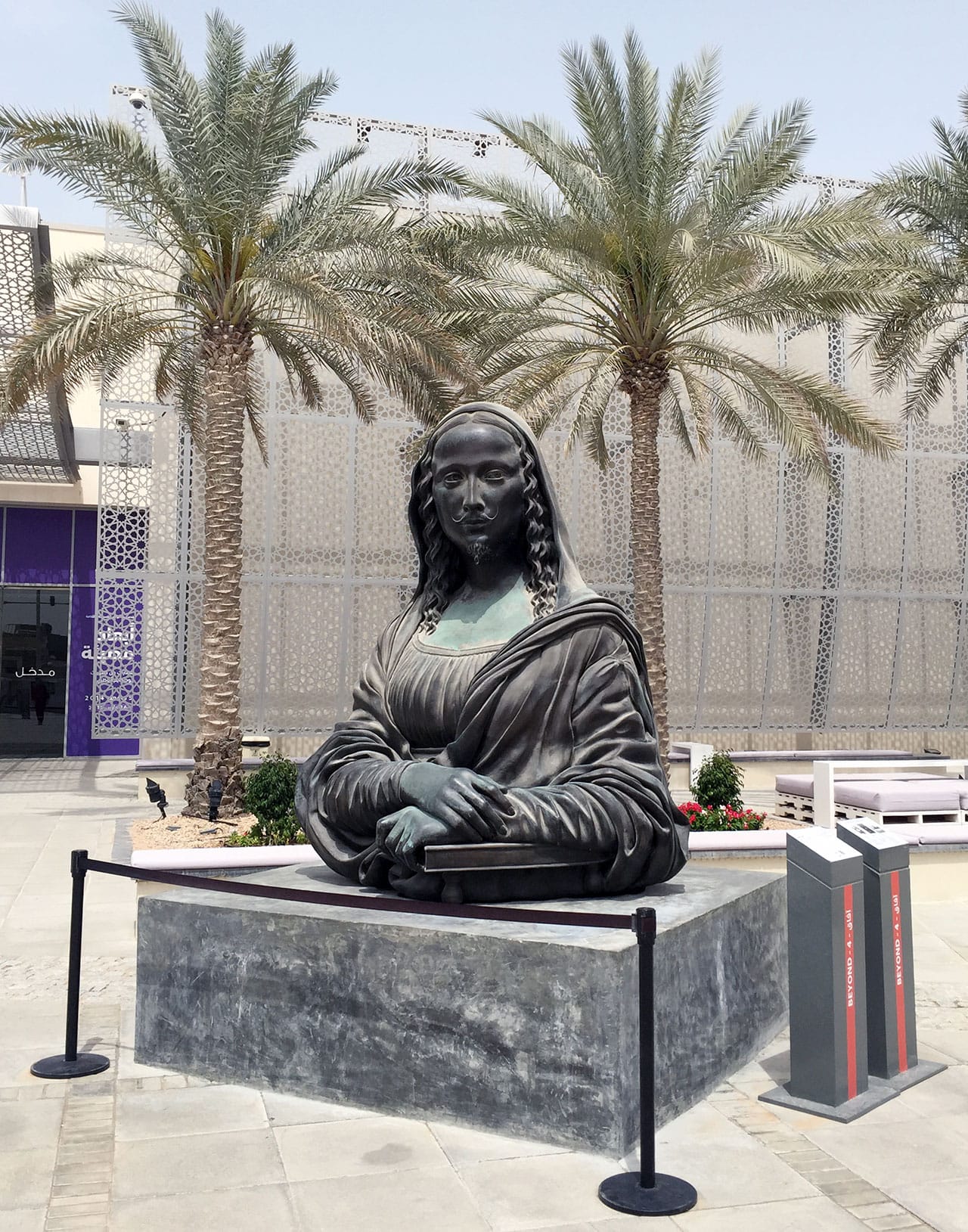
This week, the secrets of late Barnett Newman paintings, Parviz Tanavoli in the spotlight, Asian-American poetry and visual art, glitch art, old US infographics, dinosaurs at MoMA, and more.

A particularly good podcast by Tyler Green has curator Michelle White talking about Barnett Newman’s late work at the Menil Collection and curator Hannah Segrave on the new show by Baroque painter Salvator Rosa at the Cleveland Museum of Art:
Shiva Balaghi explores the new retrospective of Parviz Tanavoli at the Davis Museum, which she co-curated. It is the story of a true artistic pioneer:
When there was no modern Iranian sculptural tradition, Parviz Tanavoli invented one. When there were no exhibition spaces dedicated to exhibiting modern Iranian art, Tanavoli organized a show in the marble lobby of a bank. When there were no artist spaces for Iran’s contemporary artists to gather in the 1960s, he worked with his friend Kamran Diba to open Club Rasht. And when American audiences had never before seen contemporary Iranian art, Tanavoli rolled up fifty works by fourteen artists and carried them from city to city across the US from 1962-65. The career of Parviz Tanavoli has been marked with imagining new artistic horizons and creating new possibilities for studying, making, and exhibiting Iranian art.
The relationship between Asian-American poetry and the visual arts — it includes Hyperallergic Weekend editor John Yau (of course):
If not already visual artists themselves, the poets collected here have extremely close ties to the visual arts and visual culture, from painting to film to installation: they write about art, in both critical and creative modes, and collaborate widely with artists. It should be no surprise, then, that the diverse and vibrant work in this portfolio, some of which was specially commissioned for The Margins, often yokes text and image together in surprising ways and represents ekphrastic poetry in some of its most advanced and innovative forms. In fact, some of these pieces seem to exceed the genre of ekphrasis altogether; for example, Christine Wong Yap brings together sculpture and concrete poetry in Cloud to form a delightfully baroque thought balloon, highlighting the fact that language is, in her words, both “physical and immaterial.”
You can read John Yau’s fantastic “Further Adventures in Monochrome” here, which begins:
I dwell in possibility, Emily Dickinson
I dwell in impossibility, Yves Klein
You should understand that I did not want you to read a painting. I wanted you to bathe in it before words domesticated the experience, and you turned to such stand-bys as “illumination” and “transcendent” to describe what happened to you. Painting should not be sentenced to sentences.
The history of glitch art is considered:
“Glitch art, then,” he wrote, “is anytime an artist intentionally leverages that moment, by either recontextualizing or provoking glitches.”
It draws back the curtain on our sleekest devices and virtual constructs to reveal raw pixels and code, a surreal landscape of unformed possibilities.
The medium, however, actually dates back to Web 1.0 and well beyond. Dutch artist and theorist Rosa Menkman, in 2011’s Glitch Studies Manifesto, traces the aesthetic of decay and disruption back to “the magnetic distortion and scanning lines of the cathode ray tube,” explored by Nam June Paik in 1965’s MagnetTV, and experiments involving “the scratching and burning of celluloid,” as in Len Lye’s 1937 abstract short A Colour Box, which involved painting directly onto film stock.
Artist Molly Crabapple explores why modern-day solitary confinement is a form of torture that impacts 80,000 men and women in the United States, including people as young as 14:
The Walker Art Center has a conceptual art pop-up shop:
Created by Michele Tobin, the retail director of its gift shop, and Emmet Byrne, the museum’s design director, it is in equal parts a digital bazaar with pieces priced to sell, and an exhibition, of sorts, with curated original artworks.
It upends the logic of a regular shop. “The priority isn’t ‘get as much as you can for that item in the marketplace,’ ” Ms. Tobin said. “The priority becomes the artist’s intention and what we all think is right for that work.”
The story of artists being evicted in San Francisco’s Mid-Market district because of the tech boom and the onslaught of new startups:
Now we are down to 23. They are painters, writers, dancers, musicians – the kind of people San Francisco used to welcome. They also work in the local service industry, taking lower wage jobs that are necessary if the tech workers are going to be able to get a latte at a café.
Zaria Gunn, one of the founders of the 1061 collective, said that “I am what happens when you do these evictions.” She was one of the artists on the lower floor, and when she was tossed out, “I had no place to live for months.” Now she’s in Oakland.
The Harvard Library shared (@HarvardLibrary) a really amazing infographic from the 1920s that illustrates the provincial origins of residents in Manhattan’s Little Italy. It is an image from Robert Ezra Park’s important 1921 book Old World Traits Transplanted, which doesn’t only look at the settlement patterns of Italian Americans but all ethnic groups in the United States, including this great image (right) of the location of Japanese businesses in San Francisco:
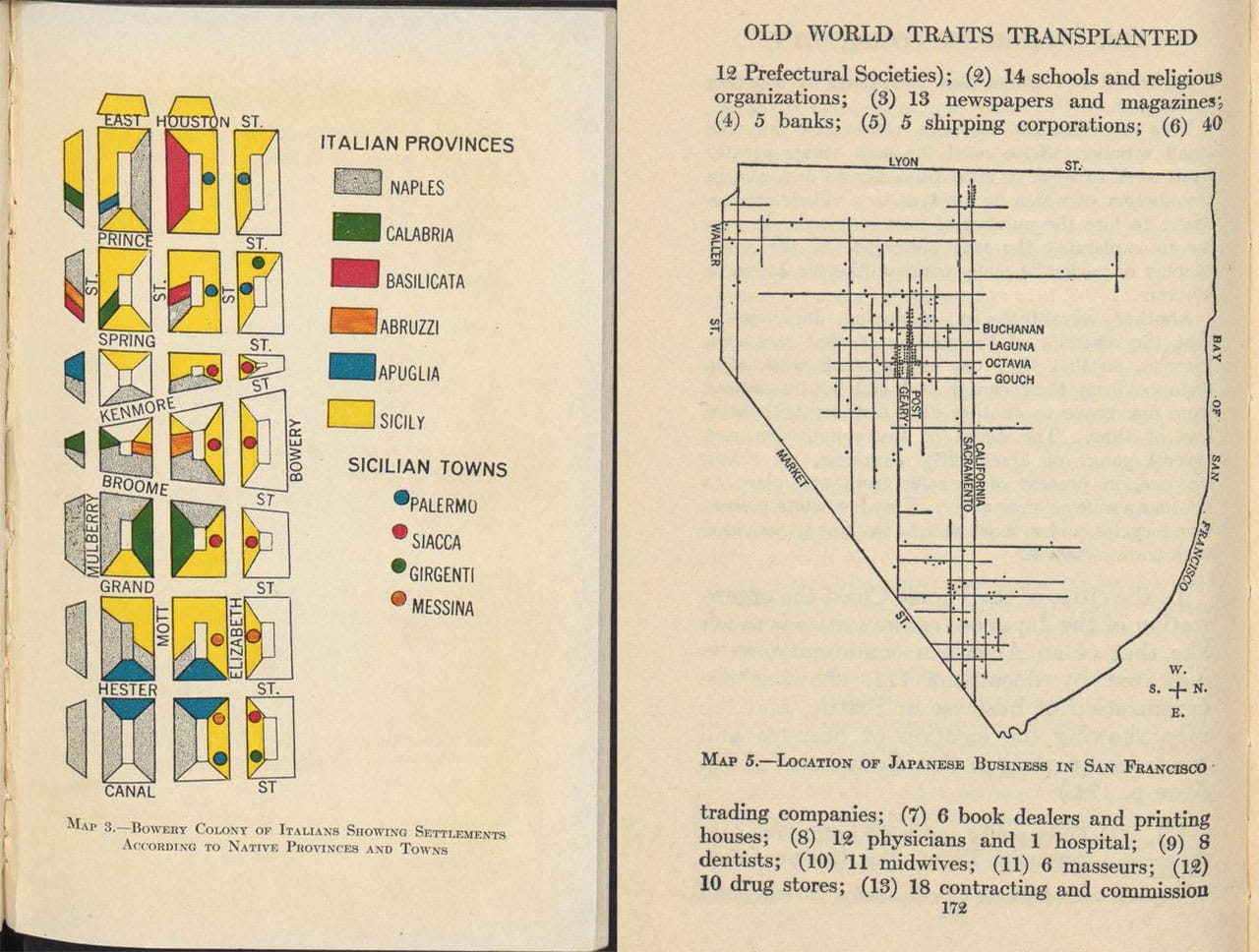
The whole book is available online at the Harvard Library website.
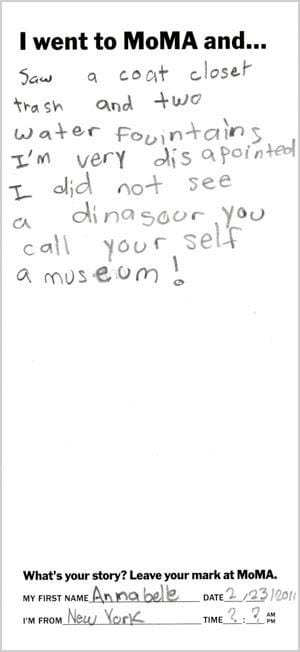
The Museum of Modern Art’s visitor response cards are always entertaining, so this one by a young girl recently posted by the museum is particularly hilarious:
Should politicians be looking at more art? Tom Parker argues:
Artists’ interests in great political leaders have declined over the last two centuries. Granted, Verdi and Wagner were inspired by their countries’ unifications to write operas about biblical and mythological figures (in Verdi’s case sometimes to escape Austrian censorship). But overall, artists’ attentions have shifted towards the question of how ordinary individuals grapple with war and dramatic political change, a trend reflecting the general democratization of society. Readers are more interested in literary figures (who they can relate to), rather than in great men (who they must look up to).
However, literary depictions of the ordeals of ordinary individuals can still inspire and instruct. Senator John McCain’s favorite novel is Hemingway’s For Whom the Bell Tolls with its cynical but tough-minded protagonist: “I am an incurable idealist and romantic. Robert Jordan is everything I ever wanted to be. I read that book at age 13 and now at age 70 … As you get older, it is harder to have heroes, but it is sort of necessary.” Moreover, two films, High Noonand Shane, have become icons of American culture in their depiction of tough but anonymous figures that face down tyrannical bullies in the 19th century West and then leave the towns they defended — alone — to an unknown future. These solitary heroes still provide inspiration; President Eisenhower watched Shane with Nikita Khrushchev at Camp David and the favorite film of both Presidents Reagan and Clinton was High Noon.
The arts can also provide instruction beyond models of political leadership. Shakespeare’s Iago, for example, sheds light on today’s terrorism. Readers have wrestled with Iago’s seeming “motiveless malignancy.” At one point, he claims to want to avenge himself because Othello promoted Michael Cassio ahead of him. But why then does Iago continue his destructive path once he tricks Othello into demoting Cassio? At another point, he muses that Othello may have slept with his wife. But why then does Iago make reference to this only once and almost in passing? Iago acts out sheer envy: “Cassio [and Othello] hath a daily beauty in his life/ That makes me ugly.” (Act 5, Scene 1). Just as Islamist terrorists and radicals claim to avenge themselves against what they consider the latest Western crime — cartoons of the Prophet, Israel and the Jews, Western military interventions in the Islamic world and the Western presence in Saudi Arabia, the destruction of the Caliphate in the aftermath of World War I — their fundamental motivation is envy and rage against the more prosperous, more successful, and more powerful West. Shakespeare’s portrait of evil can help to illuminate the recent Paris bombings as well as any social science analysis.
“Some Wars Start Small: The History of Boko Haram“:

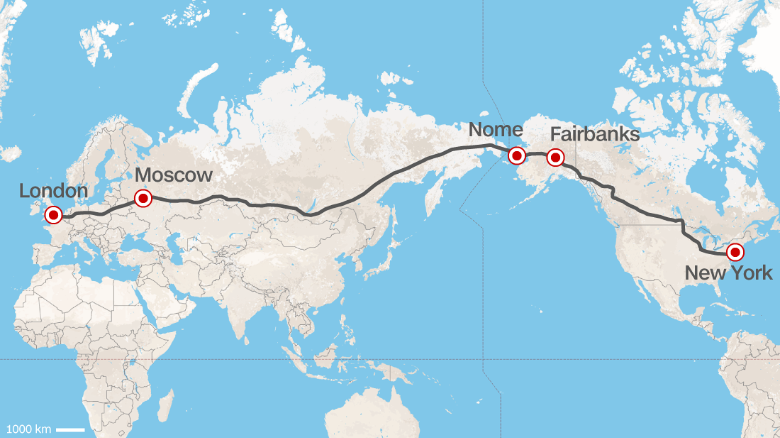
Russia wants to building a superhighway between London and New York that connects Asia to North America. The project would cost trillions of dollars:
A hundred years of fitness trends in 100 seconds (via Fusion):
Required Reading is published every Sunday morning ET, and is comprised of a short list of art-related links to long-form articles, videos, blog posts, or photo essays worth a second look.