Required Reading
This week, a quadruple rainbow, genocide at 100, remaking Mackintosh, poetry inspired by visual art, the creator of the emoticon, the first anime, and more.

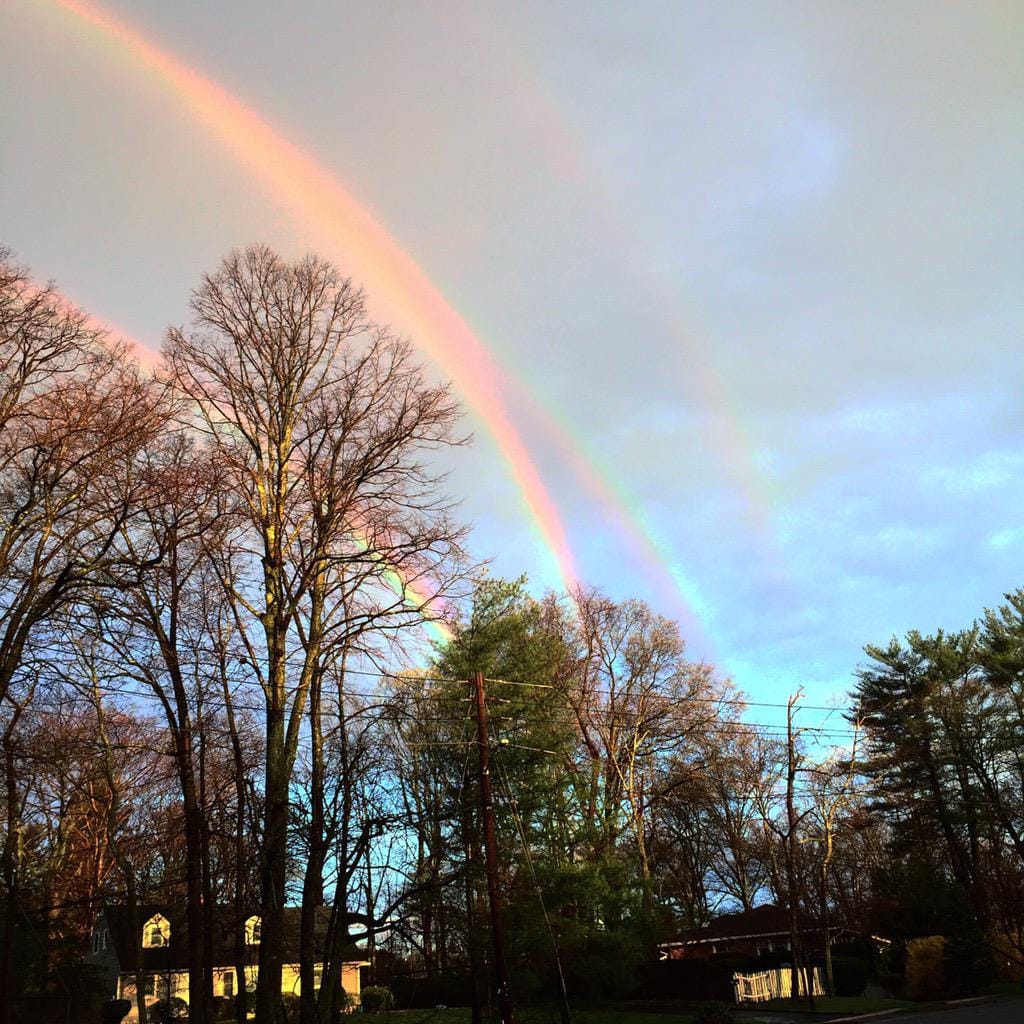
This week, a quadruple rainbow, genocide at 100, remaking Mackintosh, poetry inspired by visual art, the creator of the emoticon, the first anime, and more.

A hundred years after the beginning of the Armenian Genocide, this past week saw commemorations of all sorts all around the world to mark the occasion. The event is not only significant because of the scale of the tragedy (it is estimated roughly 1.5 million Armenians, as well as 150,000–300,000 Assyrians, 450,000–900,000 Pontic Greeks, and other groups, lost their lives in the event), but because it inspired Raphael Lemkin to coin the term “genocide” and it was the first US overseas humanitarian effort. I am myself the grandchild of genocide survivors.
Here are some articles (of the thousands that have been written in the past week) that shed light on why it continues to be a controversial topic in Turkey, and why the US shies away from the term even after Presidents Carter and Reagan both said it decades ago:
- “Why the Armenian Genocide Still Haunts the World” (Spiked)
- “Why it’s so Controversial to Call the Armenian Genocide a Genocide” (Vox)
- “Armenian Genocide: Why Obama Won’t Say the Words” (Christian Science Monitor)
- “The Armenian Rugs that Tell Two Stories” (BBC Magazine)
- And many people don’t realize that a lot of US artists were Armenian Genocide survivors, including Arshile Gorky and Arman Manookian.
Also, watch Lemkin talk about the notion of “genocide” on CBS News:
Carolina Miranda asks us to consider if these scenes of excess are Coachella or Art Basel. Here are the answers.
Painter Marilyn Minter on her first retrospective, and the term “woman artist”:
How do you feel about the term woman artist?
It’s impossible to push away. I would like to think of myself as an artist first, but that would also be disingenuous. I insist on not being the only woman in a show: I really don’t care who else they put in, but I want other women to be in shows with me. I’m really, really proud of women like Cindy [Sherman] and Marina [Abramovic] who are putting cracks in the glass ceiling. I want to join them.
There is a petition to provide all-gender bathrooms at NYC museums. The new Whitney Museum already has some.
When Charles Rennie Mackintosh’s famed Glasgow School of Art library is restored, how should it be done (and should it be an exact copy or made anew)? Well:
But above all, the school should have the confidence to reinvigorate the building as what it was always meant to be: a working art school. Muriel Gray, chair of the board of governors (who has vowed that her first act will be to re-carve the naughty graffiti she engraved into the library woodwork as a student) has stated that the school of art “will die if it becomes a museum”. And Liz Davidson is frank. “We’re going to rebuild it all with extreme care,” she says, “then hand it over to the students to treat with extreme irreverence.”
Did you know that New York’s public libraries “have more users than major professional sports, performing arts, museums, gardens and zoos — combined”? Well:
One day in 1933, a 12-year-old boy named Joseph Papirofsky, a son in a house of immigrants where only Yiddish was spoken, arrived at a public library in Williamsburg, Brooklyn. He browsed the drama shelf.
“If I had to pay, it is doubtful I would have read the plays of Shakespeare,” he said decades later.
By then, he had changed his name to Joe Papp, and was known as the creator of the summer custom of Shakespeare plays staged in city parks, and as the founder of the Public Theater. His journey, a subplot in Robert Caro’s “The Power Broker,” traces him from a boy who wore cardboard in his shoes to his reign as one of the 20th century’s most influential directors and producers.
Joe Papp’s library visits were the creation of “human capital” before the term was invented: books borrowed, then returned over and over.
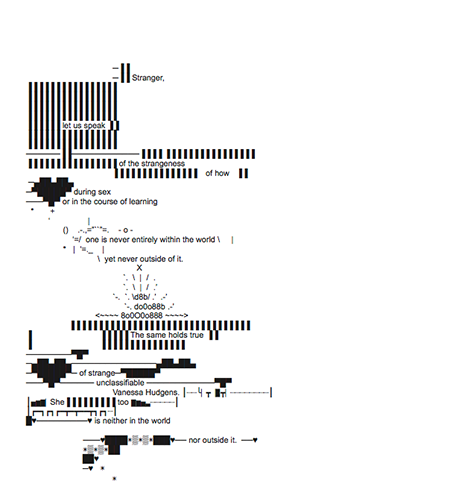
Frieze magazine published 15 poems by leading poets, among them John Yau, John Ashbery, Anselm Berrigan, Eileen Myles, Marcella Durand, and others, who are influenced by visual art; it includes Paul Chan’s “Variation on 1.0049”:
The “father” of the emoticon, Scott Fahlman, discusses their origins:
Where did the idea of the emoticon come from?
I try never to claim that I invented the emoticon because people always want to fight about that. But it was back in 1982. I was a relatively new professor at Carnegie Mellon working on computer science and artificial intelligence. Even in those days we had social media, but that was in the form of online bulletin boards — you could send an email to this place where everyone could see it. And we had to label this one particular thread to differentiate the jokes. People suggested putting an asterisk, but that didn’t seem very intuitive. It occurred to me that there were these smiley faces on t-shirts and balloons that was very big in the ’60s. And I thought that a smiley face of some kind would be really cool, so I wrote a three line post and suggested this thing. But I thought it would amuse the dozen or so people in that group, but it caught on. As soon as there was email, it spread virally.
This is the earliest known anime, “Namakura Gatana (Blunt Sword)” (1917), but it is only a taste of the history of a genre that is far older than you might think:
President Obama brings his “Anger Translator” to the 2015 Correspondents’ Dinner, and it’s hilarious:
Required Reading is published every Sunday morning ET, and is comprised of a short list of art-related links to long-form articles, videos, blog posts, or photo essays worth a second look.