Required Reading
This week, what scared Hitchcock, the future of digital arts publishing, paying for digital art commissions, copying what ISIS destroyed, an oil spill in "Christina's World," and more.

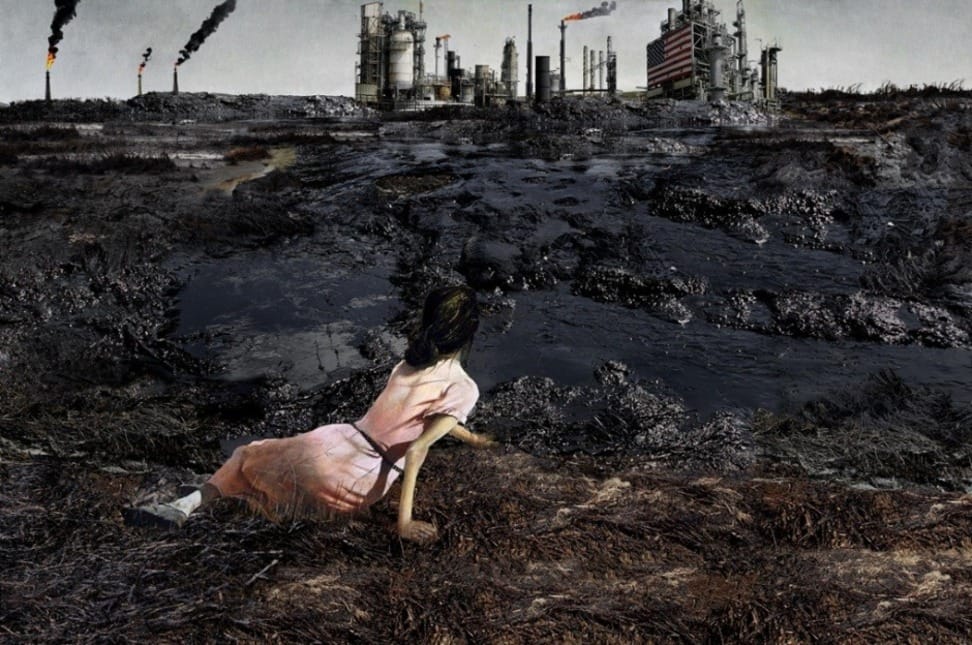
This week, what scared Hitchcock, the future of digital arts publishing, paying for digital art commissions, copying what ISIS destroyed, an oil spill in “Christina’s World,” and more.

Have you ever wondered what scared Alfred Hitchcock? A number of biographies about the great director are reviewed in the London Review of Books:
‘The man who excels at filming fear is himself a very fearful person,’ Truffaut observed, ‘and I suspect that this trait of his personality has a direct bearing on his success.’ … Peter Ackroyd, however, is firmly of the Truffaut school. His Hitchcock trembles from the outset: ‘Fear fell upon him in early life.’ At the age of four (or 11, or …), his father had him locked up for a few minutes in a police cell, an episode that became, as Michael Wood puts it, the ‘myth of origin’ for his powerful distrust of authority. Ackroyd rummages dutifully for further evidence. Was young Alfred beaten at school by a ‘black-robed Jesuit’? Or caught out in the open when the Zeppelins raided London in 1915? Did he read too much Edgar Allan Poe? It doesn’t really add up to very much. And yet – or therefore – the strong conviction persists. Fear is the key; and not just to the life. Interview the films, he once told an inquisitive journalist. Those who have interviewed the films often conclude that, like their creator, they too tremble. ‘Hitchcock was a frightened man,’ Wood writes, ‘who got his fears to work for him on film.’
In a two-part series (1, 2), some art worlders give their perspective on the future of art publishing in the digital space (Hyperallergic gets a nice shout-out). There are lots of interesting perspectives (no real answers or solutions, of course), including this prediction by Antwaun Sargent:
There are artists who are also exploring interesting concepts like the Instagram art shows that we’ve seen increasingly. These shows are exciting because they abandon this notion that platforms, like Instagram should only play a role in the digital second life of artworks by making the Internet the first point of contact. This toying around by what some people call jpeg artists opens up the possibility of better future platforms, in the coming decade that will hopefully empower us all to better experience art. I think at a basic level that’s what both the critic and general public have always wanted.
How much should artists be paid for digital commissions? e-flux was curious about this and decided to ask W.A.G.E., the New York–based group that advocates for fair artist compensation from nonprofits and other arts organizations:
From W.A.G.E.’s point of view, the work of artists, at least inrelation to art institutions in the nonprofit sector, is the provisionof content and services in the capacity of a subcontractor. As such,we believe it is in the strategic and ethical interest of artists toalign themselves with others functioning in a similar capacity.Given the exclusion of manual labor from digital art production, standards for its compensation should be set with this supplychain in mind, and in relation to “W.A.G.E. Certification,” aprogram initiated and operated by W.A.G.E. that certifies thosenonprofit institutions paying fees that meet W.A.G.E.’s minimumpayment standards.
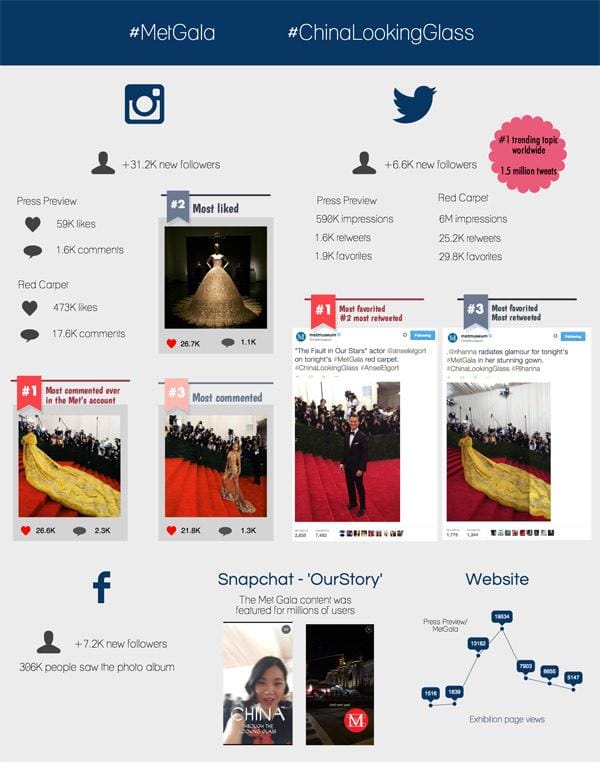
The social media engagement for the Met Gala this year was very impressive, and the Metropolitan Museum produced this infographic:
A Palestinian writer discusses his “exile” in the Gulf:
Physical exile can be shared, but the exile of the mind is much harder to render equal. It is the modern yet recycled condition of a generation obsessed with mobility, yet living mostly stagnant lives, or in an enduringly stagnant state of mind. Fear of mediocrity has made them banal. Chasing things, rather than ideas, chasing sporadic bursts of fun and living in a state of semi fear that they might be missing out on something (or someone more) fun.
Related: Nicholas McGeehan, a Middle East researcher at Human Rights Watch, has written about the “art and hypocrisy in the Gulf“:
These institutions, and some art critics as well, have touted their move to Abu Dhabi as a turning point in cultural history. But right now, in a climate of increasing repression, it seems that art and culture are being put into the service of money and power, an unquestioning surrender to authority that contradicts these liberal institutions’ very ideals.
Kriston Capps suggests the FIFA scandal may have an undesirable impact on architects:
After Qatar, architects may continue to claim that, like doctors, they don’t get to pick their clients. Or that there are no wholly decent clients, so all questions of moral rectitude just fall away. Stefan Klos, Speer’s project manager in Qatar, said as much in Der Spiegel:
SPIEGEL: Would you refuse to work in a country that keeps political prisoners and has the death penalty?
[Stefan] Klos: You are referring to the U.S. and Guantanamo?
No one’s going to buy that dodge after 2022.
A graphic a the Washington Post really visualizes the reality.
How progressive gentrifiers are exercising the politics of exclusion in Boston:
Sociologist Sylvie Tissot subverts this image of civic associations in her new book, out in June, Good Neighbors: Gentrifying Diversity in Boston’s South End. Tissot, a native of France who now teaches in Paris, was a visiting scholar at Harvard University in the early 2000s. While in Boston, she did fieldwork on a group of urban elites who — under the rhetoric of progressivism and diversity — were unwittingly exerting their power over local politics, morality, culture and public space through their participation in neighborhood associations.
Her work is a fascinating analysis of exclusion, lack of self-awareness and conflicting values. I spoke with Tissot about urban liberalism, what it means that she was welcomed by these groups, and how the terms “diversity” and “civic engagement” are wielded.
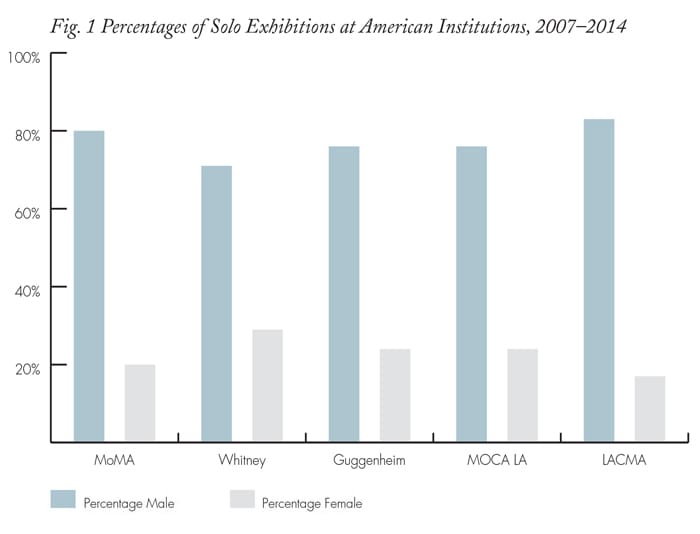
Artnews looks at the gender statistics at various museums and exhibitions, including:
Writing for the Washington Post, Orin Keer hits the nail on the head in one, long sentence about the hypocrisy of the Bill Clinton impeachment silliness:
If I understand the history correctly, in the late 1990s, the President was impeached for lying about a sexual affair by a House of Representatives led by a man who was also then hiding a sexual affair, who was supposed to be replaced by another Congressman who stepped down when forced to reveal that he too was having a sexual affair, which led to the election of a new Speaker of the House who now has been indicted for lying about payments covering up his sexual contact with a boy.
Yikes.
And artist Morehshin Allahyari wants to duplicate the artifacts that ISIS destroyed at the Mosul Museum:
Now, Allahyari is working on digitally fabricating the sculptures for a series called “Material Speculation” as part of a residency in Autodesk’s Pier 9 program. The first in the series is “Material Speculation: ISIS,” which, through intense research, is modeling and reproducing statues destroyed by ISIS in 2015. Allahyari isn’t just interested in replicating lost objects but making it possible for anyone to do the same: Embedded within each semi-translucent copy is a flash drive with Allahyari’s research about the artifacts, and an online version is coming.
Required Reading is published every Sunday morning ET, and is comprised of a short list of art-related links to long-form articles, videos, blog posts, or photo essays worth a second look.