Required Reading
This week, the origins of color, what art museums today should look like, a guide to feminist cybersecurity, a tax safe haven for selfish art collectors, emoticons as court evidence, and more.

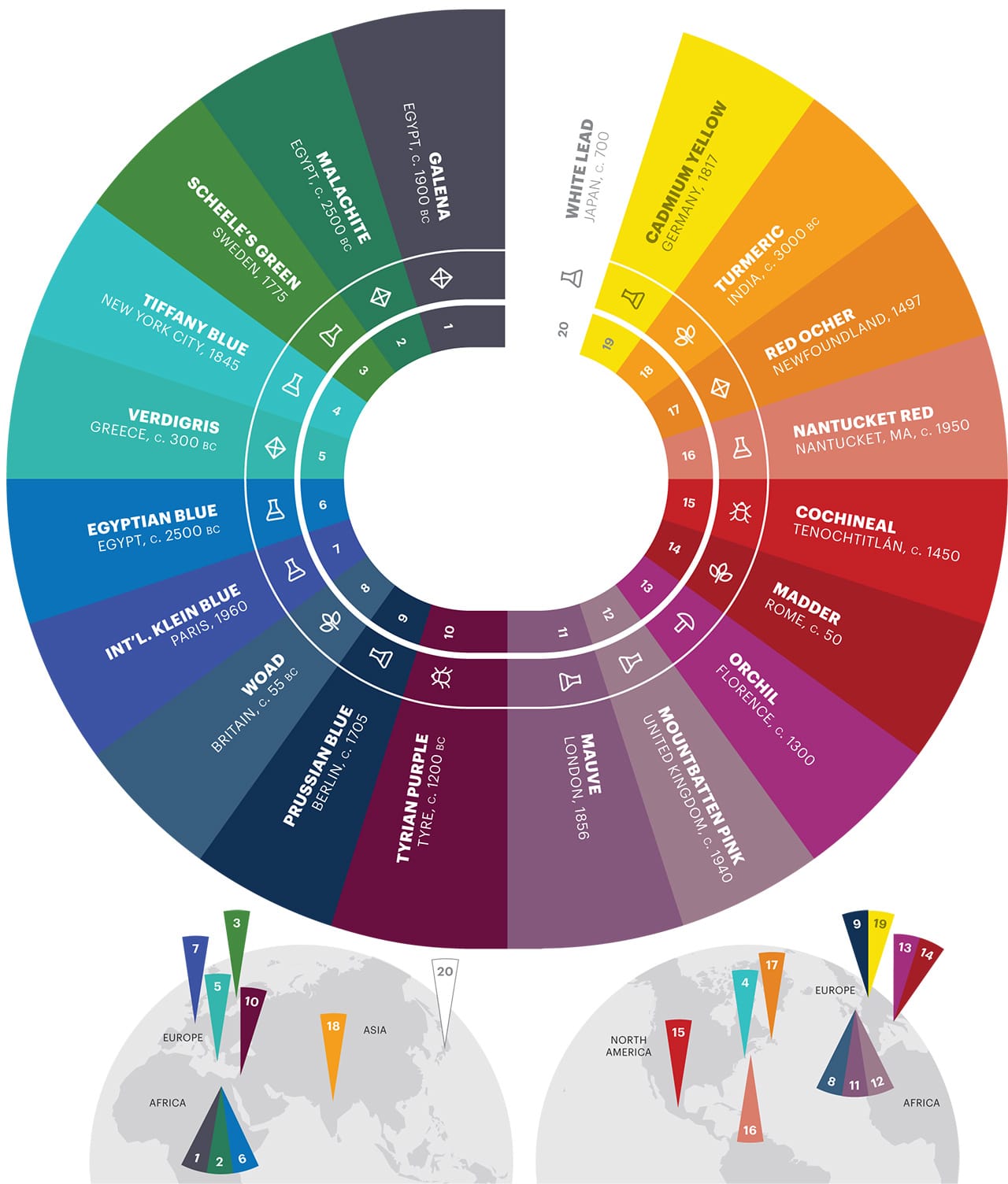
This week, the origins of color, what art museums today should look like, a guide to feminist cybersecurity, a tax safe haven for selfish art collectors, emoticons as court evidence, and more.

Holland Cotter gives some serious thought to art museums in the 21st century:
Whether any amount of inventiveness can arrest the current retreat from art’s past is, of course, a question. Again, the metrics are paradoxical. Whereas other branches of the arts, like classical music and ballet, are attracting fewer and fewer young people, museums are attracting many, yet the interest of those visitors appears to be specific and narrow: contemporary art. And because the future lies with this audience, museums are shaping themselves to it by acquiring and exhibiting more and more contemporary work.
This is essential … A DIY Guide to Feminist Cybersecurity. It reminds people:
You have a right to exist safely in digital spaces. Although we have to rely on outside parties for technology to access these spaces, there are tons of helpful tools and strategies that allow you to take greater control of your digital life and mitigate the risk of malicious threats. We’ll walk through common areas of digital life such as web browsing, private data, and smartphones to show you different ways that you can implement as much or little security as you’re comfortable with. You have power to set boundaries and protections in your digital spaces as you see fit: we hope that this guide will help you to make informed, personal decisions on what is right for you.
h/t Jennifer Chan
Maybe we should’ve listened to US author Gore Vidal, who passed away in 2012, when he had been trying to warn us for decades about the emerging idiocracy:
An examination of Vidal’s art and politics is insufficient if it does not acknowledge the secular prophecy pulsating throughout the best of his novels and essays. It is not enough to merely enumerate the ideas Vidal helped introduce to American culture, or telegraph the time jumping bravery and brilliance of Vidal’s innovative artistry, but that is a good place to begin.
… Twice Vidal attempted to battle the rise of despotic government and the degradation of political culture from the inside – running for Congress in New York, and the Senate in California. Long after he lost both races, he concluded that those defeats might have served him better than had he won: “A writer’s job is to tell the truth. A politician’s job is to not give the game away.”
The New York Times discovered a “safe harbor” for art collectors in Delaware that saves them from paying taxes … so essentially it is for obnoxious and selfish people who don’t want to pay their share:
In June, another art storage complex opened in Delaware, a 50,000-square-foot warehouse run by a Philadelphia art storage company, Atelier, that promises to keep the art at a constant 68 degrees. Next month, Crozier Fine Arts, which operates storage spaces in Manhattan, New Jersey and other areas, is scheduled to open a 40,000-square-foot storage space in Delaware.
This state is special because storage spots in most other states cannot offer the same tax advantages as Delaware. It is one of only five states without any sales or use tax, meaning that a Manhattan collector who might owe, say, $887,500 in sales tax on the purchase of a $10 million painting at Sotheby’s in New York, would owe nothing by shipping the art to Delaware directly after purchasing it.
Can you use an emoticon as evidence in court? And what do they really “mean”?
Fahlman had devised the emoticons to help clarify the meaning of online texts. But he soon realized that the meanings of emoticons themselves were highly subjective. And that was before we started communicating our feelings through endless combinations of tiny, colorful images—pouting cats, silly ghosts, and grinning piles of poo.
What do emoticons mean? As keyboard-crafted emoticons—and their slicker younger sisters, emoji—have become increasingly central to online speech, the “rampant interplay of words and symbols compounds the complexity of our language,” linguist and emoji enthusiast Tyler Schnoebelen argued last month. Our old-school text keyboards are now enhanced by thousands of digital symbols with no fixed emotional resonance, clear dictionary definition, or established grammatical rules for interpreting them in the various contexts in which they appear.
Ginger, a Twitter addict (who used to work at Twitter) confesses:
I would have thought that with all the time we’ve collectively saved by using the internet — Google, Amazon, Twitter, Netflix and Uber — we could have done something important already like solving the income disparity crisis in America. But we haven’t yet. We’ve filled those newly reclaimed hours with more online time and more entertainment.
I think a lot about privacy and our desire to record and share. How much sharing is good sharing? Does it make me feel more connected to people? Or does it make me feel anxious because I’m not getting enough attention? Should I post more selfies? Will we ever get tired of taking pictures of ourselves and posting them online? Will the novelty of recording everything wear off? Will kids who have been recorded since birth resent the online persona their parents have given them?
There has been an interesting discussion going around about BDS in the UK. 500 academics came out in support of BDS a few weeks ago, and then 150 UK authors, including JK Rowlings (of Harry Potter fame) came out against the Boycott Divestment and Sanctions movement. The writer that Rowlings cited as political inspiration was Palestinian poet Mahmoud Darkish. She wrote:
The true human cost of the Palestinian conflict was seared upon my consciousness, as upon many others’, by the heart-splitting poetry of Mahmoud Darwish.
It’s all been a fascinating look at the politics of BDS. Claire Armistead of the Guardian pointed out the irony of Rowlings’ reference:
The problem with this reading of Darwish and his work, however, is that his life was a catalogue of dialogue denied. Burnt out of his home village of Birwa as a small child, he fell in and out of love with the PLO, spent much of his life in exile and ended it in a Texas hospital.
Four years before his death, he was awarded a major prize in Holland, giving a speech that gestured at the “charming illusion” of art: “A person can only be born in one place. However, he may die several times elsewhere: in the exiles and prisons, and in a homeland transformed by the occupation and oppression into a nightmare,” he said. “Poetry is perhaps what teaches us to nurture the charming illusion: how to be reborn out of ourselves over and over again, and use words to construct a better world, a fictitious world that enables us to sign a pact for a permanent and comprehensive peace … with life.”
Film posters get animated with actual scenes from the movies:
An amazingly well done recreation of Jay Z’s album covers:
https://twitter.com/hotfreestyle/status/658638345334050818
A funny take on how many black movies begin:
How black movies start pic.twitter.com/Oa24a5Ysh6
— quay ✊🏽 (@notquay) September 19, 2015
Required Reading is published every Sunday morning ET, and is comprised of a short list of art-related links to long-form articles, videos, blog posts, or photo essays worth a second look.