Required Reading
This week, Calatrava's new Brazilian museum, an intergenerational dialogue in the arts, Chicago artists respond to the Laquan MacDonald video, issues with public art in New York, and more.

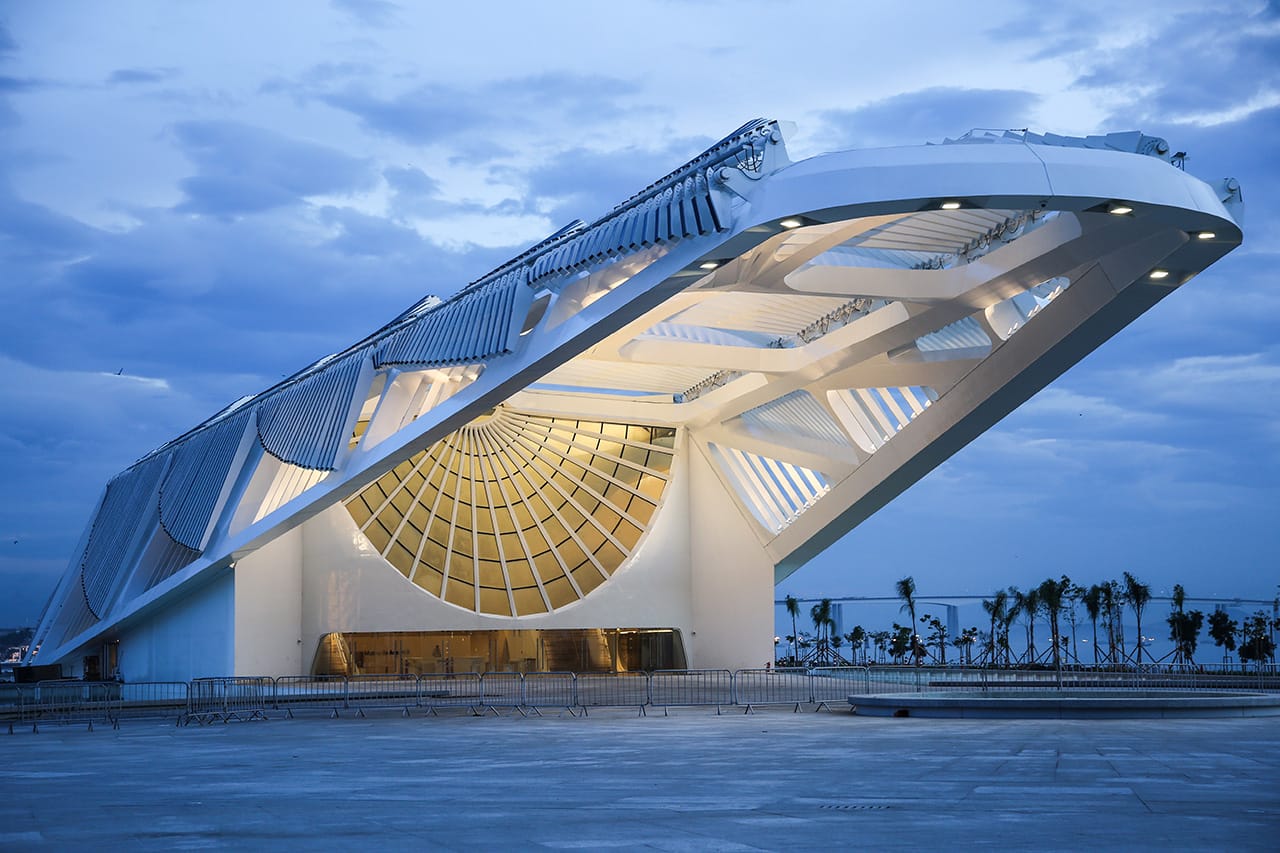
This week, Calatrava’s new Brazilian museum, an intergenerational dialogue in the arts, Chicago artists respond to the Laquan MacDonald video, issues with public art in New York, and more.

Art historian Kellie Jones explains why we need an intergenerational dialogue to tackle issues in the visual arts:
“Institutional structures do not come down easily, however, and this is the case with even the movements and institutions that we admire. Why is there a need for the ‘Say Her Name’ movement, which lists the name of black women killed by police in the United States? Because there is an element of sexism in the ‘Black Lives Matter’ movement. Of course the ‘Black Lives Matter’ movement did not set out to be sexist, and if you speak to activists they will tell you that more than anything else, they set out to draw attention to the more visible cases of police brutality, which are the cases against black males. So the question then becomes: Why aren’t the deaths of black women by police officers equally visible?
“And that is what I mean that old structures remain in place, and that is why I am so emphatic about the need for a cross-generational dialogue because we can tell each other about what we have seen and what we know. And that, too, is part of the reason why I love teaching so much. I get to take the students into my world and the students get to take me into theirs.”
Jason Foumberg gives us a little bit of insight into how Chicago artists are responding to the shocking Laquan McDonald video:
On December 1, Vélez wrote this on his personal Facebook page: “Chicago is home to one of the most relevant artists in the world: Theaster Gates. Mr. Gates works closely with/for the city (the State) and is strictly involved with not only political art but politics…We had a thousand articles on Chi-Raq [Spike Lee’s new film], what are we waiting for to elevate the conversation and debate with one of our own?”
Jerry Saltz reflects on the connection between public art, gentrification, and the privatization of public space:
And yet, as an art critic, I have to admit, from Rashid Johnson’s vexing yellow sculpture that looks like a prison and a butter factory to Adrián Villar Rojas’s cast cement modern Mayan “ruins” on the High Line to Kara Walker’s magnificent sphinx from last summer to that sweet Deborah Kass sculpture (both commissioned by the Brooklyn megadeveloper Two Trees), this semi-privatization of public space has produced some of the best public art the city has seen in decades — in fact, it may even have cracked the seemingly impossible task of staging good public art. How? By handing the job of curating it to an autonomous art-world insider rather than a public panel of judges, politicians, bureaucrats, architects, or businesspeople. This move is especially helpful in an era when money and art are already mingled together to an unprecedented degree — meaning that these groups of people, the ambitious curators and the money people who make major projects actually happen, are far from strangers; in fact, immensely well-acquainted. This, by the way, is another phenomenon I hate.
So what am I supposed to do when cultural forces I loathe are responsible for something like a new golden age of public art, which I always felt was important, but also maybe something like impossible?
The United States has a nationalism problem (not a surprise to those who aren’t Americans), but finally people are discussing it seriously:
The highest rate of “American” identity is among young rural whites with limited education. Recent surveys find that whites with an “unhyphenated” identity are increasingly voting very conservative and perceive a cultural threat from foreign influences. They also call themselves ethnic “Americans” for patriotic reasons. They favor a stronger national defense. And, they are more likely to think that an individual’s life chances are tied to their racial identity (what Michael Dawson called “linked fate”).
… Then there are the Christian Nationalists. The most visible religious tension in American politics is between the Establishment Clause and the long tradition of Protestant ownership of the moral nation. Christian Nationalists have the highest agreement with four statements about America: that is “holds a special place in God’s plan;” that “God has chosen [America] to lead the world;” that the United States “was founded as a Christian nation;” and “it is important to preserve the nation’s religious heritage.” According to a poll conducted by the Public Religion Research Institute in June of this year, 62% of Americans either completely agree or mostly agree that “God has granted America a special role in human history.” 52% said “believing in God” and 33% percent said “being a Christian” was very important for “being truly American.” Similar distributions have been found in other surveys of the public since 2010. They are also heavily invested in Biblical literalism. Agreement with these statements is strongly correlated with anti-Muslim and anti-immigrant sentiment among white Americans. Politics and the course of America are therefore a question of the degree and intensity of Christianization. Christian Nationalists are often found among Unhyphenated Americans (or vice-versa).
Dushko Petrovich asks why curators keep putting dead artists in contemporary art shows:
The 2014 Whitney Biennial is already being remembered merely as the last one in the Breuer building, but I think it would be more accurately, and respectfully, remembered as the Biennial of the Dead.
… The dead weren’t only included, they were featured. “Greater New York” 2015 won’t have a catalogue, but rather a series of small pamphlets. The first one, written by illustrious art historian and co-curator of the show Douglas Crimp, focuses on the gay scene at the Hudson River piers. A wonderful book in and of itself, the fact that it’s about work from the 1980s made by Alvin Baltrop, who died in 2004, also makes quite a statement in this context.
… Is this revival of the dead mere “nostalgia” for the past, as PS1 claims, or is it evidence that the contemporary can’t keep up with itself? Needing new materials and new markers for increasing numbers of bi-, tri-, and quintennials, we now dip ceaselessly into the past, presenting the deceased as if they had only just appeared on the scene. Beset by zombie formalists, but also market zombies of all kinds, we have apparently started to prefer the dead themselves.
Katherine Bradford talks to fellow artist Caroline Wells Chandler about her latest show (at Roberto Paradise Gallery in Puerto Rico):
Katherine Bradford: So if all the cowbois in your Roberto Paradise show are gender non-conforming how did this work itself out with the way you actually constructed them ? What were the visual decisions you made to subvert our known model of the cowboy.
Caroline Wells Chandler: It probably would have been more aesthetic to make them all blonde or brunette and sun kissed, but I kept on getting this strong feeling that they needed to be orange and I had no idea what that meant or how to implement that pallet. It was probably Matisse filtered through your swimming figures that planted that seed. After about a month of mulling it over, I realized that the cowbois needed to be electric gingers with varying pink skin tones. Red hair is perfect because it is the haircolor of the most other. There is a strange Southern saying if someone is a misfit in a family that they are, ‘a red headed step child.’ That speaks to me as the sole receiver of my family’s recessive genes.
New York City isn’t doing a good job policing developers, including Two Trees, which has long been a supporter of the arts and has many properties that house artists and arts organizations:
ProPublica’s analysis of rent histories, meanwhile, shows that the building’s original tenants were charged at least $368,000 in excess rents. Two Trees confirmed that it had imposed “accidental” overcharges in the building’s early years, but said it later repaid tenants almost $300,000 plus interest.
Together, the overcharges and Two Trees’ lack of final approval show a city that is eager to give out tax breaks but loathe to police them, enabling developers to easily sidestep tenant protections under its single-biggest housing subsidy.
Long controversial, the 421-a program is now on the brink of an historic expansion. Under a deal brokered in Albany last summer, the $1.1 billion-a-year program would allow developers to claim longer tax breaks in exchange for providing more low-income apartments.
During your next Netflix or Hulu binge, consider the environmental cost of online streaming and data (emphasis mine):
Here’s where things get a bit back-of-the-napkin: According to the U.S. Energy Information Administration, in 2012 global electricity consumption was 19,710 billion kilowatt-hours. Using Google’s 0.01 percent estimate and electricity-consumption data from the CIA World Factbook, they’re using about as much electricity annually as the entire country of Turkey. (Honestly, that number seems impossibly high considering that in 2011 Google disclosed that it used merely 260 million watts of power, at the time noted for being slightly more than the entire electricity consumption of Salt Lake City.) In its 2013 sustainability report, Facebook stated its data centers used 986 million kilowatt-hours of electricity—around the same amount consumed by Burkina Faso in 2012.
Just in time for Christmas … forensic anthropologist Richard Neave says this is what Jesus Christ may have looked like (via Yahoo News):

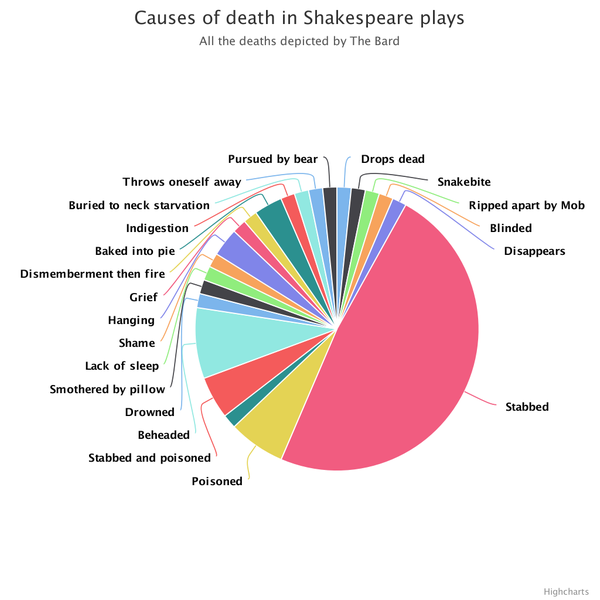
Causes of death in Shakespeare plays (via):
And since Star Wars fever is upon us, here is Yoda training some Jedi cats:
Also a Darth Vader Yule Log:
And a French ad shows us a Star Wars naked lightsaber duel with glow-in-the-dark condoms:
Required Reading is published every Sunday morning ET, and is comprised of a short list of art-related links to long-form articles, videos, blog posts, or photo essays worth a second look.