This week, MoMA's museum guard dog, Damien Hirst does Queen Elizabeth II, Philadelphia's hidden graff corridor, a profile of Daniel Clowes, Pee-Wee Herman talks about his art influences, and more.
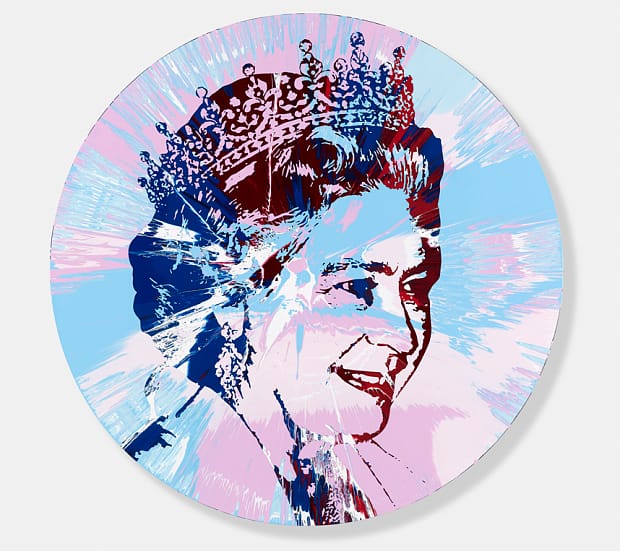
This untitled painting of Queen Elizabeth II by Damien Hirst is in the news because few people appear to have known it existed. (photo by Prudence Cuming Associates, via Telegraph)
This week, MoMA’s museum guard dog, Damien Hirst does Queen Elizabeth II, Philadelphia’s hidden graff corridor, a profile of Daniel Clowes, Pee-Wee Herman talks about his art influences, and more.
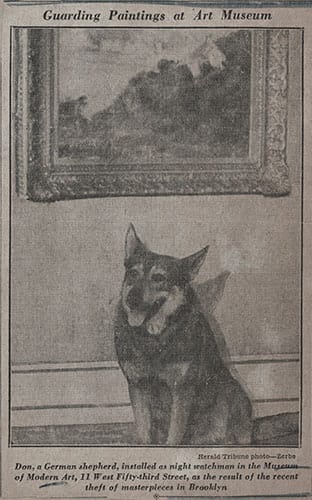
The Museum of Modern Art used to have a guard dog who wandered around without a leash after hours:
In June 1933, Don, a German Shepherd, was given to The Museum of Modern Art by Vanity Fair magazine’s kennel department. Frank Crowninshield, editor of the magazine, was a trustee of the Museum.
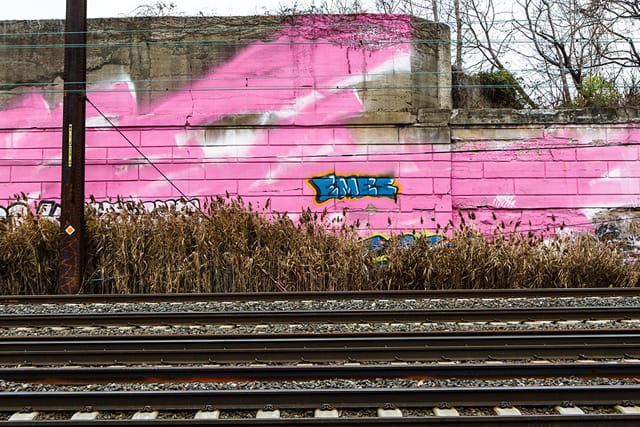
Although [Katarina Grosse’s] psychylustro did cover notable graffiti (including works by Retna, Nekst, Skrew, Curve, and Ntel), it also presented an opportunity: Before installation began, Mural Arts invited Martha Cooper to document the graffiti at the sites where psychylustro was going to be. And recently, a little over a year after Mural Arts stopped maintaining psychylustro, they sent photographer Steve Weinik to revisit the installation. The result is a likely unparalleled documentation of graffiti along the Philadelphia section of the Northeast Rail Corridor in 2014 and 2015.
Erica Garner, the daughter of Eric Garner, has endorse Presidential candidate Bernie Sanders with a very moving video:
“I think we need to believe in a leader like Bernie Sanders. People are dying. This is real. We need a president that will talk about it. Bernie is a protester. He’s not scared to go up against the criminal justice system. He is not scared.” —Erica Garner
Despite poking fun for years, perhaps bitterly, at the low station of his chosen profession — he once compared being the world’s most famous cartoonist to being the world’s most famous badminton player — Clowes has become one of his field’s most respected and influential artists. He has won many of the top awards — Eisners, Harveys, as well as a PEN Award and an Academy Award nomination for best screenplay for the 2001 film Ghost World, which starred Thora Birch and then-newcomer Scarlett Johansson. Even so, Clowes claims he’s still honing his cartooning skills. “I feel like I’m about 20 years away from getting where I want to be,” he says.
Arriving in the thick of the Reagan ’80s, ‘‘Playhouse’’ offered a funhouse-mirror vision of the Eisenhower-era United States that Reubens grew up in — its excess, its materialism, its hypocrisy, its racism, its hairstyles — with an added slathering of Los Angeles punk. (Gary Panter, who designed the famous ‘‘Playhouse’’ set, used to draw for the fanzine Slash and made crude fliers for bands like Germs.) Reubens didn’t attack ’50s conventions, though, so much as revise and exaggerate them. ‘‘I saw it as very Norman Rockwell,’’ Reubens says, ‘‘but it was my Norman Rockwell version of the ’50s, which was more all-inclusive.’’ Actors of color dominated the cast, among them Laurence Fishburne and S. Epatha Merkerson. ‘‘The King of Cartoons was black!’’ Reubens says. ‘‘Not just anybody. The king! That came out of growing up in Florida under segregation. I felt really good about that.’’
… Pee-wee also owes debts to experimental theater, cabaret and the conceptual prankishness of the artist Allan Kaprow, whose Happenings Reubens discovered in the early 1970s when he enrolled in the theater program at California Institute of the Arts, where Kaprow taught. One of Reubens’s friends there was Michael Richards, who went on to play Kramer on ‘‘Seinfeld.’’ Richards described the prevailing spirit at CalArts — where the faculty included artists like John Baldessari and Alison Knowles — as one of fecund transgression. ‘‘On my very first day,’’ Richards says, ‘‘as an introduction to the faculty, there was a pool party, and everyone was naked. What school do you go to and see that kind of liberation?’’ He recalls Reubens’s seriousness when it came to doing character work. ‘‘There was a student film where Paul wanted me to play his husband, and he played the wife and wore a dress. His performance wasn’t pushed, it wasn’t broad — he committed to it. He and I would talk about how a character’s doing you, you’re not doing the character.’’
There was something religious about the practice, which Christian missionaries caught on to by the 1820s. The Christians tried to ban surfing, but they couldn’t get to every beach. Among natives who continued to surf, the practice became a way to resist empire. It was a skill passed in secret through generations.
A Freedom of Information request uncovered these emails to a reporter at The Atlantic, showing how some powerful politicos manipulate and strong-arm the media to get the coverage they want. In this case, it’s Hillary Clinton:
On the morning of July 15, 2009, Ambinder sent Reines a blank email with the subject line, “Do you have a copy of HRC’s speech to share?” His question concerned a speech Clinton planned to give later that day at the Washington, D.C. office of the Council on Foreign Relations, an influential think tank. Three minutes after Ambinder’s initial email, Reines replied with three words: “on two conditions.” After Ambinder responded with “ok,” Reines sent him a list of those conditions …
Are the US Presidential candidates ignoring the plight of unpaid interns? Writing for the Washington Post, Christina Greer and Alexis Grenell say:
Unpaid interns, often students, are an island unto themselves. Unlike volunteers, who set their own schedules and enjoy unlimited coffee and appreciation, interns compete for the prestige of working in demanding jobs without pay. In return, these privileged few get to add the experience to their résumés and try to win favor with future employers.
This is a particularly devastating equation for black and Hispanic students, who generally do not have the same financial resources as their white counterparts. A recent Pew Research Center study found that the median wealth of white households is more than 10 times that of Hispanic households and 13 times that of black households. There is a racial divide between students wealthy enough to participate in internship programs and those who lack the financial reserves to do so.
Brokelyn suggests this Instagram account by cartoonist Emmet Truxes is Brooklyn’s answer to The New Yorker cartoons. I’m not sure that’s totally accurate, but they are clever and often poignant:
And why Kanye West tweeted this is anyone’s guess:
Required Reading is published every Sunday morning ET, and is comprised of a short list of art-related links to long-form articles, videos, blog posts, or photo essays worth a second look.