Required Reading
This week, Paul Allen's art collection, Robert Caro talks, copyediting Donald Trump, critics of color in February, and more.


This week, Paul Allen’s art collection, Robert Caro talks, copyediting Donald Trump, critics of color in February, and more.

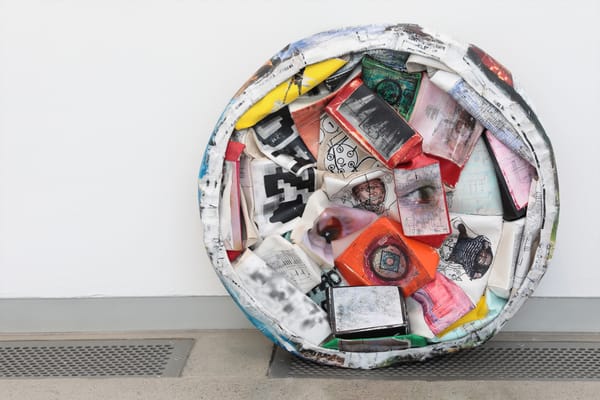
Paul G. Allen, a co-founder of Microsoft, is showing off his art collection at the Phillips Collection. The exhibition is titled Seeing Nature: Landscape Masterpieces from the Paul G. Allen Family Collection, and Philip Kennicott writes:
More important, however, are the questions this exhibition raises about wealth, art and private collectors. Collecting art isn’t morally neutral. It may seem more enlightened, and cultured, than collecting rock-and-roll memorabilia (another of Allen’s hobbies) or airplanes (ditto). But private collectors with deep pockets — Allen is worth about $18 billion, depending on which side of the bed the market got up on today — drive up the cost of art for everyone. That puts many of the works in this exhibition beyond the means of public institutions, where audiences could have regular access to them and where curators could study them and incorporate them into robust scholarly exhibitions.
… This exhibition includes only 39 works from the several hundred Allen has apparently acquired, so perhaps it’s not entirely representative. But if one searches for a theme to unite the paintings on display, one definitely emerges: This is about the power of wealth to conquer geography, to visit beautiful places, stand over and above them in a masterful way, and return with visual souvenirs that can be commodified and exchanged long after the tourist is safely home and abed.
Merray Gerges on being a critic of colour (it was written in Canada) in February:
I am a woman of colour who passes: visible enough to be subject to the question “Where are you really from?” but usually able to avert it with, “I’m a Canadian citizen.” So when I was asked by the editors at Canadian Art to weigh the virtues and the perils of an initiative like Black History Month—or African Heritage Month, as it is called where I live in Nova Scotia—I wondered: How much space can I take up without detracting from those who’ve been systemically dispossessed of it?
If I’m given an opportunity because I might be one of few writers of colour on an editor’s contact list, and if I’m selected for positions elsewhere—where the first thing I’m told is, “You’re very lucky you got this. It was very competitive”—because I say I’m interested in writing about tokenism, and it’s hot to purport to support marginalized voices, then where does that leave me when I don’t feel like speaking to any of this? I can’t help but wonder if I’m approached on the basis of fulfilling some undisclosed diversity quota, to be paranoid of institutional claims of meritocracy and, therefore, of my own merit.
Murder, suicide, and chemical weapons in Arabic love songs:
In this song, Nawal says: “واللي بيفكر يجرحك برتاح منه بقتلو” or in English: “I’ll get rid of whoever thinks of hurting you … and murder him.” So Nawal is happy to have blood on her hands in order to keep her love safe … If that isn’t love, I don’t know what is!
This Gothamist interview with Robert Caro, the famed biographer, is quite a read. The opening is quite funny:
“If you’re publishing on the Internet, do you call them readers or viewers?”
“Either, I think.”
“How do you know they’re reading it?”
“There’s something called Chartbeat—it shows you how many people are reading a specific article in any given moment, and how long they spend on that article. That’s called “engagement time.” We have a giant flatscreen on the wall that displays it, a lot of publications do.”
“What you just said is the worst thing I ever heard.”
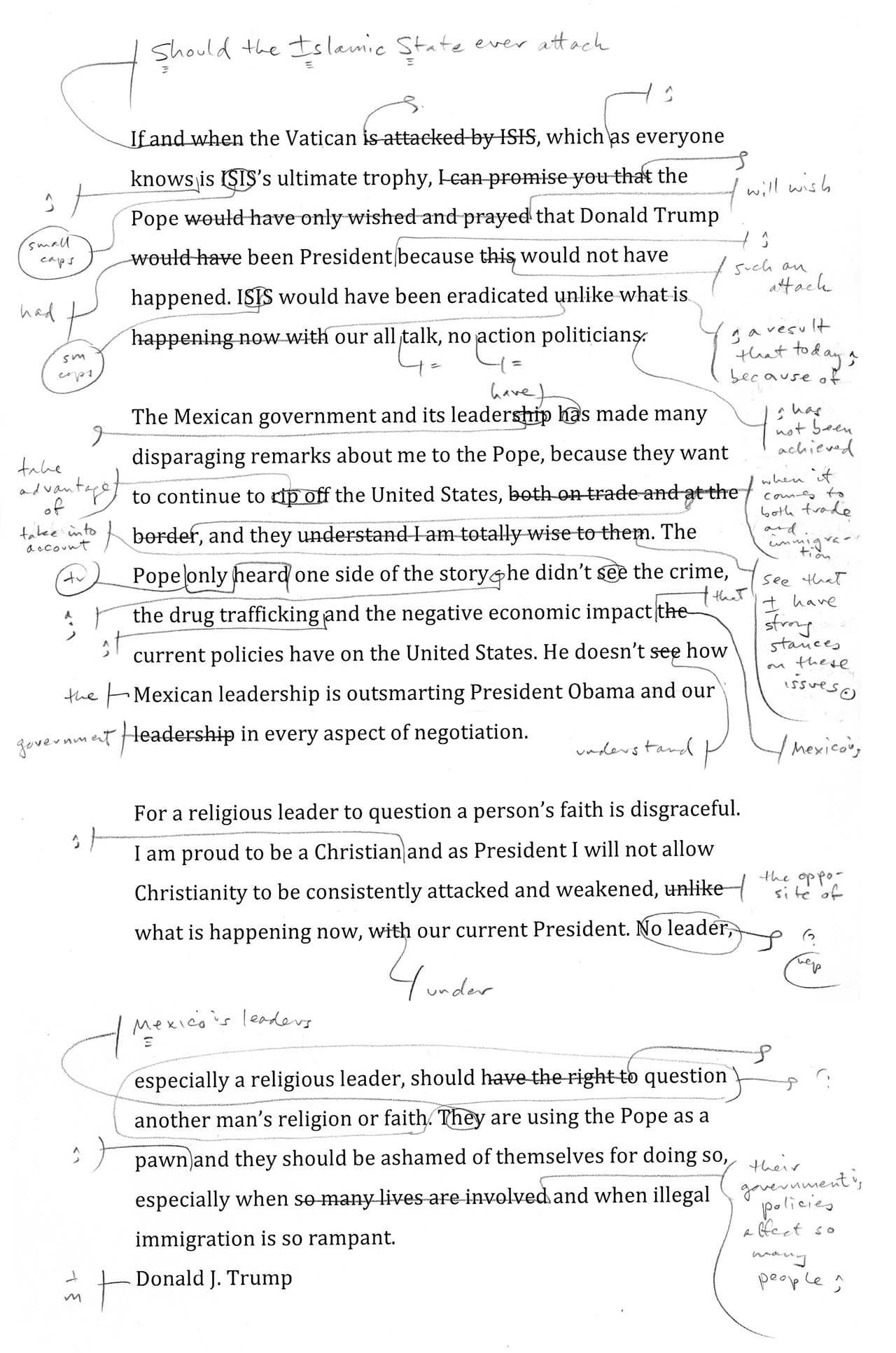
The New Yorker shows us what copyediting Donald Trump would look like:
Glenn Greenwald and Andrew Fishman penned “Greatest Threat to Free Speech in the West: Criminalizing Activism Against Israeli Occupation”:
The Israeli website +972 reported last year about a pending bill that “would ban entry to foreigners who promote the [BDS] movement that aims to pressure Israel to comply with international law and respect Palestinian rights.” In 2011, a law passed in Israel that “effectively ban[ned] any public call for a boycott — economic, cultural, or academic — against Israel or its West Bank settlements, making such action a punishable offense.”
But the current censorship goal is to make such activism a crime not only in Israel, but in Western countries generally. And it is succeeding.
Artists Chelsea Knight, Elise Rasmussen, and Brienne Walsh discuss the Kardashians, and the conversation goes everywhere:
CK: I think that the crux of it, or the thing that keeps it interesting for me, is the quantity of labor they’re doing for their appearances. I mean, this is no joke, you know what I mean? They roll out of bed with talons on.
BW: I loved that cover you sent me, with the Kardashians and all the men that they’ve ruined.
ER: Well that’s the thing. I think there’s a real fear of powerful women like Kris Jenner.
BW: Like they’re going to ruin a man.
ER: It’s become this idea of the castrating woman, right? It’s such an old, antiquated notion. But it’s still very much resonant today.
BW: It’s interesting that the Kardashians, who are perceived as being so stupid or silly by the general public, can still have that power just by virtue of being women. It’s the same power we ascribe to Hillary Clinton.
How cat hair brought down a pair of art forgers:
In 2009, the Federal Bureau of Investigation finally gathered enough evidence to confiscate the Toyes’ supposed Hunter collection, and during the raid they noticed that “they lived in a very modest house with approximately 30 cats,” Magness-Gardine says. When forensic investigators analyzed the seized works, they found cat hair embedded in the paint—a characteristic not shared by Hunter’s authentic work. “That’s essentially what brought them down,” Magness-Gardine says. William Toye pled guilty to art fraud in 2011.
What do students think of the public art at the University of Houston? Glasstire wanted to find out:
There are dozens of giant Presidential busts in Virginia (more info at Smithsonian):
The secret lives of “Tumblr Teens“:
Lilley and Greenfield grew up with the internet as a toy, competing with friends to make the most viral video, pranking adults at a strip mall within walking distance of their homes in Reading, Pennsylvania, when they weren’t old enough to drive. Lilley’s first YouTube hit was posting the audio of President Obama calling Kanye West a jackass for interrupting Taylor Swift at the 2009 Video Music Awards. Lilley read me the video’s YouTube description out loud—“Obama Calls Kanye West a Jackass [ACTUAL AUDIO]. Obama: Kanye West Is a Jackass! A JACKASS! Obama: Kanye West is a JACKASS!”—and muttered, “Wow, I was already so meta.” I thought he meant “meta” as in self-referential, but he meant meta like metadata, as in search engine optimization. When he posted the video he was 15, and it currently has more than 177,000 views.
People were understandably excited by Kendrick Lamar’s performance at the Grammys last week. Some say he stole the show. You can watch it here.
But writing for the Root, Demetria Lucas D’Oyley considers why more people are reacting negatively to Beyoncé’s performance than Lamar’s. She writes:
In fairness, there is absolutely some sexism at play. LaSha rightfully assesses that Beyoncé’s attire of a leotard and tights during her Super Bowl performance is unfairly used to discredit her message. She points out, “Black men, after all, whether in Levi’s or Kente cloth, can still declare their allegiance to blackness no matter how they’re dressed.”
And she notes that although both Lamar and Beyoncé infuse their black-empowerment messages with lines about sex, no one has raised a brow about Lamar doing so, despite perceiving those same ideas as a strike, so to speak, against Beyoncé. That men face no penalty for expressing sexual desire, while women are shamed, is blatant sexism.
So yes, there is sexism at play in the different responses to Lamar’s and Beyoncé’s performances.
While it may be part of the reason that think pieces condemning Lamar are in short supply, sexism is not the core reason as LaSha asserts. There are other major factors to take into consideration that explain the lack of overanalysis about Lamar’s performance and the abundance of such about Beyoncé.
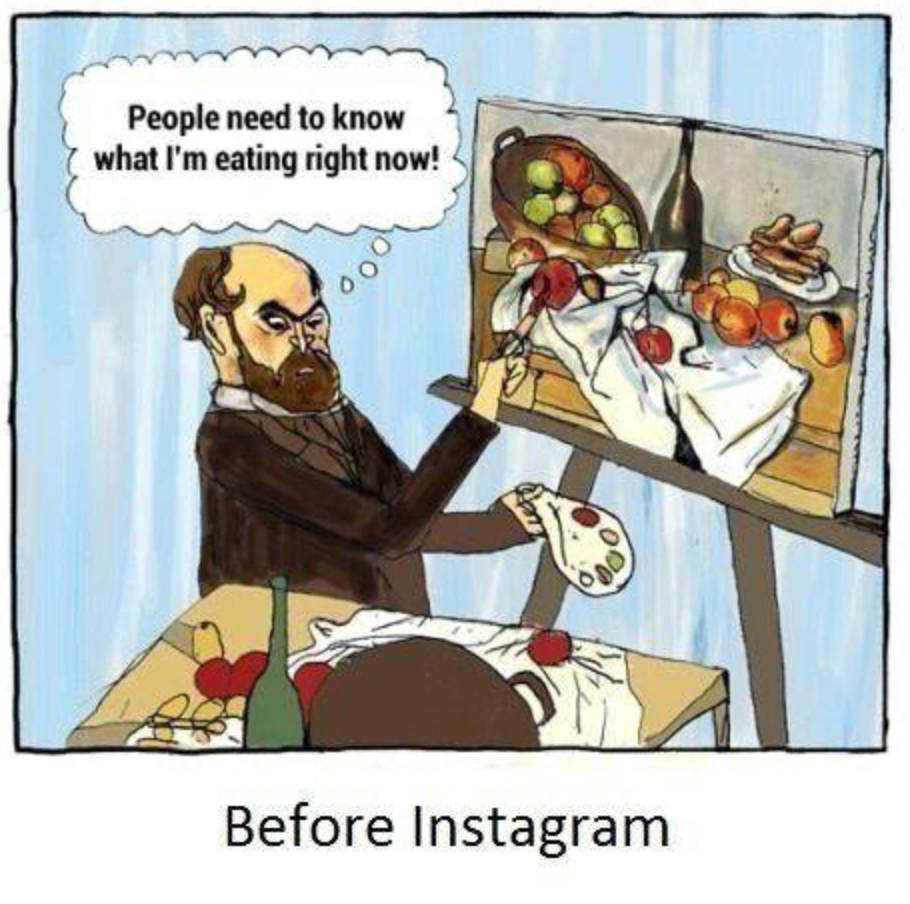
What artists did before Instagram:
Required Reading is published every Sunday morning ET, and is comprised of a short list of art-related links to long-form articles, videos, blog posts, or photo essays worth a second look.