Required Reading
This week, the oldest photo of New York, galleries and museums and money, troubles at the Picasso estate, first dates for conceptual artists, and more.

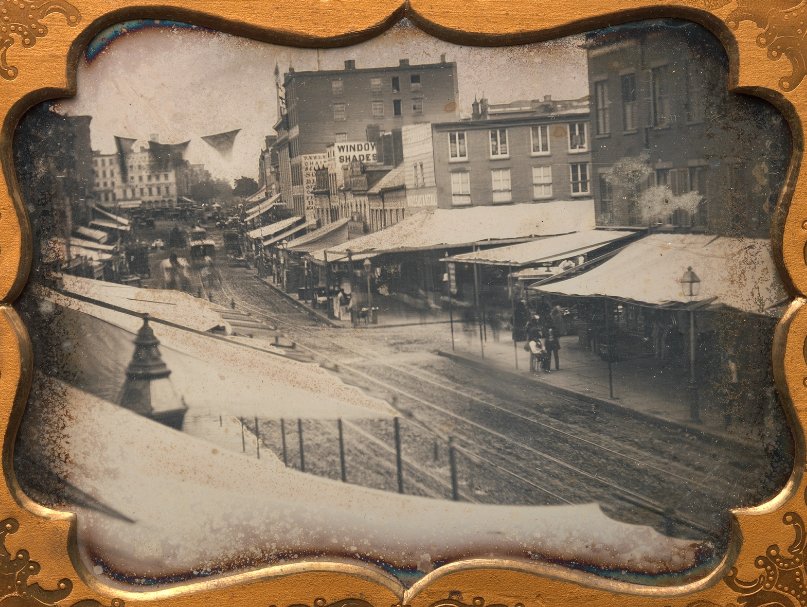
This week, the oldest photo of New York, galleries and museums and money, troubles at the Picasso estate, first dates for conceptual artists, and more.

Are art galleries getting too involved in the financials of museum exhibitions?
In today’s exploding art market, amid diminishing corporate donations and mounting exhibition costs, nonprofit museums have been leaning more heavily on commercial galleries for larger amounts of money — anywhere from $5,000 to $200,000 each time — to help pay for shows featuring work by artists the galleries represent.
The increasingly common arrangement has stoked concerns about conflicts of interest and the dilution of a museum’s mission to present art for art’s sake. Such cozy situations raise the specter of a pay-to-play model and could give galleries undue influence over what the public sees.
“It’s really gotten out of hand,” said Lawrence Luhring of the Luhring Augustine gallery. “It’s the brazenness of it — just the expectation of ‘How are you going to contribute?’ ”
Money, family, and the afterlife of a very successful artist, or Vanity Fair investigates Picasso’s estate:
When he died, Pablo Picasso left behind some 45,000 works, all complicated by countless authentications, rights, and licensing deals. Milton Esterow delves into the challenges faced by the five surviving heirs and the simmering conflict between two of them.
Curator Daniel Palmer writes about the strange professionalization of the artist:
With the rise of speculative collectors cashing in on younger artists—many of them just out of school—whose work is made cheaply and en masse, and resold at a significant profit, there has also been a hyper-professionalization of the role of the emerging artist himself. (My choice of pronoun is not by default: the artist in question is almost invariably male—the gender imbalance in the art market is on full view in this trend.) He has business cards, printed on fine paper stock. His website is pristine. His CV is extensive, and correctly formatted. He may have even hired a Hollywood agent. And yet the art market has refocused his goals toward short-lived commercial success rather than a career.
The New Yorker imagines first-date options for conceptual artists:
Take a date and affix it to a brass plaque. On the wall next to the plaque, mount a label that identifies the work as “DATE” (2016). Display “DATE” in a gallery, as if it were a work of art, because, in a sense, isn’t it? Realize two weeks later that it’s actually a dried fig.”
… Try to schedule a second date. Every time one of you suggests a time that the other can’t do, cut a little piece of your clothes off.”
https://twitter.com/kanyewest/status/707705694389198849
Turkey has had a major crackdown on freedom of expression with the takeover of a big opposition newspaper, Zaman. As bad as they are, Nate Schenkkan writes that things are about to get worse:
Next on the government’s target list is likely to be the Peoples’ Democratic Party, a predominantly Kurdish party with connections to the PKK that, just a year ago, was holding press conferences alongside government representatives announcing a roadmap for peace. After threatening Erdogan’s grip on power with a strong result in one of last year’s parliamentary elections, the party has since found itself under withering attack. Now there is a mounting drumbeat calling for its outright ban. Whether journalist or politician, secularist or Islamist — these days no one in Turkey is safe.
I normally enjoy Twitter, but I’m starting to sour on it. Julieanne Smolinski appears to have the same problem:
I like Twitter. Twitter has been good for me, and for my career. But there’s also been plenty of bad and unhealthy. And lately the scales have begun to tip heavily on the side of the negative.
There are a lot of essays out there about quitting Twitter as a lifestyle choice, so I should be clear: I’m not quitting forever. This isn’t an essay about growing up or moving across the country. I’m not quitting because it’s existentially bad for me, or making me a worse person, or ruining my attention span, or because I have poor impulse control, though those are all good reasons to quit.
… And issues at another micro-blogging service: how does Weibo balance Chinese government restrictions and grow its user base?
The core of Weibo censorship is the lack of clear rules that users can follow. You don’t know whether you will be the next target of censorship. Such tactics instill fear in you, then you start to behave yourself. Gradually, it becomes natural not to speak your mind. Over time, you lose the ability to express yourself as a normal person would do in a free society. That is the effect of censorship in the long run.
Do you think Weibo has become better at censoring content?
I think it’s probably getting worse. More censorship doesn’t necessarily mean better censorship.
During my time at Sina, sensitive words increased from 2,000 to at least over 10,000. Phrases like “McDonald’s” and “combo No.3”
Clickhole has some fun imagining “6 Heartwarming Norman Rockwell Paintings We Would Ask Him To Make If He Were Still Alive“:
5. Zeus throwing lightning bolts into an electric car: Electric cars are big in the news now, and The Saturday Evening Post, if that still even exists, would probably want to run a cover about them. Just painting a car seems a bit boring, though, so we’d ask Norman Rockwell to jazz it up by having the Greek god of thunder perched on a cloud, hurling lightning into the car’s engine, and electricity would be crackling around the wheels. At the bottom of the painting, Rockwell could’ve written “ELECTRIC CAR” in a nice yellow font. We would be very firm about the yellow font, even if Rockwell objected.
And this:
Worst Star Wars convention ever pic.twitter.com/Q44ltbleVI
— joe heenan (@joeheenan) March 10, 2016
Required Reading is published every Sunday morning ET, and is comprised of a short list of art-related links to long-form articles, videos, blog posts, or photo essays worth a second look.
Correction: An earlier version of this post mistakenly identified the daguerreotype at the top as the one taken in 1839 or 1840 from the rooftop studio of Samuel F.B. Morse and John Draper, who worked together at New York University.