Required Reading
This week, the dawn of the Anthropocene, the true story of Bob Ross, Stuart Davis, Grangerizing, the future of "the American dream," the Dismal Swamp, and much more.


This week, the dawn of the Anthropocene, the true story of Bob Ross, Stuart Davis, Grangerizing, the future of “the American dream,” the Dismal Swamp, and much more.

Scientist officially declared the dawn of the Anthropocene epoch (the human-influenced age), because experts say human impact on the Earth is so profound that the Holocene must give way to an epoch defined by nuclear tests, plastic pollution, and domesticated chicken:
The evidence of humanity’s impact on the planet is overwhelming, but the changes are very recent in geological terms, where an epoch usually spans tens of millions of years. “One criticism of the Anthropocene as geology is that it is very short,” said Zalasiewicz. “Our response is that many of the changes are irreversible.”
To define a new geological epoch, a signal must be found that occurs globally and will be incorporated into deposits in the future geological record. For example, the extinction of the dinosaurs 66m years ago at the end of the Cretaceous epoch is defined by a “golden spike” in sediments around the world of the metal iridium, which was dispersed from the meteorite that collided with Earth to end the dinosaur age.
For the Anthropocene, the best candidate for such a golden spike are radioactive elements from nuclear bomb tests, which were blown into the stratosphere before settling down to Earth. “The radionuclides are probably the sharpest – they really come on with a bang,” said Zalasiewicz. “But we are spoiled for choice. There are so many signals.”
Who was Bob Ross, really? First of all, his hair was naturally straight:
“He got this bright idea that he could save money on haircuts. So he let his hair grow, he got a perm, and decided he would never need a haircut again,” Kowalski explains.
Before he could change it back, though, the perm became his company’s logo — Ross hated it. “He could never, ever, ever change his hair, and he was so mad about that,” Kowalski says. “He got tired of that curly hair.”
But viewers never got tired of Ross or his show, The Joy of Painting. With his soft, hypnotic voice, he’d bring his viewers in close as he created 30-minute masterpieces — distant mountain ranges, seascapes, forest scenes, always with those happy little trees. He’d sling his palette around, blend the titanium white paint, whisper about his life in Alaska, then gently tap his fan brush to create a canvas full of fluffy clouds. With his partly unbuttoned chambray shirt, his halo of tight curls and his soothing demeanor, Ross was a fixture on PBS.
James Panero reviews the Stuart Davis retrospective at the Whitney Museum:
The great shame of this exhibition’s pop psychology, or more likely pop psychosis, is how its archival research has indirectly illuminated a more relevant understanding of Davis’s methodology. Far from the superficial coolness of pop, Davis was the hottest of artists. He incorporated the visual landscape of popular culture not as pop commentaries but as personal expressions. He deployed modernist innovations such as cubist simultaneity but, unlike European examples, he looked beneath the surface. Mere “visible phenomena,” as Barbara Haskell explains, “ignored what he believed was true about perception—that it involves the totality of one’s consciousness. He reasoned that if his art were to be truly realistic, it must include his ideas, emotions, and memories of other experiences.”
In the 19th century there was a DIY craze to custom illustrate favorite books:
But Grangerizing also became a DIY practice, sort of like scrapbooking. Pick up a battered old botany book from the late 19th century, and it’s not uncommon to find a few extra illustrations, some hand-colored, pasted in by a woman of your great-great grandmother’s era. It’s one of those interesting, mostly forgotten domestic arts practiced by women at a time when they were barred from participating in so much of the arts, culture, and scholarship of their day.
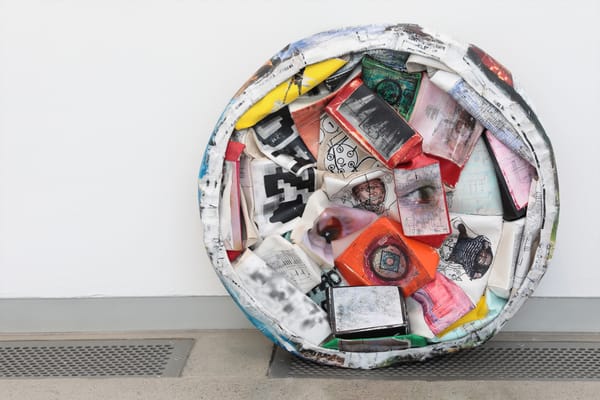
… But the practice of Grangerizing, or extra-illustrating, wasn’t universally loved. Around the turn of the last century, it faced quite a backlash, as perfectly good books were pilloried for their prints and modest single volumes expanded to sets of eight or ten to accommodate all the prints injudiciously thrown in. In 1893, the Book Lover’s Almanac criticized the practice, calling Grangerites “knights of the shears and paste jars” and pointing out the folly of “crowding a Bible or a Shakespeare with engravings by the thousands in sets of dreary uniformity as long as your arm.” They called this type of unimaginative extra-illustration “a delusion and a snare, and a weariness to the flesh.” They illustrated the shears-and-paste set this way:
Do tech giants know the public has little power? Probably, and they are taking advantage of it:
Time, taxes and terrorism have changed the mood. Digital behemoths are hardly alone among multinational corporations gaming competition between different tax regimes to minimise their bill. But they are among the slickest navigators of the labyrinth. And, perhaps because their products are enmeshed with the intimate lives of consumers – people literally take Apple devices to bed – the offence is more keenly felt.
Here’s a question we might all well be asking: “What’s the future of ‘the American dream’?” Brian David Johnson is a futurist at Arizona State University’s Center for Science and Imagination. He explains in this radio broadcast how he envisions a different future:
For myself, as a futurist, one of the things that I’ve learned is the way that you change the future is you change the story that people tell themselves about the future that they will live in. I’ve seen it happen time and time again in universities, in corporations, in the government. If you can change that story, people will actually make different decisions.
How Italy stopped UNESCO from declaring Venice a World Heritage in Danger site:
In October 2015, the International Council on Monuments and Sites (Icomos), sent a mission to Venice on behalf of Unesco to investigate the situation, and its report concluded that no significant progress had been made towards resolving any of the specified problems. The city council tried to prevent the mission from meeting representatives of civil society, who have been increasingly active in recent years drawing attention to the cruise ships, uncontrolled tourism and declining resident numbers, but the mission insisted on receiving them.
The Icomos report was sent on 9 June 2016 to the Italian government for any factual corrections to be made so that it could be included among the action papers supplied to members of the World Heritage Sites Committee before it convened on 10 July. The report was delayed, however, so it was not attached to the main papers, but buried among attached documents, making it less likely that its very critical comments would be read by members, who might then have objected to Unesco’s recommendation that Italy submit yet another report by 1 February 2017—in other words, be spared listing for another year.
One of the smartest leftist journalists in Israel, Mairav Zonszein, asks the big question: “Should I Give Up On Changing Israel from Within — and Take a Stand by Leaving?” She writes:
Israel currently has the most right-wing government in its history, and “leftist” is a bona fide bad word whose definition just keeps broadening. An Israeli who never set foot across the Green Line but who protested in central Tel Aviv against Israel’s past two wars in Gaza is considered radical. A soldier who has fulfilled his military service and then speaks out against the actions he carried out is a traitor. A 2016 poll shows that 72% of Jewish Israelis believe Israel’s control over the Palestinian territories does not even constitute an “occupation.”
Under these circumstances, how can the left possibly hope to shift the discourse, much less end the occupation?
Have you heard of the Dismal Swamp? If not, you should be aware of it and its rather radical history:
The Dismal Swamp covered great tracts of southeast Virginia and northeast North Carolina, and its vegetation was far too thick for horses or canoes. In the early 1600s, Native Americans fleeing the colonial frontier took refuge here, and they were soon joined by fugitive slaves, and probably some whites escaping indentured servitude or hiding from the law. From about 1680 to the Civil War, it appears that the swamp communities were dominated by Africans and African-Americans.
… Marronage, the process of extricating oneself from slavery, took place all over Latin America and the Caribbean, in the slave islands of the Indian Ocean, in Angola and other parts of Africa. But until recently, the idea that maroons also existed in North America has been rejected by most historians.
“In 2004, when I started talking about large, permanent maroon settlements in the Great Dismal Swamp, most scholars thought I was nuts,” says Sayers. “They thought in terms of runaways, who might hide in the woods or swamps for a while until they got caught, or who might make it to freedom on the Underground Railroad, with the help of Quakers and abolitionists.”
By downplaying American marronage, and valorizing white involvement in the Underground Railroad, historians have shown a racial bias, in Sayers’ opinion, a reluctance to acknowledge the strength of black resistance and initiative. They’ve also revealed the shortcomings of their methods: “Historians are limited to source documents. When it comes to maroons, there isn’t that much on paper. But that doesn’t mean their story should be ignored or overlooked. As archaeologists, we can read it in the ground.”
You may think twice before eating gummy candy after watching this video about how they it’s made:
Over eten – De weg van een snoepje from Eén on Vimeo.
Required Reading is published every Sunday morning ET, and is comprised of a short list of art-related links to long-form articles, videos, blog posts, or photo essays worth a second look.