Required Reading
This week, a queer black Minimalist, Trump fact-checks, Shakespeare gets a co-author, US pop culture's black male problem, and more.


- The story of Minimalism has long been dominated by straight white men, but that might be partly because members of that movement were erased, like Julius Eastman:
Part of the pleasure of Eastman’s rediscovery has been the belated, deserving reinsertion of a black, gay figure into music history. With additive, slowly transforming repetitions at the heart of his major pieces, Eastman has a clear connection to the Minimalist canon. But in the early 1970s, well before many others, he was using those repetitions as a structure to contain improvisation, as well as rhythms and harmonies borrowed from pop.“
Minimalism was still in its austere, two-dimensional phase, conceptual and concerned with abstract pattern,” Mr. Gann writes in “Gay Guerrilla,” “but in one step Eastman started mixing genres and forecasting techniques that would be tried in Post-Minimalism 15 years hence.”
- Many newspapers are finally publishing their extensively researched reports on the myths and realities of Donald Trump. First, the New York Times looks into the psychology of a man who fears losing his status:
The recordings reveal a man who is fixated on his own celebrity, anxious about losing his status and contemptuous of those who fall from grace. They capture the visceral pleasure he derives from fighting, his willful lack of interest in history, his reluctance to reflect on his life and his belief that most people do not deserve his respect.
… There is little trace of sympathy or understanding. When people lose face, Mr. Trump’s reaction is swift and unforgiving.
… Ultimately, Mr. Trump fears — more than anything else — being ignored, overlooked or irrelevant.
Then there’s the Washington Post investigation into his charitable giving, which isn’t as generous as Trump pretends it is:
For as long as he has been rich and famous, Donald Trump has also wanted people to believe he is generous. He spent years constructing an image as a philanthropist by appearing at charity events and by making very public — even nationally televised — promises to give his own money away.
It was, in large part, a facade. A months-long investigation by The Washington Post has not been able to verify many of Trump’s boasts about his philanthropy.
Instead, throughout his life in the spotlight, whether as a businessman, television star or presidential candidate, The Post found that Trump had sought credit for charity he had not given — or had claimed other people’s giving as his own.
The Times also published a two-page spread that lists all the people, places, and things Trump has insulted on Twitter this election season:
The @NYTimes has printed a list of all of the people, places, & things that Trump has insulted on Twitter during the campaign. pic.twitter.com/bNb156aHY6
— deray (@deray) October 24, 2016
- Arts reporter and podcaster Tyler Green spots some really strange hangings at the National Gallery of Art, including this one:
I guess the good news is that the NGA didn't install this great 1952 Braque on one of two doors, but… pic.twitter.com/l0ze5h4Cb8
— Tyler Green (@TylerGreenBooks) October 24, 2016
- Oxford University Press has decided to give credit to Elizabethan playwright Christopher Marlowe as Shakespeare’s co-writer on three of the Bard’s plays. Is this a partial death of the modernist myth of the individual genius? Maybe:
Scholars working on New Oxford Shakespeare, a collection of all of Shakespeare’s known works, said his collaboration with other playwrights was more extensive than has previously been known.The research, by 23 international scholars, has identified 17 of 44 Shakespeare plays as being co-written with other authors.
- A Trump supporter and member of the alt-right develops a theory of white male identity politics ?:
On his blog, Cernovich developed a theory of white-male identity politics: men were oppressed by feminism, and political correctness prevented the discussion of obvious truths, such as the criminal proclivities of certain ethnic groups. His opponents were beta males, losers, or “cucks”—alt-right slang for “cuckolds.” “To beat a person, you lower his or her social status,” he wrote on Danger and Play. “Logic is pointless.”
Although he disdained electoral politics (“No thinking man buys into this two-party political system”), he was in an ideal position to foresee Trump’s rise. In July, 2015, he tweeted, “I said if a Republican acted like me and ran for office, it’d be a movement. Donald Trump has proven me right. People are tired of pussies.” Politics is a blood sport, but, during the primaries, Jeb Bush and the rest of Trump’s “cuckservative” opponents preferred to be genteel. “What are Trump’s policies? I don’t particularly care,” Cernovich wrote on Danger and Play. And, in another post: “If Trump offends you, it’s because you live in a cucked world where no one speaks their minds.”
- ProPublica released this controversial report this week, and it points out that Facebook allows advertisers to exclude users by race:
When we showed Facebook’s racial exclusion options to a prominent civil rights lawyer John Relman, he gasped and said, “This is horrifying. This is massively illegal. This is about as blatant a violation of the federal Fair Housing Act as one can find.”
The Fair Housing Act of 1968 makes it illegal “to make, print, or publish, or cause to be made, printed, or published any notice, statement, or advertisement, with respect to the sale or rental of a dwelling that indicates any preference, limitation, or discrimination based on race, color, religion, sex, handicap, familial status, or national origin.” Violators can face tens of thousands of dollars in fines.
The Civil Rights Act of 1964 also prohibits the “printing or publication of notices or advertisements indicating prohibited preference, limitation, specification or discrimination” in employment recruitment.
Facebook’s business model is based on allowing advertisers to target specific groups — or, apparently to exclude specific groups — using huge reams of personal data the company has collected about its users. Facebook’s microtargeting is particularly helpful for advertisers looking to reach niche audiences, such as swing-state voters concerned about climate change. ProPublica recently offered a tool allowing users to see how Facebook is categorizing them. We found nearly 50,000 unique categories in which Facebook places its users.
- This bus ad in Copenhagen encourages ex-pat Americans to vote, and it’s pretty genius:

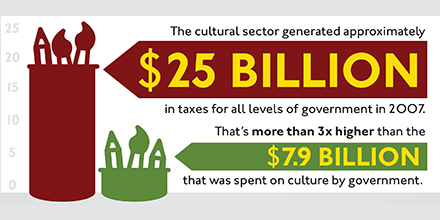
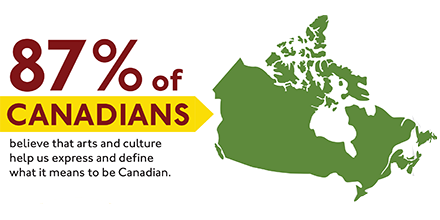
- The Canadian Arts Coalition has some infographics that point out the impact of the arts in Canada, including:
- Wesley Morris considers US pop culture’s problem with black male sexuality:
The black penis is imagined more than it’s seen, which isn’t surprising. This newly relaxed standard for showing penises feels like a triumph of juvenile phallocentrism — it’s dudes peeking over a urinal divider and, as often as not, giggling at what they see. Not all of that peeking is harmless; some of those dudes are scared of what they’ve seen. And knowing that — knowing even a whiff of the American history of white men’s perception of the black penis — leaves you vulnerable to attack, even when all you think you’re doing is going to see, I don’t know, “Ted 2.”
Officially, there are no penises in “Ted 2,” the comedy written by, directed by and starring Seth MacFarlane that was a hit last summer. And yet they’re everywhere — scary black ones. Mark Wahlberg plays a New England knucklehead named John, who swears that you can’t use the internet without running into one. When a mishap at a fertility clinic leaves him covered in semen, a staff member tells him not to worry; it’s just the sperm of men with sickle-cell anemia, a disease that, in the United States, overwhelmingly afflicts African-Americans. John’s best friend, Ted — a nasty animated teddy bear — gets a huge kick out of this: “You hear that? You’re covered in rejected black-guy sperm,” it says. “You look like a Kardashian!”
- Twenty Americans explain why they are voting in a presidential election for the first time and who they will vote for:
Najla Abdulelah, 23, transportation analyst, Marietta, Georgia (born in Baghdad, Iraq)
“I moved out of Iraq at the end of 2006. I moved to Jordan with my mother and two siblings, three years into the war. My elder sister and my father stayed back in Iraq, him because of his job and my sister because of school. We came to the U.S. through the U.N. as refugees, in November, 2008. It’s a very, very long process. It only got sped up after my father passed away in Iraq, and I guess we were then seen as political refugees, rather than just refugees seeking asylum from a war-torn country. It took over a year and a half, and then, randomly, the U.N. selected Georgia for us. I’m voting for Hillary Clinton, and I say that with hesitation. She’s not the only one who voted to go to Iraq, but she’s the only one that’s so close to winning the Presidency. I just feel that I don’t have the luxury that many others might have to vote for a third-party candidate. If that vote that I cast could even tip the scale by one vote of sand in Trump’s favor, I just did my own people a disservice. I did myself a disservice. The hate that he’s spewing and the fear that he’s feeding off are allowing people to believe that what he’s saying is in fact true. But it’s not.”
- Man dresses as his dog’s favorite chew toy for Halloween. As expected, it’s really adorable:
To the man who dressed up as his dog's favourite toy for #Halloween. You are my hero. pic.twitter.com/MkaJj7IlHp
— Jonno Turner (@jonnot) October 28, 2016
Required Reading is published every Sunday morning ET, and is comprised of a short list of art-related links to long-form articles, videos, blog posts, or photo essays worth a second look.