Required Reading
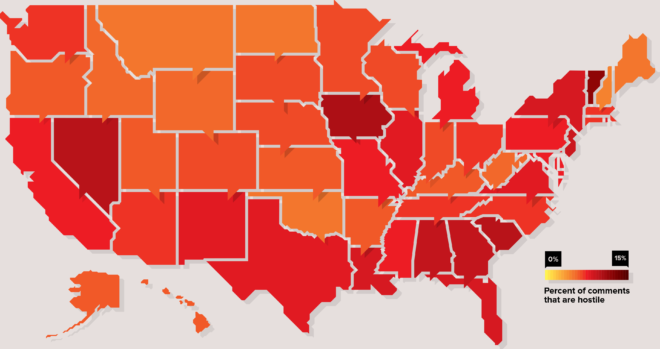
This week, becoming "fake news," Guatemalan artisans fight back, Larissa Sansour's film controversy, Chinese pro-military film propaganda, the trolls of Vermont, and more.


- A witness to the Charlottesville terrorist attack explains how he ended up at the center of various conspiracy theories and “fake news”:
Desperate to lay blame on anyone besides the alt-right, they seized on these facts to suggest a counter-narrative to the attack, claiming there was no way that someone with my background just happened to be right there to take the video. Even ignoring the fact that someone with my background—raised in Virginia, UVA graduate, lives in Charlottesville, worked to resolve ethnic conflicts overseas, politically progressive—is exactly the kind of person you’d expect to find at a protest against Nazis, their theories were absurd and illogical. They wrote that I was a CIA operative, funded by (choose your own adventure) George Soros, Hillary Clinton, Barack Obama, the IMF/World Bank, and/or a global Jewish mafia to orchestrate the Charlottesville attack in order to turn the general public against the alt-right. I had staged the attack and then worked with MSNBC and other outlets controlled by the left to spread propaganda. They claimed my ultimate goal was to start a race war that would undermine and then overthrow Donald Trump on behalf of the “Deep State.” (I’m generalizing here as the theories are widely variant and logically inconsistent, and I’m only aware of the small percentage I could be bothered to read.)
- Satirists can’t keep up with Trump, but they’re trying. Here a bunch discuss various magazine covers they created post-Charlottesville.
- The Working Family Party had a great response to Louise Linton’s (Steven Munchin’s wife’s) tone deaf Instagram post this week:
Louise Linton, wife of foreclosure bankster @stevenmnuchin1 tagged brands on her Instagram. We tagged how she bought them. pic.twitter.com/57PTHkzc7k
— Working Families Party 🐺 (@WorkingFamilies) August 22, 2017
- ProPublica reports on how major tech companies are helping far-right websites monetize their hate:
But ProPublica’s findings indicate that some tech companies with anti-hate policies may have failed to establish the monitoring processes needed to weed out hate sites. PayPal, the payment processor, has a policy against working with sites that use its service for “the promotion of hate, violence, [or] racial intolerance.” Yet it was by far the top tech provider to the hate sites with donation links on 23 sites, or about one-third of those surveyed by ProPublica. In response to ProPublica’s inquiries, PayPal spokesman Justin Higgs said in a statement that the company “strives to conscientiously assess activity and review accounts reported to us.”
- A far-right group is trying to smear antifa groups with a fake meme campaign. BBC summaries Bellingcat’s findings:
The online campaign is using fake Antifa (an umbrella term for anti-fascist protestors) Twitter accounts to claim anti-fascists promote physically abusing women who support US President Donald Trump or white supremacy.
Researcher Eliot Higgins of website Bellingcat found evidence that the campaign is being orchestrated on internet messageboard 4Chan by far-right sympathisers.
- Guatemalan artisans are going after the fake sellers on Etsy and elsewhere, and with some success:
Using bots to scan for keywords and specific types of images, Dillon locates products on Etsy, Google and Shopify that seem suspect and then reaches out to individual sellers to ask what percentage of profits are passed back to the artisans, what their transparency policies are and more. Sellers who can’t prove that they have legitimate relationships with Guatemalan artisans are then reported to their hosting sites to be removed. So far, this process has led to the identification of over 64,000 products on Etsy alone that infringe on artisan copyrights, and communication with Etsy’s legal team has led Dillon to believe the company will be cooperative with Ethical Fashion Guatemala’s requests for infringing product removal. Similar conversations have taken place with teams at Google and Shopify.
- David Batty takes a look at the accusations of anti-semitism against Larissa Sansour’s new film project showing at the Barbican:
In a letter to Sandeep Dwesar, the chief operating and financial officer of the Barbican, Merron wrote: “While the Barbican synopsis casts the film as a sci-fi feature about fictitious technologically advanced aliens who land in an area to implant a ‘false history’, I understand that the film is clearly filmed in Israel and that the dialogue is in Arabic and purports to show the ‘aliens’ seeding the land with porcelain in an effort to create the ‘false’ impression that they have a historical connection to it.
Requesting its removal from the exhibition, Merron said: “It is therefore not much of a stretch to suggest that the film is a means by which to deny the historical Jewish connection to Israel and an exercise in delegitimisation. Accusing Jews of falsifying our connection to Israel smacks of antisemitism and is of grave concern.”
In reply, Dwesar said: “The short film has been programmed for its poetical vision before anything else. … Having spoken to the curator and the artists, the intention is that the symbolic visual language in the film speaks of history and tradition, yet it cannot necessarily be placed in any distinct or quantifiable time period.”
- Wolf Warrior 2 is the second biggest grossing film in Chinese film history but there’s a darker side to this pro-military propaganda flick. Writing for RobertEbert.com, Simon Adams breaks it down:
This is the second highest-earning film in all of Chinese history, and its characters’ sense of patriotism is built on the back of racist assumptions that would, in a European or American narrative, be rightfully criticized for being part of an ugly “white savior” power fantasy. In time, “Wolf Warrior 2” might seem benignly kitschy, though its core ideas about how only the Chinese military can save a nameless African country from bloodthirsty native rebels and amoral European mercenaries, will always be gross.
… Look at how the Africans celebrate their newfound savior by behaving like racist fantasies of uncivilized mindless savages: they dance around an open bonfire while pounding on hand-drums. Look at Tundu, Leng’s portly African “godson” sidekick who sells bootleg porn and eats a lot. Heck, look at Tundu’s mom, an overweight woman who breaks bottles and body-slams African rebels to protect her son. Tundu’s mom’s heroism might be a sign of her being a secret bad-ass, but her violent outbursts are played for laughs. She’s a punchline, not a supporting character. She has no more depth than the African rebels who shoot up Tundu’s fellow victims.
And there’s this distressing piece of news: Chinese Film Critic Feared Fired After Damning Review of ‘Wolf Warrior II’
- A group wants to fix our mistaken assumptions about bubonic plague images and they’re doing something about it:
Between about 1347 and 1353, the Black Death wiped out an estimated 50 percent of the European population. It was horrendous. “People were terrified,” says Jones.
You would think, Jones says, “that if this was such a major catastrophe, there must be drawings of it. But there aren’t.”
Required Reading is published every Sunday morning ET, and is comprised of a short list of art-related links to long-form articles, videos, blog posts, or photo essays worth a second look.