Required Reading
This week, MVRDV's stunning Tianjin Binhai Library, cybercrime in galleries, a history of protest posters, the nationalist critics of the Taj Mahal, and much more.


- Cybercrime is hurting commercial galleries, according to The Art Newspaper:
The fraud is relatively simple. Criminals hack into an art dealer’s email account and monitor incoming and outgoing correspondence. When the gallery sends a PDF invoice to a client via email following a sale, the conversation is hijacked. Posing as the gallery, hackers send a duplicate, fraudulent invoice from the same gallery email address, with an accompanying message instructing the client to disregard the first invoice and instead wire payment to the account listed in the fraudulent document.
Once money has been transferred to the criminals’ account, the hackers move the money to avoid detection and then disappear. The same technique is used to intercept payments made by galleries to their artists and others. Because the hackers gain access to the gallery’s email contacts, the scam can spread quickly, with fraudulent emails appearing to come from known sources.
- Antwaun Sargent writes that this is a golden age for “Black Painting” in the US:
Specifically, we’re witnessing the awakening of black figurative painting and portraiture, and as a figure Michelle Obama “is an archetype,” Sherald, 44, told me last week on the phone from Baltimore, where she’s based. “I want all types of people to look at my work and see themselves, just like I watch a Reese Witherspoon movie as a black woman and can empathize with her because we have had to internalize whiteness in that way to survive.”
- A short history of protest posters by G. James Daichendt:
The history of protest posters dates back to the 16th century when Martin Luther and members of the Protestant Reformation posted Luther’s 95 Theses on the church doors. The message communicated a discontent and ultimately provoked a split within the religion. While this interpretation requires some reframing, it’s not hard to imagine how the poster has proven to be a powerful tool to amplify one’s voice in a community. Often anonymous and for a specific moment in time, the shelf life of posters may not be long but the impact (negative or positive) is often received as a harsh criticism or a call to arms depending upon the power structures being challenged.
If it’s clear that Facebook and Google can’t manage what they already control, why let those corporations own more? America’s antitrust enforcers can impose such a rule almost immediately.
For one thing, there is no doubt these corporations qualify for antitrust regulation. Facebook, for instance, has 77% of mobile social networking traffic in the United States, with just over half of all American adults using Facebook every day.
Nearly all new online advertising spending goes to just Facebook and Google, and those two companies refer over half of all traffic to news websites. In all, Facebook has some 2 billion users around the world.
- Hindu nationalists in India are starting to be more vocal of their criticism of the Taj Mahal, which is the country’s most popular tourist attraction. The issue for nationalists is that it was built by a Muslim ruler:
Critics of the Taj Mahal are also growing increasingly bold. In past months, religious nationalists in the Hindu-majority country have stepped up a campaign to push the four-century-old Mughal monument to the margins of Indian history. One legislator recently kicked up a national storm when he labelled the tomb “a blot”.
Resentment at the fact the country’s most recognisable monument was built by a Muslim emperor has always existed on the fringes of the Hindu right. But those fringes have never been so powerful.
Attacks on the monument, a lifeline for its home state of Uttar Pradesh, have grown so loud that last week the state chief minister – himself a critic of the Taj – was forced into “a day-long exercise in damage control”, one newspaper said.
- A conversation on the “deep history of humans and music” with Gary Tomlinson:
Whenever people think about the origins of music, they stack it up against language. Automatically they start with, “Well, what’s its relationship with the origin of language?” And to pry those two things apart was of course a very important agenda in my book, because when they’re put together either music is made to piggyback on language as something subservient to the origin of language, something that came along as a result of language—this is Steven Pinker’s view of music as “auditory cheesecake”—or else music is made into a romanticized, ur-emotional language from which we finally came to speak propositional notions, while the heart of music remained something emotional. I think both of those views of music are wrong, I think they’re incomplete, I think they’re silly in some ways. Music the language of emotions and language the language of propositions—this is so drastic a simplification of what we do as humans with both music and language.
- Why are YouTube and Facebook removing evidence of atrocities? The Intercept reports:
The disappearance of Abdusalam’s photos are part of a pattern that’s causing a quiet panic among human rights groups and war crimes investigators. Social media companies can, and do, remove content with little regard for its evidentiary value. First-hand accounts of extrajudicial killings, ethnic cleansing, and the targeting of civilians by armies can disappear with little warning, sometimes before investigators notice. When groups do realize potential evidence has been erased, recovering it can be a kafkaesque ordeal. Facing a variety of pressures — to safeguard user privacy, neuter extremist propaganda, curb harassment and, most recently, combat the spread of so-called fake news — social media companies have over and over again chosen to ignore, and, at times, disrupt the work of human rights groups scrambling to build cases against war criminals.
“It’s something that keeps me awake at night,” says Julian Nicholls, a senior trial lawyer at the International Criminal Court, where he’s responsible for prosecuting cases against war criminals, “the idea that there’s a video or photo out there that I could use, but before we identify it or preserve it, it disappears.”
- Activists are realizing that foreign governments have a bigger role in protests than they previously have had in the US. Micah White, one of the co-founders of Occupy, writes about his own experience:
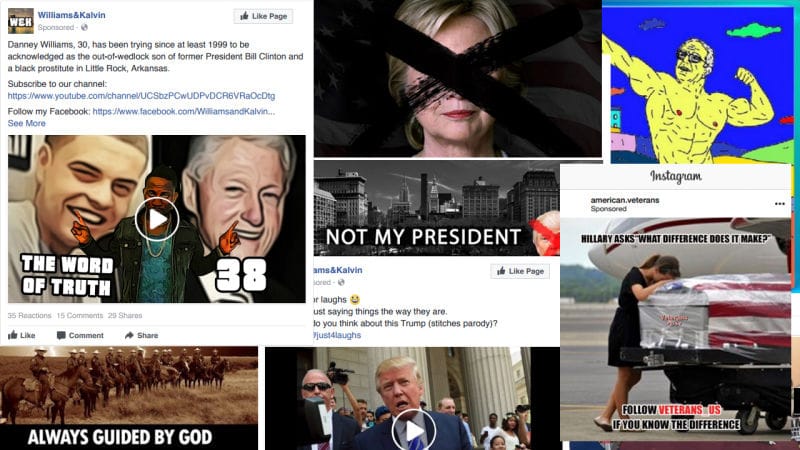
Black Matters was one of many fake activist groups, such as Blacktivist and the police brutality tracker DoNotShoot.us, created to mimic and influence American protesters. RBC discovered around 120 Facebook, Twitter and Instagram frontgroup accounts with a combined total of 6 million followers and likes.
As a revolutionary American activist I’d been on guard against domestic intelligence agencies, not foreign governments, and Russia exploited that posture.
She started blogging about development issues and other purely local matters. Along the way, she became pretty well versed in development issues and how to ferret out information. That was helpful when she was walking around with her camera this winter. She does that often merely to document changes in the neighborhood for the blog. She always wonders what might have been in a certain place previously.
She walked past a brownstone that looked a mess from the outside. Windows were broken and the front door had been replaced with plywood and close with a huge chain. “It just looked unkempt with a lot of construction debris.”
A neighbor saw her with her camera and began chatting. Kelly said she was just taking photos for her blog. The neighbor said, “You want a scoop?” She alluded to a “celebrity” who now owned on the block. Kelly figured she must mean some Hollywood type, since they have been spotted with regularity in recent years. But then the neighbor said, “Paul Manafort.”
- Lindsey Hilsum reviews four books on the realities of Syria today, and she writes:
The Western focus on ousting ISIS rather than the regime of Bashar al-Assad has been the cause of much bitterness among Syrian activists. They understand that, unlike the Assad government, the jihadists with their anti-Western ideology are a threat to Europe and the US, but the regime and its allies have killed far more Syrians, and activists resent the way their hopes were lifted and then dashed. “The problem is not that the world did nothing,” says one of Wendy Pearlman’s sources in We Crossed a Bridge and It Trembled. “It’s that they told us, ‘Rise Up! We are with you. Revolt!’… People were encouraged to stand by the revolution because they thought they had international supporters.” The book comprises interview fragments untethered to narrative, so although many of the testimonies are moving, it reads like raw material or the transcript of a podcast.
- The TV show Family Guy called out Kevin Spacey back in 2005:
- In case you want to read the 31-page federal indictment against ex-Trump campaign manager Paul Manafort and Richard Gates:
READ the 31-page federal indictment against ex-Trump campaign manager Paul Manafort and Richard Gates: https://t.co/a1m4tRo5Yh pic.twitter.com/a6tmw8j0ZV
— NBC News (@NBCNews) October 30, 2017
2017: When a fictional president is held to a higher standard than the actual President. https://t.co/1u6qTLQhNw
— Millennial Politics (@MillenPolitics) October 30, 2017
Required Reading is published every Sunday morning ET, and is comprised of a short list of art-related links to long-form articles, videos, blog posts, or photo essays worth a second look.