Required Reading
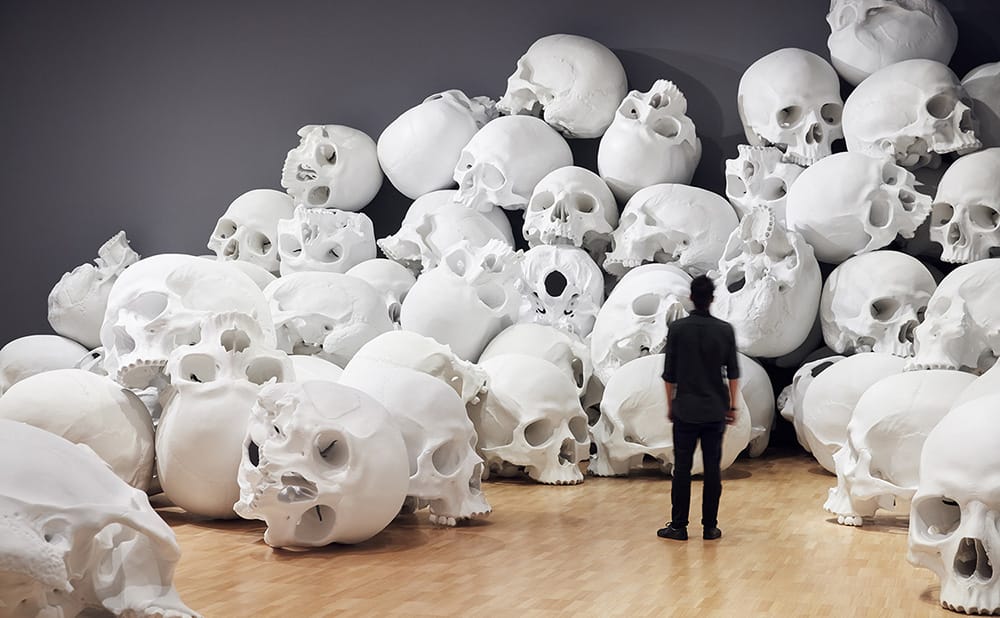
This week, Ron Mueck's giant skulls, white men on pedestals, the world's first biological house, destroying modernist landscapes, a dog named Masterpiece, and more.

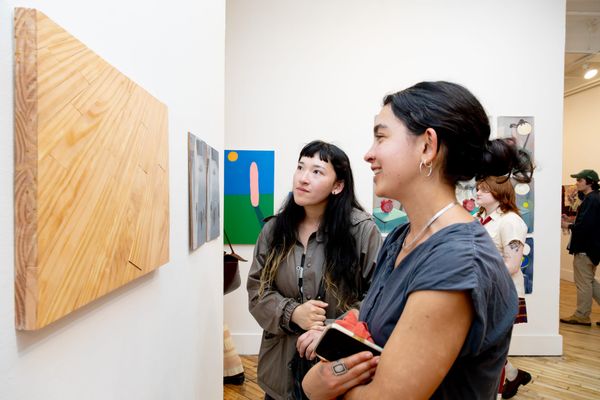
- Jillian Steinhauer writes about the Kenya (Robinson) and Doreen Garner exhibition at Pioneer Works that explores why we put white men on pedestals:
Lionized in bronze and lauded for his accomplishments, without any acknowledgement of the brutal exploitation that made them possible, Sims is the quintessential white man on a pedestal. With her sculpture PONEROS (2017), artist Doreen Garner provides an essential corrective: This man doesn’t have blood just on his hands, but all over him.
That may sound heavy-handed, but it doesn’t feel that way in person. PONEROS is part of “White Man on a Pedestal,” a duo show featuring work by Garner and the artist Kenya (Robinson) at the arts nonprofit Pioneer Works. (Robinson), who’s forty and grew up in Gainesville, Florida, and Garner, a 31-year-old Philadelphia native, both live in New York City, where they’ve exhibited art together before — though never in such a potent combination. Garner takes a visceral approach: In Pioneer Works’ vast, industrial gallery, the disgust underpinning PONEROS is bolstered by the abstracted, evocative horror of the artist’s flesh-like creations. Black women’s body parts are cast in silicone, stapled together, and studded with steel pins; their blood, tissue, and muscle are represented by agglomerations of foam, fiberglass insulation, glass beads, and pearls. In the stunning Rack of Those Ravaged and Unconsenting (2017), these bulges hang under fluorescent lights, like pieces of meat awaiting the viewer’s inspection. Garner has sharpened her style of grotesque beauty for several years, and the effect is deeply disquieting.
- Audrey Wachs asks, “Why are we wrecking our best modernist landscapes?“
Despite their historic significance, these sites are constantly imperiled by bad maintenance, and the public antipathy that follows—“What’s with all that concrete, and where are all the flowers?” While it can take decades for an artist’s work to be appreciated, as Halprin noted, landscapes and the land on which they sit are often at the mercy of changing real estate interests and don’t have time to mature in the public perception. Though some, maybe most famously Boston’s Government Center, are wildly unsuccessful and are being (sensitively) adapted right now, many upgradeable landscapes whose potential could be teased out with thoughtful changes are instead being plowed over with heavy-handed schemes that dishonor the original design intent.
- What museums have to cope with when dealing with natural disasters:
Large museums have detailed emergency-response plans—in some cases, built in their very architecture. The Getty Museum, recently threatened by wildfires around LA, has a million-gallon water tank and an air-filtration system that keeps out smoke. The Whitney Museum in New York City is protected by a 15,500-pound flood door “designed by engineers who build watertight latches for the U.S. Navy’s destroyers.”
Not all museums are impenetrable fortresses, though, and the state museum of Smithsonia was considerably more modest. In fact, it was woefully understaffed, which is why it had to rely on volunteers, played by the HEART participants, to evacuate it. They had divided into five teams of five, each with a team leader who in turn reported to the incident commander, Megan Salazar-Walsh.
- Danish architecture firm Een Til Een has developed the world’s first Biological House using bio-based materials, including tomato stems, soybeans, seaweed, flax, and straw, the house highlights the possibilities of building habitable structures out of alternative materials:

- Fady Joudah discusses how “we live in a moment where racism against Arabs and things Arab is permissible“:
The piece is part of a wider symptom in American letters and their participation in culture-making and reification. The poetry world is no exception. The journalist-poet whose specialty is travel writing in Arab lands always manages to tell us how the Arabs (Syrian, Lebanese, Palestinian, etc.) learn from his teachings as he explains their literature to them and their mindset to us.
… Recently, an influential poet, critic, and editor apologized and deleted a tweet she’d posted in which she described George W. Bush as a better American than Trump in terms of their treatment of Arabs and Muslims. “The Iraq war was terrible but” is already a hackneyed trope. This kind of “slip” is an act of nationalistic forgetfulness — a political act, whereby the devastated and murdered Iraqis (to say nothing of the victims of that war’s domino effect) are erased.
Arabs are only alive on the surface of the liberal psyche. They bob up bloated, are sometimes acknowledged, other times swiped aside.
- This is a type of graffiti that is definitely unwelcome to most of us, a doctor burning his initials on the liver of patients:
Patients of Dr. Simon Bramhall probably weren’t expecting an autograph on their transplanted organs. That didn’t stop the surgeon from signing their livers like Roy Moore on high school yearbook day.
Bramhall pleaded guilty to two counts of assault for using an argon beam to burn his initials on two patients’ livers at Birmingham’s Queen Elizabeth Hospital in 2013, according to the BBC. The beam can be used to sketch a non-harmful outline for operation on the livers surface.
- We talk about government surveillance but maybe we should be more concerned with corporate surveillance:
Leaked documents show that C2i claimed it had “real-time intelligence assets” in a range of environmental campaigns including Greenpeace, Friends of the Earth, local green groups in Oxford and “all anti‐aviation groups”.
Its clients included Royal Bank of Scotland, British Airways and Porsche around 2008. That year, C2i pitched its services to Donald Trump’s property development firm, which was seeking to create a huge golf course and build a hotel and flats on ecologically sensitive land in Scotland. C2i said Trump’s firm was “under threat from a consortium of environmental activists”. However, it is not known whether Trump’s firm hired C2i. The firm and C2i declined to comment.
- Now this is truly a “masterpiece“:
Required Reading is published every Sunday morning ET, and is comprised of a short list of art-related links to long-form articles, videos, blog posts, or photo essays worth a second look.