Required Reading
This week, democratizing portraiture, Chinese art heists, Burning Man, Silent Sam, hoarding, and more.

- Democratizing portraiture? Hmmm …
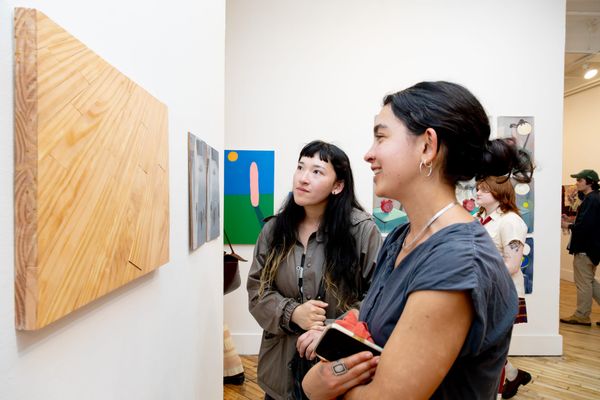
Amid the current debates roiling public discourse, Lemay believes that a balanced inspection of the images that resonate with us is a perfect way to confront sensitive issues productively. “There are some tricky topics that [the featured artists] have addressed,” she says, including “issues of race, issues of gender. And it’s always nice to get into those topics—which have so much meaning for so many different people—through an art object.”
The use of art objects, she says, is an effective way to catalyze dialog. “You’re talking about an object someone else made,” she says, “but you can use that object to query and explore different ideas or issues that otherwise might have felt too loaded or tricky to talk about.” Portraits tend to be deeply personal as well; discussing an individual artist’s perspective rather than an abstract topic like immigration policy forces debaters to consider the humanity underlying opposing arguments.
- Good luck trying to erase artist Steve Locke, he’s not having it, and Adrian Walker of the Boston Globe explains why:
Locke is an African-American artist, who is also one of the city of Boston’s current artists-in-residence. In January, he wrote an intriguing proposal for an installation addressing the tragic origins of Faneuil Hall, a gift from a merchant — Peter Faneuil — who made part of his fortune from the slave trade.
At the time Locke made his proposal, he was unaware that there was a campaign to rename Faneuil Hall. But his idea — which has been embraced by City Hall — has collided head-on with the protests to rename the space. On social media, particularly, Locke has been denounced for somehow undermining the notion of stripping the slave trader’s name from the landmark, and accused of providing political cover to Mayor Martin J. Walsh.
Those charges are fact-free, but they open a window into what sometimes passes for political discourse in this town. He’s right: We should be having a debate over how to come to terms with Boston’s Colonial (and slave-connected) history. Instead, it has immediately degenerated into a food fight over who is in the pocket of whom.
- Some of the greatest works of Chinese art keep getting brazenly stolen from museums around the world. Is it a conspiracy?
- Writing about the Burning Man exhibition in DC, Jillian Steinhauer says in The New Republic:
Burning Man didn’t start in the desert, but there’s a reason it has thrived there: Miles of parched earth make for a perfect blank canvas. As Doherty writes, “In a place with nothing, anything seemed like everything.” At the heart of Burning Man—not just the artworks but the entire festival—is its ability to inspire in attendees a combination of awe and pride: We made it. Look what we did. Look at what we’re capable of. There’s an earnestness to this sentiment that’s both admirably pure and grossly myopic, as if Burners were the only ones ever to have built a city, experimented with alternative models of living, or spent time in the Black Rock Desert.
This is the root of so much of the self-congratulatory language that can make the festival seem insufferable to those who’ve never been. “You are the hope of the human race,” reads an “award of excellence” given out by a pair of Burners to other attendees in 2007. “Who would do this? We could let our imaginations run wild—who had ever done it in the history of mankind? It felt like glory,” Larry Harvey says in Doherty’s book. The pioneer-savior message gets even more muddled when it’s turned into a commodity, as in the gift shop of the Renwick during No Spectators. There, for $129.99, you can buy a necklace that boasts the word ego in large gold letters. Is the flaunting of one’s ego meant to be a good thing? How do the Burning Man principles of “communal effort” and “radical self-reliance” align?
- We wrote about the toppling of the infamous “Silent Sam” statue on the campus of the University of North Carolina, but did you know it’s history? Writing for Forbes, Kristina Killgrove explains:
“Silent Sam and other Confederate monuments erected during Jim Crow represent white Southerners’ efforts — and specifically efforts by white Southern women in groups such as the United Daughters of the Confederacy — to revise Civil War history,” UNC history graduate student and Silent Sam sit-in member Jennifer Standish tells me. Nearly 50 years after the end of the Civil War, dozens of Confederate statues were erected around the U.S., but particularly in the South.
RELATED: This was the speech read at the inauguration of “Silent Sam,” and it’s a doozy of white supremacy.
- I love vintage art reviews that get it wrong, like these mixed reviews of Andy Warhol’s Campbell’s Soup cans:

- Priscilla Frank of the Huffington Post took her muppet boyfriend — yes, you read that right — to a new film called The Happytime Murders, which is directed and produced by Brian Henson, son of Jim. She writes:
A few years ago, I ordered my boyfriend a make-your-own Muppet designed specifically to look like him. The gift was, in all honesty, as much for me as it was for him. I love his face. Why not get a second, and make it fuzzy?
My Human Boyfriend and Puppet Boyfriend have their differences. One is made of flesh, the other fleece. One has a pale complexion, the other a rubber duck yellow. One is chatty, the other demure. I can tell both are very smart (from their glasses), but until recently, only one of these boyfriends had ever taken me out publicly for a proper date.
That changed this week, when I learned of a screening of a raunchy comedy in which humans and puppets co-exist, solve crimes and have weird inter-species sex. It was the perfect opportunity to take Puppet Boyfriend on our first official outing.
- White Supremacy in heels? Rachel Cargle writes about “tone policing to whitesplaining, the liberal white women’s feminism is more toxic than they realize,” and continues:
Instead of sharing in the outrage of Nia’s brutal murder, they came with fury for being tagged in a post that they felt challenged their own perceived feminist accomplishments. There were grand displays of defensiveness, demands that they be acknowledged for all the things they had done for black people in the past, and a terrifying lashing out that included racial slurs and doxing.
The fragility of these women was not a surprise to me. In a crucial moment of showing up for our marginalized community, there was more concern about their feelings and ego as opposed to the fight forward for women as a whole. What could have been a much-needed and integral display of solidarity and true intersectionality quickly became a live play-by-play of the toxicity that white-centered feminism can bring to the table of activism.
- Taylor Lorenz thinks posting sponsored content on Instagram is the new summer job. She writes:
Indeed, according to teens, all you need to do to make money this way is make at least one of your Instagram accounts public, amass a thousand or so followers (an easy threshold to meet), and reach out to brands you like on Instagram. If you have enough followers, the brands—typically small clothing and accessories start-ups aimin
g to court Generation Z—will even come to you.
- There are nuclear weapon nerds? Of course there are. Paddy Johnson is on it:
The photographs of nuclear tests included in the show were conducted during the arms race that followed the second World War between Russia and the United States. In 1949, only four years after the World War II had ended, Russia detonated its first atom bomb. Both governments invested heavily in the development of these weapons, and up until the end of the Cold War in 1987, fear of mutually assured destruction was a part of daily life for Russians and United States citizens alike. This context is only alluded to in the exhibition, though recent geopolitical developments remind of that era,
from Trump’s regular taunting of North Korea last year, to the 2014 U.S. taunting by Kremlin appointed newscaster Dmitry Kiselyov. Russia, he reminded viewers, is “the only country in the world capable of turning the U.S.A. into radioactive dust.”
Perhaps because these images focus on the explosions and their cultural impact, none impart the destructive effect the bomb had on the people living in Hiroshima and Nagasaki, adding to the level of remove. In his Pulitzer Prize winning book, The Making of the Atomic Bomb, Richard Rhodes dedicates no less to 19 pages to first hand accounts of the devastation in Hiroshima, recounting story after story chronicling men, women, and children whose skin hung off them as if it were a loose rubber glove. “Silence was the only sound the dead could make,” wrote Rhodes in his description of the aftermath. In this show, that mass human suffering is removed, thus allowing the material released by the United States government to retain some of its original purpose as propaganda.
But most Americans are not curtailing their shopping habits. And as consumers demand cheaper clothing, electronics, and other goods, manufacturers are spending less to make them, which sometimes means they fall apart more quickly. The share of large household appliances that had to be replaced within five years grew to 13 percent in 2013, up from 7 percent in 2004. Cheap clothes might lose their shape after a wash or two, or get holes after a few tumbles in the dryer; electronics become obsolete quickly and need to be replaced. While some of this stuff can be recycled or resold, often it ends up in landfills. In 2015, the most recent year for which data is available, Americans put 16 million tons of textiles in the municipal waste stream, a 68 percent increase from 2000. We tossed 34.5 million tons of plastics, a 35 percent increase from 2000, according to data from the Environmental Protection Agency. Over that same time period, the population grew just 14 percent.
- On the 10th anniversary of Georgia’s war with Russia, a Georgian condom manufacturer created this special edition:
A Georgian condom manufacturer marks the tenth anniversary of August war with Russia with this special edition of their product pic.twitter.com/joxGYJuTI6
— natalia antelava (@antelava) August 20, 2018
Required Reading is published every Sunday morning ET, and is comprised of a short list of art-related links to long-form articles, videos, blog posts, or photo essays worth a second look.