Required Reading
This week, whither Warhol, Occupy Anish Kappor, Crayola-fication of colors, .art domain grab, deep-fried electronics and more.

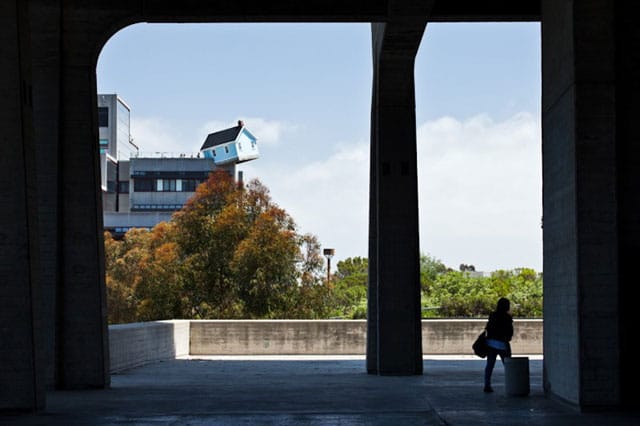
This week, whither Warhol, Occupy Anish Kapoor, Crayola-fication of colors, .art domain grab, deep-fried electronics and more.

Should we get over Warhol? Jonathan Jones appears to think so, and I tend to agree since he dominates so much of the lazy art making that goes on nowadays. He writes:
Turning art into a mass-produced commodity, and the artist into a brand identity, Warhol at his worst anticipated what have become routine artistic strategies in a smoothed-out global art machine.
Occupy Anish Kapoor has begun. The mega-rich artist has bought a house in London and has left it empty for years. Not everyone appreciates this:
A homeless man who has joined the group in the property said: “How can someone do this? How can you own a place like this and not even use it when there are people sleeping in the streets?”
A fascinating article about the role Crayola crayons had on cultural perceptions of colors. They have contributed to our spectral homogeneity:
There are plenty of other languages that blur the lines between what we call blue and green. Many languages don’t distinguish between the two colors at all. In … the Thai language, khiaw means green except if it refers to the sky or the sea, in which case it’s blue. The Korean word puruedacould refer to either blue or green, and the same goes for the Chinese word qīng.
Remember the woman who gave a Clyfford Still painting a lap dance? She is now saying that the bath salts made her do it. Good one.
E-flux has, along with a number of companies like DeviantArt, applied to develop the .art domain on the internet. I’m not sure why people would migrate to another tld since .com, .org and other top level domains are doing just fine. We all know how well .tv, .biz not to mention .us has done. I do like the out of the box thinking of this idea though. AFC has an opinion on the topic, though the comments on that post are where the discussion gets really interesting.
This is thought provoking, if a little scary, since it appears that private museums are running circles around public museums. Ugh. From Artnet:
During a conversation with art advisor Josh Baer at Art Basel last week, [Jeffrey] Deitch described the burden of raising money from museum patrons, who, unlike gallery clients, have fewer tangible incentives to give. “At the gallery, I was in the fortunate position that I had things people wanted,” he said. But when he got to Los Angeles, “people wouldn’t take my phone calls because they figured ‘he’s going to ask me for money.’” Plus, many philanthropists prefer giving to more urgent causes than art. “People say it’s more important to give to hospitals or needy children than the museum,” he said.
This is fun compilation of exhibition reviews for famous artists. André Breton once wrote the following about one of Mexico’s most famous artists, “The art of Frida Kahlo is a ribbon around a bomb.” Great line.
There may have been 306 booths at this year’s Art Basel, but one gallery brought in 12.5% of the whole fair’s value. I bet you can guess which one — Gagosian. Though how reliable are these numbers? No one publicly makes the actual price they sell works publicly available.
In this video, The New York Historical Society explains why the streets of Lower Manhattan are not in a grid, and why Broadway is at an angle.
Henry Hargreaves’s latest art projects involves “deep fried electronics.” Wired explains:
The harmful chemicals in obsolete and discarded gadgets collect in dumps (usually in Asia) with toxic consequences for the environment, like so much artery-clogging fat sediment. “I’m as guilty about getting excited about the latest Apple product,” says Hargreaves. “I see a connection between tech and fastfood culture, both are fetishized, quickly consumed then discarded.”