Required Reading
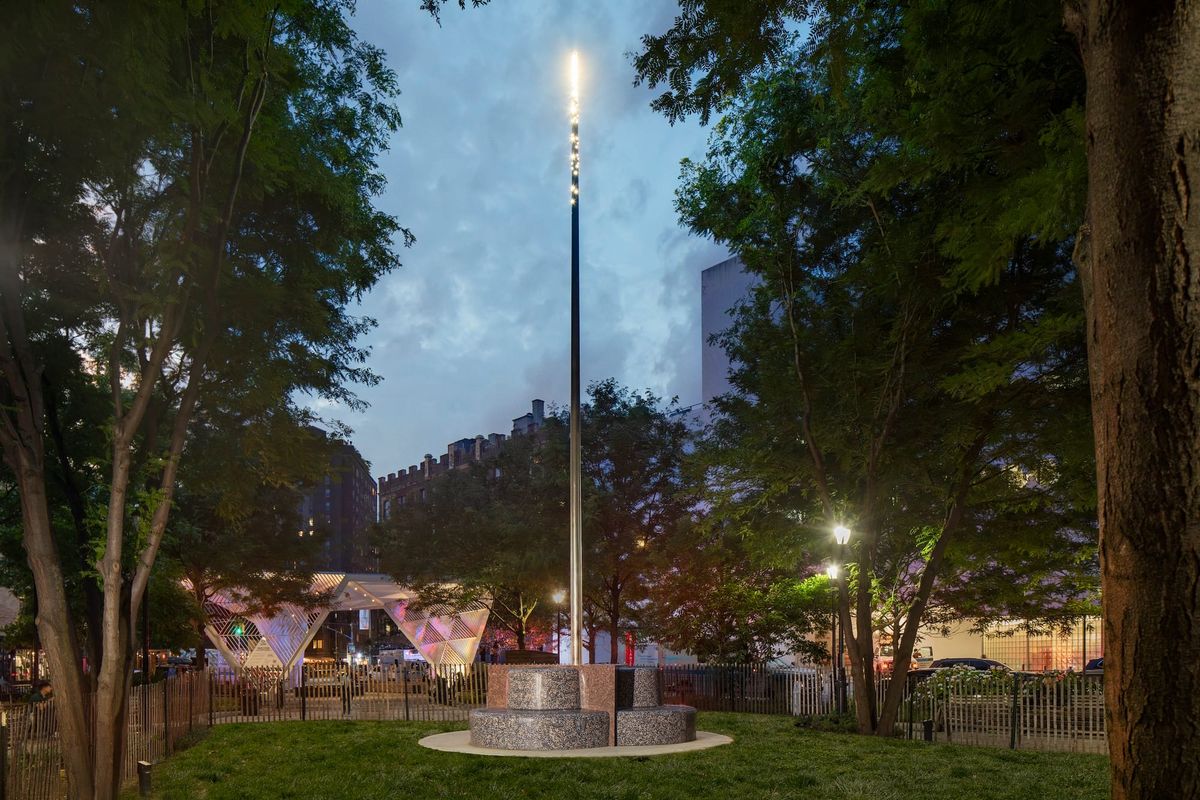
This week: Scott Burton’s last sculpture, remembering Lebanese environmental activist Mona Khalil, AI slop in art journalism, NYC’s rollerskating queer icon, and more.

As Trump continues to threaten to seize Greenland, historian Andrew Holter considers the political implications of Rockwell Kent's 1930s paintings of the landscape and Indigenous communities of the island for the Nation:
Kalaallit Nunaat, as the land is called in the Kalaallisut language, was no blank canvas or mere backdrop to exotic adventure. The longer Kent spent there, the more sincerely he sought to understand the place from the perspective of his neighbors. That effort was fraught and maybe futile, but their influence ensured that his paintings would amount to commentaries on the question of Greenland’s future—and that later paintings, like the WPA mural Mail Service in the Tropics, would carry more explicit anti-imperialist messages. If Americans didn’t see Kent’s Greenland canvases as such at the time, we’d do well to see them that way now: as late-arriving testimony against the imperial vanity of the United States and Denmark alike.
A sculpture of Patrice Lumumba has come to life at the World Cup, thanks to Michel Kuka Mboladinga. The superfan spends DR Congo's matches in statuesque poses to honor the assassinated revolutionary, Hannah Jackson writes for Vogue:
Though Lumumba favored traditional dark suits, Mboladinga’s colorful clothing is an intentional diversion from his muse. He often sports the colors of the country’s flag. At the Congo vs. Botswana match at the Africa Cup of Nations in December 2025, Mboladinga wore a spirited yellow striped blazer over a blue-and-white gingham shirt with a vibrant blue satin tie, his pocket square featuring the flag’s sky blue, sunny yellow, and bright red. For a later match against Algeria in January 2026, he paired a more muted blue blazer with a butter yellow shirt and cherry red trousers."
“I stand motionless because I believe it gives the team emotional stamina,” Mboladinga told the Wall Street Journal. “Just as Lumumba sacrificed his life for our country, mine is a small price to pay because of how deeply I care about this team.”
Amidst an ebola outbreak in the country, all travelers from the Democratic Republic of the Congo are required to quarantine for 21 days before entering the United States. Mboladinga has become so important to the Congolese team that the players lobbied President Félix Tshisekedi to make him a member of their official delegation, allowing him to isolate in Belgium with the team and official memebers of the Fédération Congolaise de Football Association.
Dan Friedman and Abby Vesoulis of Mother Jones discovered that the National Park Service's reinstatement of a statue of a slave owner that was taken down in 2020 cost $527,000 in tax dollars:
The documents also show that the agency initially awarded the contract for refurbishing all of Freedom Plaza last December, then added the Rodney statue in January in a no-bid process. The agency modified the existing contract, conducting no competitive bidding, and agreed to the sharply higher price because—as with much of the administration’s “beautification” effort connected to the anniversary—it was in a rush.
“The work was expedited to ensure it is done before our nation’s 250th,” an Interior Department official told Mother Jones. “All of the projects throughout DC are set to be done before the Fourth, so they have to be done on a rolling basis.”
Shout-out to Jordan Eddy, Lauren Tresp, and Natalie Hegert of Southwest Contemporary for calling out a widespread phenomenon: AI slop websites that plagiarize articles from real publications. In case you need another reason to support independent art journalism, they explain:
We swiftly identified a doppelgänger of another Glasstire story, a clone of a Hyperallergic review, and an ape of a piece from The Art Newspaper—each accompanied by an unrepresentative AI image. All of it is under the banner of a three-starred American flag, part of the site’s bizarro patriotic branding. Our investigation was like a special episode of Black Mirror for contemporary art nerds.
Smith and another editor are currently churning out five or six slop articles every day. Our publisher Lauren Tresp puzzled over the fact that the site doesn’t appear to run ads—What are they even getting out of this?—and then she found an AI-generated Facebook video that revealed the underlying scam. ArtReview USA appears to be tied to a Bulgarian marketing firm that’s asking artists to pay 300 Euros to be profiled on the “prestigious American platform seen by curators and collectors.” The site’s lifted and warped content is meant to lend it art world legitimacy.
The Israeli military killed 76-year-old Lebanese turtle conservationist Mona Khalil, whose "Orange House" on the beach stood as a symbol of hope. Defector's Sabrina Imbler writes about her legacy of climate activism and refusal to abandon her home:
On the day Khalil died, Israel and Hezbollah agreed to a ceasefire. But such agreements have never stopped Israel from bombing. Since a ceasefire was declared in the Gaza Strip in October 2025, Israel has violated the agreement at least 3,300 times, per Al Jazeera. It is now turtle nesting season, but it is unclear when the volunteers Khalil trained will be able to return to the beach to keep watch as the turtles enter the world in the most vulnerable stage of their lives.
Conservation takes many forms. It can involve political advocacy or laboratory research. The conservation work Khalil did might best be described as labor. Each day during sea turtle nesting season, which spans roughly May through October, Khalil woke before dawn to walk the beach. She placed metal grates above any eggs she found to secure them from hungry foxes, dogs, and crabs until they hatched. She watched for the tracks of adult turtles and moved eggs away from the surf in times of high-tide flooding. She was trained by scientists from the Mediterranean Association to Save the Sea Turtles (MEDASSET), presented her data at conferences, and shared it with conservation groups. She held beach cleanups, did television interviews, and wrote monitoring guidelines for future volunteers. She invited families vacationing in the area to join her on her morning patrols and taught them about the turtles, their habitat, and the threats they face.
As abusers and war criminals govern the United States, anti-ICE protesters from Texas have been sentenced to between 50 and 100 years in prison in a brazen attempt to silence dissent. Sam Levine has the story for the Guardian:
“Most often, judges will sentence defendants for separate counts concurrently. Here, it appears that the judge stacked the sentences for each count consecutively. I would have expected lengthy sentences here, more in the ballpark at 15 to 25 years, but nothing like 50 to 100 years,” she wrote in an email.
The Trump administration praised the sentences.
“The sentences handed down today make clear that Antifa terrorists who attack law enforcement and federal facilities will face swift and uncompromising justice,” Todd Blanche, the acting attorney general, said in a statement. “Their violent extremism has no place in our country, and the Department of Justice will continue to aggressively investigate, disrupt, and prosecute those who threaten law enforcement officers or undermine the rule of law.”
Writer and historian Kaitlyn Greenidge spoke with the directors of the classic queer film By Hook or by Crook about representation and a bygone era of San Francisco for Harper's Bazaar:
Harry, you had a quote that I loved where you said, “Representation always fails.” And then you were like, “Well, I don’t know if people are ready for that conversation.” But I want to have that conversation because I think that’s really true. Representation always fails.
HD: To start, I’d say that I suppose I’m not against explanation in every case. I guess it could happen that a moment of explanation—which is also a kind of reduction—is important and moving. I call it “bridging,” and a few people are great at it, more or less. God bless ’em, really. But having said that, I will also say that the pressure to make oneself legible is heavy. Édouard Glissant refers to it as making yourself “transparent.” Capitalism says, “Help us slot you in, make it easy for us to exploit you. Provide a figure we understand.” And in return, they promise to supply “rights,” privilege, security, which has heretofore been withheld.
To remain opaque, I mean, to remain irreducibly specific—in other words, to not explain—is to hold on to a kind of power. Especially for artists, but probably just anybody, if you think about it. And that’s what we were doing with By Hook or by Crook.
For JSTOR Daily, curator and librarian Emilie Hardman delves into the fabulous archive on Rollerena Fairy Godmother, a rollerskating AIDS activist and queer New York legend:
By 1982, a piece in the Philadelphia Gay News assumed that “most New Yorkers, gay and not” already knew “what to say to a man clad in a frilly gown your great-grandmother would have thought chic as he’s whizzing by on roller skates,” and it was: “Hi! Rollerena!” Famously skating through gay neighborhoods and appearing at the city’s early Pride events, then known as Christopher Street Liberation Marches, Rollerena was a familiar figure in queer New York. She also appeared at Easter parades and was waved in past long lines by bouncers at discos, including the incomparable Studio 54. In a 1981 interview, Rollerena explained that her “purpose in life is to be a good fairy godmother … to bring love, to bring happiness, to unite people in a common cause.” That unifying spirit is one of the archive’s clearest points. Rollerena’s audience was never narrowly defined—her world intentionally included gay men, lesbians, transgender people, drag queens, activists, partygoers, and curious strangers alike.
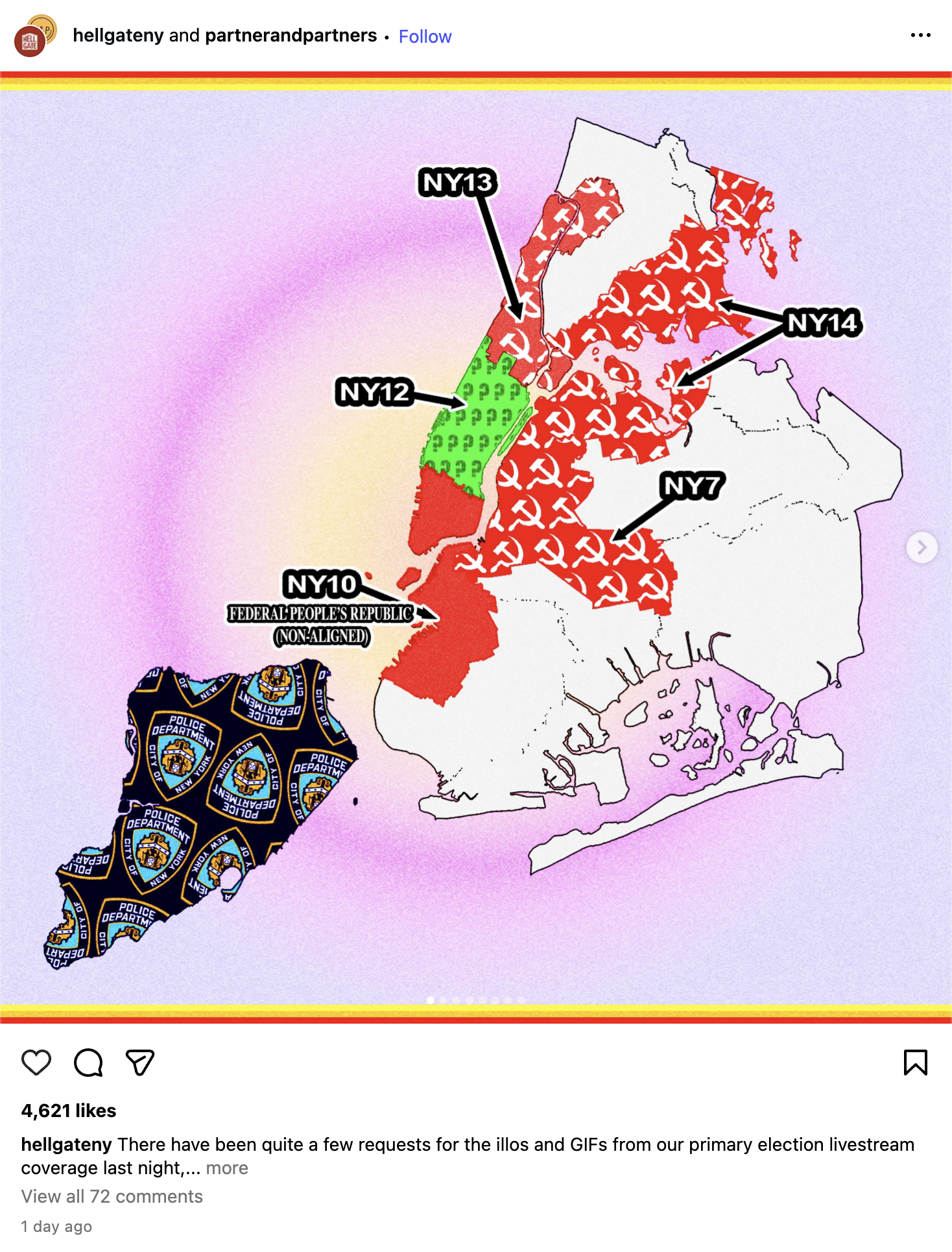
New map of the city just dropped! Partner & Partners design studio ate:
It's just a skit it's just a skit ...
@bentonmcclintock This is how I see LA #JOKE #vogue #friends #lacore ♬ original sound - Benton McClintock
Beach bod loading:
@stellatssssss let’s all take notes 🥹📝
♬ original sound - Alyssa Stellato
Required Reading is published every Thursday afternoon and comprises a short list of art-related links to long-form articles, videos, blog posts, or photo essays worth a second look.