Sable Elyse Smith Reveals the Shapes of State Violence
The artist’s critique of the prison-industrial complex simultaneously deepens and skewers the legacies of Minimalism.

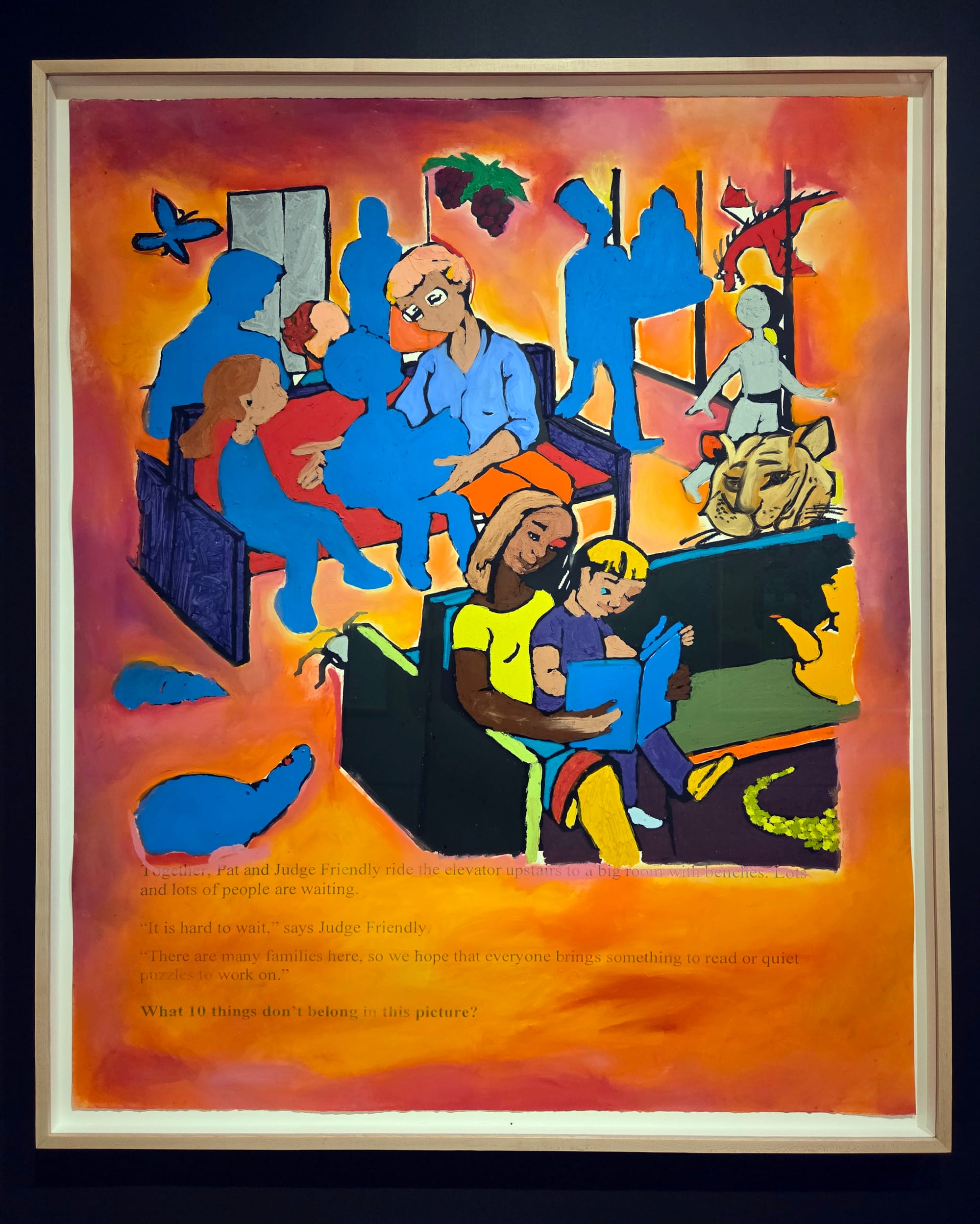
AUSTIN — A sustained critique of the United States carceral system runs through Sable Elyse Smith's work. Clockwork at the Contemporary Austin, the culmination of her winning the 2026 Suzanne Deal Booth / FLAG Art Foundation Prize, consists mainly of paintings appropriating prison coloring books for visiting children on the first floor, and large-scale sculptures and installations on the second. Seen as a whole, Smith’s work co-opts Minimalism’s repetition and seriality as a metaphor for structural injustice, drawing attention to the rhythmic qualities of technological and administrative tyranny.
The coloring books Smith adapts were originally created to help children emotionally absorb the violence of incarceration. Smith’s transformations seem to liquefact their pictures and texts so that they melt the foundations of the institutions they represent. Two works share the same page design, a waiting room of a courthouse filled with families as well as an assortment of creatures, asking — absurdly — “What 10 things don’t belong in this picture?” One version of Smith’s coloring scheme blocks in a select number of the human figures in solid blue, turning them into police officers as omnipotent institutional authority, while the other version places x’s and o’s across figures and faces, referencing the oppressiveness of such spaces. Smith rightly shifts the ludicrous question of belonging into a critique of recurrent power structures.