Students Invent Way to Light-Paint in 3D
Two-dimensional light painting is so passé.

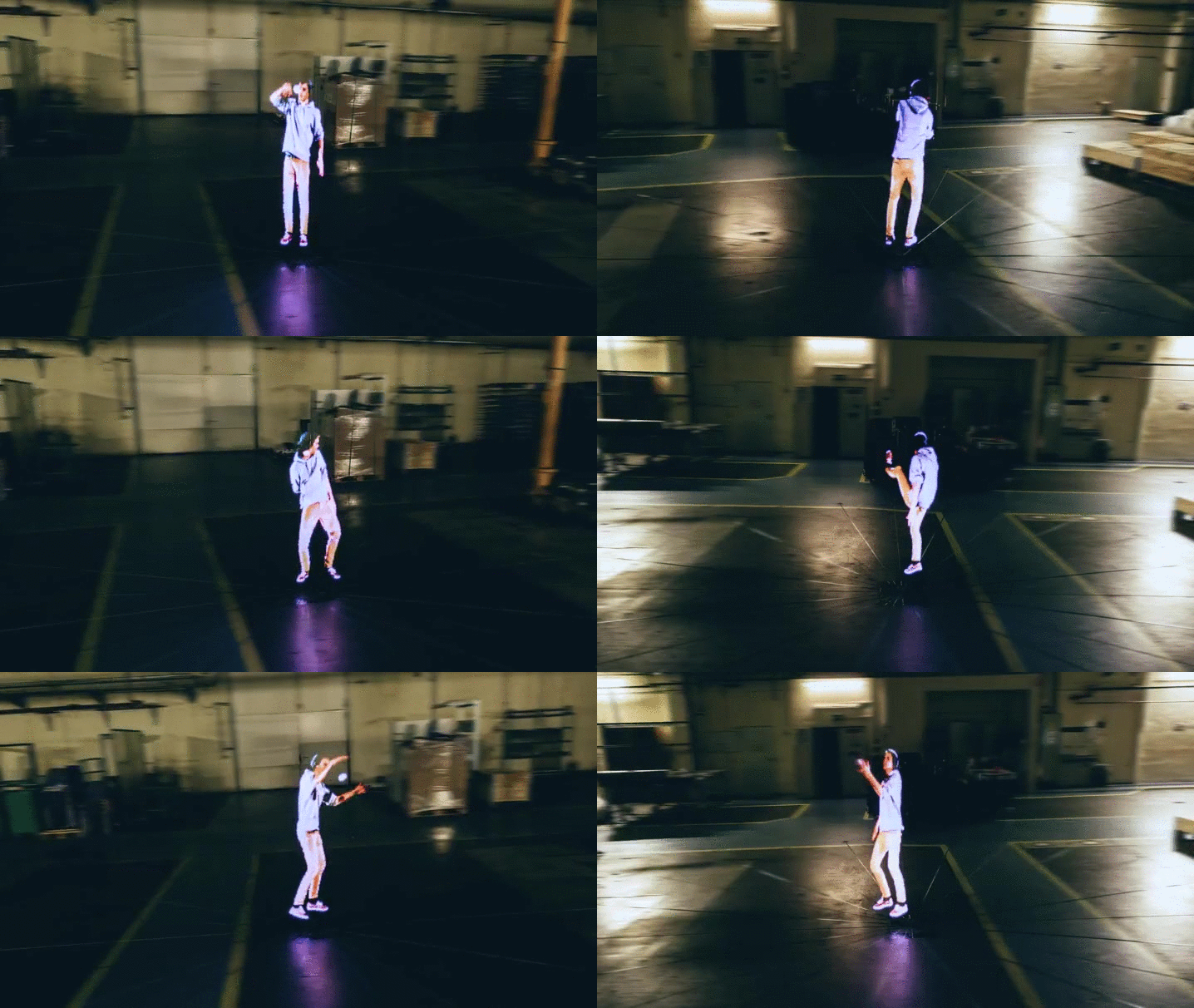
Two-dimensional light painting is so passé. A new technique invented by Vienna-based film production company Film Spektakel combines traditional light painting, stop motion, and hyperlapse to create 3D-animated light paintings. Dubbed “holopainting,” after the resemblance of the results to holograms, it’s not to be confused with the holopaintings in the Star Wars universe, though we suppose you could create your own holographic Princess Leia with the technique.
Created by Thomas Pöcksteiner, Peter Jablonowski, and Markus Fic, holopainting was part of a graduation project at the University of Applied Science St. Pölten. Here’s how it works: The designers built a massive 3D scanner using 24 Raspberry Pi computers with webcams arranged on tripods in a circle around a room. A man stood in the middle of the circle, playing with a ball, while the cameras photographed him from 24 different perspectives. In order to record his motion, the cameras were programmed to shoot at a delay of 83 milliseconds. Then, to prepare the pictures for being painted with light, the trio spent several days cutting the figure out of each photograph and placing it against a black background. Using the pixelstick, a computerized light-painting stick equipped with 200 LEDs, they “painted” each photograph.
When they projected these light-painted photographs from the exact positions of the original cameras, what resulted was a glowing 3D animation of the original subject. Once this animation stood shimmering in the middle of the room, they did a hyperlapse around the “world’s first holopainting,” as they called it.
The technique is impressive, but it lacks the spontaneous elegance and versatility of low-tech 2D light paintings by the likes of Picasso. To try this at home, you’ll just need a Pixelstick, 24 Raspberry Pis with webcams, a 48-Port-Switch, 375 meters of LAN cable, a Canon 6D, and a Sachtler Ace Mand, plus plenty of programming knowledge. Easy!