The Case for Palestine at the Venice Biennale
Does the exhibition prefer to destroy its long-standing significance for artists, curators, and art workers than to hold the moral clarity that this moment is asking from us?
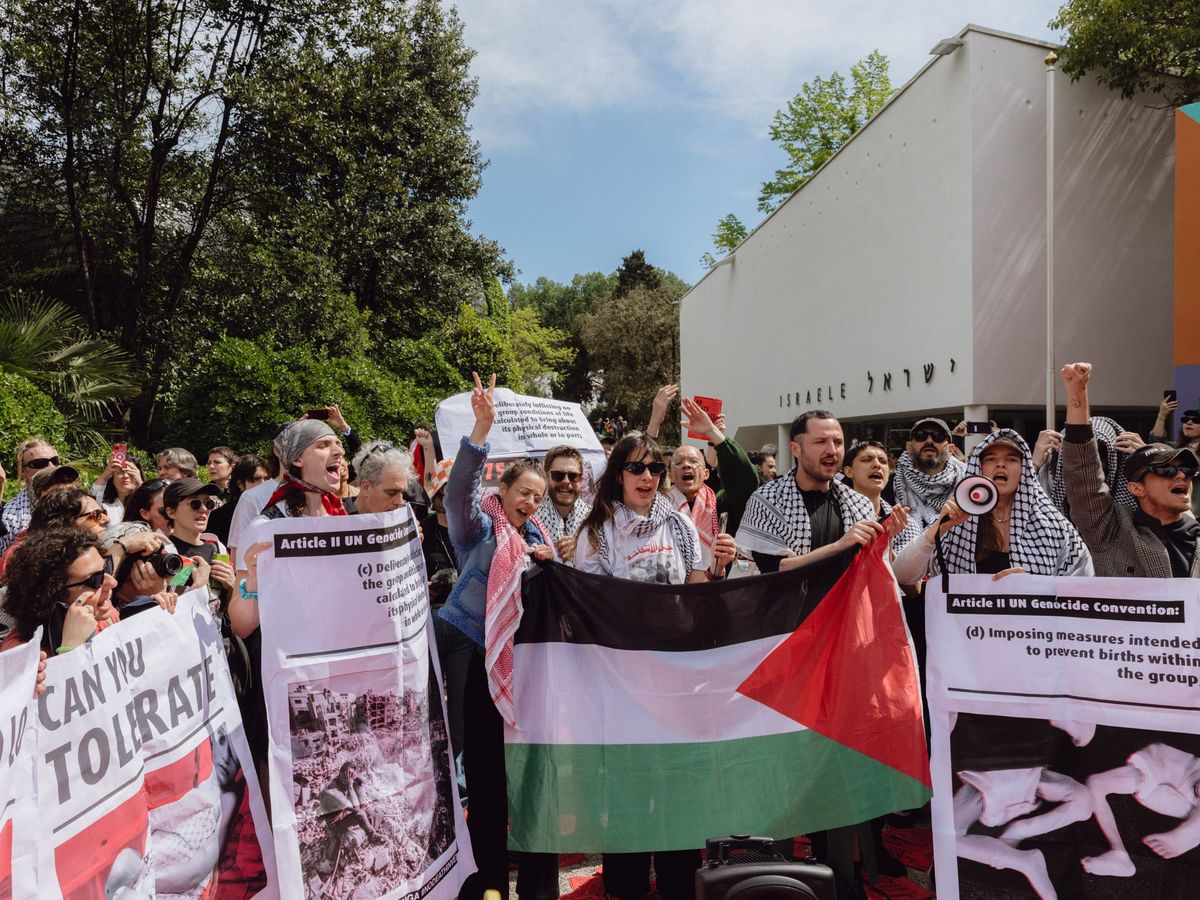
In May, the 2026 Venice Biennale, curated by the late Koyo Kouoh, will open with the theme In Minor Keys. In December 2025, the Israeli Ministry of Culture announced that Belu-Simion Fainaru will be representing Israel at the 61st International Art Exhibition. The Israeli Pavilion in the Giardini remains closed, supposedly for renovation, but the Biennale has made a very deliberate and demonstrative choice to allocate Israel a space in the Arsenale while its national pavilion is shut, instead of forcing them to seek an alternative space in the city or, like last year, during the Venice Biennale of Architecture, to not participate at all.
In other words, the current administration of the Venice Biennale of Art is actively ensuring the presence and participation of a state that was founded on the ethnic cleansing and illegal occupation of Palestine — a state that is currently 27 months into conducting a brutal genocide in Gaza. A state that has killed, maimed, and destroyed indiscriminately, with at least 72,045 people dead, many tens of thousands more missing under the rubble, some evaporated by thermobaric weapons, their remains scarcely identifiable, and over 80% of buildings and infrastructure destroyed or damaged with the clear intent to render Gaza uninhabitable. A state that is escalating its violent military occupation of the West Bank, and is continuing a pattern of repeated air and ground attacks on Lebanon’s sovereignty. A state that is engaged in over 2,000 violations of the so-called UN “ceasefire” agreement since November 2025, while continuing to murder and restrict aid. Let’s not forget Israel is also the subject of ongoing genocide proceedings at the International Court of Justice, while the UN Security Council endorses the grotesque farce of Trump’s "Board of Peace."
Does every institution prefer to destroy its long-standing significance for thousands of artists, curators, and art workers than to hold the moral clarity that this moment is asking from us? This is a naive question in many respects. Cultural institutions built on the ideology and preservation of so-called Western democracy have repeatedly demonstrated failures of ethical leadership.
We understand that the mechanisms of formal justice have been neutralised and therefore, as art workers, we resort to the tools at our disposal in order to refuse the normalization of the atrocities that continue with impunity. In this refusal, we look to art’s potential to have the capacity to be a space for revolutionary thinking. Palestinians show us the way, as do many of our predecessors, writers, artists, and thinkers whose shoulders we stand upon.
The hypocrisies, contradictions, and paradoxes that capitalist market structures have thrown up as established culture have revealed themselves to be inadequate and obstructive to answering this moment seriously. Now that we are asked to look away from genocide, what lengths will we go to, to maintain the structures of success and recognition that many of us are so deeply invested in?
In May 2022, artist Tai Shani wrote in Art Review: “The only meaningful action artists have in the face of huge networks of power and systemic injustice is the right of refusal. Especially when all the structures that benefit from not only our work, but also our politics, leave us ethically vulnerable. By remaining silent, on the other hand, we are suggesting that Palestinians deserve to live dehumanised, torturous lives under occupation, quietly and in absolute submission.” This right of refusal remains one of our only tools in the face of fascism, and this should be the bare minimum. If we do not refuse now, we will be made to refuse by the conditions of fascism, which will sideline, suffocate, and defund practices that do not align with its aims. This is already happening, and we will be inevitably changed by this — our desires shaped by brutality, desensitised and sanitised to fit an agenda that is hostile to our positions and our work.
The list of cancellations, firings, rejections, and witch hunts that have been orchestrated to silence anything and everything to do with Palestine — Palestinians, their culture and lives, which continue to be annihilated under the cover of this so-called “ceasefire” — has been recorded and exposed. Yet, for now, it has succeeded in creating a suffocating silence and wilful ignorance, often justified through erroneous accusations of antisemitism.
To feel fear is not a paranoid delusion. The catalogue of retaliation for the most minor expressions of solidarity has proven that. It is a calculated application of power that creates a climate of fear — fear of losing livelihoods, reputation, and, most crucially, the fear of not being able to live a life you have built for yourself, doing what you love. This fear’s darkest triumph is how morality becomes a private practice and power decides the only public truth: how it isolates resistance by individualizing the risk, making it feel impossible to say anything about the cheapening, dehumanization, and defiling of life — life that artists are obsessively concerned with representing.
History shows that when formal justice is suspended, there is a transfer of responsibility to the civilian, the worker, the writer, the artist, the student, etc. Post-WWII, post-Holocaust structures and institutions were erected by “liberal democracies” to safeguard the world, in the wake of atrocities vowed to happen “Never Again.” These have since been eroded, discredited, and destroyed. The executors of these responsibilities, the custodians of formal justice, are themselves being sanctioned, their condemnations tempered and muted to allow the smooth flow of geopolitical power.
This era of ruthlessness and impunity is exposed not as a failure of the system, but rather the revelation of the system operating exactly as designed — one that is now challenged by a perpetrator that is the very embodiment of Western, capitalist, colonial, and supremacist imperatives. The application of law is revealed as uneven, manipulated, and ultimately just protocol for managing the appearance of order. This is the ideological framework of Western domination: imperial and genocidal at its core. That this colossal catastrophe in Gaza has been reduced to phrases such as “live-streamed genocide,” and images (there have been so many that have carved a new visceral threshold each time deeper into the void of the imagination) that can wash over you smoothly is a central symptom of that failing. It appears as a numbness, fatigue, and collective aversion to face what that spells for our shared world. It must be confronted because it spells a horrific precedent and permission that is far-reaching and destroys the possibility for any form of social contract. It redefines supposed red lines as nebulous horizons on shifting ground, impossible to orient oneself toward. It mutates the sacrosanct “inviolable rights” into a necropolitical question of grievability, reiterating the core Western categorization of the “human” as a biopolitical relational field.
The most pervasive argument we have received in response to the urgent call to boycott and exclude Israel is, “What about dialogue? How do we get out of this situation if we close off communication with Israeli institutions and potential political allies?” Beyond the moral humiliation of haggling for a middle ground, a supposedly neutral position in the complex facilitation of mass death (which is as ridiculous as it sounds), this hollow argument also neglects the powerful isolating function that boycotts seek to impose: to force actual change because the cost of continuing genocide and apartheid becomes too high for the perpetrator. When the continuation of planned annihilation leads to a profound isolation that is too costly to ignore, it creates the conditions for the only “dialogue” that matters — the one that alters the material calculus of the aggressor.
The current reality — of moral failings that enable general impunity in the face of an absolute betrayal of humanity — brings debilitating shame and psychic injury to anyone who contemplates its consequences adequately. Witnessing a scale of cruelty and indifference fractures one’s foundational belief in a minimum standard of human decency and collective conscience. Wow, this is us!
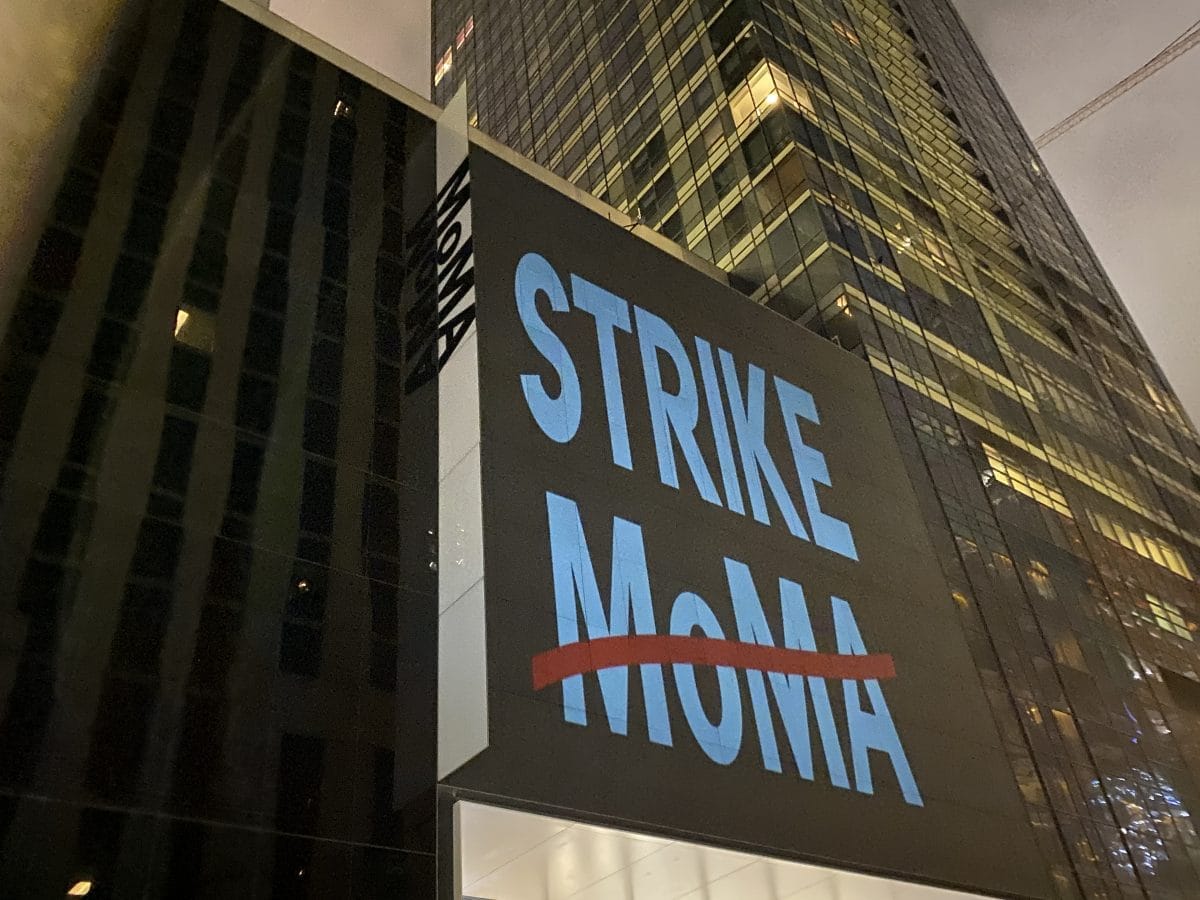
It is also important to reckon with the asymmetrical ground upon which we organize. Our capacity to mobilize collectively on an international scale has been weakened by decades of demobilization within the cultural field. As a result, we are often able only to represent change, rather than organize in ways that transform the material conditions enabling the very politics we claim to represent. This erosion leaves us stunned in the face of these particular machinations of power, but history shows that such moments are often the most fertile ground for the production of political and structural change, along with the important exceptions that continue to emerge: the extraordinary organizing around the Whitney Biennial and groups like Strike MoMA successfully target specific museums and boards; and the successful campaigns against funders such as Strike Outset and No Arms in the Arts, refusing money from companies and individuals invested in the occupation of Palestine.
Giving permission (loudly or in silence) for mass annihilation to continue unabated also legitimates a devastating tool that can be scaled, reconfigured, and used repeatedly. It is hubris to believe these consequences will not find you. After over two years of witnessing the radically unacceptable being established as normal life, it is clear that the strategies mobilized against protesting genocide can and will be used against all dissent. In fact, in the interval between the writing and publication of this piece, active and violent repression has escalated ferociously – against LGBTQIA+ rights, the fight against racial discrimination, hard-won workers’ rights and unionising, reproductive rights, environmental safeguarding, the most basic conditions for life. We all live in the grace of those who fought for these freedoms. It is hard to imagine a horizon where any of these rights would be spared from destruction.
An individual does not represent the state — except in the few privileged contexts where they absolutely do, as is the case for UEFA, Eurovision, the Olympics, or the Venice Biennale. Claiming civilians have absolute immunity from the non-violent pressure of boycott is to demand they bear no relation whatsoever to acts done in their name, funded by their taxes, and enabled by the societal consensus that is expressed in every aspect of Israeli society and culture. The notion that a perpetrator state’s civilian population is damaged more by a boycott than by their own implication in their state’s systemic brutality is dangerous, and ultimately hopeless in terms of imagining change.
A boycott targets the infrastructure of complicity — in this instance, the social and cultural normalization of genocide. A successful boycott campaign creates a level of political risk through widespread, sustained consumer and cultural refusal, which can transform into escalated political pressure and sanctions. These have direct, serious impact on the future of the Palestinian people and on our own, intertwined futures. A boycott is also a form of collective self-defence against being made complicit in crimes, where one’s capacity to act within the realm of civitas is constrained or deliberately curtailed; using personal social and economic power to impose a red line. This is particularly compelling in contexts where national representation forces other participants to share a stage with representatives of a state that is conducting a genocide.
The word "genocide" has become a semantic battleground, for fear, or hope of the legal framework it carries in holding Israel and its allies to account. But this word, and whoever adjudicates its legitimacy, is not our moral imperative to act; it is unnecessary when we have already been witnesses. We have seen with our own eyes the most spectacular horrors of the world.
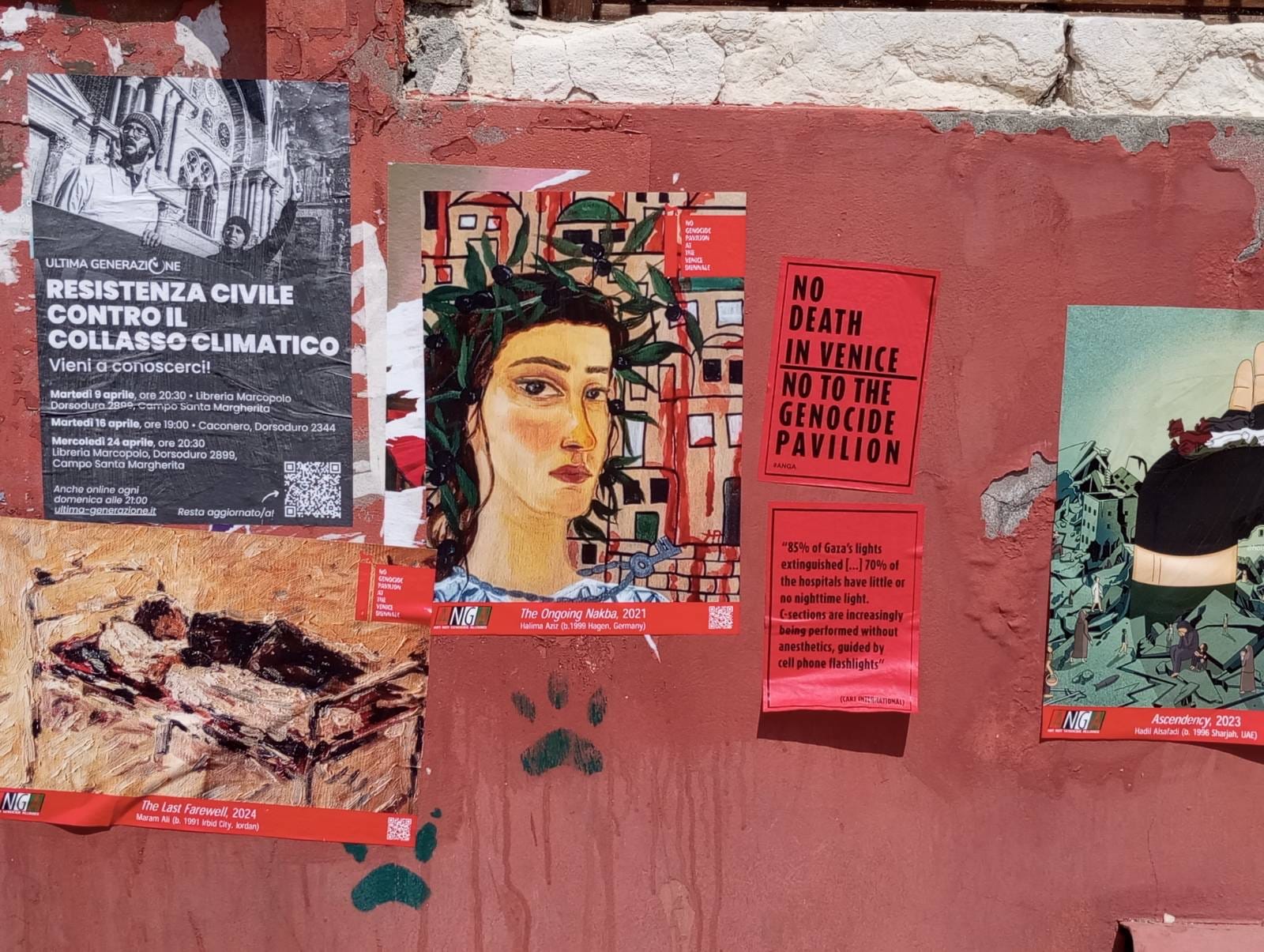
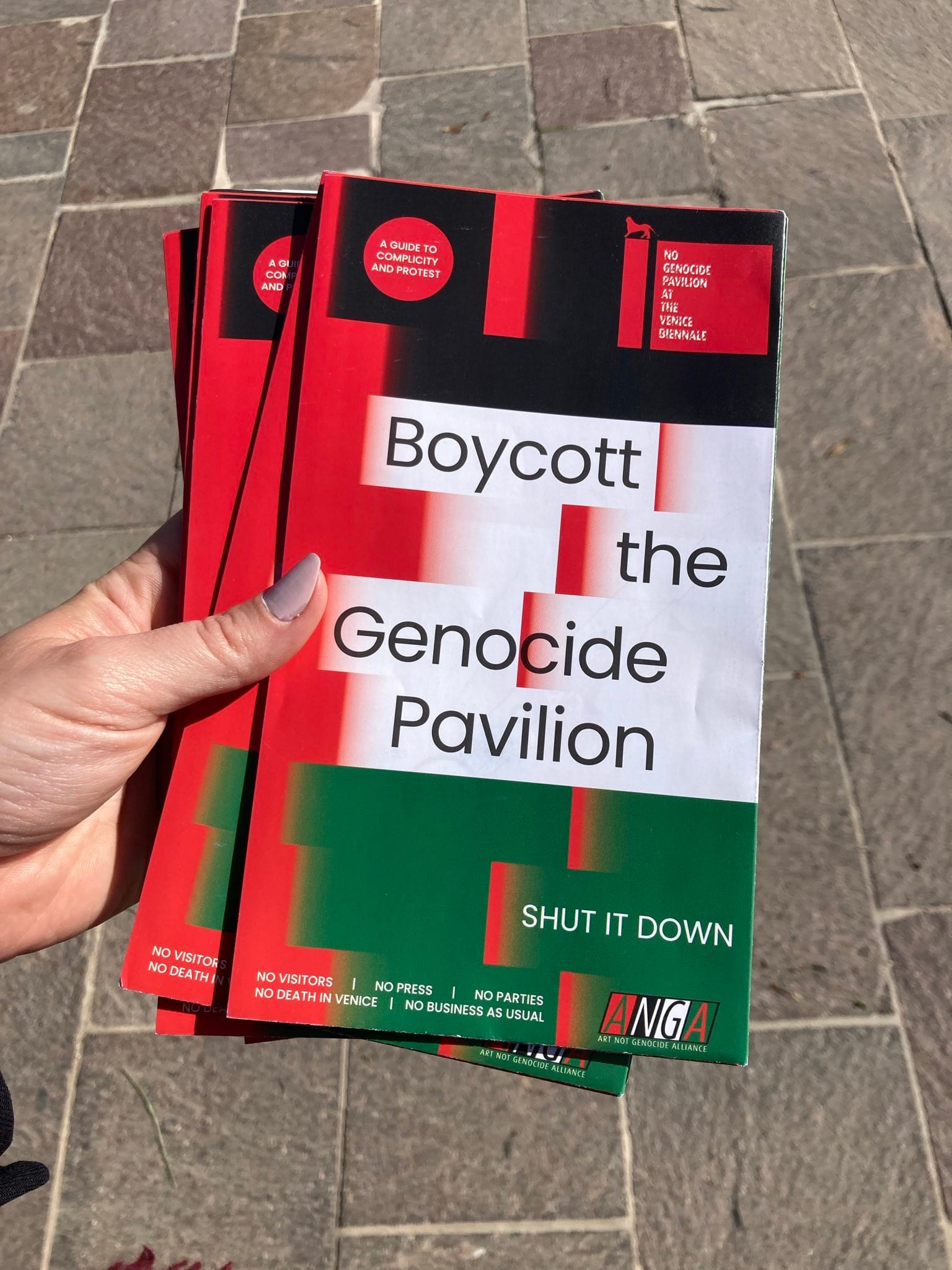
Over the last two and a half years, thousands of artists, writers, musicians, and actors have taken principled positions to address complicity within their fields. At least 1,500 international arts organizations have endorsed the call for the cultural boycott of Israel, become Apartheid Free Zones, and/or endorsed PACBI and the Palestinian Boycott, Divestment, Sanctions (BDS) movement. The Venice Biennale forcefully objects to such exclusion in its responses to the Art Not Genocide Alliance (ANGA) mobilization against the participation of Israel since 2024, insisting that the Biennale is unable to take any such action. But as a microcosm of global politics, the Biennale has, over its 129-year history, consistently functioned as a site of contention, exclusion, and protest, where both state and non-state actors have used the exhibition to enact and contest political positions.
During May ’68, students at the Venice Fine Arts Academy declared, “Venice is infected with capitalism and even the Biennale is a hostage,” as artists and allies occupied national pavilions in the Giardini, turned artworks to face the walls, and unfurled banners opposing the Vietnam War and apartheid in South Africa; the independent “Boycott the Biennale Committee” called for artists to withdraw entirely from the exhibition. In 1970, American artists boycotted the USA Pavilion in opposition to the Vietnam War. Twenty-four of the 47 artists withdrew, framing the boycott as a refusal of the instrumentalization of art as a cultural veneer for “ruthless aggression abroad and intolerable repression at home.” The 1974 edition of the Biennale was explicitly anti-fascist and functioned as a platform for protesting the 1973 Chilean coup. It excluded the Chilean military regime from official participation, and the presentation of exhibitions, debates, and public programs was dedicated to Chilean artists in exile and to declared international solidarity with those resisting dictatorship.
Today, the Venice Biennale refuses to take action or speak out against Israel for its barbaric crimes against humanity, committed in full view of the world. Instead, it offers a form of liberal apathy that operates hand in hand with fascism. History offers art workers clear lessons in how to respond. We are calling on participants in the Venice Biennale to demand that the Biennale does not give cover to genocide.