The US Pavilion Is Taking Online Donations
The American Arts Conservancy, the nascent nonprofit executing Alma Allen’s 2026 pavilion project, said it received no financial support from institutions.

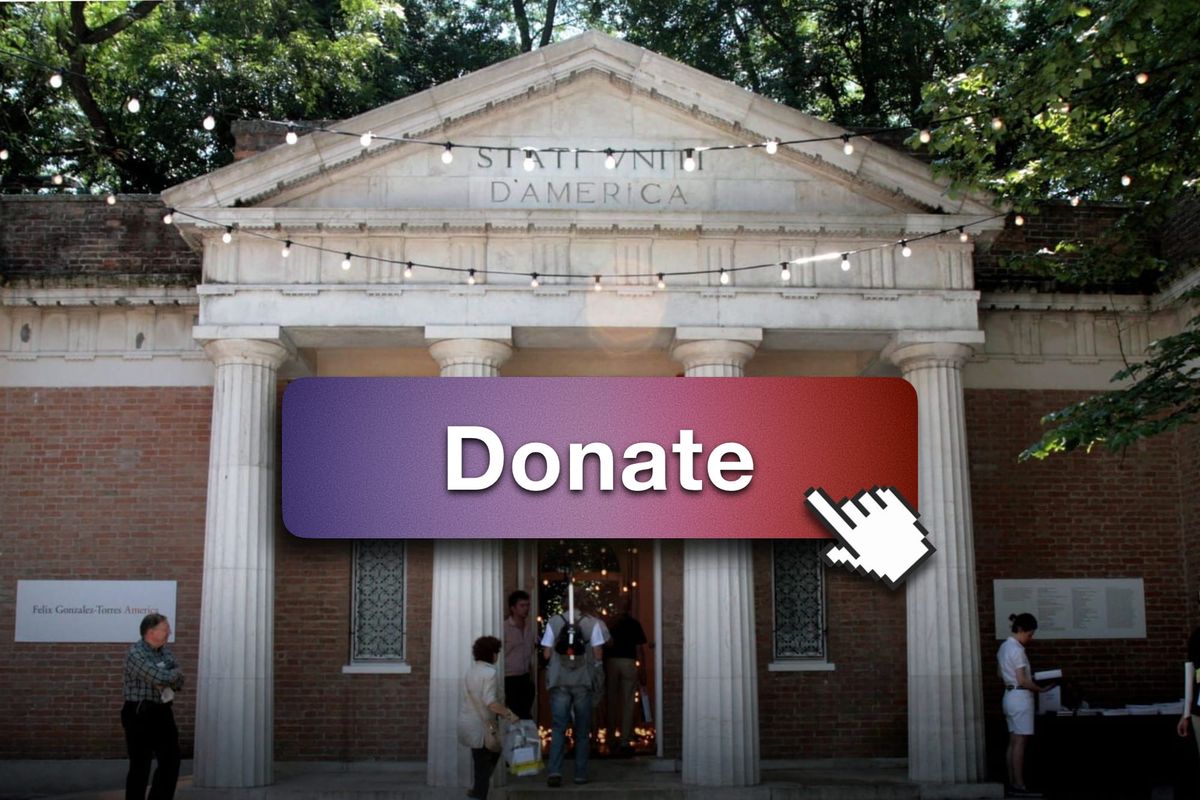
In the past, donors to the United States Pavilion at the Venice Biennale have proudly announced themselves as patrons of the contemporary art world’s most prestigious event. This year, however, under the thumb of the Trump administration’s State Department, the funding for Alma Allen’s national pavilion remains unusually opaque.
Unlike the numerous sponsors that publicly backed Jeffrey Gibson’s monumental 2024 US Pavilion, including the Ford and Mellon foundations, no organizations or individuals have yet to claim any direct funding ties to Allen’s exhibition.
Instead, the American Arts Conservancy (AAC), the year-old nonprofit tapped to execute the 2026 pavilion, is fundraising for the exhibition via a “Support Our Mission” button on its website, inviting anyone on the internet to donate a minimum of $100 toward the project.
As it has in the past, the United States government footed $375,000 of this year’s pavilion cost, but required the artist to secure additional funding because “the total exhibition cost significantly exceeds the federal grant amount,” a State Department spokesperson told Hyperallergic. While the total price of Allen’s pavilion has not been made public, expenses for Simone Leigh’s 2022 pavilion reached an estimated $7 million, while Gibson’s exceeded $5 million. (The State Department took over the pavilion artist selection process from the National Endowment for the Arts following Trump’s budget cuts to the agency.)
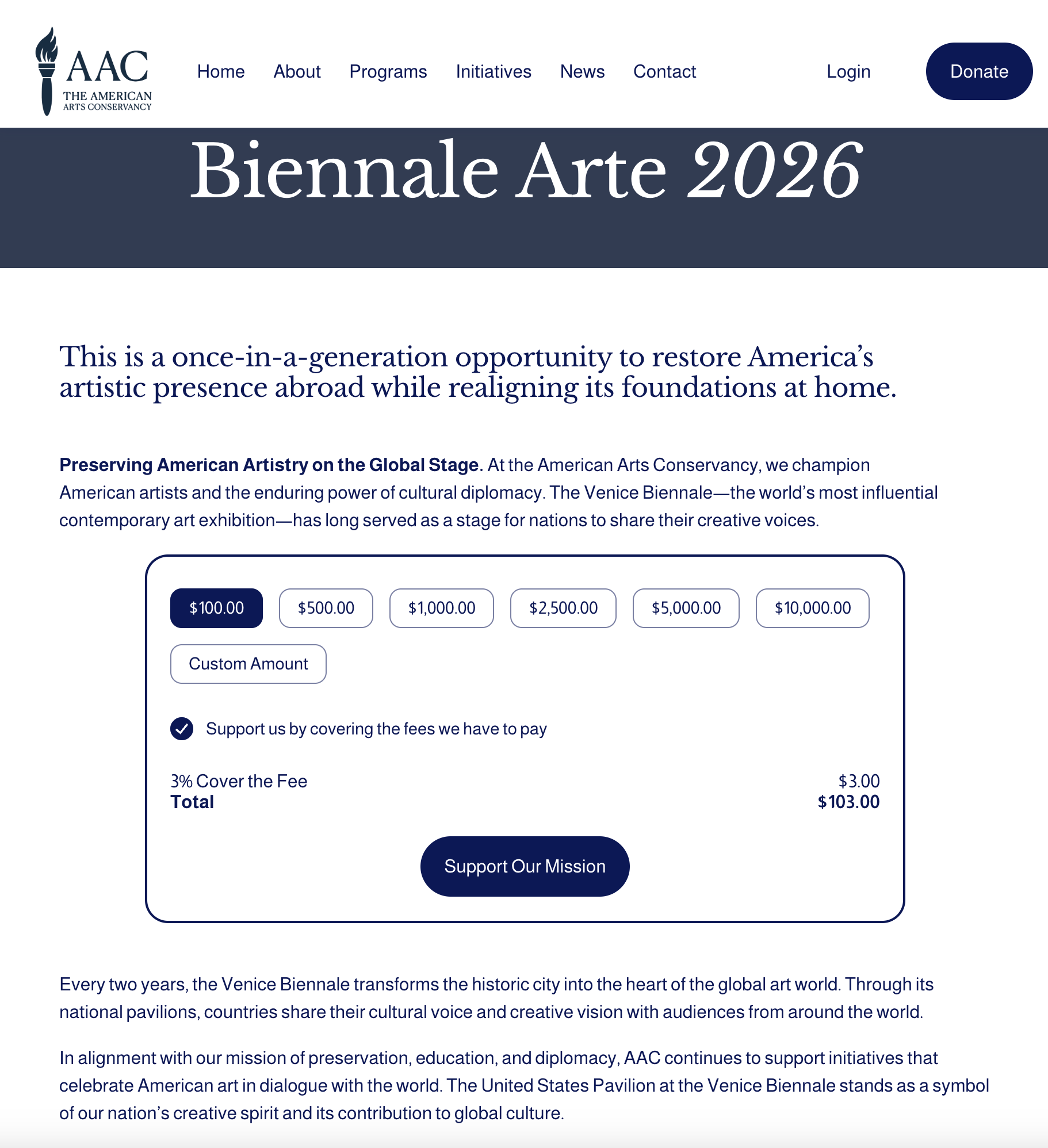
AAC’s Executive Director Jenni Parido, whose most recent work experience before securing the coveted role as US Venice Biennale Commissioner was running a pet food store in Florida, told Hyperallergic in an email that the organization did not receive “corporate or foundation funding” for the pavilion.
“AAC has raised funds for the U.S. Pavilion through the generous support of private citizens who believe in the importance of American artists and cultural exchange,” Parido said.
Individual donor names, Parido continued, will appear on the pavilion wall and on an updated website during the event.
Parido would not name specific donors, but posts on the nascent organization’s Instagram account suggest wealthy Trump allies attended benefit events for AAC tagged “#ArtPatrons,” including Rufus Hankey, the son of auto-loan billionaire Don Hankey, who underwrote Trump’s $175 million bond during his 2024 New York civil fraud case.
A spokesperson for Perrotin Gallery, which has represented Allen since Mendes Wood DM and Olney Gleason reportedly dropped him after accepting the commission, told Hyperallergic that while the gallery will provide “operational and logistical support” for the artist’s pavilion, it is not funding it. Perrotin did not provide additional details on how the exhibition was funded.
Generating funding for pavilion projects outside traditional sponsorships is not entirely unique to Allen’s exhibition. In 2024, Jeffrey Gibson partnered with pavilion commissioners to sell limited-edition cashmere blankets for $7,500 through Sotheby’s to help finance his project.
This year’s unconventional biennale funding structure follows a similarly irregular artist selection process. After taking over the selection process from the NEA, the State Department initially chose curator John Ravenal and artist Robert Lazzarini to represent the US, but later dropped the commission after a partnership with the University of South Florida fell through.
In November, the State Department announced that Allen, who lives in Mexico, and curator Jeffrey Uslip, who sits on an advisory council of AAC, would represent the US instead, circumventing the official application process.
In a statement to Hyperallergic, a State Department spokesperson described the pavilion as an opportunity to promote “American Excellence,” a term that the Trump Administration deployed in its campaign to overhaul content at the Smithsonian Institution last year.
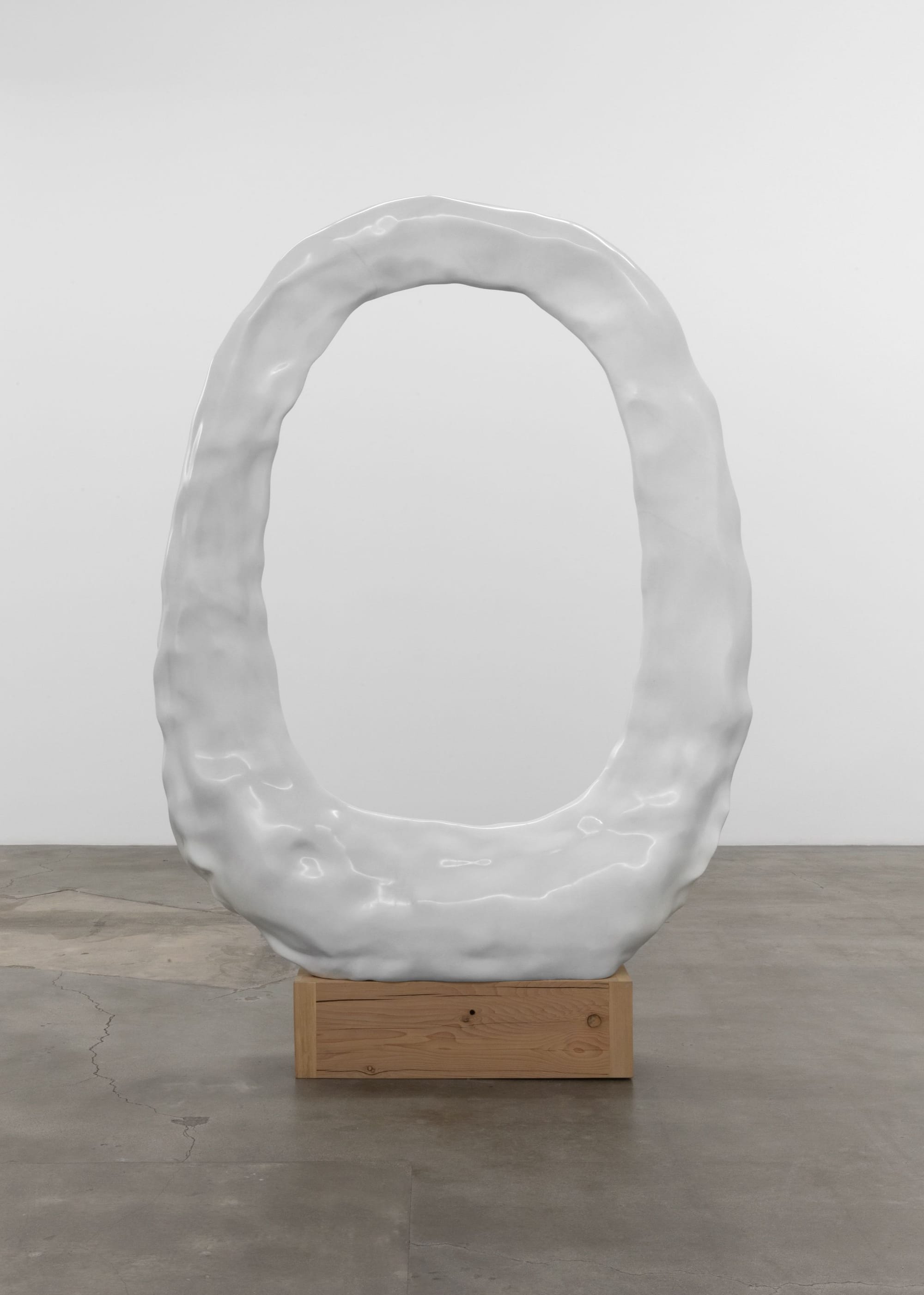
“The Trump Administration delivered the selection of a talented self-taught American sculptor who personifies the greatness of the American Dream,” the spokesperson continued.
Parido told Hyperallergic that the AAC will donate some of the money raised through its pavilion fundraising efforts to the Peggy Guggenheim Collection in Venice, a move she said reflects the organization’s “commitment to the city’s cultural community.”
The Peggy Guggenheim Collection has not yet responded to Hyperallergic’s inquiry regarding how much the institution expects to receive from the AAC, or whether it was previously aware of the donation.
Ahead of the Biennale’s preview opening next week, tensions are mounting around several national pavilions in the Giardini, including those of Russia and Israel. The event’s jury announced last week that it would not consider “countries whose leaders are currently charged with crimes against humanity by the International Criminal Court (ICC)” for the Biennale’s Golden Lions awards.