Venice Biennale Awards Jury Won’t Consider Russia and Israel
The women-led jury said it will omit nations whose leaders are charged with crimes against humanity by the International Criminal Court.

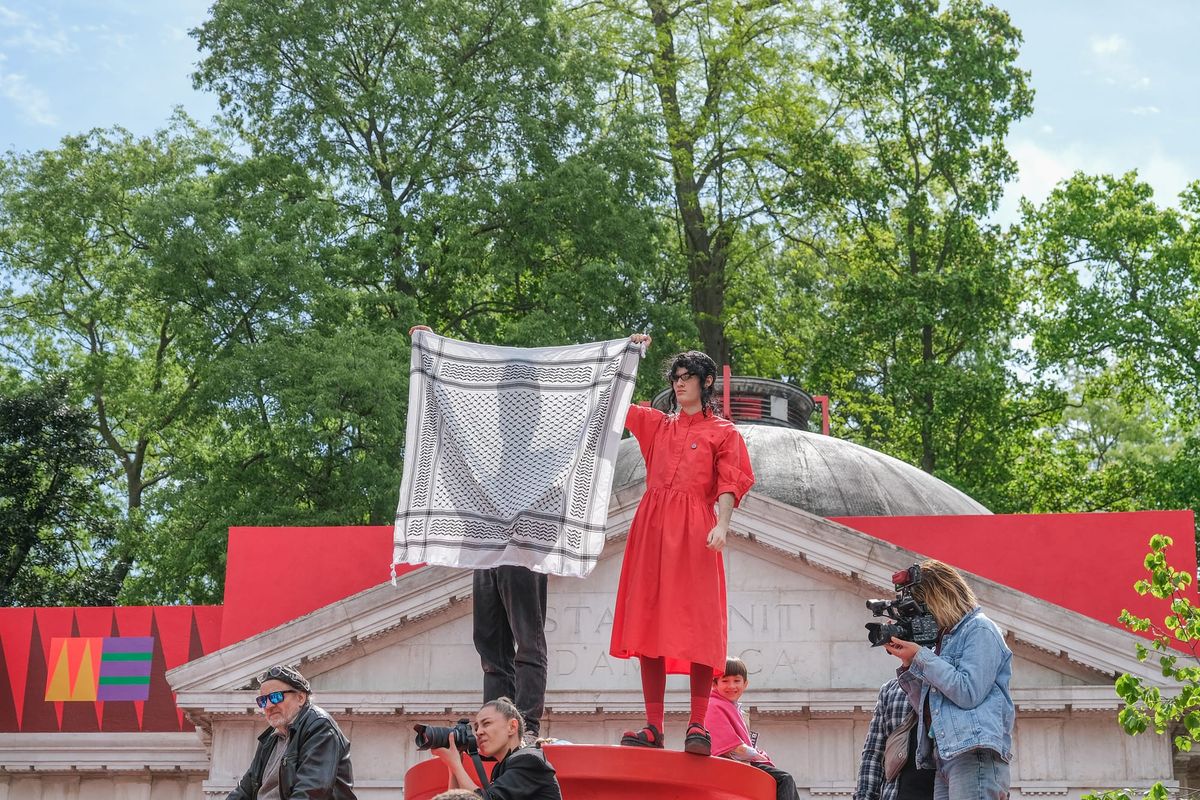
Within a day of its official assembly, this year's international awards jury for the 61st Venice Biennale has issued a statement declaring its decision to omit “countries whose leaders are currently charged with crimes against humanity by the International Criminal Court (ICC)” from its consideration for awards.
“We acknowledge the complex relationship between artist practice and nation-state representation that provides a central structure for the Venice Biennale, particularly the way this relation binds artists’ work with the actions of the state they represent,” read a portion of the jury's declaration, published on e-flux today, April 23.
A majority of artists included in the central exhibition In Minor Keys, among them Carolina Caycedo, Walid Raad, Guadalupe Maravilla, Zoe Leonard, and Cauleen Smith, also issued an open letter on the matter to the foundation earlier this month. Today, the group told Hyperallergic in an email that they “wholeheartedly support the jury in their decision.”
“It is extremely heartening to see the jury's alignment with what we also feel should be the ethical principles around participation in a major international exhibition such as La Biennale,” the group said in an emailed statement, also noting that “national pavilions, by definition, represent their country’s government.”
The jury is responsible for awarding two Golden Lions — one to the best national pavilion, and one to the best artist exhibiting in In Minor Keys, the international exhibition curated by the 61st Venice Biennale's late Artistic Director Koyo Kouoh. Chaired by the Associação Cultural Videobrasil Founder and Artistic Director Solange Farkas, this year's all-women jury includes Elvira Dyangani Ose, Zoe Butt, Marta Kuzma, and Giovanna Zapperi.
Though the jury's statement does not name specific countries, Russia and Israel stand out among the 100 national pavilion participants with ICC arrest warrants for President Vladimir Putin and Prime Minister Benjamin Netanyahu. The court has charged both leaders with various war crimes and crimes against humanity in Ukraine and Gaza, respectively.
A press office spokesperson for the Venice Biennale told Hyperallergic in a statement that its jury “acts autonomously and in total freedom of opinion in the exercise of its functions.”
“With regard to the statement issued today by the Jurors, this is a position that the members have chosen to anticipate and make public. It represents a natural expression of the freedom and autonomy which La Biennale guarantees,” the spokesperson said.
The jury's statement comes as the Biennale Foundation leadership faces mounting criticism for allowing Israel and Russia to participate in the 2026 iteration. In an extensive group presentation for its pavilion exhibition, Russia marks its return to the Biennale after two consecutive absences. In 2022, following the Russian invasion of Ukraine, representing artists Kirill Savchenkov and Alexandra Sukhareva withdrew from participating, and in 2024, the pavilion was loaned to Bolivia.
Since March, nearly 10,000 people have signed an open letter to the Biennale Foundation opposing Russia's return to the exhibition. The European Union also sent a letter of intent to suspend or terminate its €2 million (~$2.3 million) grant to the Biennale Foundation over Russia's participation last week, as the European Education and Culture Executive Agency confirmed in a statement shared with Hyperallergic.
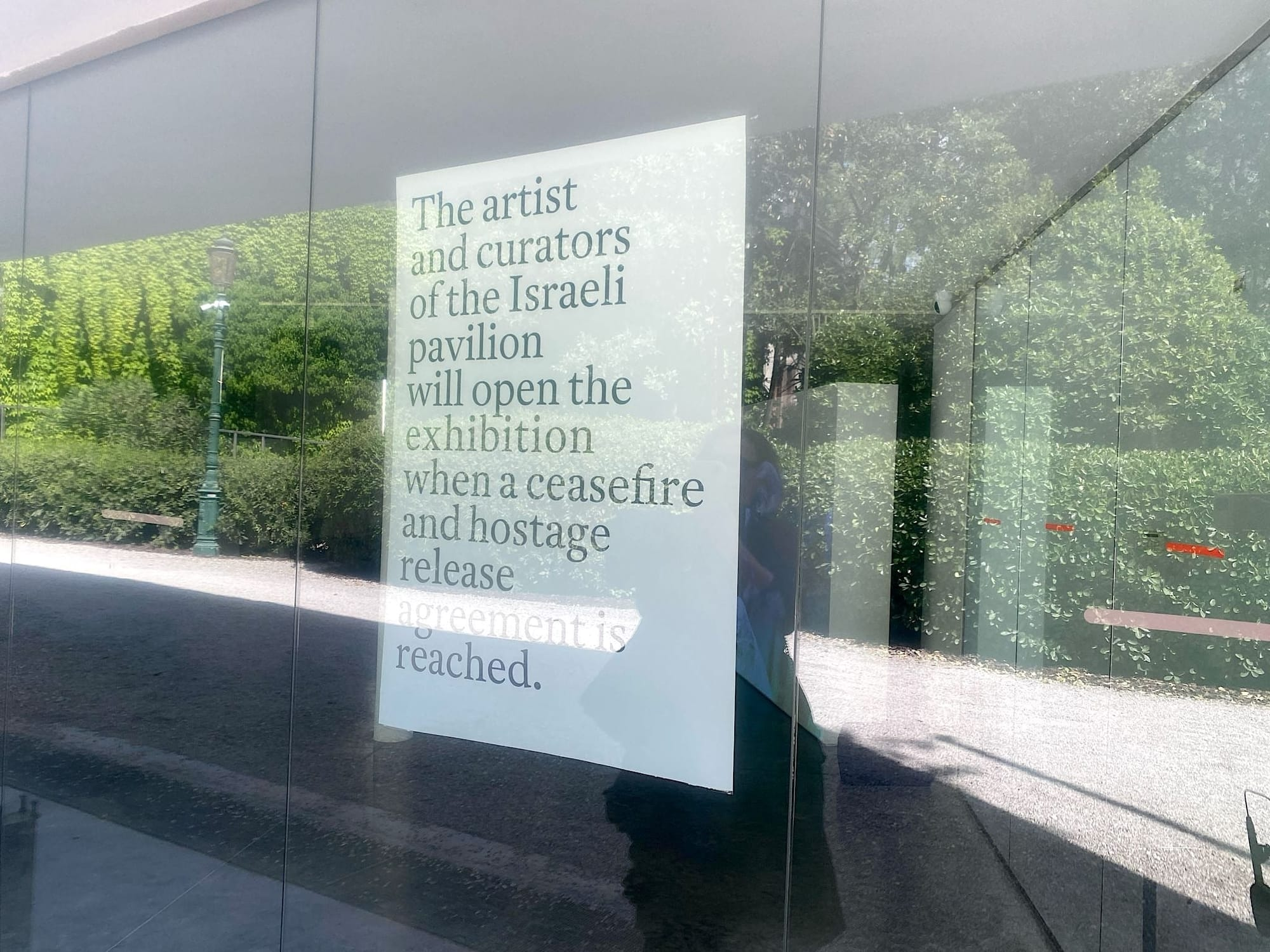
Although the Israeli pavilion is reportedly undergoing renovations, the Biennale secured a temporary pavilion space for Israel in the Arsenale complex. Its participation in the 2024 Biennale was met with fervent protests, and curators Tamar Margalit and Mira Lapidot and artist Ruth Patir ultimately decided to shutter the pavilion until a “ceasefire and hostage release agreement is reached” — a move critics said did not go far enough.
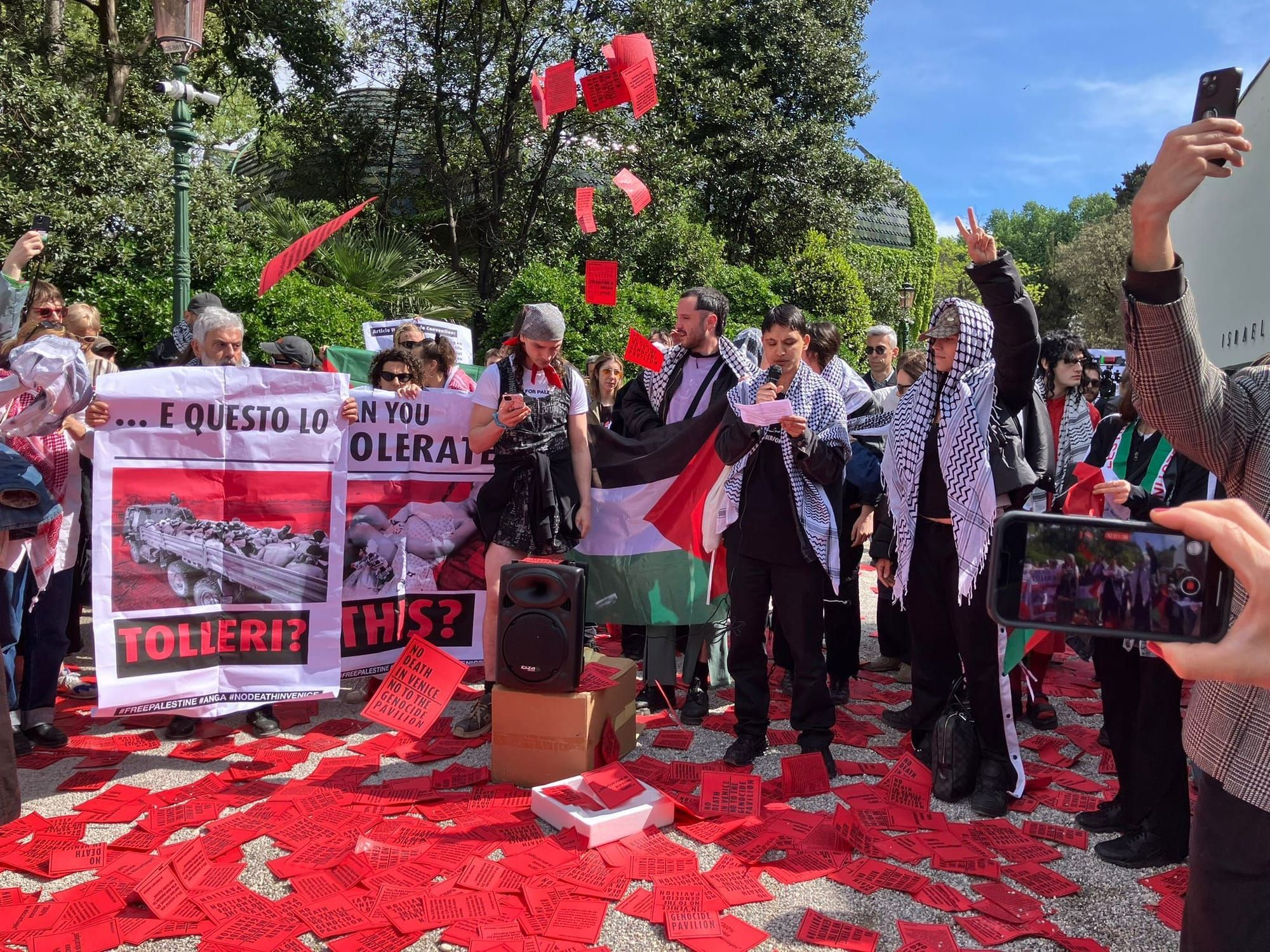
The Art Not Genocide Alliance (ANGA), which steered the most prominent actions against Israel's participation in 2024, has continuously pushed for a boycott of the 2026 Biennale over Israel's inclusion, writing in an opinion piece for Hyperallergic that “a boycott targets the infrastructure of complicity — in this instance, the social and cultural normalization of genocide.”
This year, dozens of national pavilion artists and curators, and other art workers affiliated with the Biennale have also signed ANGA's open letter calling for Israel's expulsion this year.
Though ANGA also welcomed the jury's declaration and attributed it to the collective worldwide pressure on the Biennale, the group noted in an email to Hyperallergic today that “the jury's refusal to name Israel reveals its limits.”
“At a moment of ongoing genocide in Gaza and escalating violence in the occupied West Bank, Lebanon, and the region at large, such ambiguity sustains impunity,” the group said.
Echoing the In Minor Keys artists, the Biennale award jury's published declaration invoked Kouoh's curatorial statement for the group exhibition: “In refusing the spectacle of horror, the time has come to listen to the minor keys, to tune in sotto voce to the whispers, to the lower frequencies; to find the oases, the islands, where the dignity of all living beings is safeguarded.”