Tracey Emin’s Cult of the Self
The YBA artist spearheaded contemporary art's trend of coupling extreme self-introspection with relentless self-promotion.

LONDON — There’s an unsettling sensation of reading someone’s personal diary upon entering Tracey Emin’s retrospective A Second Life at Tate Modern, for that’s what her entire body of work is. The Young British Artists movement (YBAs) — of which she and Damien Hirst were perhaps the loudest figures in the 1990s — was once described as a mere footnote in art history, but today that’s no longer the case; Emin is now a Dame and was professor of drawing at the Royal Academy from 2011 to 2013. Nevertheless, her work has no art historical anchor: There is no socio-political commentary, no observations about British life or womanhood, nor any subject that lies outside of the immediate orbit — or literal body — of Tracey Emin herself.
Furthermore, there is scant context, history, or curatorial commentary accompanying the works on view, though they are arranged loosely chronologically. There is a single introductory panel outside the show’s entrance — obscured by the ticket checker’s desk — outlining her themes as “love, desire, loss, and grief,” but no further biographical detail other than accolades following her nomination for the Turner Prize in 1999.
In short, the art speaks for itself. Except it doesn’t. The written words are what speak: those covering her blankets and chairs and innumerable pages of innermost thoughts, such as her “Tracey Emin C.V.” (1995). And, of course, there are the titles of the works which, for many, provide their only form of context.
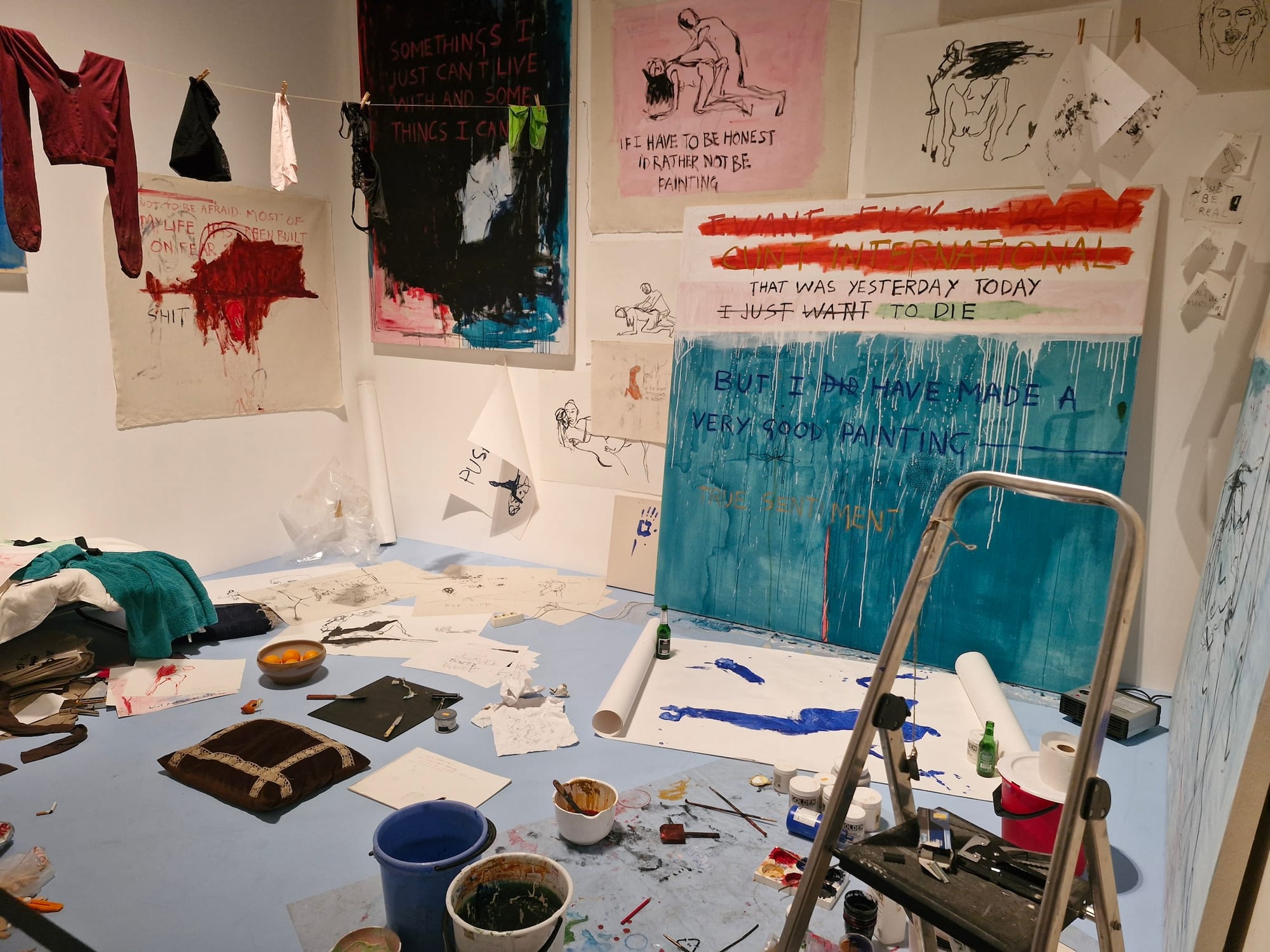
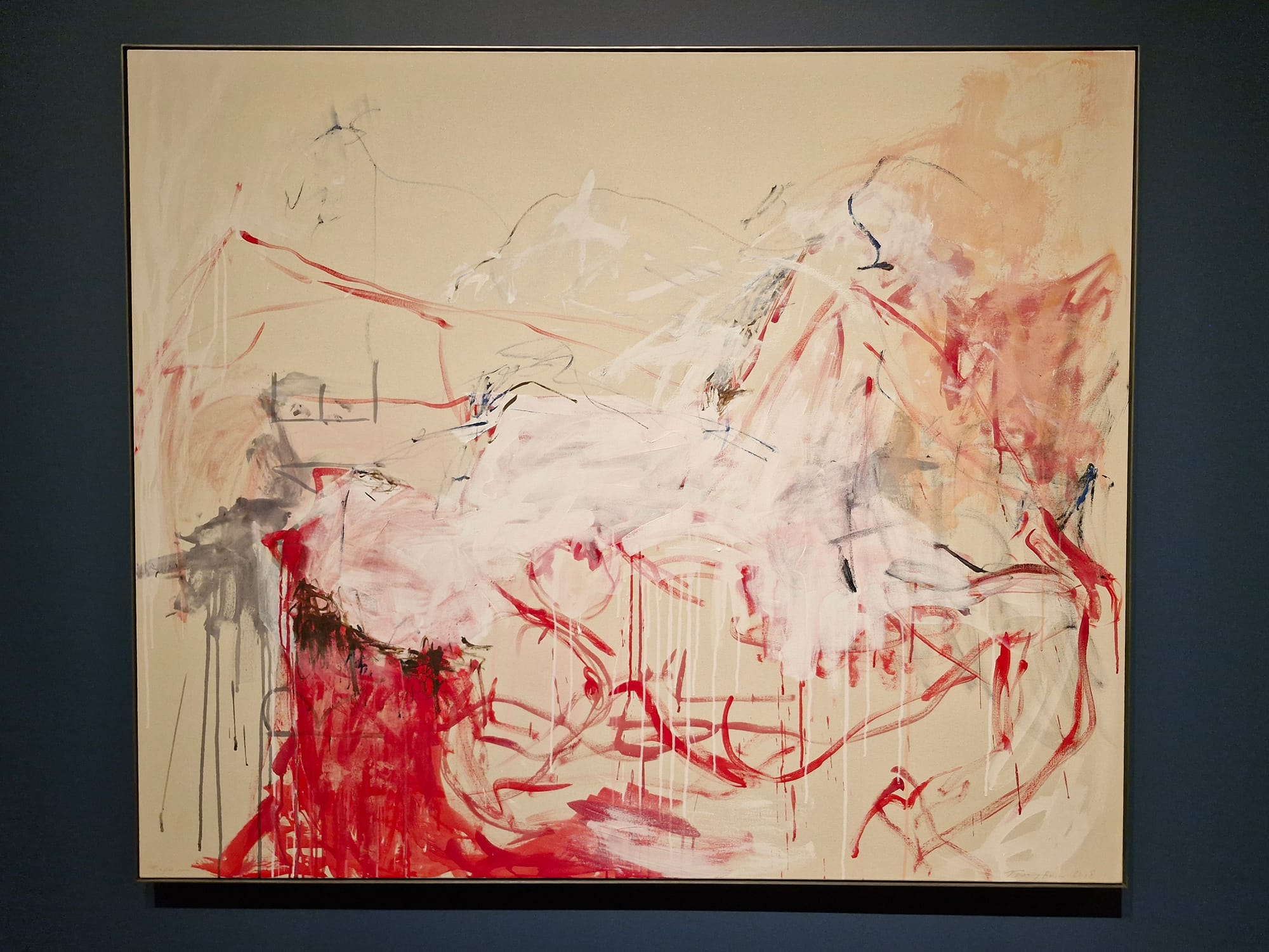
The words that appear most frequently are “I,” “You,” and “Me,” showing us Emin’s consistent focus on the intimate experiences of her own body and mind — for the identity of the “You” remains unimportant, and perhaps intentionally so, as it is never made explicit whom she is addressing. The less said about the paintings, the better, for they are not so much attempts at representation in the sense of art as we usually know it as they are rather desperate stabs and slashes of blood red, white, dripping navy, and black. There is a recreation of her debris-filled chaos of a studio entitled “Exorcism of the Last Painting I Ever Made” (1996), and indeed, her paintings appear to be literal exorcisms of her own experiences. The title of one painting, “Rape” (2018), gives its subject the entire context and therefore its meaning, and from thence its raw, emotional power. Without the words, Emin’s images, for all their visual rawness and anguish, are obscure and redundant.
This is art as therapy. It should be exempt from the usual modes of criticism: how technically proficient it is, what we can learn from it, or what Emin is saying to her audience, because it is conceived entirely as a means of self-exploration, and, in the case of traumatic events such as abortions and sexual assaults, a means of reclaiming her own body. This is something many survivors will powerfully identify with, and a caption at the exit details helplines for those seeking support for cancer, mental health, and sexual abuse.
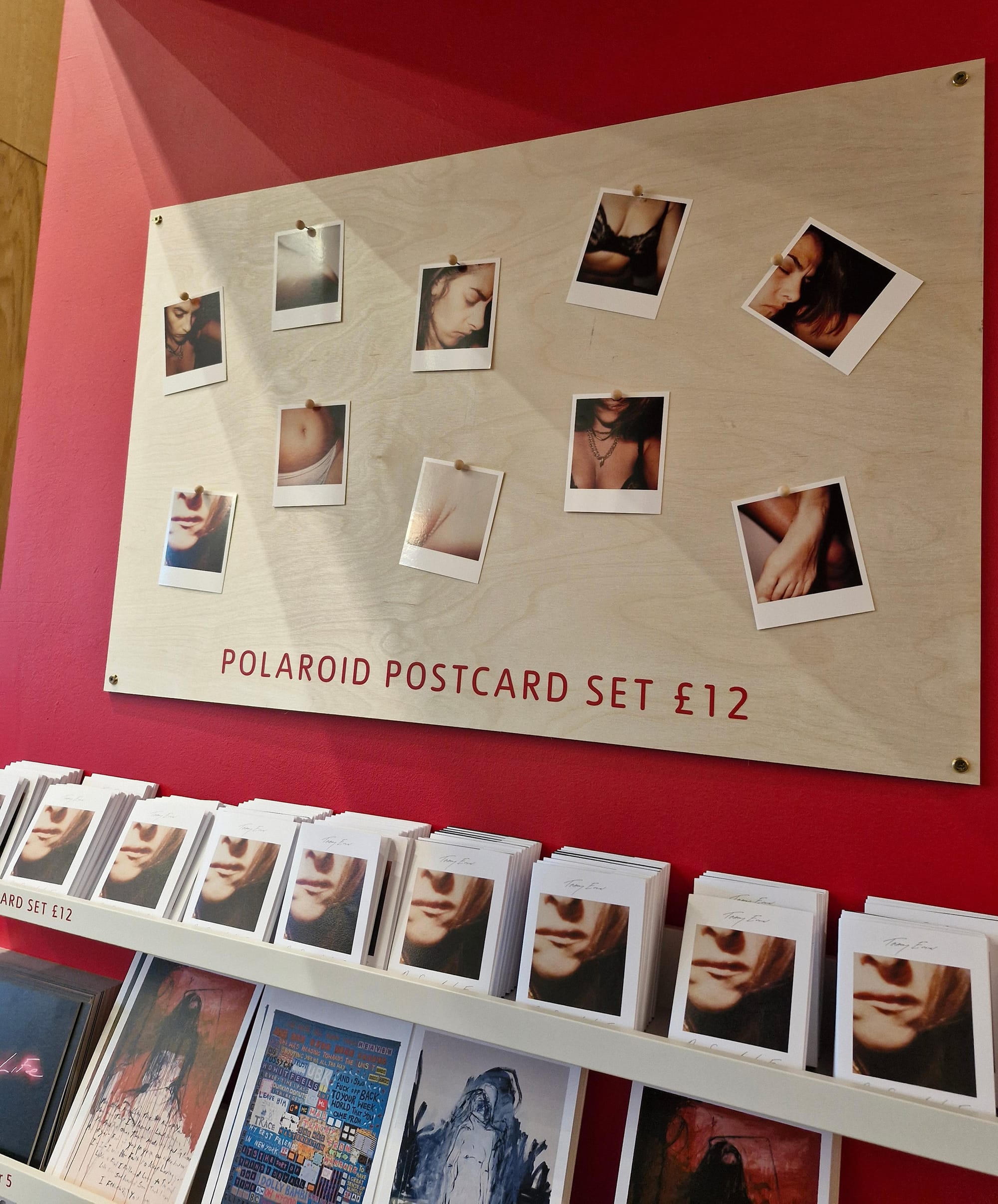
Should we as an audience be looking at the intimate personal pain of this woman, though? If the art were framed or curatorially contextualized as speaking for women or victims of abuse, and the horrors women and their bodies go through, then yes, we should; we can empathize with and learn from it in solidarity. Except it is not: Emin wants us to see absolutely everything, unabashedly, as her art. What emerges is a kind of cult of the self, which is perhaps why Emin out of all the YBAs resonates most with today’s audiences. In the era of Instagram, social media encourages the unhealthy need to validate and curate oneself and one’s bodily experiences publicly, as if such things only exist when broadcast and liked by followers. Take a sequence of Polaroids detailing Emin’s body post-stoma surgery from 2020 to 2025; every inch of bloodied self is snapped individually, in close detail, from genitals to stoma to face. The fact that images of this sequence (the non-intimate ones only) are available for purchase in the gift shop speaks to the way in which we increasingly worship at the altar of our very navels.
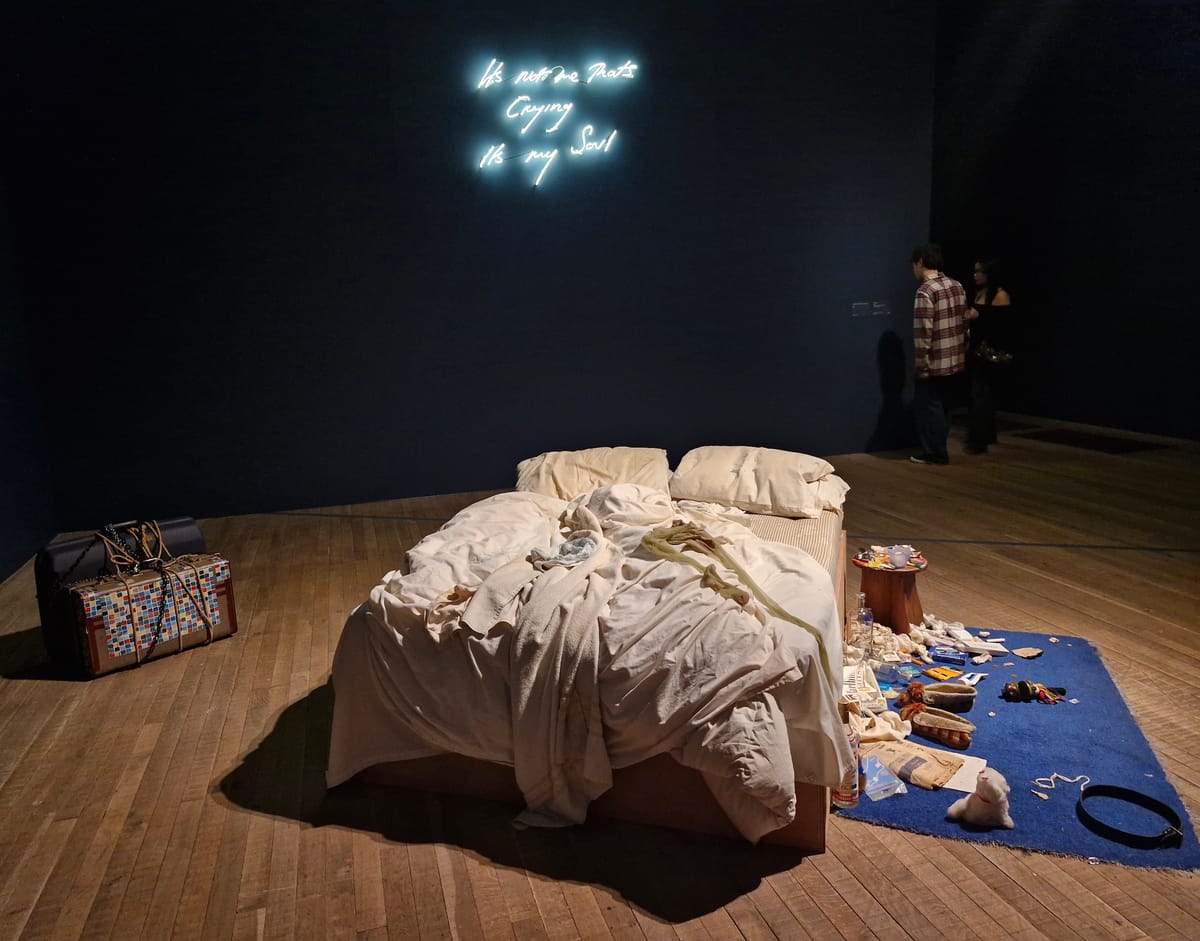
We arrive at a reconstruction of Emin’s unmade bed, which was sensationally nominated for the Turner Prize. Its controversy cannot be overstated: it is the sort of thing that an art school student who spent all night partying instead of making work would submit for their thesis show, and yet it received the ultimate recognition, doubly cemented by its purchase by advertising executive Charles Saatchi. This legitimized the notion that one need not be able to draw to become a successful artist (see also the sub-Rodin style mini-bronzes, or the sub-Yves Klein blue body print paintings in the show), but possess an unshakeable and bulldozing focus on one’s own self. Far from being a footnote in contemporary British art, Emin has spearheaded the trend for extreme self-introspection coupled with relentless self-promotion. The queue for entry into this absolutely packed show demonstrates what a success that combination has become in today’s world.
Tracey Emin: A Second Life continues at Tate Modern (Bankside, London, England) through August 31. The exhibition was curated by Maria Balshaw, Alvin Li, and Jess Baxter.