Turner and Constable Hit the Screen
The camera glides smoothly over landscapes of old England in a film that tries hard to dramatize the rivalry between the two masters.

Turner & Constable: Rivals and Originals, the story of England’s two pre-eminent landscape painters, both of whom flourished in the 19th century, fills 12 large galleries at Tate Britain. The film of the exhibition, which is an account of the gentle clash of two titans, takes us on a smooth camera glide from room to room, homing in on individual paintings, often to the accompaniment of music which sounds sweetly lulling and timeless, and was in fact written specifically for this film by Asa Bennett.
How easy is it to bring paintings alive? Making a feature-length film of nearly two hours devoted to an exhibition of paintings is no easy matter. To engage with a painting is a singular, highly personal, face-to-face business. Images mediated by film risk a loss of engagement, a loss of that crucial encounter with the tactile meaning of a smooth — or, perhaps better still, a crusty — surface.
It is not paintings alone that we see. There is film of the here-and-now too: Constable’s beloved Dedham Vale in Suffolk, for example, or shots of London where Turner grew up, including Maiden Lane in Covent Garden, where his proud father hung up the paintings of his prodigy of a son in the window of his barber’s shop. From time to time, snatches of the poetry of James Thomson, author of The Seasons (originally published in 1730), a work much celebrated during the poet’s lifetime, are read out loud.
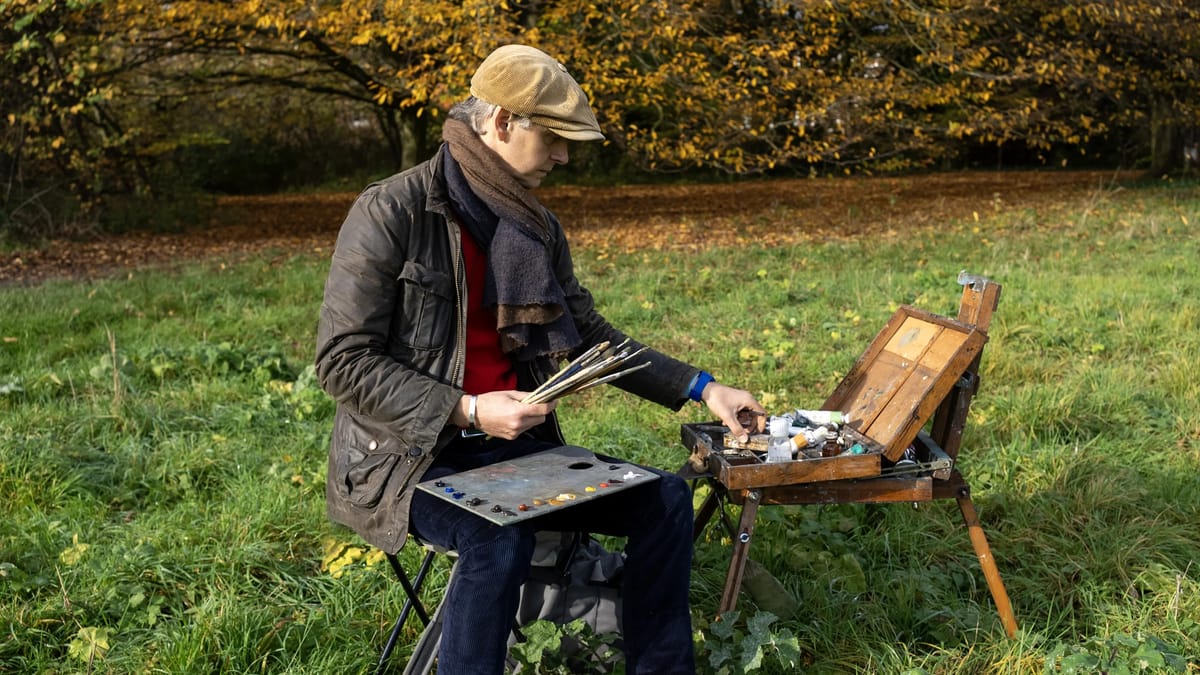
Experts sit in front of us from time to time, filling out the stories of individual paintings. The liveliest of these, in fact the only one who is ever seen much separated from the seat of his chair, is Lachlan Goudie, a Scotsman who is a painter of landscape himself. Goudie, whose red handkerchief lolls foppishly from his breast pocket, talks with bite, spirit, and an infectious enthusiasm. His turns of phrase are memorable, too. We see him both in the gallery and out in Constable country himself, in his Barbour-look jacket and mossy-hued cap, burdened down by any outdoor painter’s wherewithal, showing us tubes of finger-messy pigment ready to be squeezed out. Constable’s were kept in little pouches made of pig’s bladder, he tells us.
Clip from Turner & Constable: Rivals and Originals
These two painters lived through turbulent times indeed, as the experts tell us. Turner, ever desperate to be on the move, makes his first journey to the Alps during a pause in the forever wars with Napoleon, and brings back jaw-dropping scenes of plunging caverns and soaring peaks. Constable, on the other hand, busies himself mining the riches of his native Suffolk soil.
The film moves easily between painted image and Suffolk as it looks today, which is remarkably similar to how it looked during Constable’s own exploration of his beloved locality, from Flatford Mill, to the bargees who transported the grain that was milled by his affluent father. When we shift to images of London, we tick off the familiar sight of a red bus and the reassuring neoclassical portico of Tate Britain.
The film is a serious enough endeavour, both in what it shows and how it fills out its historical and intellectual context without strain or pomposity. Could it have been a little less smoothly, glidingly sweet, a little less of a nod in the direction of a general call, o ye tourists from more benighted lands afar, not to forget the calm, beauteous, unspoilt, Godly countryside of dear olde Englande? Is not a little bit of cunning fiction-peddling part of the rich mix? Yes.
Turner & Constable is currently screening in select theaters in the United Kingdom.