UK Museums Hold Over 260,000 Human Remains, Report Finds
A new exposé from the Guardian details extensive holdings of human remains from former British colonies, as well as potential mishandling of body parts.

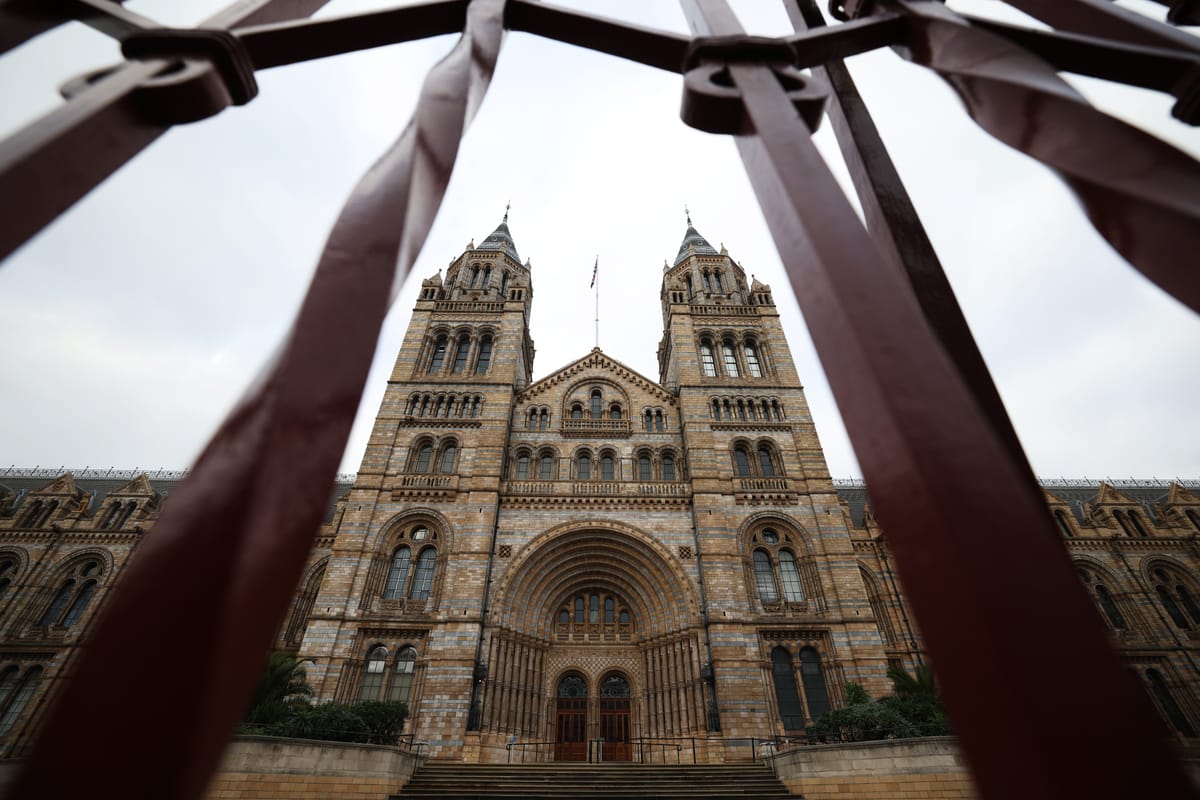
Museums and institutions in the United Kingdom hold more than 263,000 items of human remains, including bones and complete skeletons, according to a recent investigation. Following a public records inquiry, the Guardian found that 241 UK museums held significant collections of human remains, among them 28,914 items confirmed to originate from outside Europe, including former British colonies, prompting concern among experts.
According to the report, the majority of the remains acquired outside Europe, totaling 11,856, originated in Africa. Nearly 10,000 of these remains came from Asia. Items from Oceania, North America, and South America were less common within the collections analyzed.
Toyin Agbetu, a museologist and anthropologist at University College London, told Hyperallergic that he was "unsurprised" by the findings, but found the sheer volume of human remains "breathtaking."
Two UK institutions held the majority of non-European remains: the Natural History Museum (NHM) in London and the Duckworth Collections, an anthropology lab at Cambridge University. NMH maintains 11,856 of these remains, and has the largest collection of remains from Asia and North and South America. Duckworth had the highest number of remains from Africa, 6,223 of its 8,740 non-European human remains.
On its website, the NHM claims it acquired most of its human holdings through donations in the 1800s and mid-1900s, coinciding with the height of British colonial power. Some of its items, the museum acknowledges, were acquired through “unacceptable” practices. The NHM said it considers “ethical perspectives” when reviewing proposals to work with the collection, follows comprehensive guidelines for the care of remains, and outlines processes for requesting their return.
"As a decolonial scholar-activist and political anthropologist, I understand that there is value in hosting some remains and allowing limited research access to them for the purpose of learning about our shared humanity," Agbetu said.
"However, this is only if done with the explicit informed consent of the deceased's descendants,” he continued. "I consider doing otherwise, especially on the scale revealed by the Guardian, especially when human remains have been acquired through coercion and violence, to be ethically indefensible.”
The investigation also revealed that some institutions, which were not named in the report, could not provide specific information about their holdings because the items were unidentified and stored in cardboard boxes.
A spokesperson for the NHM told Hyperallergic that “the Museum has not refused to return any remains for which connections have been established with requesting communities and places of origin.”
Duckworth Collections also claims to adhere to UK government guidelines for the proper treatment of human remains. Cambridge University declined to comment for this story.
While the British Museum is not named in the report, the institution has a public database listing items from its collection of 6,000 human remains, including Egyptian mummies. But no regulations require the museum to list these items.
One expert, Dan Hicks, an archaeology professor at the University of Oxford who viewed the public inquiry findings, told the Guardian that British colonists had acquired some of the remains now held in UK museum collections through looting. These items were stolen from graves and battlefields, Hicks said, and brought back to the UK to advance eugenic pseudoscience or to keep as souvenirs.
Across the Atlantic, United States museums and academic institutions hold an estimated 110,000 Native American remains, according to a 2023 investigation by ProPublica.
Though the US Congress passed the Native American Graves Protection and Repatriation Act (NAGPRA) in 1990, mandating federally funded institutions to return remains to tribes, many groups are still waiting for the return of their items from museums.
In 2023, Hyperallergic published an investigation by scholar Erin Thompson that detailed the AMNH’s extensive holdings of human remains, including those belonging to apparently enslaved individuals, genocide victims, and Ipiutak people covered by NAGPRA.
The UK government does not have any such legally binding repatriation law as NAGPRA, Agbetu told Hyperallergic.
"NAGPRA functions, at least in part, as a reparative instrument that recognises both the spiritual and political dimensions of holding ancestral remains against the will of their descendants and imposes enforceable obligations," Agbetu said. "By contrast, UK guidance centers institutional discretion, not community authority, and even allows the sale of human remains in some circumstances."
The most comparable government guidelines are contained in the Human Tissue Act 2004, which allows UK national museums to deaccession the remains of a person who died less than 1,000 years before its enactment. But Agbetu described that provision as more of an advisory than an obligation.
"A credible UK framework should move from guidance to rights, and from retention to restitution," Agbetu said.
New York University legal scholar and museologist Jane Anderson, who focuses on the return of colonial collections, told Hyperallergic that she was surprised this information was not more widely known.
"In assembling these collections, no one thought that the communities from where the collections came might come to ask for them back," Anderson said. "And that failure to consider all institutional publics is a considerable oversight in mission."
Anderson said institutions should disclose their collections to the public and assist communities in locating their ancestral items.
"Some would call the refusal to repatriate the continuation of spiritual warfare," Agbetu told Hyperallergic.
"The continued retention and treatment of ancestors held without consent as ethnographic resources, rather than as relatives with communities and rights, compounds that harm,” he said.