Unofficial Iraqi Pavilion Pops Up in Venice, but Not That One
Ali Eyal and David Horvitz satirize America’s oil war in an installation at a Chevron gas station on Venice Boulevard.

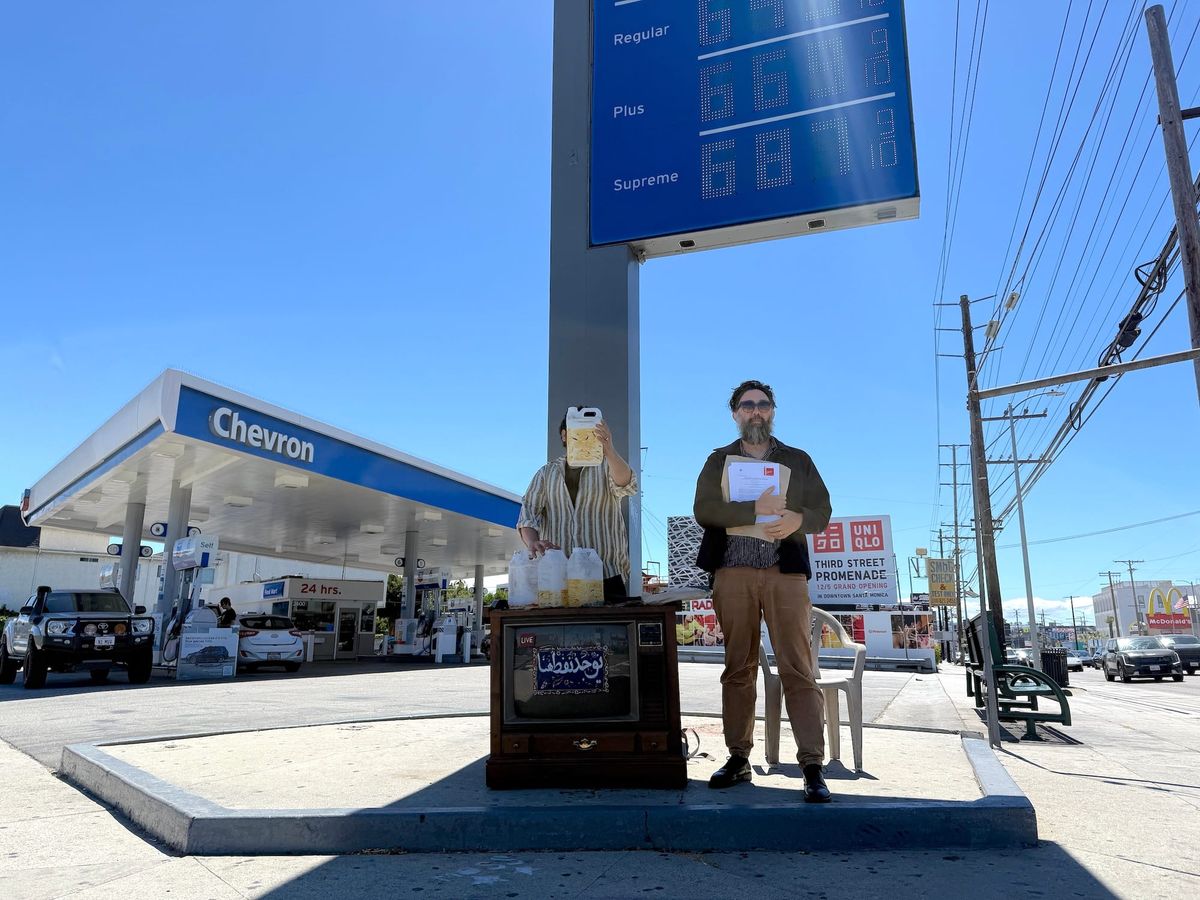
VENICE, CALIFORNIA — On a bustling corner along Venice Boulevard about a mile and a half from the beach, artist Ali Eyal stood outside a Chevron gas station last Friday, May 29, posing as a black-market petrol salesman.
On the screen of an old-fashioned television set, he had painted the words “We have oil here” in ornate Arabic calligraphy. Atop the set sat four jugs resembling those filled by roadside gas vendors, their exteriors painted a noxious shade of ochre. The level of “gas” is consecutively diminished in each one, until it transforms into a thin red sunset. “I’m ‘duskaphobic,’” Eyal told Hyperallergic. “Bad things always happened after dark.”
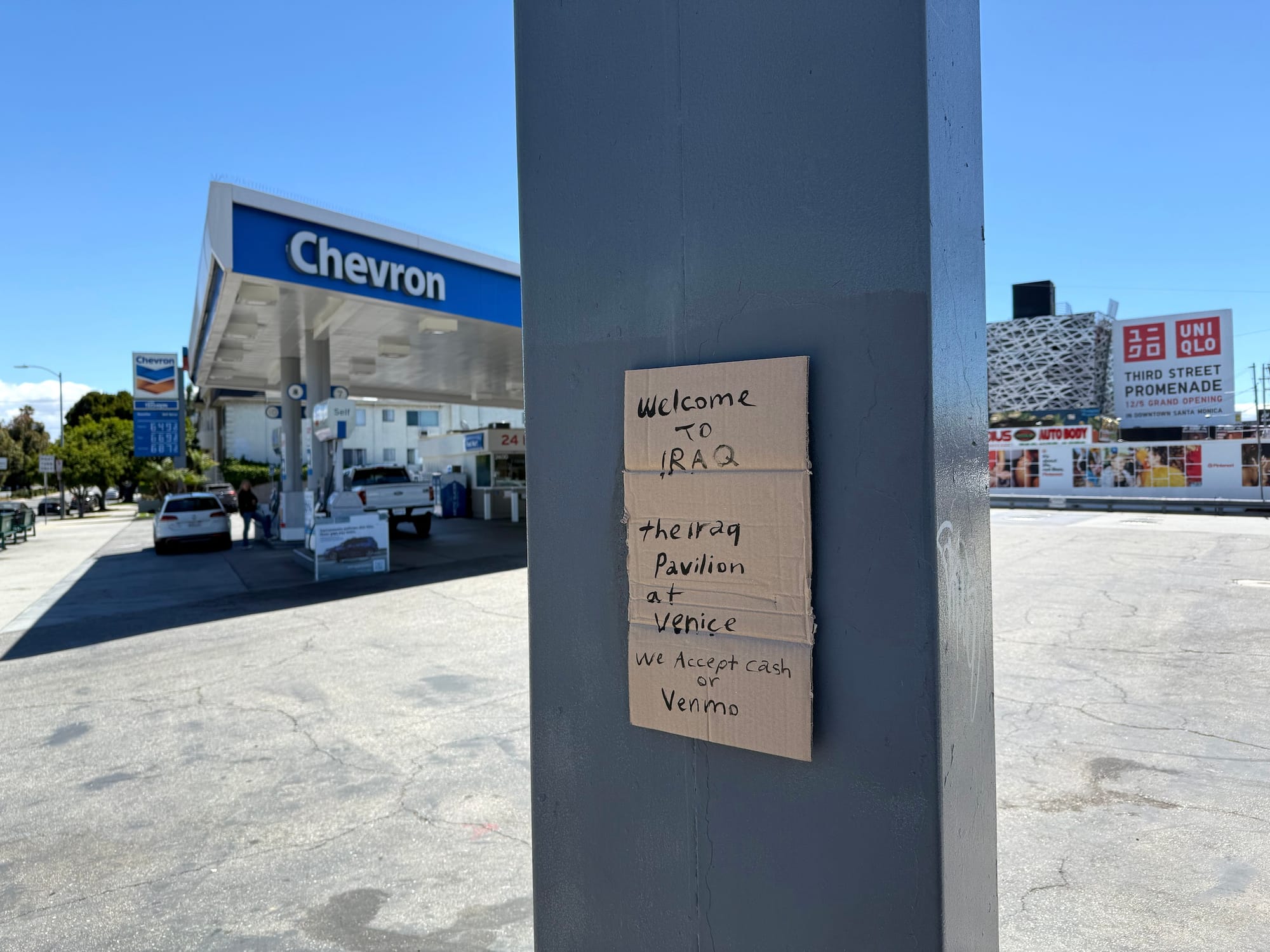
The one-day pop-up installation was Eyal’s unofficial Iraqi Pavilion for the 61st Venice Biennale, curated by fellow artist David Horvitz, who mocked up a faux press release complete with a fuzzy Biennale logo, consistent with his persistent form of art trickery. “If Venice doesn’t officially recognize a pavilion, can we fill that gap,” he quipped. Iraq has not had an official pavilion at the contemporary arts festival since 2019, when the Ruya Foundation presented a solo exhibition by Serwan Baran, whose expressionistic paintings confront the horrors of war.
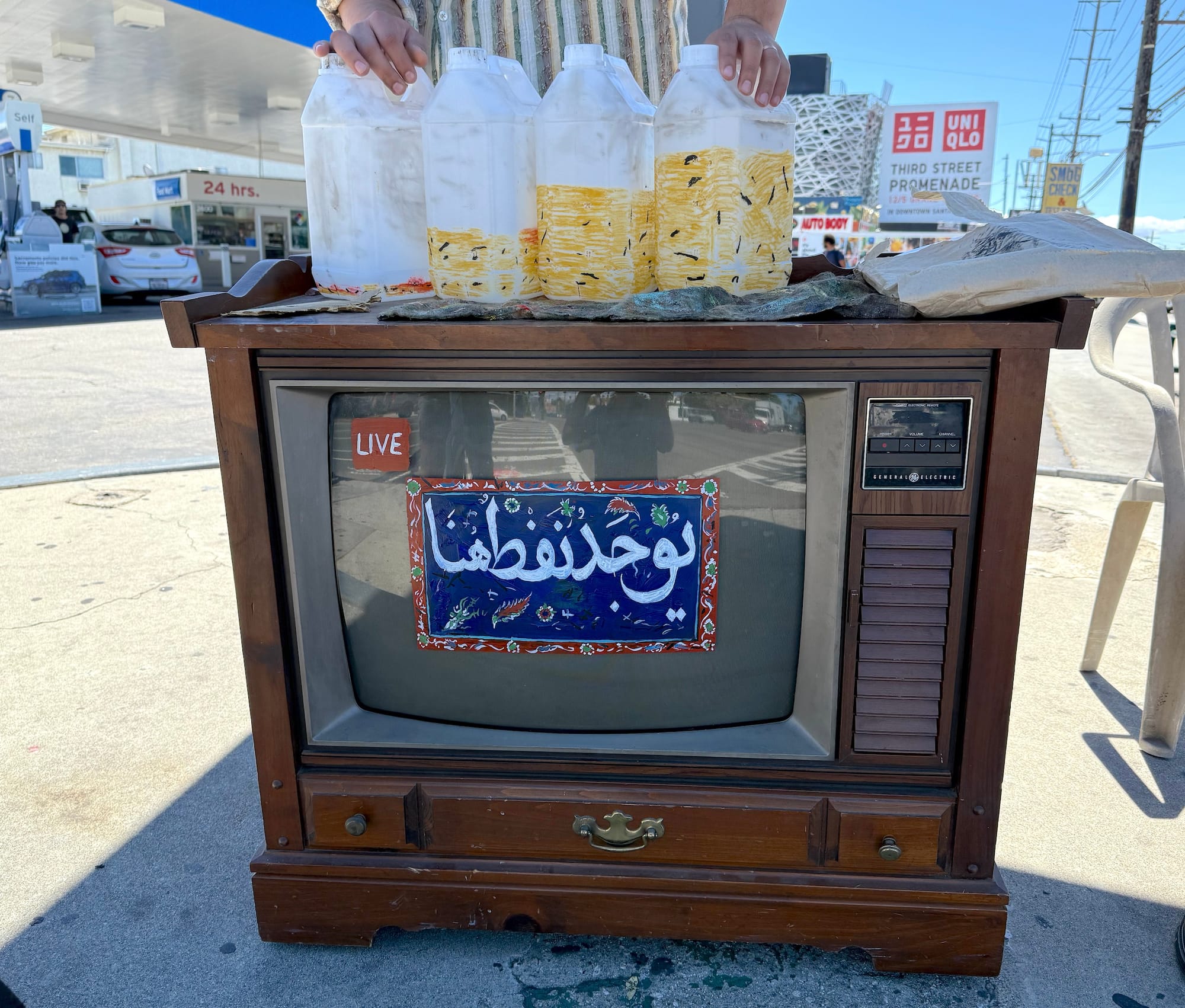
Titled “Welcome to Iraq,” Eyal’s temporary artwork shared a name with the official Iraqi pavilion from 2013, which showcased a diverse range of work by 11 artists.
Now based in Los Angeles, Eyal grew up in Baghdad during the United States occupation of Iraq, and his large-scale, dream-like paintings conjure his childhood memories, both traumatic and hopeful. Growing up under sanctions, fuel was scarce, often obtainable only through illicit, informal networks. At his unsanctioned pavilion last week, Eyal was not actually selling gas, but rather pocket-sized oil pastel drawings of candles in bottles, his family’s only source of light when the power failed. “They said they would bomb us into the stone age, and they did,” he recalled.
Although rooted in the aftermath of the 2003 invasion of Iraq, the themes addressed in Eyal’s pavilion have a tragic resonance with the US and Israel’s attacks on Iran and the demand for oil and gas underlying both conflicts. The war has resulted in deadly fuel shortages around the world, notably leaving Cuba, where US sanctions have exacerbated the energy crisis, in the dark.
As with all his work, Eyal presented a particular vision of national identity, filtered through individual experience. The project straddled different methods of cultural and economic distribution, from the discrete nationalistic displays of the Biennial to the global infrastructure of resource extraction and exchange. At a mundane Venice intersection, his unsanctioned Venetian outpost provided a darkly comic rejoinder to both.
As Eyal hawked his drawings to passersby, he was met with a mixture of indifference and curiosity. “We’re from Ireland,” said one couple, rebuffing Horvitz’s attempts to hand them a flyer.
While he was setting up, Chevron employees asked him to relocate to the edge of the property, which serendipitously placed the installation directly beneath a sign announcing gasoline prices between six and seven dollars per gallon. The juxtaposition rendered Eyal’s bootleg stand all the more prescient.
“Oil changed my life as an Iraqi forever,” he said. “This is my own Iraq.”