What Carmen Maria Machado Wants You to Know About Power
The author and memoirist spoke to Hyperallergic about curating the work of Cuban painter Rocío García, whose characters linger in the space where power and pleasure meet.

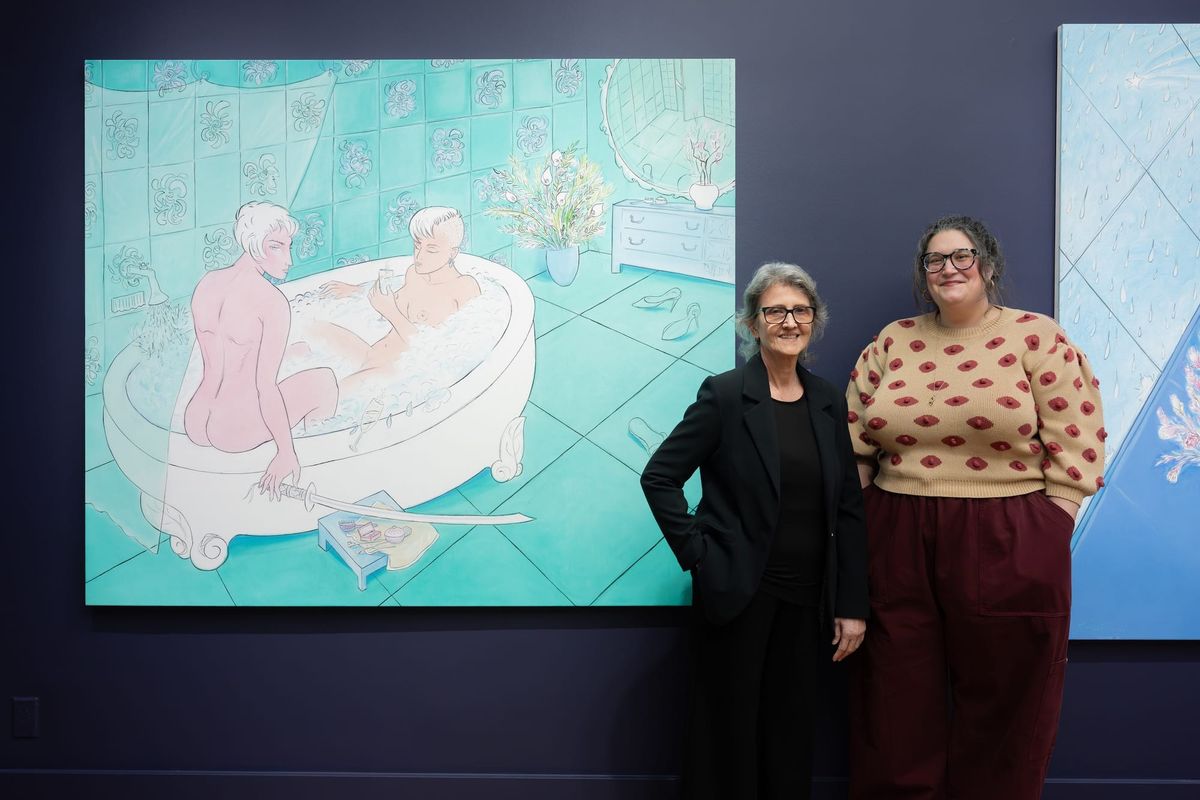
Carmen Maria Machado spent exactly one semester as a journalism major. She was recently shuffling through old papers, riddled with feedback from her professor: “too many adjectives.”
“She didn’t know what to do with me,” Machado recalled. Several major-switches later, she landed on photography, “the thing that I took the most pleasure in.”
Most readers associate Machado with indelible short stories on gender, selfhood, and queerness and her memoir In the Dream House (2020), a poignant account of domestic abuse narrated through dozens of refracted, genre-specific lenses. But the author has also spent the last decade quietly building relationships with visual artists and writing about their work. She’s bonded with Colombian-American artist Ilana Savdie over their shared fascination with the bizarre imagery of horse births, composed a dark fairytale for Hugh Hayden’s recent catalog, and explored the geometric worlds of painter Deborah Zlotsky, who first suggested she write about art when they met at Yaddo in 2016.
For The Object of Power is Power, titled after a quote from George Orwell’s 1984, the Leslie-Lohman Museum of Art in Soho invited Machado to collaborate with Head Curator Stamatina Gregory on a one-room show of paintings by Cuban artist Rocío García. Walking through the dim cave of the gallery, I felt instantly that Machado had met her match: García’s massive canvases narrate tales of their own, trading in the very same questions of sexuality and power that the author has long probed through language.
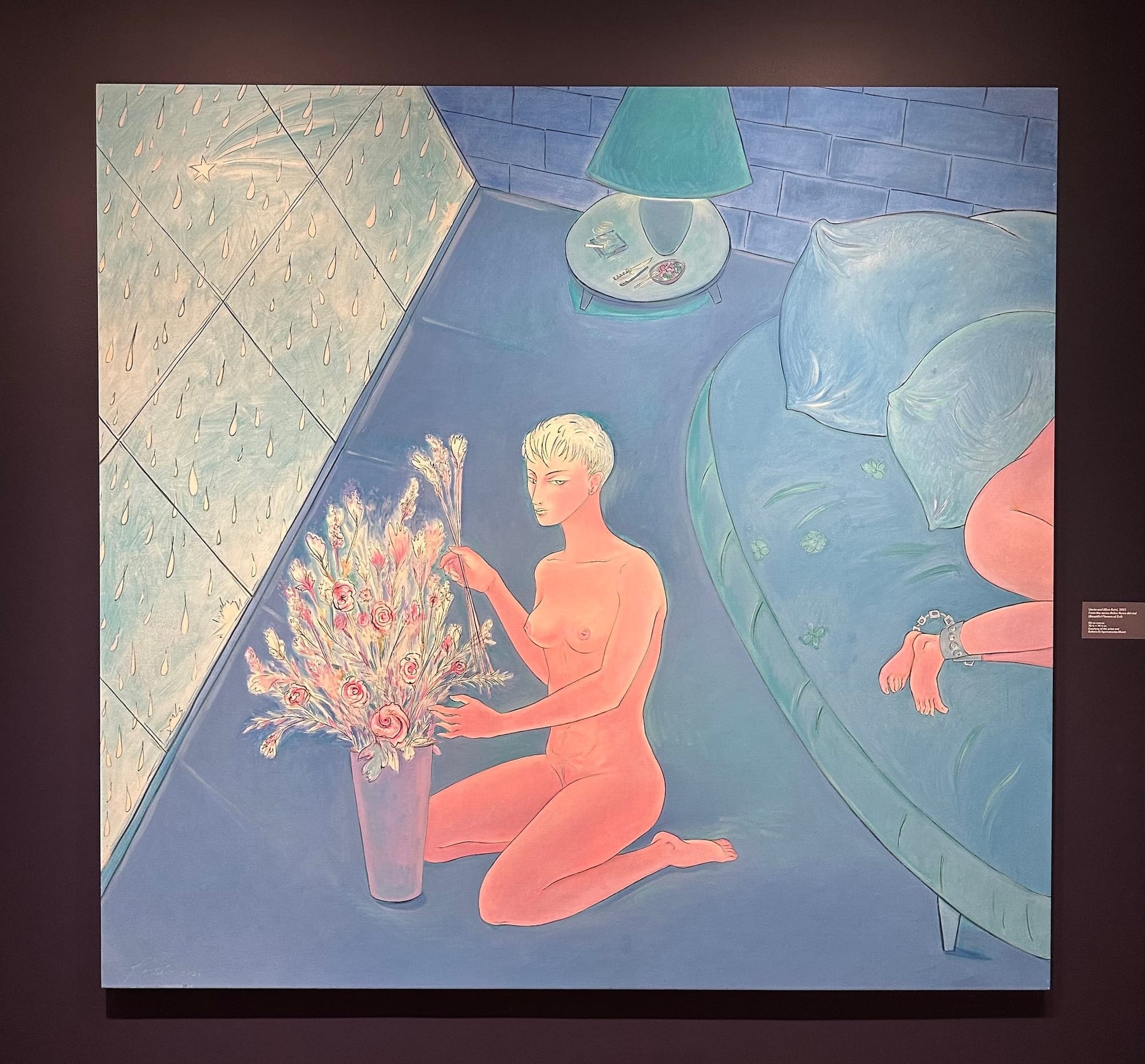
García, now in her 70s, has spent decades going against the grain of her surroundings. She studied at Repin Academy (now the Imperial Academy of Arts) in Saint Petersburg, where she faced off with the Eurocentric standards of training and art history and fell in love with Matisse at the Hermitage. She has drawn inspiration from Japanese history, captured scenes of male sex workers in Cuba, and imbued a comic-strip and film noir sensibility into her treatment of pleasure, power, and migration.
I spoke with Machado last month about the process of curating García’s work amid rising fascism in the United States and an ongoing embargo against Cuba, her favorite paintings in the show, and the question at the heart of her wall text: “Why do pleasure and terror hover so close together in the blue light?” Our conversation has been lightly edited and condensed for clarity.
Hyperallergic: Last year, Aimée Chan-Lindquist from the museum handed you a catalog of García's artwork and proposed this collaboration. What made you say yes?
Carmen Maria Machado: I've never curated a show, but I've collaborated with other artists like Ilana Savdie and Robin Francesca Williams. I just started it randomly a decade ago, and now it's a thing I do, and I really enjoy it. I was a photography major in college, so I have a little bit of visual art background. Not a ton, but I just really love art, and I find getting to respond to it and be in it very pleasurable. So I try to say yes whenever I can.
When they asked me, I looked at Rocío’s work and was like, "Oh, I totally see why they're pairing us together." It was that sense of familiarity. It's the same feeling I got when I saw Leonora Carrington's work. It feels very synchronous. I'm about to go on six months of residency. It's the last big thing I did, so it was a cool thing to go out on.
H: Coming in with that perspective as a writer who has worked and engaged deeply with all kinds of art, how was the process of putting this show together?
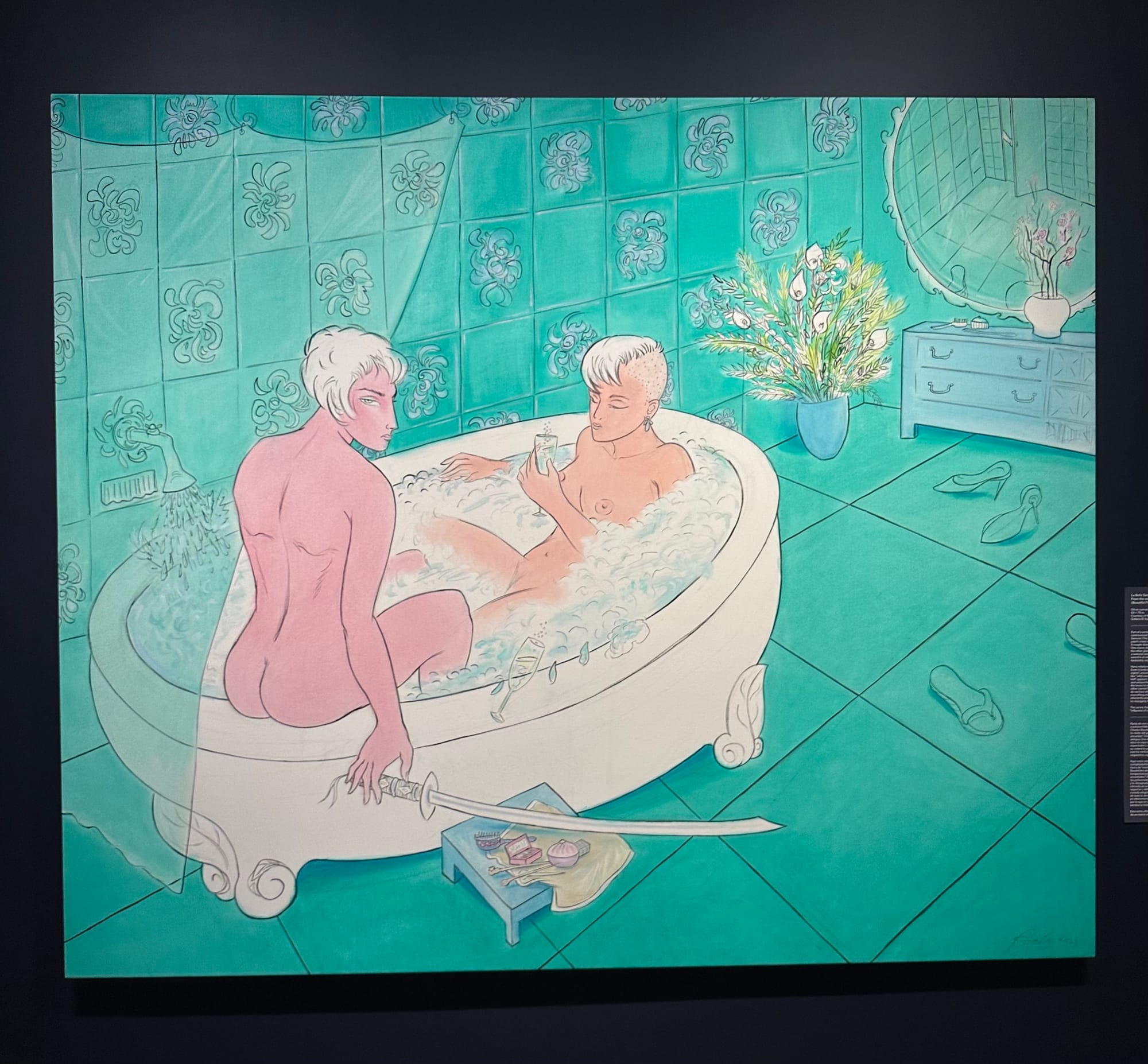
CMM: I could not have done it without Leslie-Lohman. They were amazing and very helpful. The paintings, the actual work that was selected, were ultimately Rocío's decision. A lot of work was hard to source coming from Cuba right now, obviously. But I did really love what she chose. The painting of the lesbian couple [in “La Bella Samurai” (2021)] is my favorite one in the show. I really love it. The triptych that's on the far wall is from 2006, so it's older, and there are a lot of pieces from 2020 and after, which was actually helpful because I've also been thinking a lot about fascism and pandemics. Her work is in conversation with a lot of the big movements of the last decade.
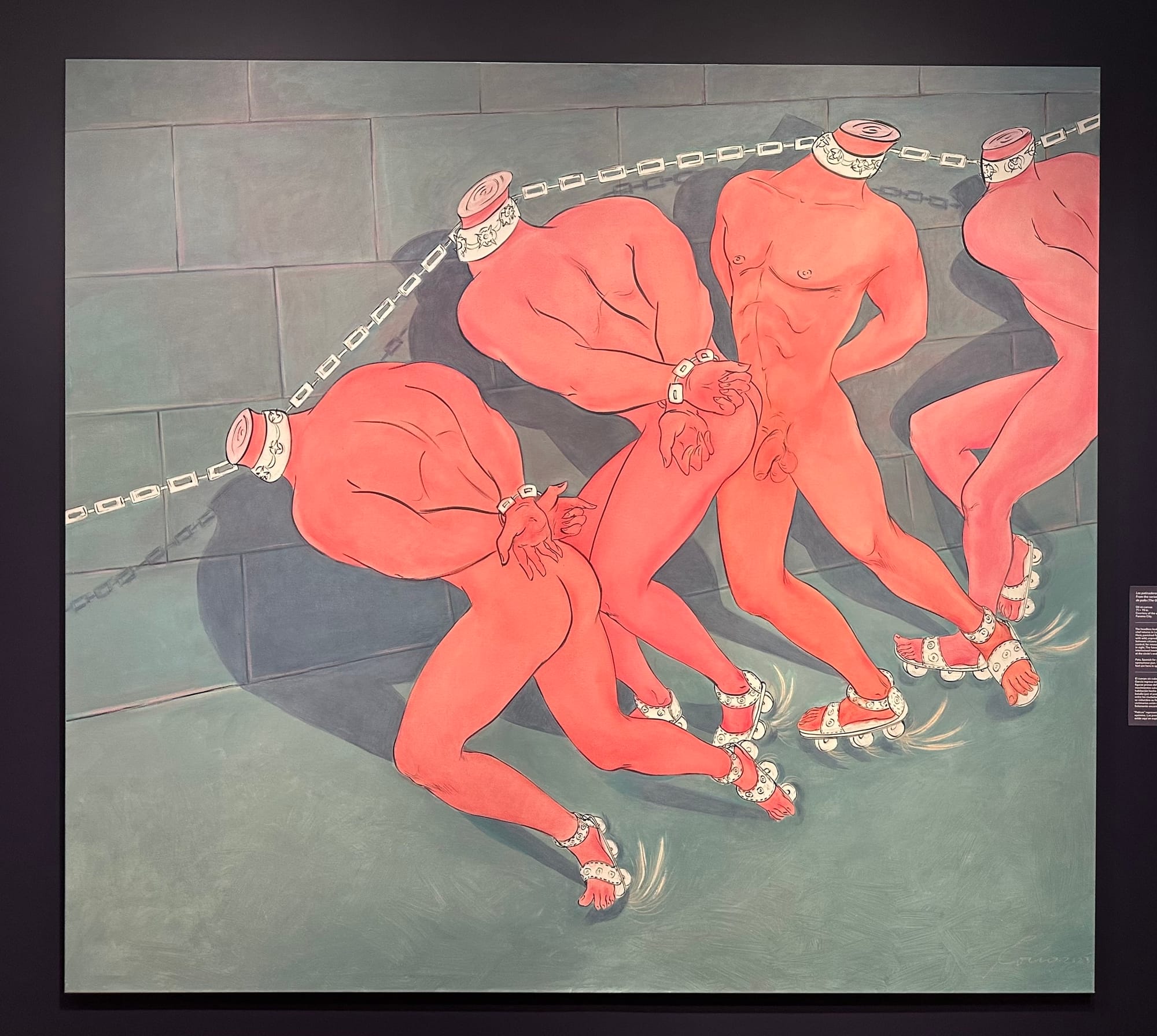
Then getting to actually write the labels, sit with the work, write the wall text … I was really intrigued by the fact that Rocío's work is interested in power. And I did title the show [based on] the Orwell quote. She's using a lot of BDSM imagery, she's interrogating relationships, she's thinking about state power and violent power, and she's also thinking about power in a more holistic way. I was writing the wall text right when those folks were killed in Minneapolis. So it was just me, thinking about death and the state. I feel like it really captured what I thought was so interesting about Rocío's work, which is that it has these neutral questions of power depending on what the power is.
H: Your text was a perfect prelude to her work because you asked a lot of questions in it, mirroring her refusal to just offer up answers.
CMM: I learned only when I got to the show that asking questions in wall texts is quite common in curatorial statements. I was like, "Oh, well, I just like to do that!"
H: Well, sometimes they can get prescriptive or academic, but your questions really throw us into the emotions and moods of these paintings. I know you have a knack for titling your short stories — "The Husband Stitch" comes to mind — so how did you come up with the Orwell quote for this show?
CMM: Thank you! Also, my new book that's coming out next year — best titles yet. Anyway, I did what I sort of do, my hack for titling. Sometimes I find titles out in the wild, but a lot of time, I will write down a bunch of idioms, phrases, sayings, and compound words that are related to the idea, and then I just kind of fuck with them for a while. I was looking up lots of idioms and phrases and ideas with “power” in them. A lot of the quotes were not good, and there was another that Stamatina said was somebody else’s show title a few years back. But “the object of power is power” was one that we both really liked. Orwell feels very appropriate for the moment and captures the energy of this question of power in the show.
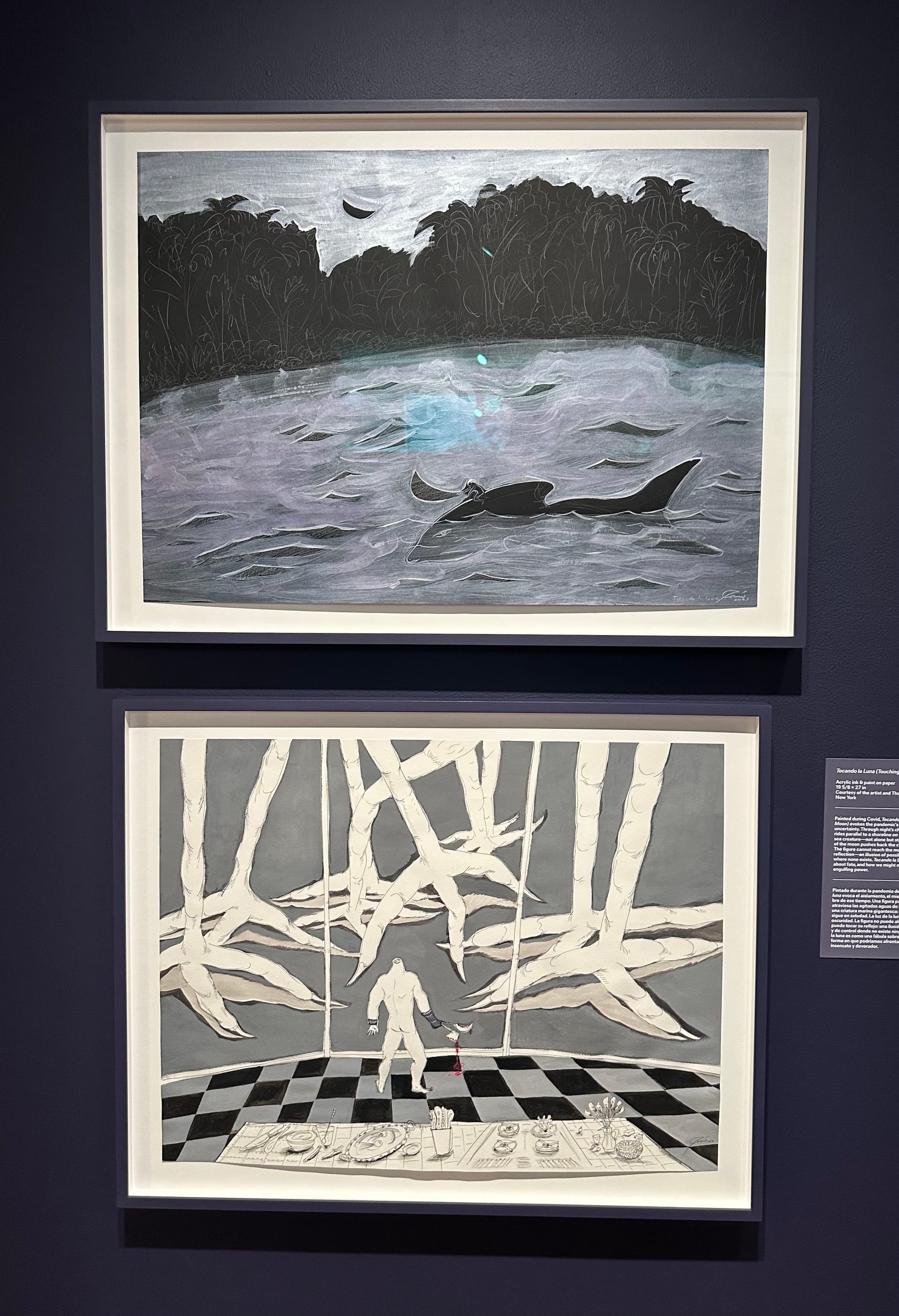
H: How do you see those quiet, smaller works García made during the pandemic, like “Tocando la Luna” (2021), conversing with the monumental canvases in the show?
CMM: I liked “Tocando la Luna” so much because it's so different than everything else in the show. Her work is so big and colorful, and I found there was something about the quietness and the bigness to that painting. You're talking about the ocean, this huge creature, and the night sky, contained in this very small space. I was fascinated by the idea of the moon and its reflection in the water. I was really pleased that Rocío chose that to be part of it. It just felt right.
H: Tell me about why “La Bella Samurai” is your favorite work in the exhibition.
CMM: The suspicion of the main figure that we’re looking at is so relatable to me. There's something about struggling to be vulnerable in the face of love and intimacy. Rocío said that she made this painting at the beginning of her relationship with her current partner. There is something very vulnerable about that, and if you’re a certain kind of person, which I think I am, you're a little suspicious of that. You just think, "Can I trust this thing?" It felt like such a beautiful, subtle, interesting point that felt very gay. Very. Relationships are so strange, and we idealize lesbian relationships, which I talk about a lot in my memoir. But in this painting, we have somebody who is both newly in love, and you can just imagine the room is, like, full of steam, there's all the unguents and the lotions and the cast-off slippers and the glass of champagne or wine. And then you have this figure who can't quite release herself into this room of pleasure. There's also someone either entering or leaving the room in the mirror, which I fucking loved. And I was like, "Is that us? Is it her? Me, coming or leaving?” There’s something so narrative about her work that I find so fascinating.
H: And it echoes so much of your own writing with its uncanny, psychological worlds unfolding before us.
CMM: I'm working on a new novel right now. It’s lesbians behaving badly at the end of the world, amid fascism and everything kind of closing in on itself. So I've been thinking about that a lot on my own, and I feel like this show added texture and entered into the space of my brain.
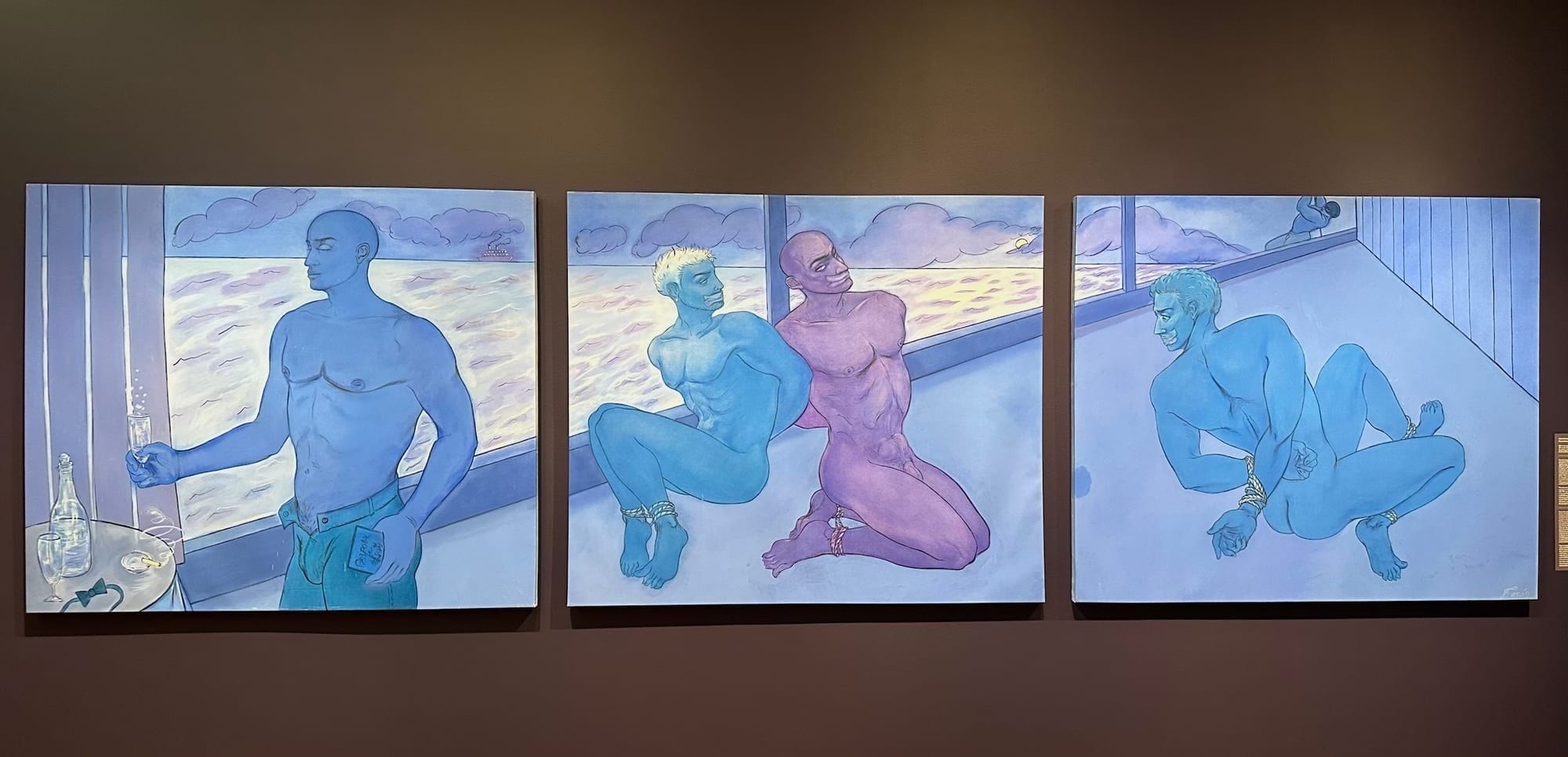
H: Can you share what drew you to that 2006 triptych, “Like the Last Blues,” which grapples with borders and passports?
CMM: Well, it's funny because I'm right now organizing everything I own, all my papers. Literally an hour ago, I pulled out the paperwork that I had to file to go to Cuba a decade ago, which was very convoluted. I was remembering just how complicated it was and how intense it was to go there. It really is a different world, and our government has made it so difficult. And so in that series of paintings, I love the idea of staging it like a thriller in terms of genre, which is also a thing that I do. It tells this human story using a stylized genre lens that feels appropriate, which I thought was really cool. This idea of migration and Cubans able to leave, people able to enter, a story about passports and this underground black market that they're all navigating, and then the people who are getting betrayed. It’s such a great example of her responding to her surroundings using this genre lens.
H: What was the process of working with García like, especially amid the US government’s sanctions on Cuba?
CMM: Logistically speaking, it was quite tricky just because it's hard to get internet. The one time we spoke when she was in Cuba, we had a very limited window of time, and the service wasn't great. I haven't been to Cuba in over a decade at this point. Most of my family has left. And the embargo and what's been going on in Cuba, especially since COVID, has just been completely catastrophic and immoral, evil. So it wasn't like we were working side by side the whole time, but more like we were going back and forth. I was also asking her a lot of questions and trying to figure out what the line is between how I interpret something she's painted and what she actually intends it to be. It was helpful to learn how unique her work is in contemporary Cuban art of her generation. She stands apart in these really interesting ways, but she's also a teacher, so she's been really influential. It just felt simpatico.
H: You mentioned that you’ve worked with artists and museums in the last decade or so. What was your relationship with visual art growing up?
CMM: My dad is an engineer, and art is a hobby of his. He really loved philosophy, art history, and natural history. He used to buy all the Sister Wendy books. I do have a little bit of a photography background, but it’s a thing I picked up, I think, from him. I don't know what would've happened if I had not had that young education in it. I really loved Monet, which is somewhat embarrassing.
H: I mean, we all did! Like, there’s a reason why.
CMM: God, I loved Monet. I loved the Pre-Raphaelites. Waterhouse’s “The Lady of Shalott” (1888). I love big paintings with weird details. Any Biblical story about a woman killing a man. Actually, in my new book, I have the story of Jael, who drove a tent peg through a warlord's temple. The title of the story is from the Bible story, which is “He Asked for Water and She Gave Him Milk.” I remember my father showing me the two Holofernes beheadings by Caravaggio and Artemisia Gentileschi. He was showing them to me side by side and said, "So this one is a little more sterile. And that one, she's ripping into him.” I feel like my dad taught me how to see emotion in painting.
H: You're using a different part of your brain when you write about visual art and try to crystallize that emotion, even though, as you mentioned, it is very much connected to your literary work.
CMM: Translation is the best analogy. You know, I don't speak Spanish well enough to translate it, but I did take a translation class in grad school. It never would have occurred to me that translation is its own art form, but of course it is, right? How do you create a translation that feels like it's true to the spirit of whatever the thing is? I feel like it's the same problem here — I'm yanking work out of this visual space and putting it into text.
H: I know exactly what you mean. Speaking of translating between mediums, do you still maintain your photography practice?
CMM: I used to joke that I have the most expensive Instagram in the world because I still am paying off my student loans from when I was in college, and the only place my photography really appears is on Instagram. I used to love the dark room and I don't have the kind of space for that, and have not in a while. I have a Holga that I really love and that my partner and I both try to use. My dream is to have a Hasselblad one day. If I sell a TV show or if something really big happens, I'm getting a Hasselblad.
I think the best work that I did was this series of two people having sex. I think the photos are honestly incredible, and I still am really proud of them. They’re shot on this really grainy, 3200 film, and they're abstract. These people I knew were like, "Do you wanna have sex with us?" And I was like, "I don't know, but can I photograph you?" And they were like, "Sure." And so I did that. It's probably the work I'm the most proud of in terms of film photography. Maybe one day, when I have some time and space, I'll go back to it.
H: That series also sounds like it echoes Rocío’s work, with similar questions of power, play, vulnerability.
CMM: One day, I'm gonna figure out a way to use them in something.
H: How do you want visitors to think about power after experiencing this show?
CMM: I want people to think about power as holistically as Rocío does, and as I guess I do. To be interested in both the violence and power of the state, and the power as we exchange it between people — the way that we turn our power over to other people when we're in relationships. And then consensual power, where you're getting to play with this idea consensually for your own pleasure. It's so multidimensional. That's the thing I love about it the most.