What Do We Really Think of the New New Museum?
Hyperallergic’s editors sit down for an earnest conversation about the institution’s expanded building and inaugural exhibition.



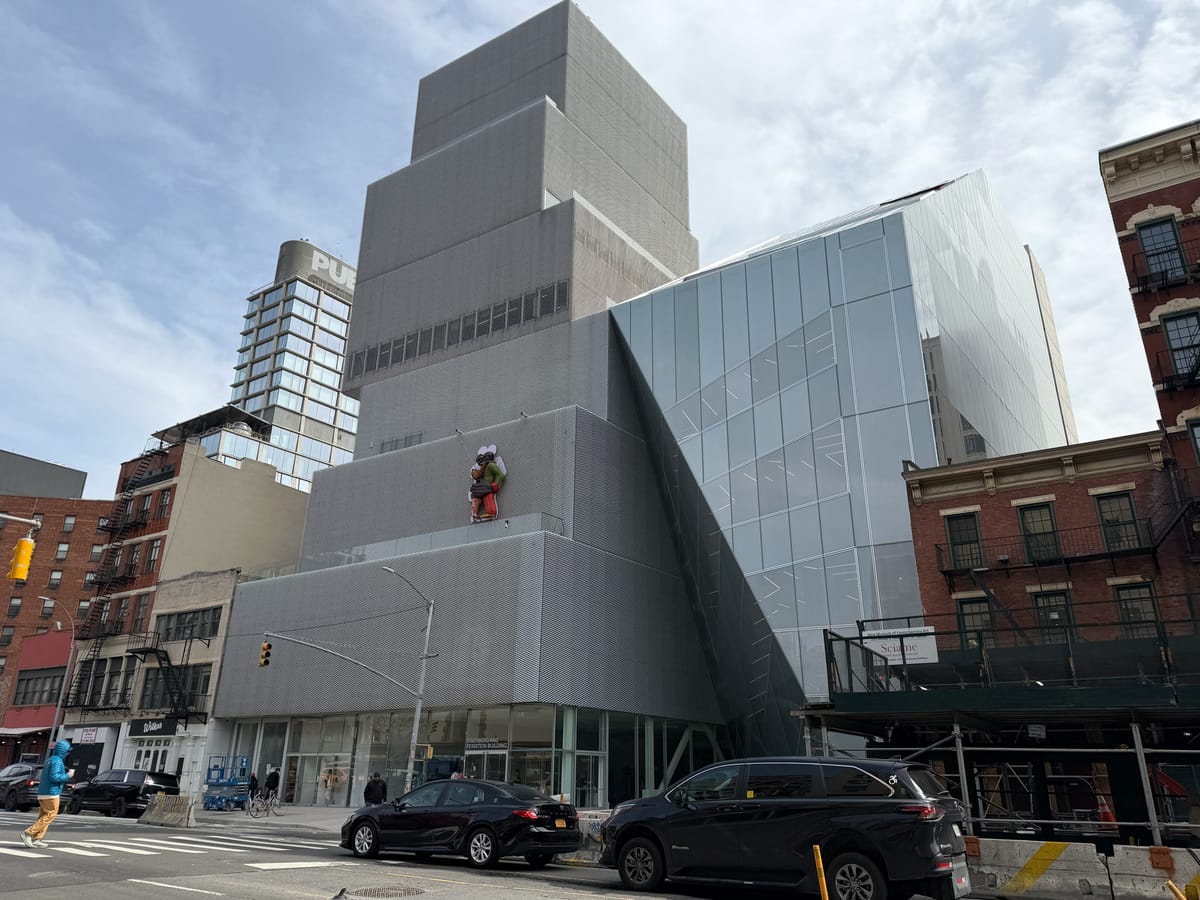
After a four-year process and two-year closure, the New Museum has finally returned. Designed by OMA / Shohei Shigematsu and Rem Koolhaas, this 60,000-square-foot expansion doubles the institution's exhibition space and creates more room for artist residencies, public programs, and its "cultural incubator," NEW INC.
The inaugural exhibition, New Humans: Memories of the Future, explores what it means to be human amidst cataclysmic technological change across the 20th and 21st centuries through the work of more than 150 artists, scientists, filmmakers, and more.
It's certainly bigger, but is it better?
Hyperallergic's editors got together after the press preview earlier today to share our thoughts on the expansion, the exhibition, and what the new New Museum holds for the future. Read our conversation below.
—Lisa Yin Zhang, associate editor
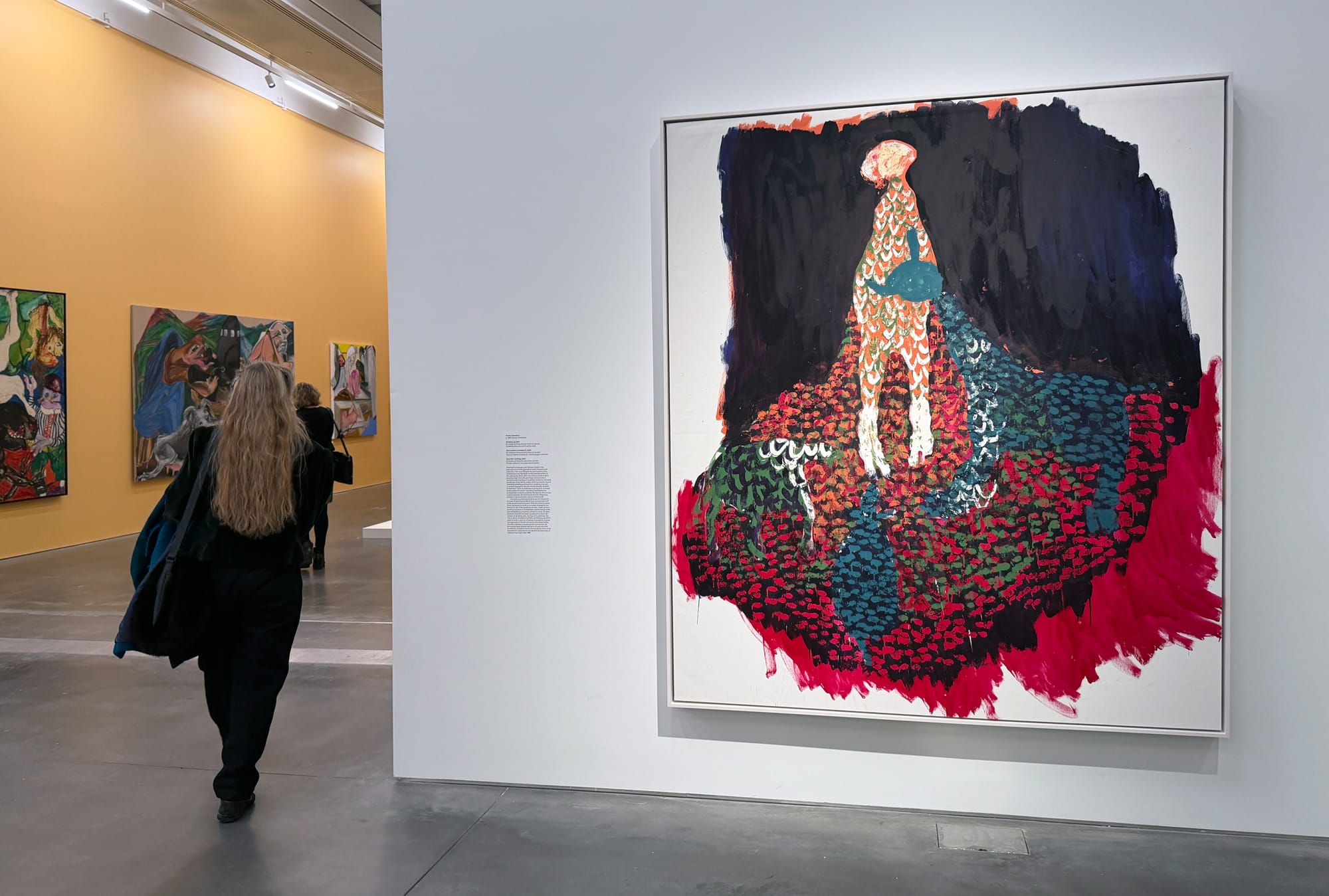
Hakim Bishara, editor-in-chief: Alright, how was it?
Hrag Vartanian, editor-at-large: Well, I wrote an intro while walking through the museum.
Hakim: Already?
Hrag: Yes, I’ll read it:
Perhaps it was inevitable that the neo-colonial language of contemporary art would lead to the collecting not only of objects and histories, but also of museums themselves. The new New Museum is many things: contemporary, perhaps, but also a science, history, anthropology, and many other museums in one. It echoes the desire of its patron class to own the world and its affiliated courtier class to deliver it to them on a silver platter, or encased in perforated metal, in this case.
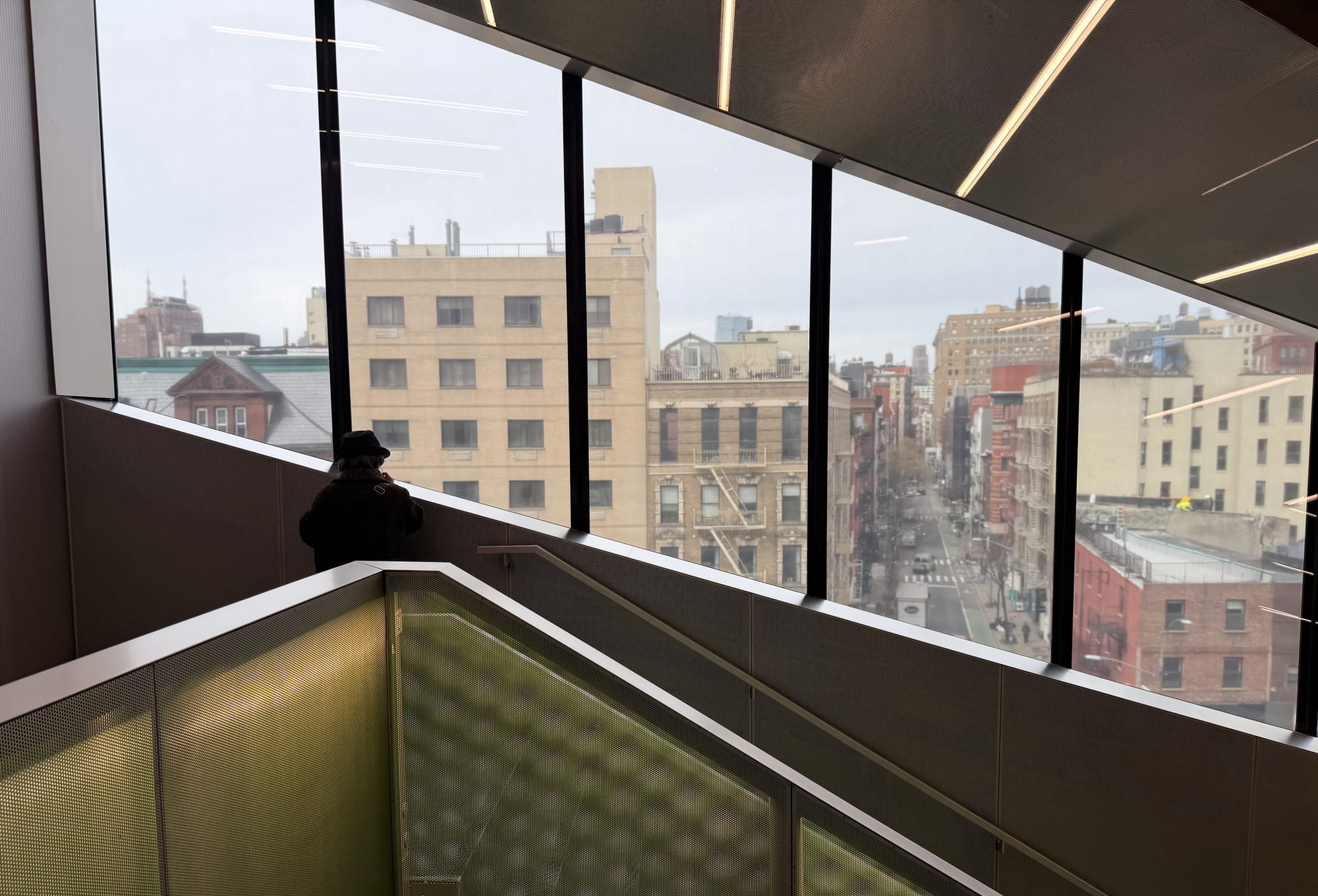
What we've gotten is a mishmash of Obama-era startup culture, dated by the lime green and perforated metal. That, at the very least, gave us a central staircase with nice views of the neighborhood. But galleries feel quite industrial, and more aligned with the commercial gallery spaces that defined the design of the previous building.
And I’ll add, what they left from the previous building is odd, including that strange wheelchair-inaccessible staircase between the third and fourth floors, where they exhibited three artworks, including Judith Hopf’s “Phone User 5” (2021–22). And then the long narrow gallery that is on the north side of the second floor galleries — which had some of the best works in this show, including Frank Malina’s “Reflections III” (1962), Kenneth Knowlton and Leon Harmon’s “Computer Nude (Studies in Perception I)” (1967), and Alison Knowles’s “The House of Dust Edition” (1967).
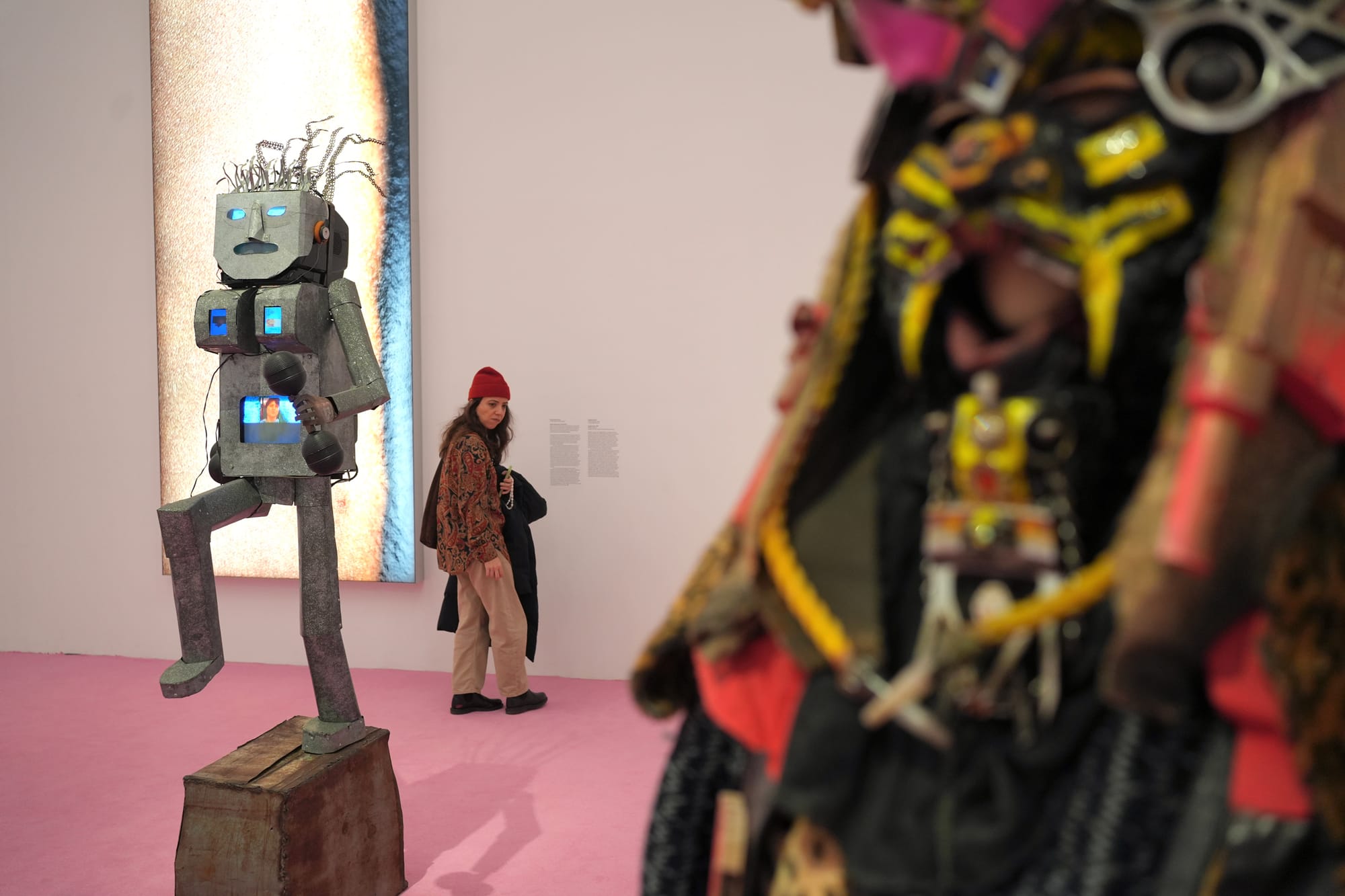
Shigeko Kubota's "Jogging Lady" (1993) on view in the Hall of Robots, with a close up of Rammellzee's "Chaser the Eraser" (1994–2001) on the right (photo Hrag Vartanian/Hyperallergic)
Hakim: Strong words. For me, it felt like more of a useful expansion than an inspiring reimagining of the museum. The best part is the staircase atrium.
There’s more breathing room, and a welcome shift from the stacked floors of the old building. Still, I found the doors to each floor too narrow to accommodate the increased volume of visitors.
Also, I didn’t see more amenities to support the increased space. No new restrooms, for example.
Lisa Yin Zhang, associate editor: There actually were new restrooms — they were just hidden behind unmarked doors, extremely hard to find.
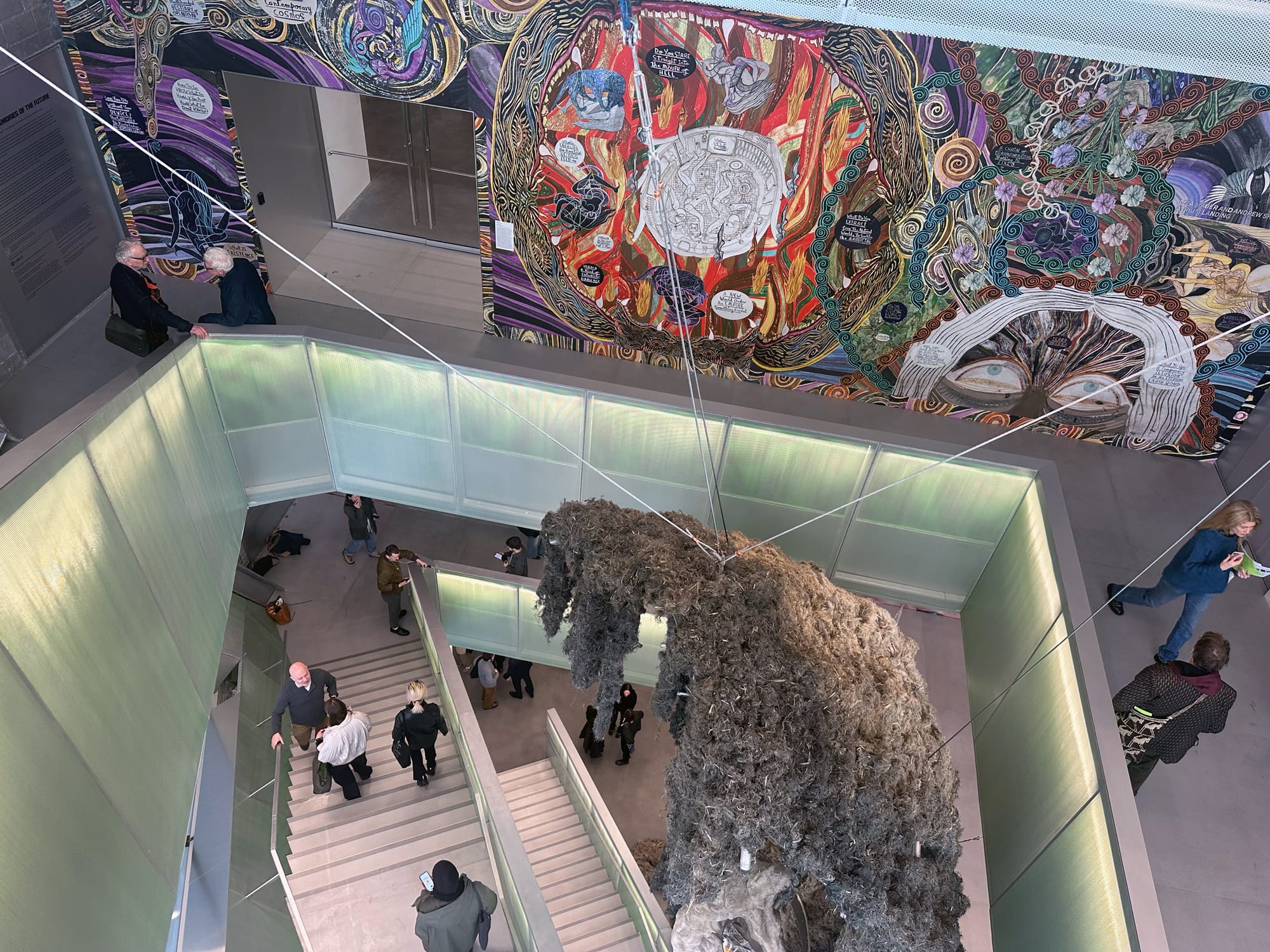
Hakim: The stairs are slippery.
Hrag: I felt it at the top of one staircase. And the staircase surfaces have sharp edges. An older colleague expressed concern about the railings and potentially cutting herself on the metal balusters or stairwell walls. I’m not sure what to call them.
Hakim: I heard a couple of older people complaining about the slippery stairs. “I’m scared,” one said.
The design looks great from the outside, but inside, the functionality is in question. The merging of the old and new galleries felt seamless, but the design could be more organic. The thinking is still more or less vertical, just with wider galleries.
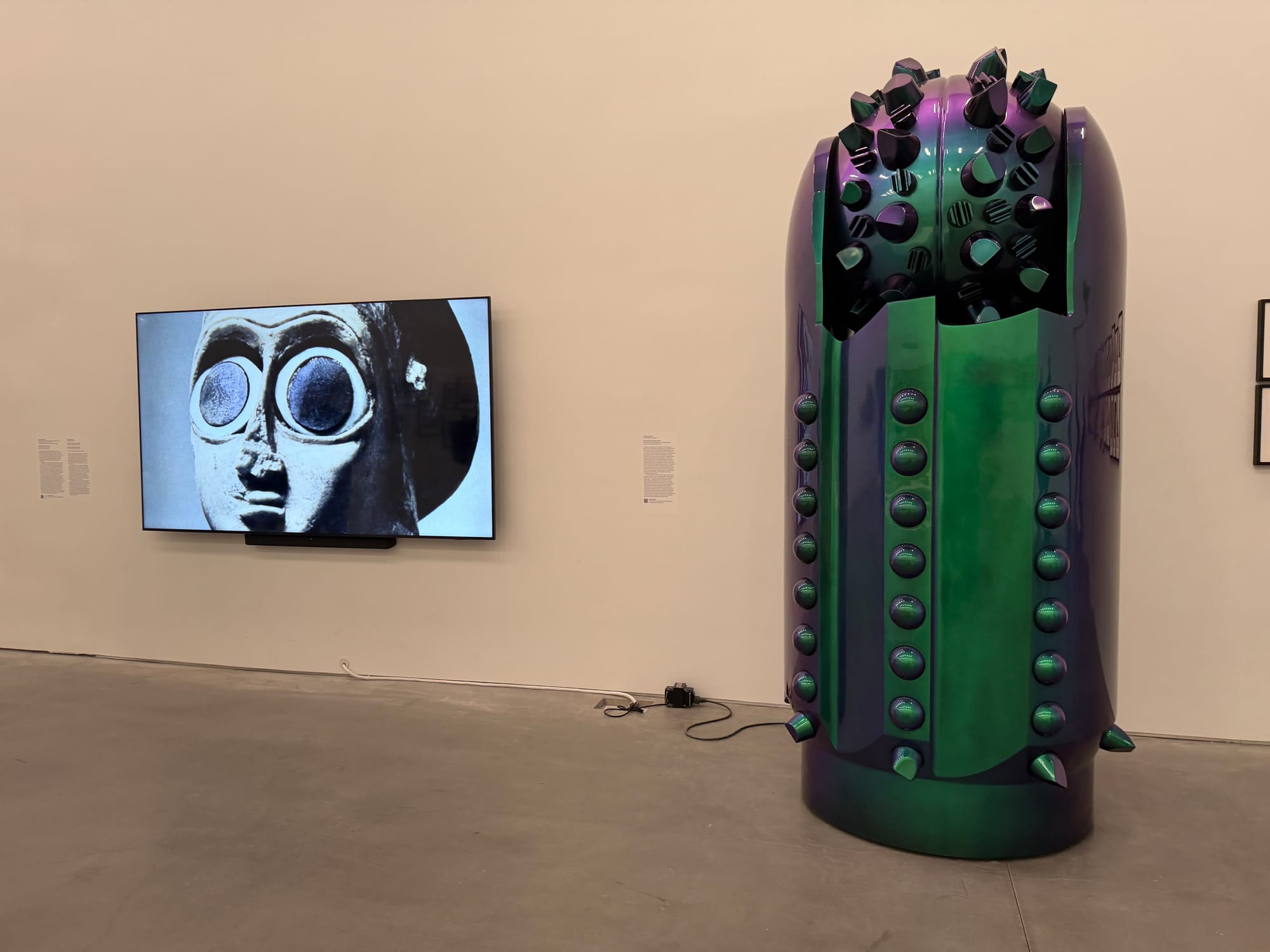
Valentina Di Liscia, senior editor: Here's my thing. I think both the exhibition and the exhibition spaces felt more like a private foundation or collection than a public museum, especially for an institution that is making a big deal out of its engagement with its audience and with the neighborhood. The exhibition galleries were too crowded — there was too much work, over 700 objects. The wall texts were too long and verbose. There was just too much. And I don't think that shows a lot of empathy toward the visitor, if we can't appreciate the works on view. Like, what and who is this for?
That was my main takeaway. Was it the case that the curators had all this extra space, and so they were like, ‘Let's put as much as possible in here?’ One thing we all observed is this sense that there was no editing — no editing in the wall texts, no editing in the exhibition itself. Everything felt kind of tossed together.
I think that did a disservice to individual works, and to that very human experience of being moved by an artwork and going home and feeling like it opened up a whole new world.
Lisa: I think the new building is, like, fine. It was a little bit janky. It felt pretty seamless with the old building, which is good — but that also made it feel dated.
That feeling of datedness extended to the show itself. I think part of that was because of the choice to slot in contemporary works with, you know, the Giacomettis and Francis Bacons.
I don't feel like the ideas from the works from the last century were any more dated than the contemporary works about the future, you know? It was deeply uninspiring, as if we, as a species, are incapable of creating anything truly new.
Lakshmi Rivera Amin, associate editor: The building itself is very hostile to visitors, which is hard to imagine because the first one was, like, not a welcoming place. It felt like the visitor experience was an afterthought. And the show was so sprawling that it didn't say anything new.
Valentina: You said something during the preview that stuck with me, Lisa. You said, “This looks like the museum someone envisioned would be the future of museums 50 years ago.”
Hrag: They designed it 12 years ago and they're like, okay, we're gonna build it eventually. Which is a shame, because Renzo Piano’s design for the Whitney Museum still feels fresh and it opened just over a decade ago. This already feels dated, and it opened this month.
Lisa: Yeah, exactly.
Hrag: I disliked that it started with Duchamp, Dalí, and Brâncuși works, among other well-known names, since that suggests a very pedestrian view of art history and what this new museum was.
Valentina: And in that same gallery, you had the new Wangechi Mutu works, which are wonderful, but I think sadly get completely lost.
I just think we all need more transcendental, sublime experiences right now. And this was the opposite. It reminded me of rotting in an Instagram hole for a few hours and then walking out and feeling bad about yourself.
Lisa: Yeah. I think if I could use just one word to describe the whole thing, it would be: “inhuman.”
Hakim: “Post-human,” perhaps?
Lisa: Ha, yes.
Valentina: That sanitizes it a little bit. “Post-human” sounds like we're entering a new era. This was just like — apocalyptic, almost.
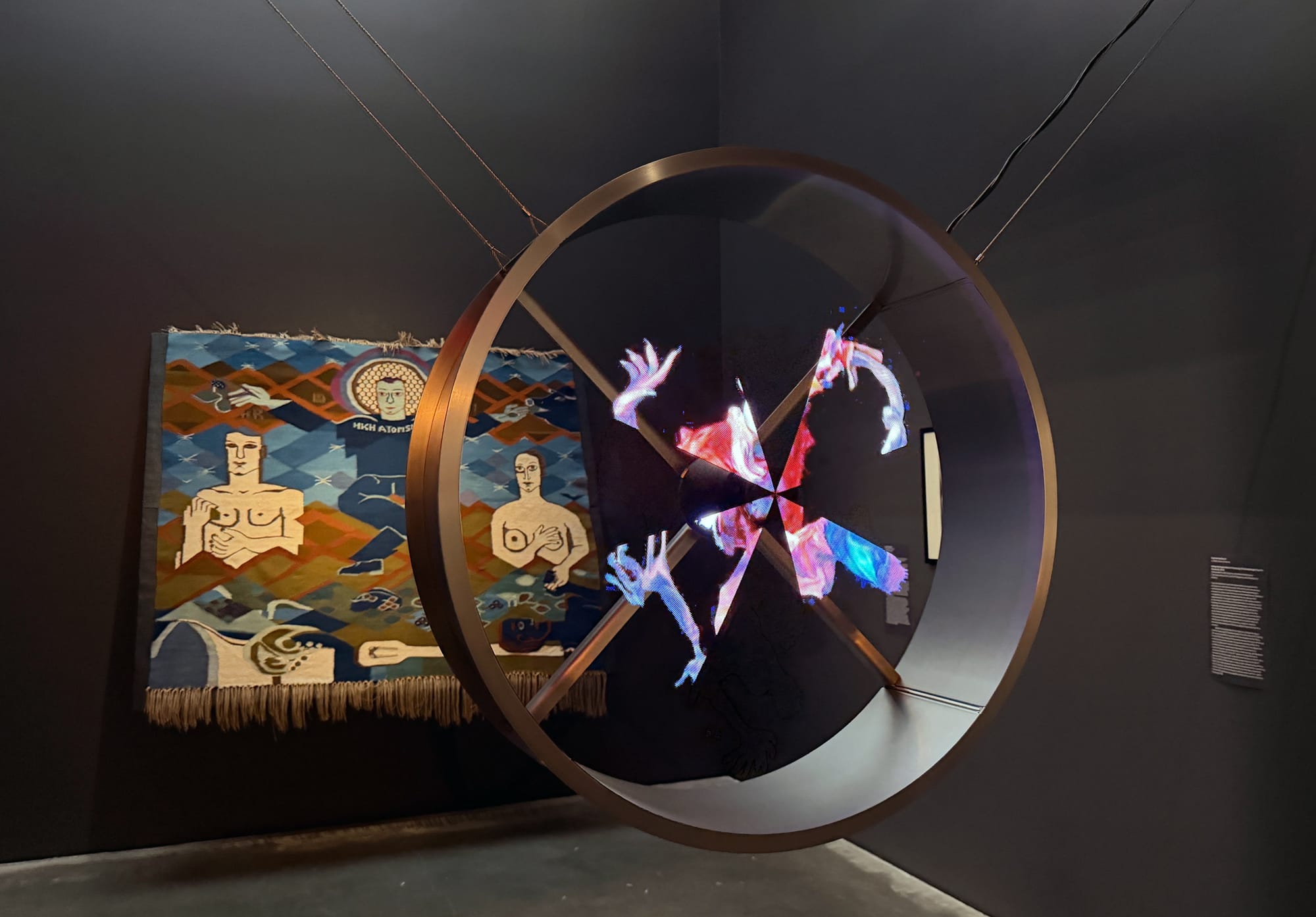
Lisa: Well, this is a new era, and it has no people in it. This show felt like it was made by somebody who isn’t thinking about people, who doesn't like them. It was way more about technology —
Hakim: But that's the point of the show.
Lisa: But like, the title of the exhibition is “New Humans.” Where are the humans?
Valentina: Technology has a human side to it, too. And it did not always appear in the show.
Hakim: Do you wanna talk about the different floors? There’s a different feel to each floor.
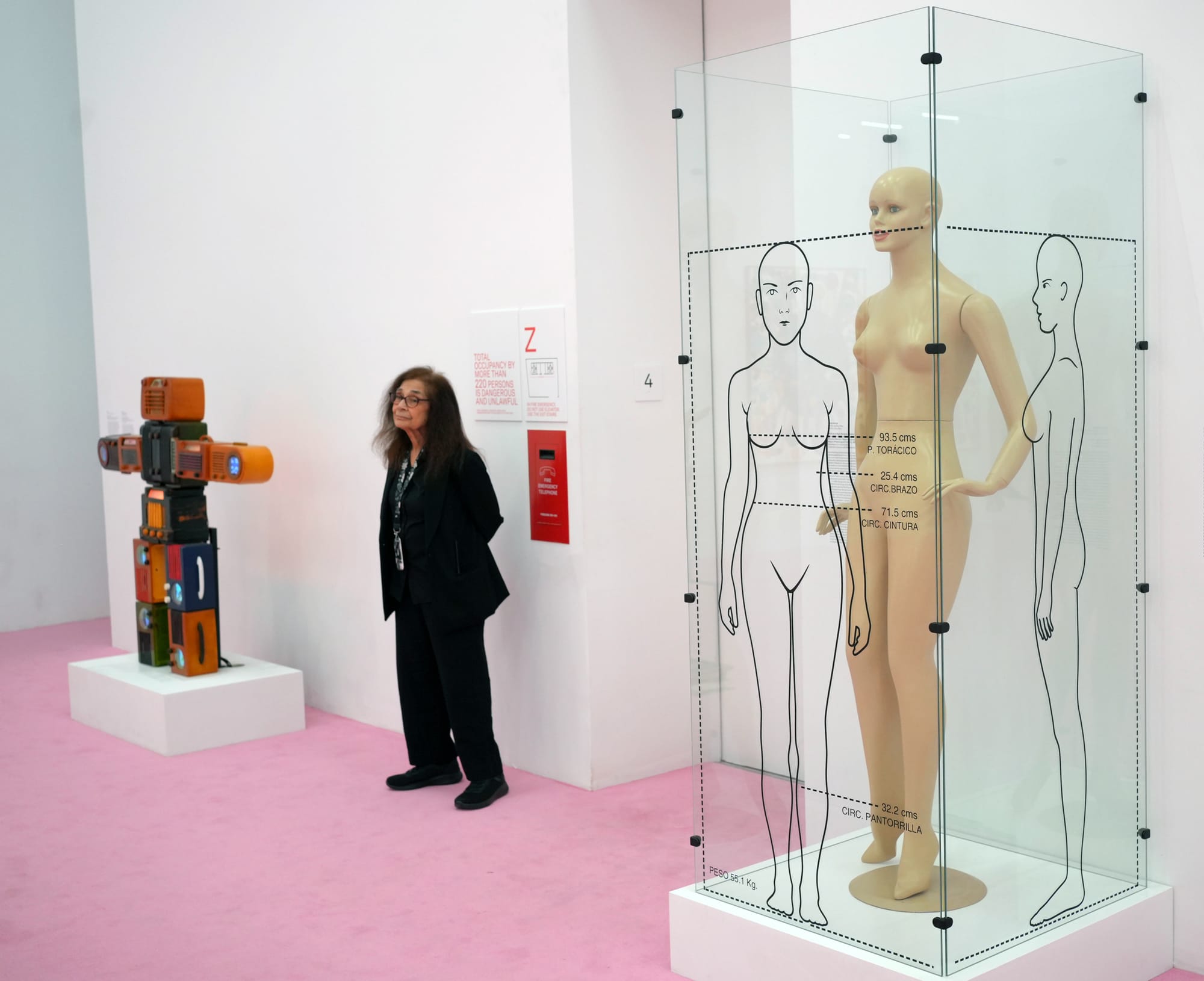
Hrag: The fourth floor, called the Hall of Robots, felt like a science museum with the ET display and the “Glass Man” by Franz Tschakert, which hails from the German Hygiene Museum, which is a medical museum. And then the wall photographs by Seth Price were just dull and took up too much space for what they were, which were close-ups of human skin.
Many of the objects there felt really little thin and I kept thinking, “oh, look … the human body imagined in a different way.” And I thought Teresa Burga’s “Perfil de la Mujer Peruana / Objeto-Estructura-Informe Antropométrico (Perfil Fisiologico 1) [Profile of the Peruvian Woman / Object-Structure-Anthropometric Report (Physiological Profile I)],” (1980-81/2017) with the mannequin in the vitrine verged on the cheesy. It didn’t feel insightful, but illustrative of something that went nowhere. It was a room of various visions of the body, and many were quite rudimentary. Perhaps a group of school kids could get excited by this, and I hope that’s the case, but as an adult it was quite flat and uninspired.
Valentina: There were also some body artworks on the second floor, on a smaller scale but more thoughtfully done, which I think were a more interesting exploration, like Berenice Olemdo’s “Olga,” a sculpture of a children’s orthosis animated by a motor. But I agree with you, Hrag. There was something very exhibit-esque about that fourth floor. Very Bodies circa 2006.
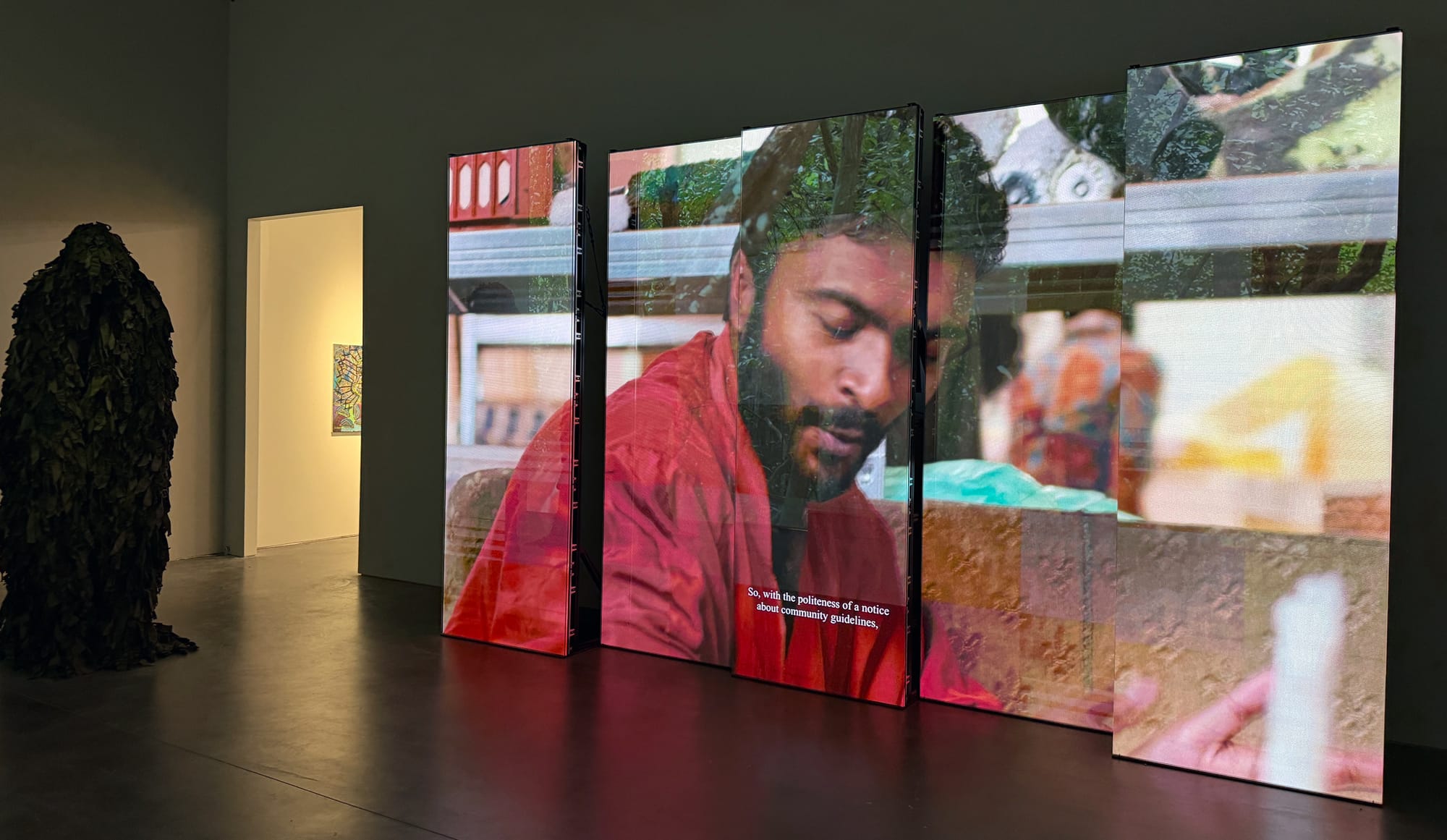
Hakim: I did like Christopher Kulendran Thomas’s video installation on the third floor. It’s well-installed.
But I sensed a missed opportunity in the sky room on the seventh floor. They could’ve had a hologram of Donna Haraway there…
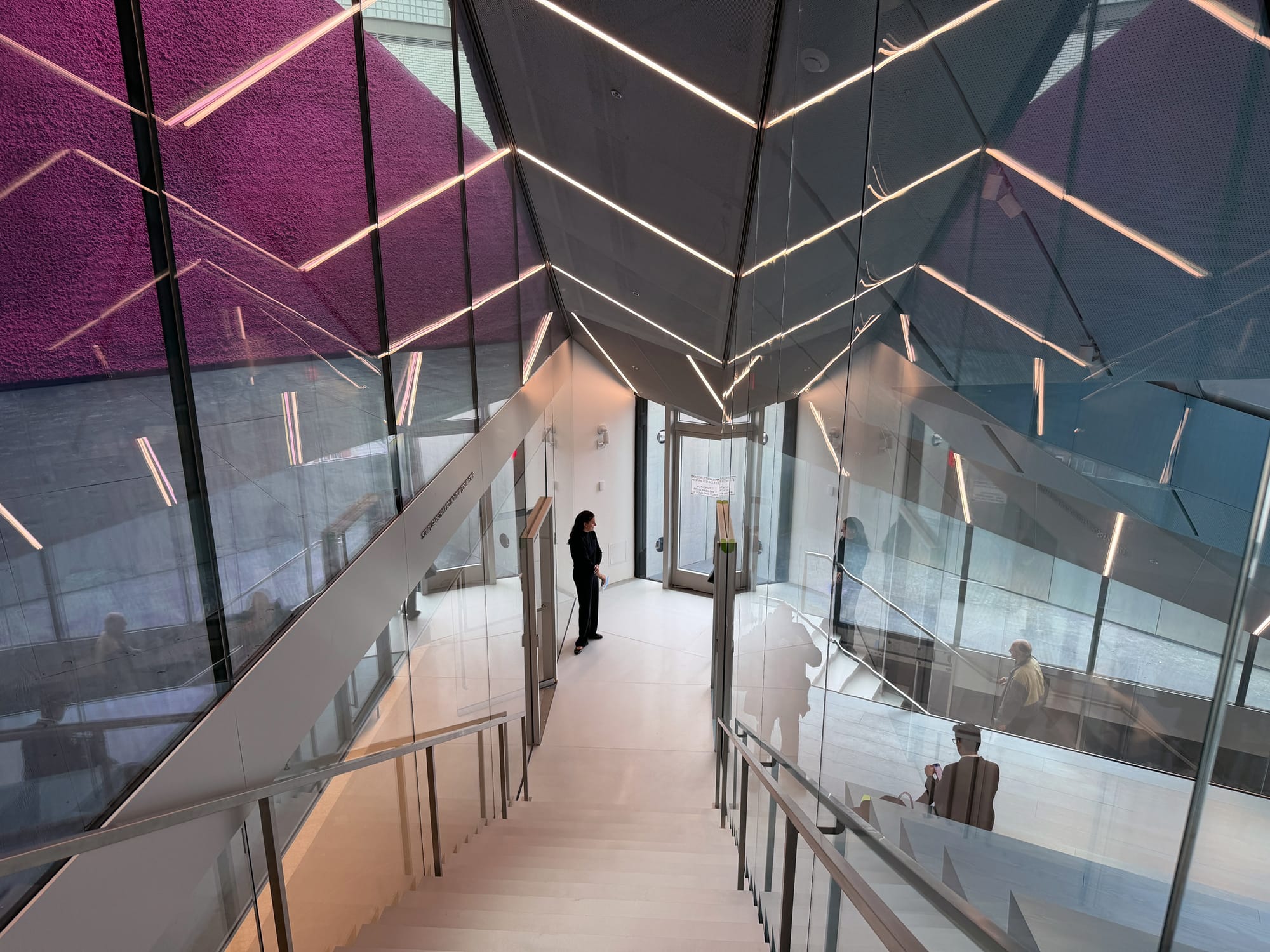
Lisa: I actually liked the installations a lot of the time — I felt like they tried to make them visually appealing.
There was one specially built display case on the third floor housing the almost Magical Realist work of the Danish artist Ovartaci — I thought that was successful.
Even the red room, with the salon-style hanging and the sculptures by Giacometti, Germaine Richier, and others in the center —
Hakim: I liked the red room.
Lisa: I did, and I didn't.
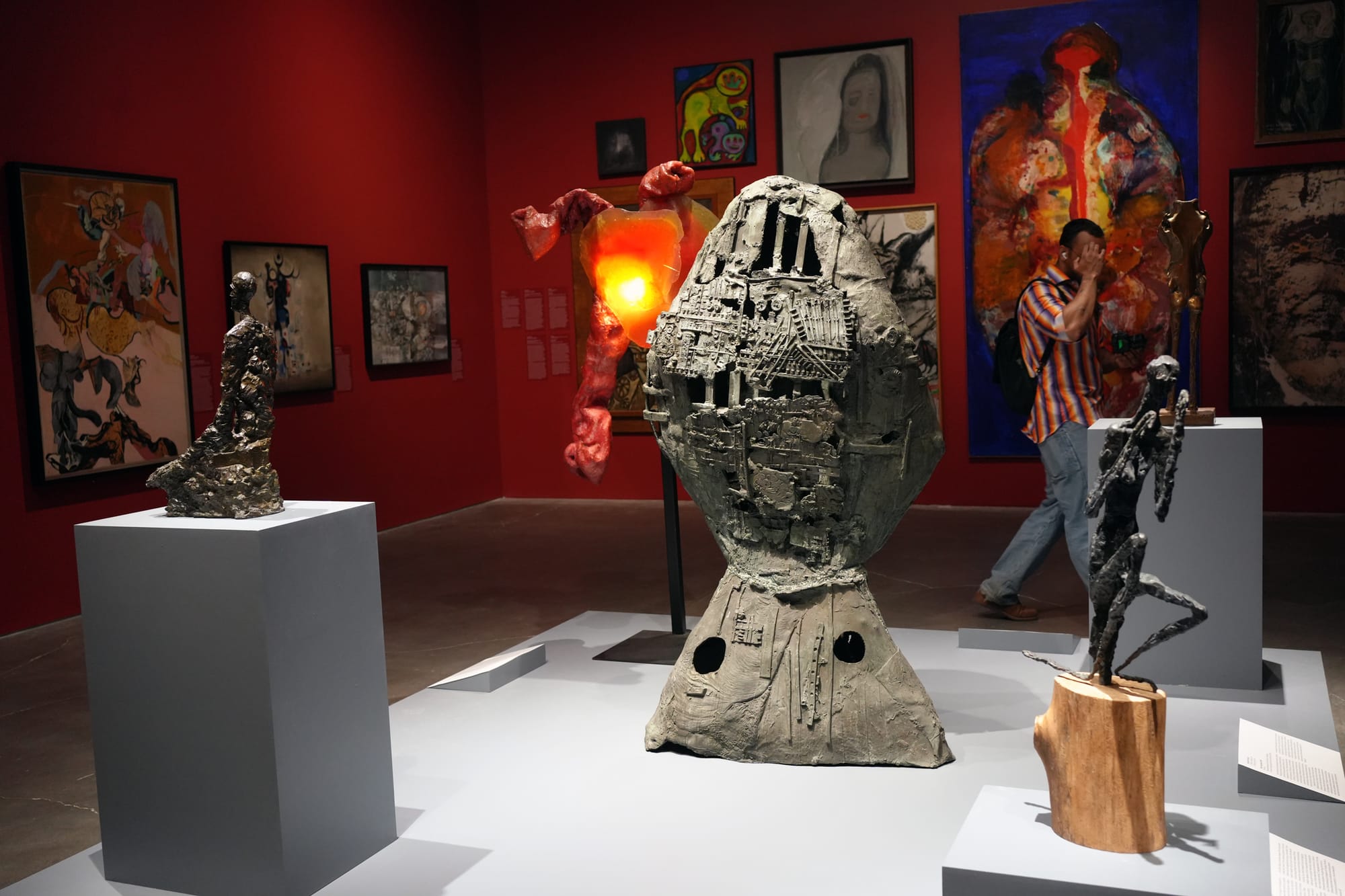
Lakshmi: I liked some individual works, but often the way they were arranged, installed, or even lit did them a disservice. They got lost because they were haphazardly shoved into a room with more work than it could fit, and the wall text didn’t connect them in any compelling way. Not to mention the fact that I saw multiple museum workers scrambling to replace pieces of paper with vinyl-printed wall text during the preview. I know they don’t get paid enough to do that.
Lisa: The wall texts didn't talk to each other at all. It seemed that the museum invited people to write them, and I'm not sure they read what each other wrote. I would've cut at least the first line of almost every single wall text. And then about half more.
Lakshmi: Agreed. And they were trying to do something intentional by putting writers’ names and initials after each blurb, but it ended up feeling overly academic and disjointed.
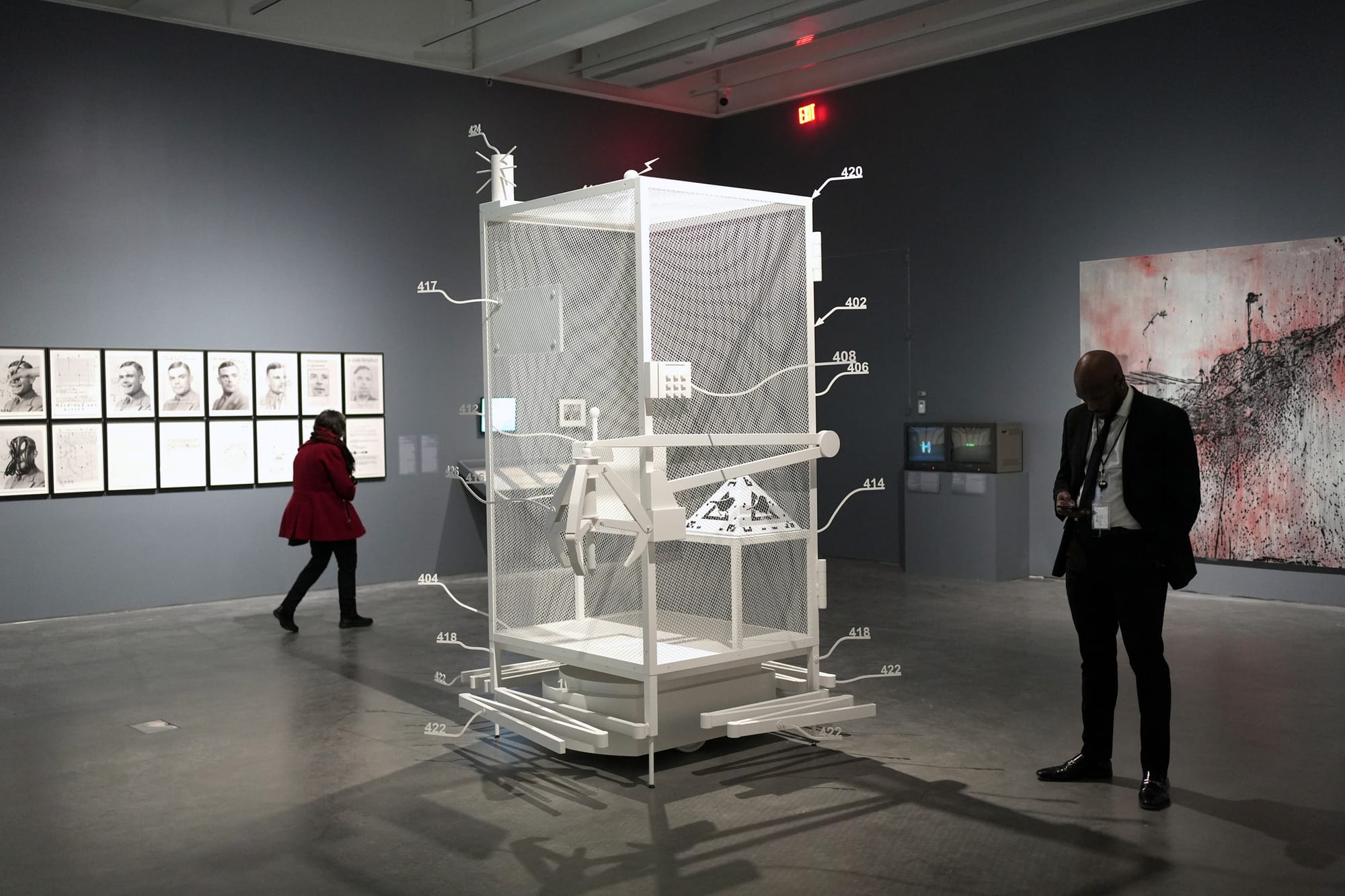
Hrag: Everything felt strangely safe. The wall text for that Simon Denny work was like a farce. I have to read it. It says “… the real world patent modeled in Simon Denny's ‘Amazon Worker Cage’ (2019) actualizes the prisons humans find themself in amid larger automated workflows.” Ok, thanks, New Museum, noted.
Valentina: The wall texts gave me this feeling of dread. And likewise, a lot of the individual works in the show were great, but they were shrouded in this fog of malaise.
Hrag: There were also a lot of bad paintings, like Jacqueline Humphries’s conceptually and visually leaden paintings from 2024–25. One of Miriam Cahn’s paintings was great, while the other was simplistic and flat, and Jamian Juliano-Villani’s “Susie Bobby Ryan” (2022) is the perfect example of bad navel-gazy pandemic-era art with its lack of perspective, privileging of forgettable popular culture, and finding inspiration in the mundane — and I hope most of that stuff doesn’t leave the studios of artists.
Valentina: But there were some amazing paintings, like that piece by Maina-Miriam Munsky on the second floor, “Geburt II [Birth II]” (1967). I did not know this artist. She was a German New Realist. It was very cool to discover her work.
Hrag: There were some excellent paintings, like the works by Wangechi Mutu. And the whole “New Images of Man” room was very nice, but didn’t feel like a contemporary art museum, more like a conventional display from an encyclopedic or Modern Art museum. Updating the juxtapositions with some names that aren’t normally included didn’t make it new, just refreshed.
That room, like the rest of the show, was still very much tethered to Western European Modernist ideas of art and its obsessions with the self and European history. The Holocaust was even cited in the wall text, as well as the too-often repeated quote by Adorno that “to write poetry after Auschwitz is barbaric,” because anyone who has studied genocide today knows that persepctive is the result of a Eurocentric vision of barbarity, since the Holocaust is part of a continuum of genocides that are ongoing today, and scholars don’t view it has having any type of exceptional status, like they once did.
Yet the Gaza, Rohingya, Sudanese, or Artsakh genocides, all events that question the human today, are nowhere in this exhibition. How can you talk about the “New Human” without delving into the actual genocides of our time?
Yet again, the New Museum isn’t very new, but kind of conventional in their framing. I can only imagine why they refused to discuss contemporary genocide, which really challenges each and every one of our ideas around humanness and who is allowed to be classified and seen that way.
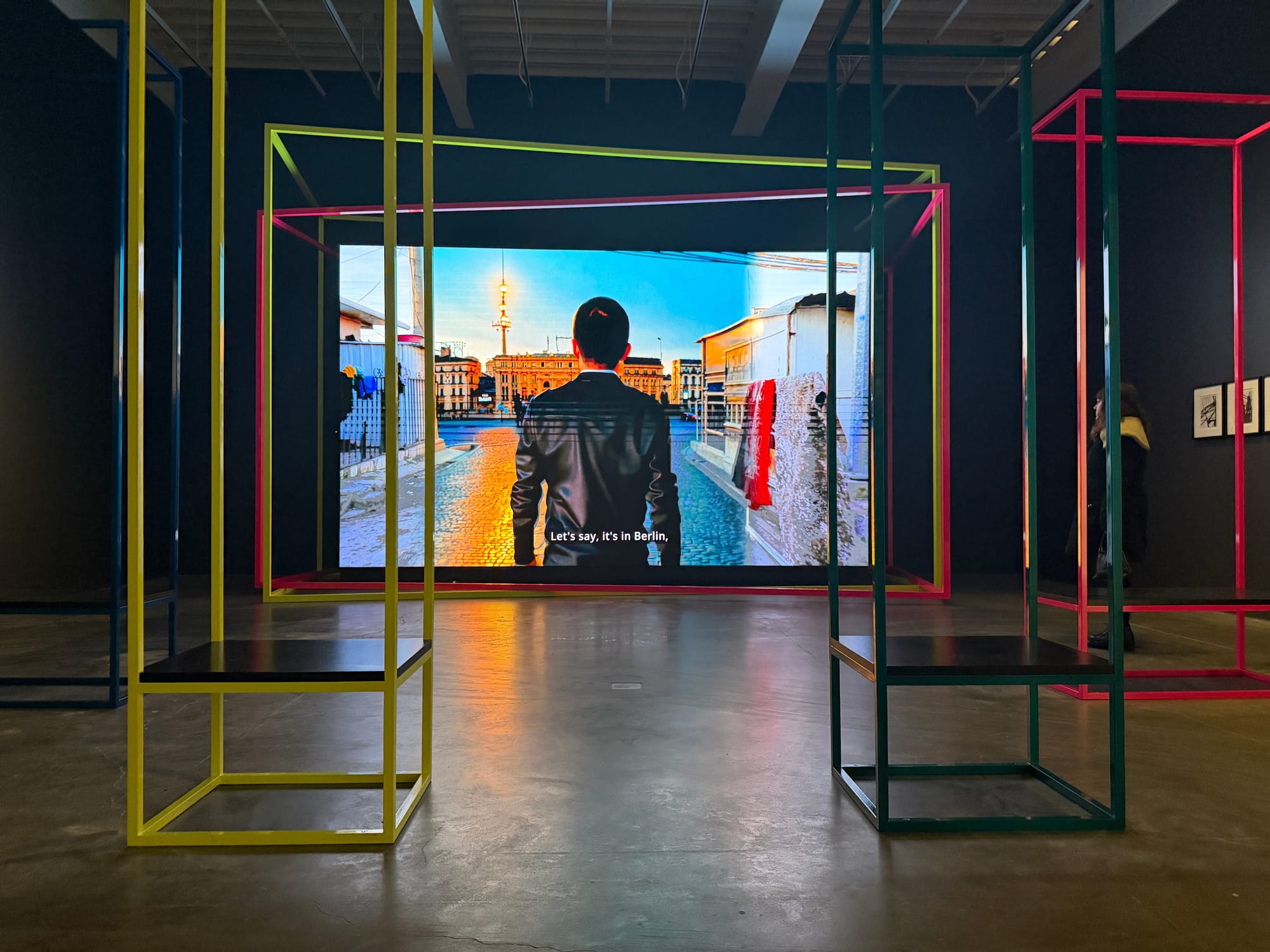
Hakim: Some rooms focused on experience, like Hito Steyerl’s “Mechanical Kurds” (2025).
Lisa: I noticed that there were a bunch of people watching, but nobody was sitting.
Valentina: Oh, I didn't even notice they were benches. They’re not inviting seating.
Lakshmi: They're supposed to mirror the structures in the film, but it's not clear that you're supposed to sit in them at all. And they’re among the few benches that were even available for people throughout the show.
Lisa: The only benches were next to video work! I actually did another pass and looked again — not a single other bench.
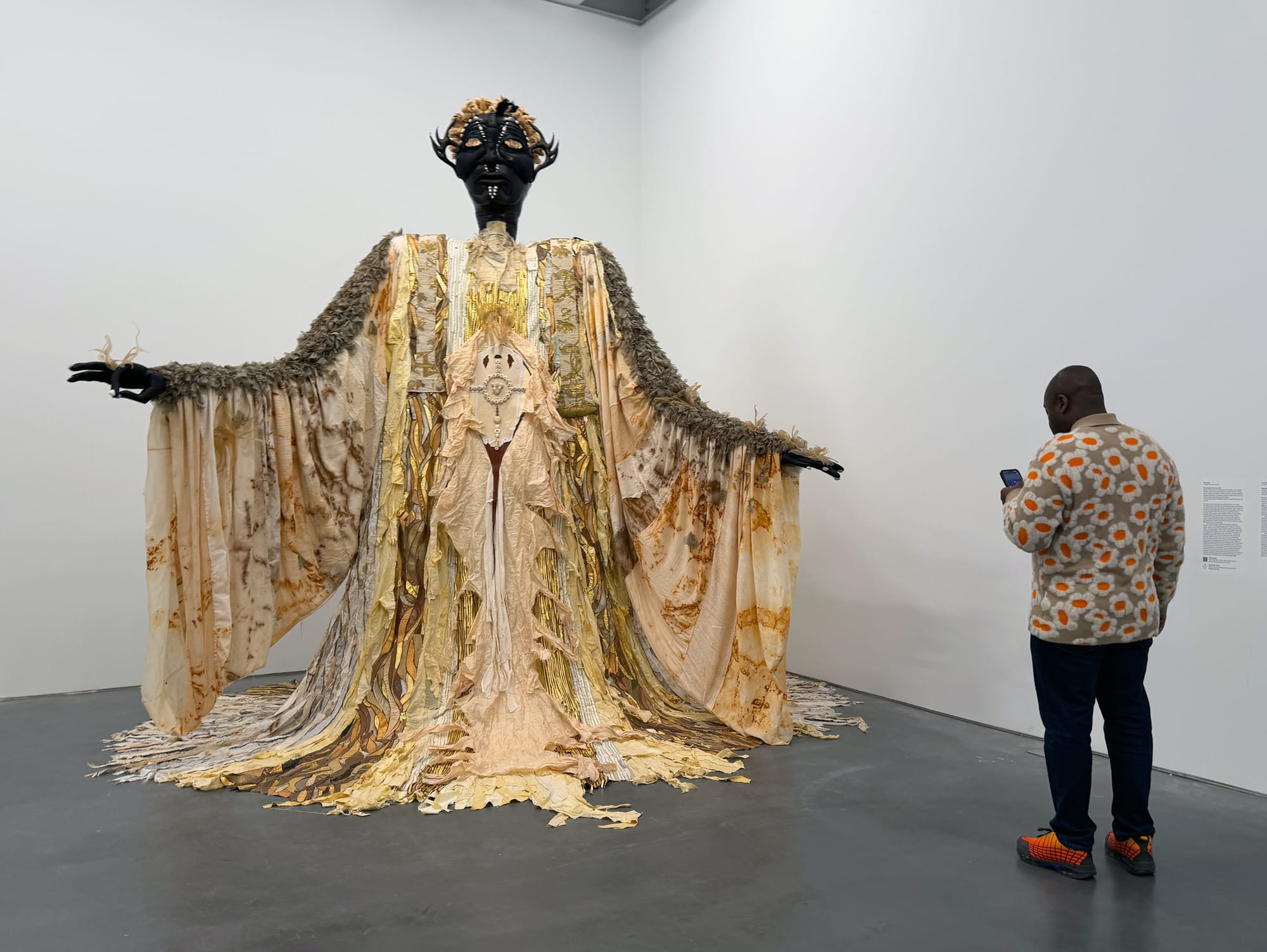
Hakim: Let's talk about how this expansion changes the New Museum, because I feel like it turned from a boutique museum into an encyclopedic one overnight. Do you think all of their shows are going to be massive like this?
Lisa: I don't think so.
Lakshmi: I hope not.
Valentina: It would've been better to do three separate shows, maybe.
Hrag: When the original museum, designed by SANAA in collaboration with Gensler, reopened in December 2007, the whole museum was filled with the Unmonumental exhibition, which was billed as “un-heroic” sculpture by 30 artists. In retrospect, that show was okay, but not that memorable, so this full-museum show continues in that tradition.
Hakim: Does having all this space give you more freedom, or less? Does it make you more institutional and less experimental, or does it actually give you space to experiment more?
Hrag: I didn't see any experimentation in the curation. Did any of you feel differently?
Hakim: No. Other than the hovering balloons that can fall on your head.
Lakshmi: I don't know if it was materially different to me from the old building, though the staircase did bring more sunlight and airiness to the space.
There is more space. But a lot of it is dedicated to administrative offices and “sky rooms” on the upper floors, which won’t always be accessible to the public.
I got the impression that the expansion was more for the institution itself to host events, artists in residence, and “incubate,” whatever that means. But the actual exhibition spaces, and even the lobby, make it clear that we are not meant to linger or reflect.
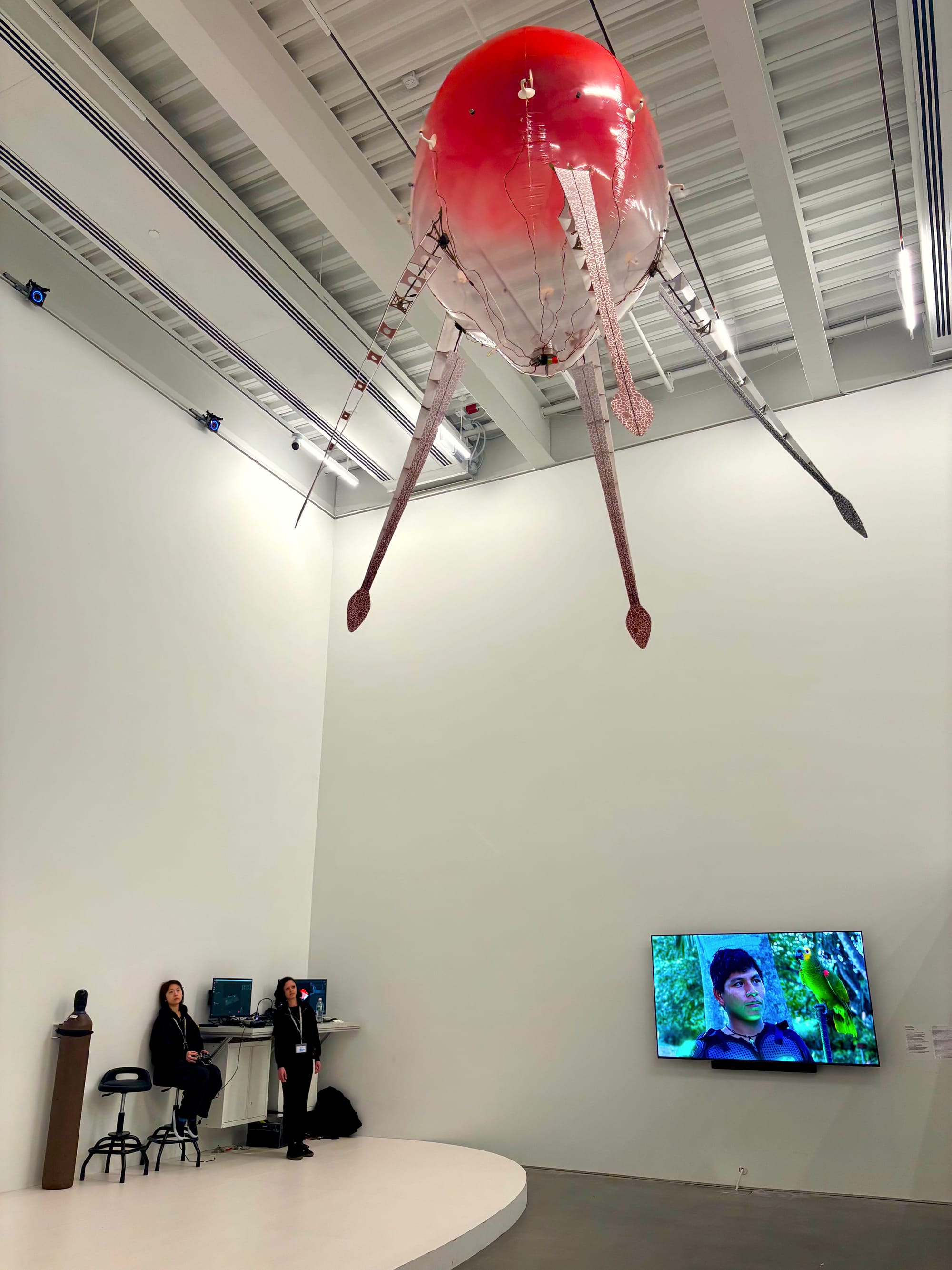
Valentina: This is, I think, the core of the problem. It’s a lot of space, but for what? Like, there were microcosms in that exhibition that could have been their own show. The small blue gallery that explored relationships between humans and machines — with the kinetic piece by Jean Tinguely, and the Konrad Klapheck painting of a typewriter that subverts the aesthetics of fascism, and the Allison Knowles work — that was its own exhibition, and it didn’t need a lot of space to be successful.
Lakshmi: I also enjoyed the work in that room, including June Leaf’s “Out of the Blue” (2018–19), but not its lighting or layout.
Hrag: It was hard to enjoy and view a lot of the video work, unlike this year’s Whitney Biennial, which gave consideration to our video-viewing experience.
Valentina: The video works on that second floor were all bleeding into one another — the Camille Henrot, the Hito Steyerl … You could hear them all at once. It was cacophanous.
Hrag: I didn't think those full-wall murals by the staircases worked. I saw what seems like a version of that Tishan Hsu “ears-screen-skin” wallpaper in the atrium at his solo show at the ICA Toronto, and it didn’t feel as forgettable as this version did. Here it reads as a supergraphic for a mall franchise, perhaps an athletic brand.
Lakshmi: You can't really look at them. Those were another example of cosmetic or aesthetic changes that aren’t practical for museumgoers themselves.
Hakim: It's like somebody took the elevators of the Whitney Museum and turned them inside out.
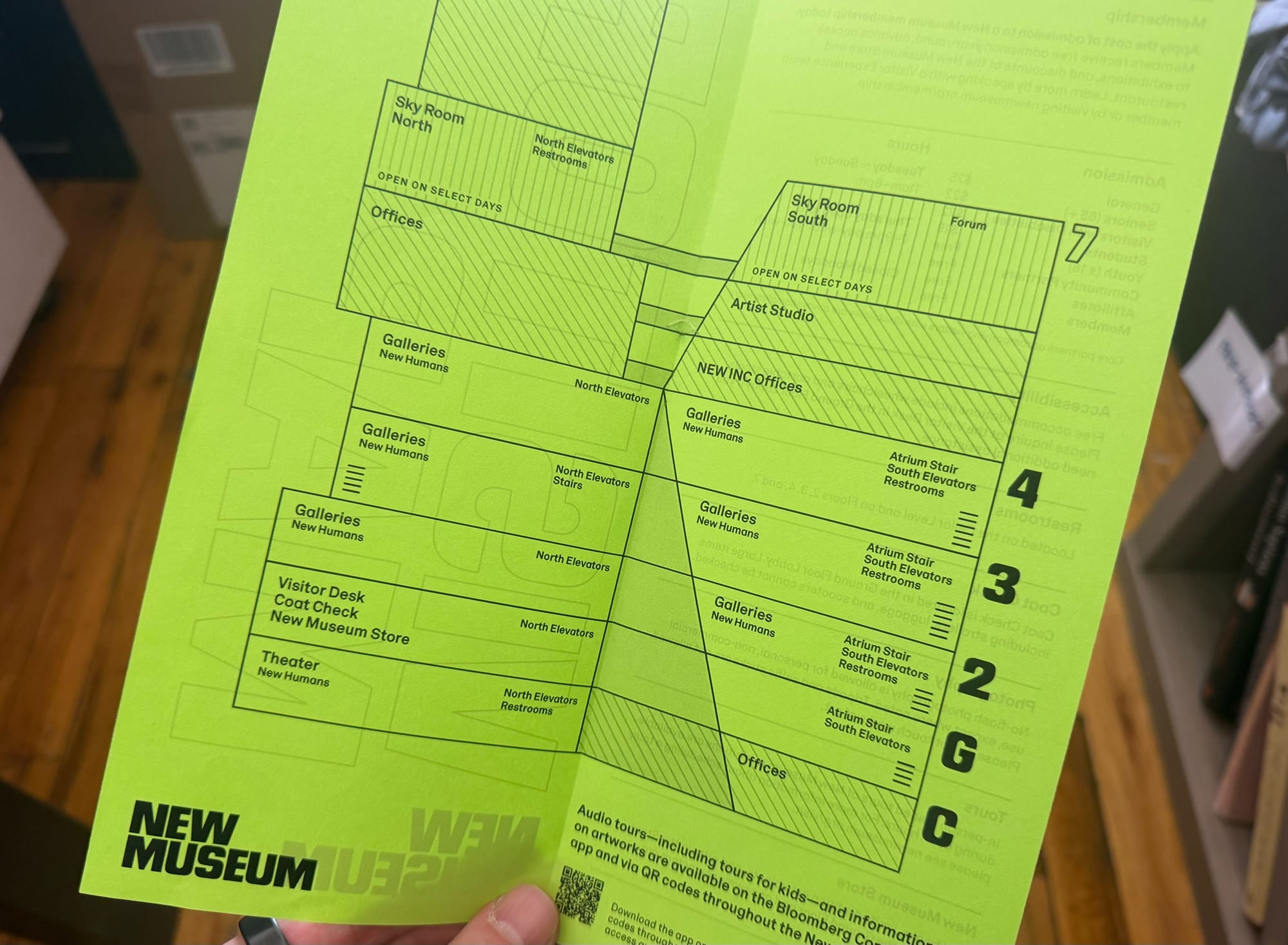
Hrag: I thought the visitor map was one of the worst things in the whole building. Did someone even finish it? It’s a joke of a schematic. It makes no sense. I was just like, how does this tell me what I'm looking at?
Valentina: I think the New Museum is leaning very heavily into being an institution that perceives itself as on the frontiers of technology. Like, a big part of the expansion is creating a home for NEW INC, which the museum calls its “art and technology incubator.” I keep going back to that word — “incubator.” It's such a silly word to use because incubation is about warmth, it's about shelter, it's about tenderness, it's about affection, and this space and exhibition felt like the opposite of that.
Lisa: I feel like it was trying to signal its, like, cutting-edge-ness, but it all came across as inhuman.
Hrag: It doesn't feel new. Nothing felt new about the curation.
Hakim: It's a corporate vibe. A bit like a startup.
Valentina: I think a startup could make a better building. Honestly, I really do.
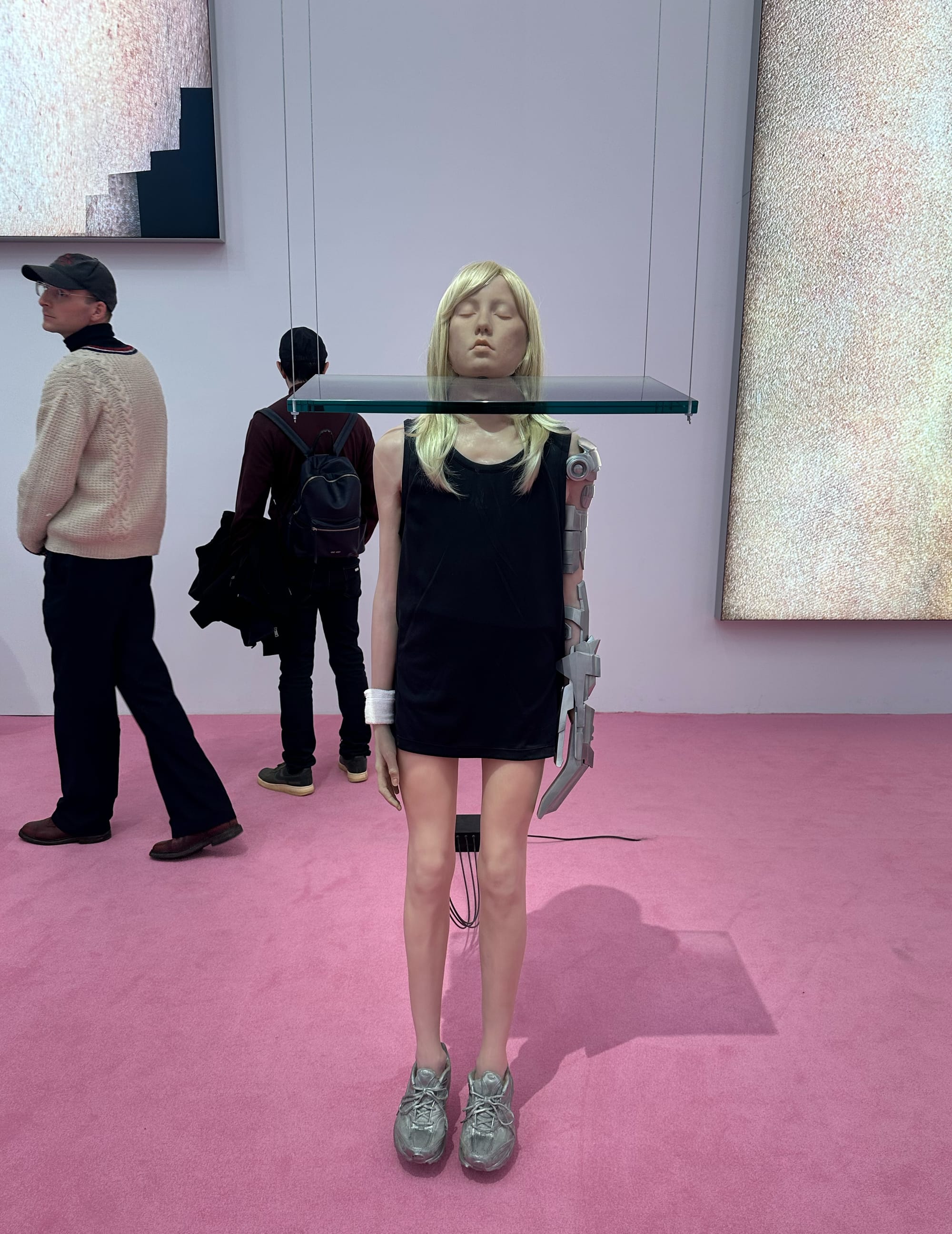
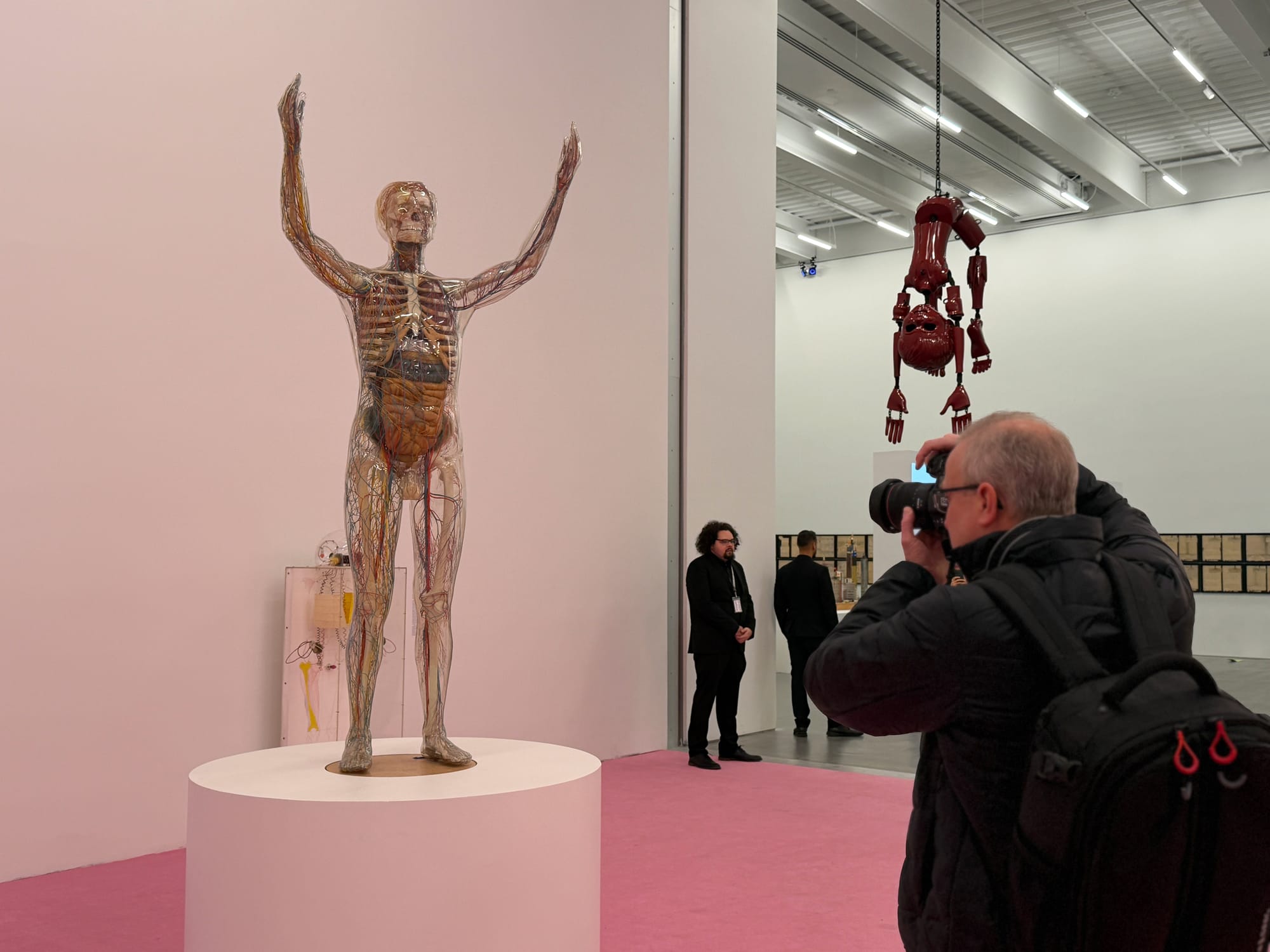
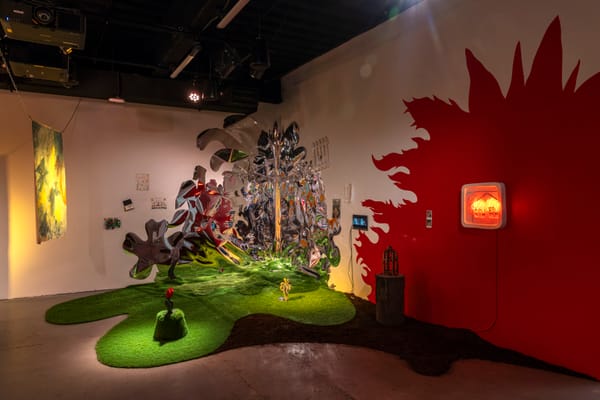
Installation view of New Humans: Memories of the Future (photo Lakshmi Rivera Amin/Hyperallergic)
Hrag: I want to mention one of my least favorite artworks in the whole show, Sara Deraedt’s “Baby being born out of a computer” (2024). It really felt like the most rudimentary sketch by a mediocre art student.
And a lot of things that are not really art. Like the prosthetics, which are not actually art, and the makers didn’t claim them to be art, or those facts aren’t presented if they, in fact, did. I don’t think the curators made the case that they were. I remember doing an exhibition back in the 1990s and the artist did create prosthetics during World War I, so it was common for artists to work on these things, but are they art? During World War II, artists taught camouflage classes but is that art too? I don’t see evidence that they thought of them that way.
So, sure Anna Coleman Ladd’s “Painted metal facial prosthesis” (1917–20) is nice to look at, and she was trained as a neoclassical sculptor, but these were not created with that intention, which we know is important, but perhaps they are something else. It seems like the curators are trying to make them art, why? It points to a hierarchy that places art at the top, which is a very bourgeois idea, and I think what those artists did during wartime was just as valuable.
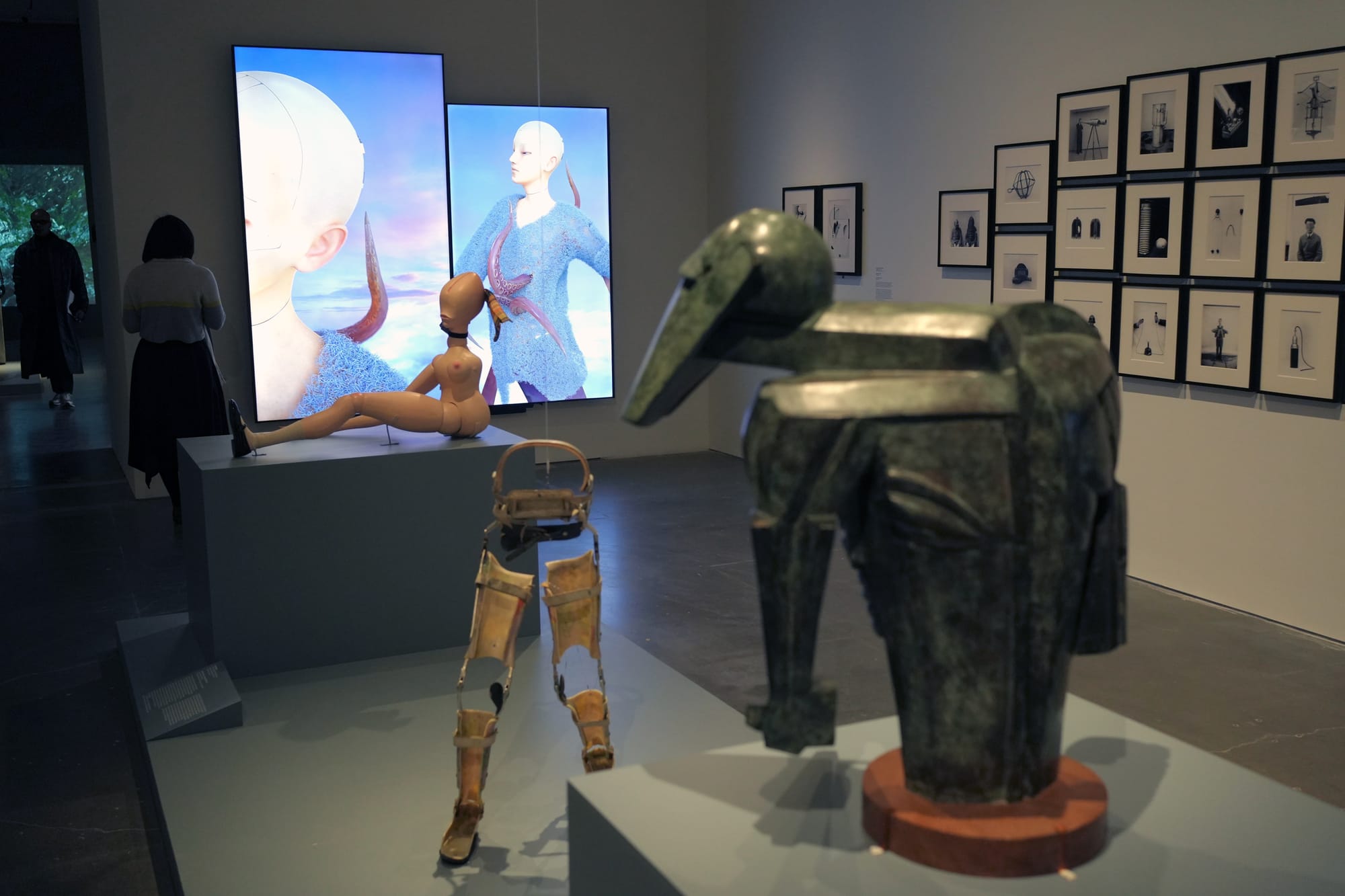
Lisa: You pointed out earlier that it felt like an anthropological museum at certain points. There's a part of me that is intrigued by that idea of looking at humanity from a step back — seeing us as just another animal.
They had a lot of works by the Dadaists, who responded to the brutality of World War I. I don’t think the prosthetics themselves were needed to make that point.
There was a sort of argument about war in there. A lot of work made during and after the world wars, when humanity remakes itself. It was almost, sort of, beginning, to gesture at the fact that we again live in wartime, but it couldn’t finish the point.
Hakim: And we're in that moment again, where we have wars over oil — that's what's happening in Iran and Venezuela. So we have all these technological breakthroughs, but we’re still acting like cavemen.
Hrag: It was so obvious. I didn't need a show to tell me that. I could have just looked at my Instagram feed. And it felt a little bit like that. What’s new here?
Hakim: I’m generally averse to posthuman art. It’s a form of escapism. People need to be reminded to be more human, not less.
Valentina: I feel like art is supposed to give us a reason to keep fighting. It's supposed to give us a reason to stay in it, to fight for beauty, to fight for humanity. And this was kind of like, telling us to just give up.
Lisa: Yes. A hundred percent.
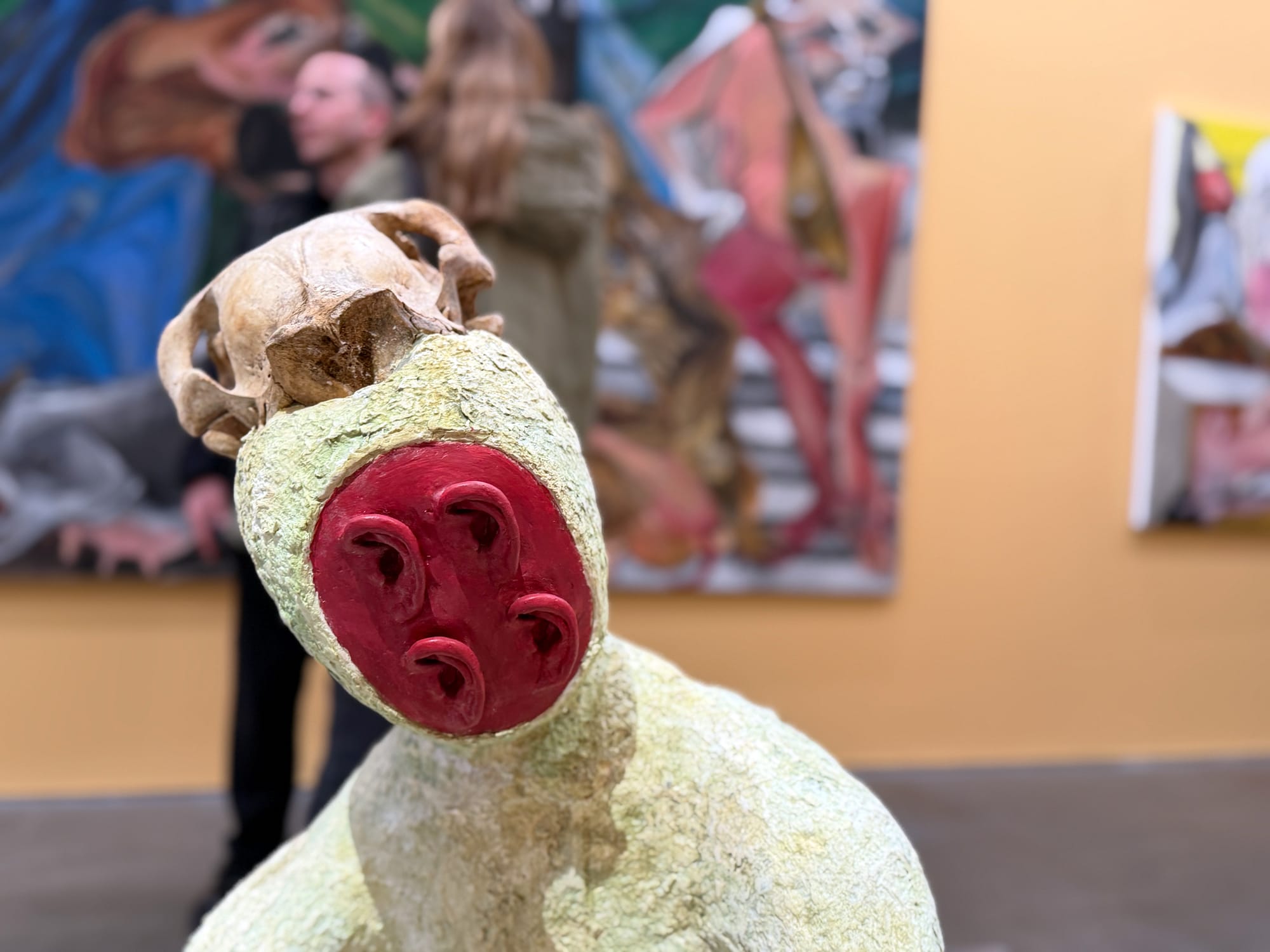
Installation view of New Humans: Memories of the Future (photo Hakim Bishara/Hyperallergic)
Lakshmi: There is something about technology, pessimism, and this sanitized, corporate aesthetic meant to mark the institution as an advanced entity hurtling into the future, having moved beyond the need for comfort, beauty, or culture. We see this everywhere in the art world. The same systems of violence and fascism masquerading as futurism or innovation or whatever. “Everything's crumbling and technology is killing people but what if we leaned in?” vibes.
Hakim: Yeah, it's something like, “Thanks for healing cancer, technology, but I don't even want to be human anymore.”
Valentina: It's nihilistic.
Lisa: I feel like a really big strain of being alive right now is actually this counter-reaction against AI, against technology — forging new ways to live, in human, community ways. And that wasn’t reflected here at all.