What’s a UFO Show With No Flying Saucers?
The Drawing Center’s Voice of Space has vast potential, but a lack of strong focus and commanding imagery makes it more earthbound than cosmic.

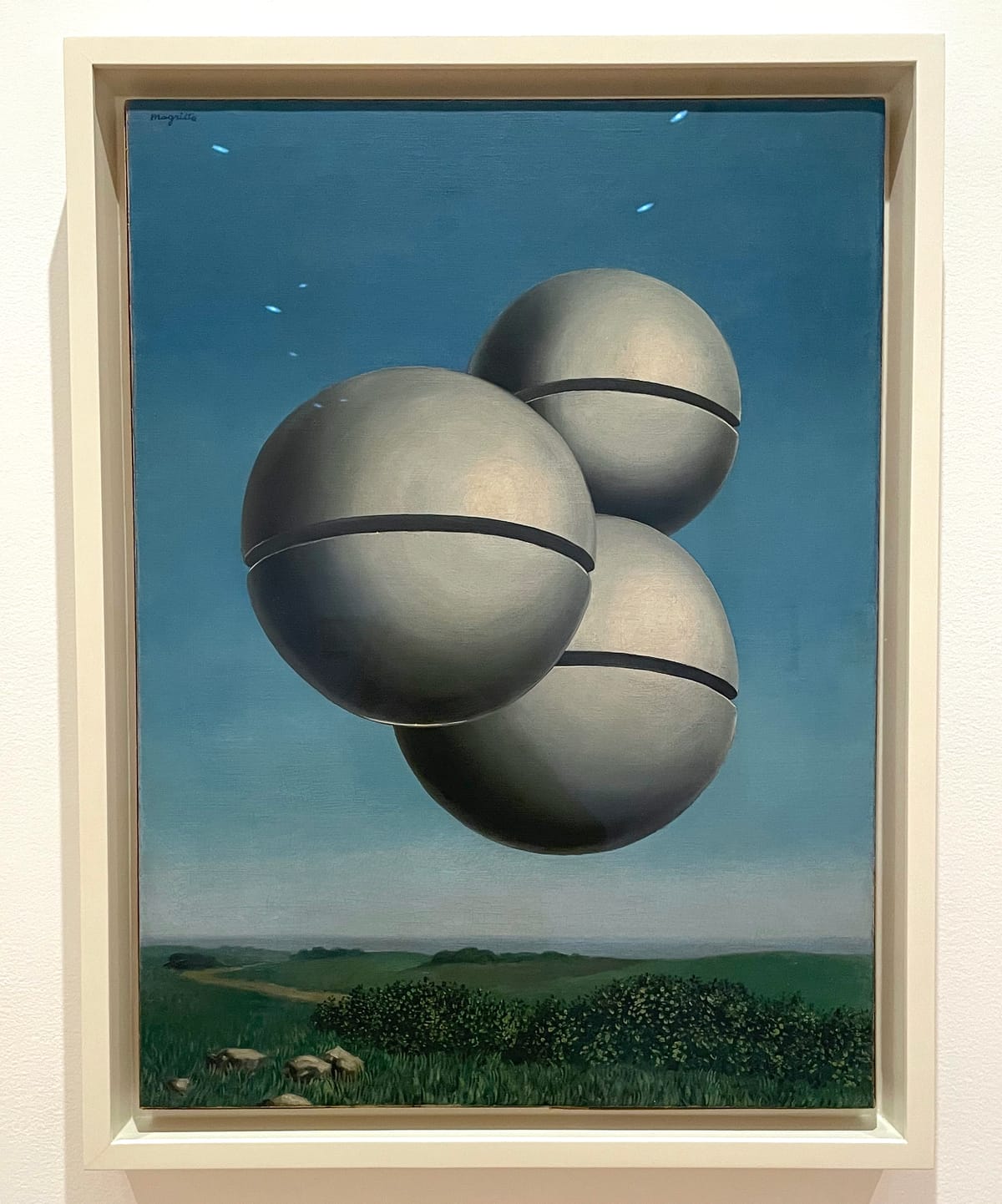
Voice of Space: UFOs and Paranormal Phenomena at the Drawing Center has ambitious goals. The wall text asks: “What role do UFOs and paranormal phenomena play in shaping our understanding of the universe, and how do they challenge or expand our beliefs about humanity’s place within it?”
These questions put a lot of pressure on the group show and its individual artworks and, for the most part, even the strongest pieces aren’t up to the challenge. A 1931 painting by René Magritte that gives the show its name is its most commanding image: Three giant gray orbs, meant to be bells, hover over a bucolic landscape. Typical of the artist, it’s a cool if somewhat kitschy picture, but it doesn’t quite tap into the mysteries of the universe.

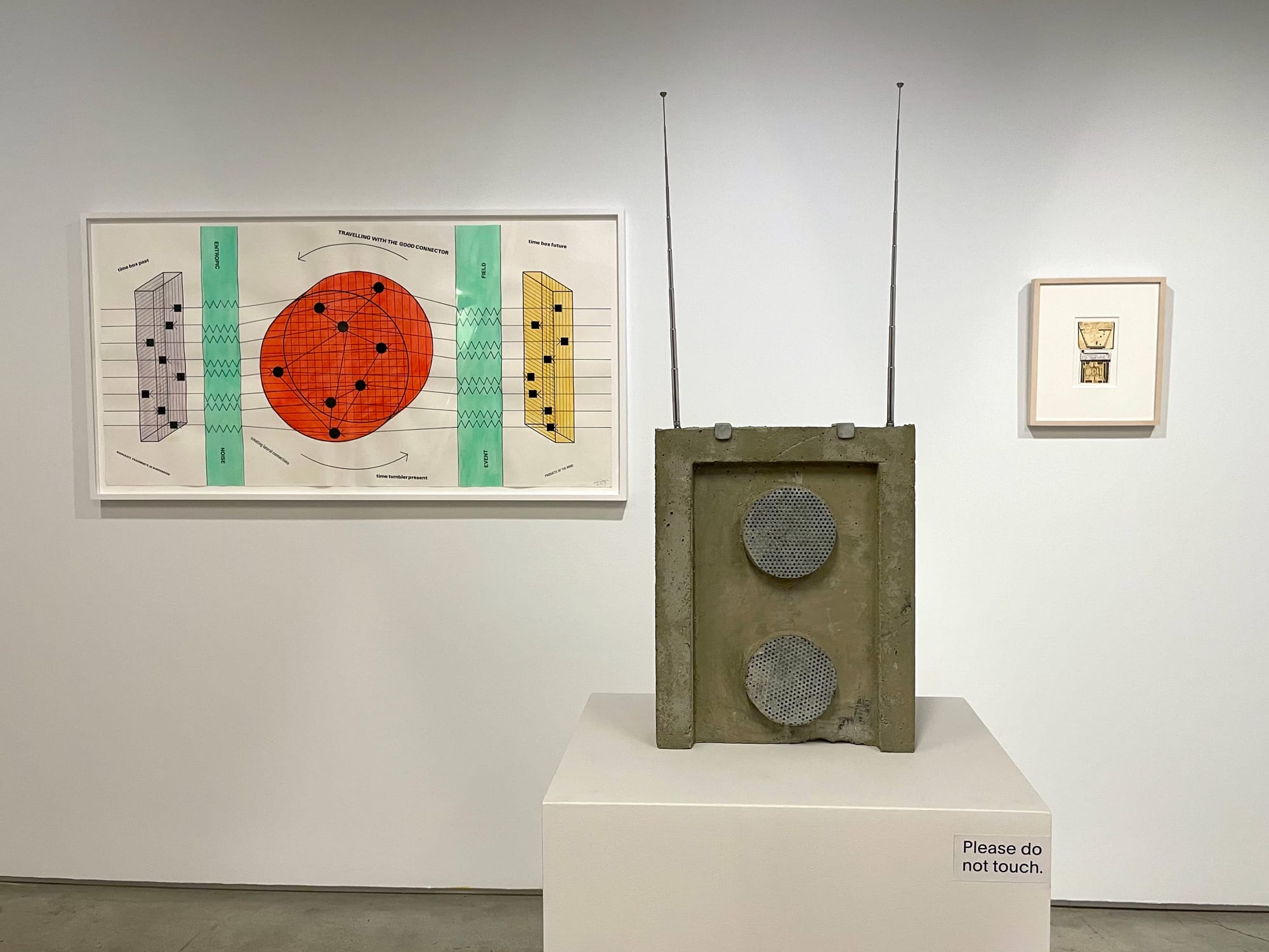
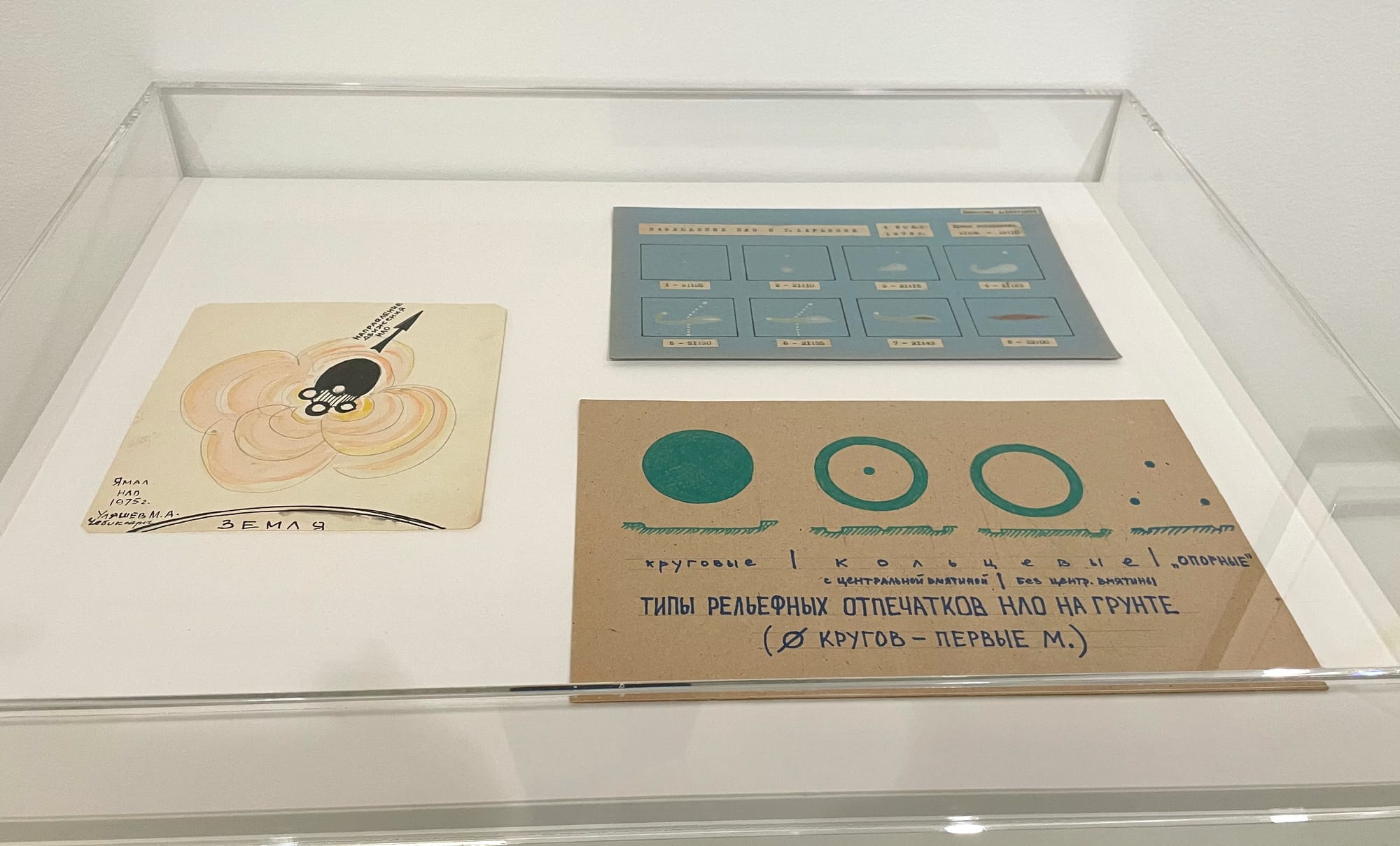
Other works range from visionary drawings, like a blue hand marked with circles by Hunkpapa Lakota artist He Nupa Wanica (Joseph No Two Horns), to scientific-looking diagrams to cerebral pieces that offer more name recognition than genuine interest, such as a dry painting of tiny arrows by Howardena Pindell and some insubstantial drawings by Isa Genzken and Sigmar Polke. A handful are gems, including David Weiss’s sketches of strange little creatures and outer space, and a drawing of a UFO trajectory attributed to M.A. Ulyashev (both from 1975). Yet not much demands attention, and several pieces require some explanation that would be best placed on wall texts alongside the art.
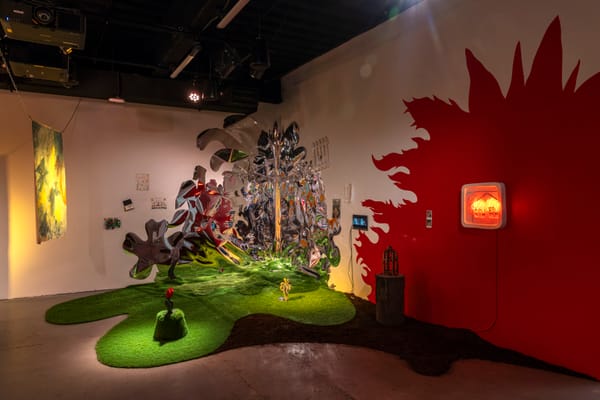
The installation itself is reserved enough that you could almost miss the vastness of the theme. The show is located in the Drawing Center’s small back gallery and lower level, rather than the large front gallery (which houses a Trisha Donnelly show), so it almost feels like an afterthought. But what’s really hindering Voice of Space is an identity crisis. By combining concepts that are overlapping but distinct — extraterrestrial life and paranormal phenomena — it dilutes both, and it doesn’t commit enough to the captivating weirdness of either.
Maybe it’s an indication that much modern and contemporary art after Surrealism has been resistant to subjects that border on the irrational. Last year’s enthralling Sci-Fi, Magick, Queer L.A.: Sexual Science and the Imagi-Nation at the USC Fisher Museum of Art in Los Angeles had one foot in the art world and the other in Hollywood, and it was the latter that dove headlong into alternate worlds, bolstered by theosophical societies and sci-fi costumes and aesthetics. That show embraced the subject matter’s potential for drama and spectacle via some theatrical staging and viewing areas that bombarded visitors with psychedelic visuals from the likes of Kenneth Anger, Cameron, and others who gained credibility in art-world circles without relinquishing their eccentricity.
Among this show’s most striking works is a drawing of a jagged black form enclosed by and containing lines radiating in different directions, with an amorphous multicolored shape on one side. The artist, Paulina Peavy, took her extraterrestrial experiences seriously: In the 1930s, she claimed to be transmitting information in her art from an alien being named Lacano, whom she’d encountered during a seance.
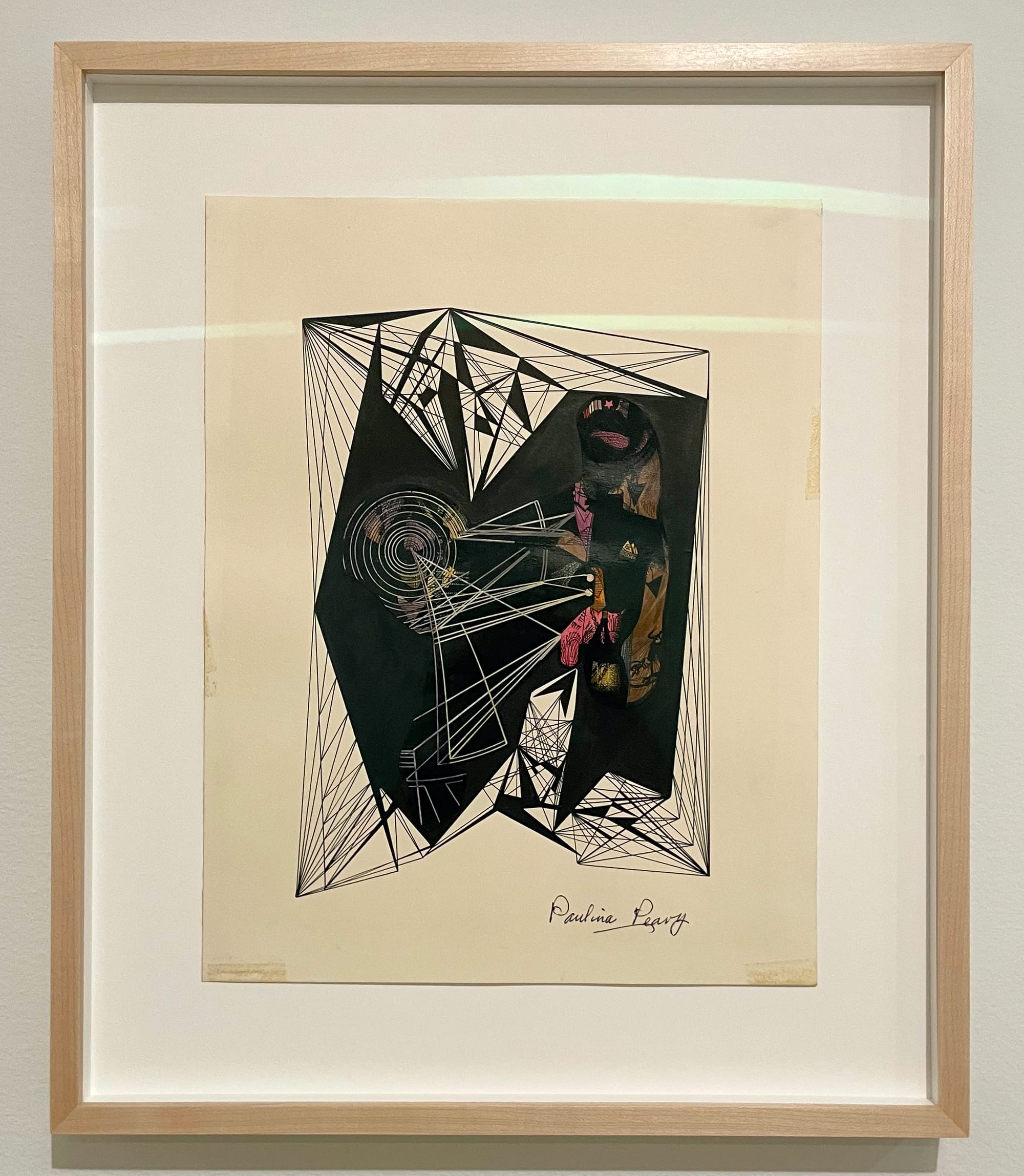
Peavy symbolizes some of the show’s unrealized possibilities. The work feels scientific and experimental, but without context, it’s hard to intuit the extraterrestrial connection. The catalog offers more insight into the artist’s personal cosmology.
The catalog's introduction makes a point of noting that the show includes no flying saucers or little green men, commonly seen as gimmicky symbols of life in outer space, but maybe a few wouldn’t have hurt. (There are, in fact, a couple of flying saucers in a drawing with Russian text attributed to A. Beletskiy, and in Weiss’s sketches.) And more works by contemporary artists who approach the conceit with their own sense of the bizarre would’ve been welcome. For starters, maybe the 1974 film Space Is the Place featuring Sun Ra and his Intergalactic Myth-Science Arkestra? Or, if we’re talking paranormal phenomena, I’d think that Mike Kelley would be an obvious choice. His Ectoplasm Photographs series (1978/2009), playing on 19th- and early 20th-century spirit or ghost photography, may be grounded in satire, but the over-the-top images of cotton “ectoplasm” streaming from his face convey an artist who doesn’t hold back.
Around the time I saw the exhibition, I watched a documentary on Alice Cooper, where the king of rock ’n’ roll cabaret described his 1970s band as “half girl, half guy, half alien.” Whatever that means, it sounded outré and otherworldly — and maybe even utopian. Voice of Space could use a little more of that spirit.

Voice of Space: UFOs and Paranormal Phenomena continues at the Drawing Center (35 Wooster Street, Soho, Manhattan) through February 1, 2026. The exhibition was organized by Olivia Shao.