Why Are We Paying for the Privilege of Rejection?
Application fees are one of the least examined but most pervasive forms of class stratification in the arts.

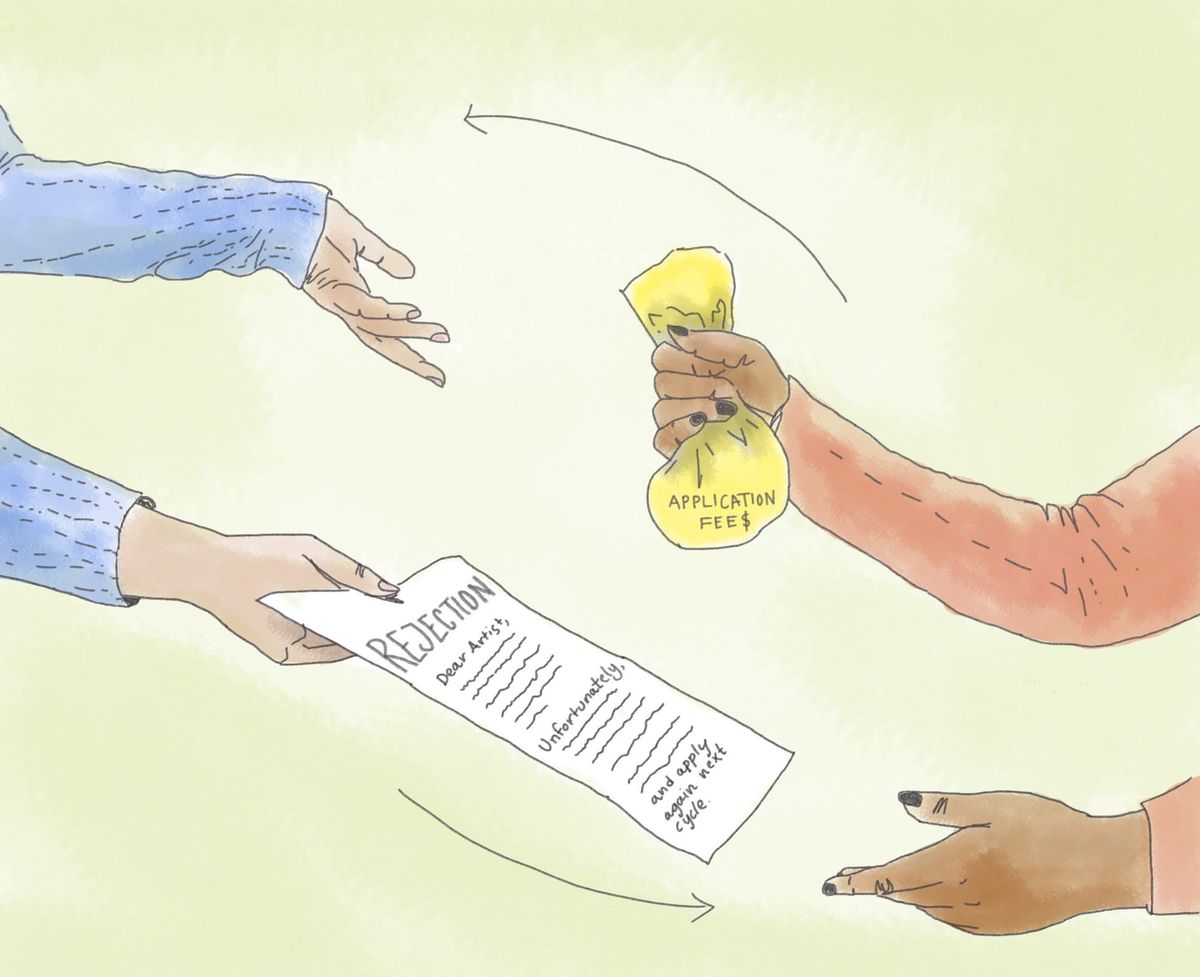
We tell young artists never to pay for the privilege of being considered. Then we send them into an art world that invoices them for the opportunity. Ten dollars here, $40 there, “just a SlideRoom fee,” “just to cover jurors.” Small line items with significant consequences. The logic is tidy: it weeds out the unserious, funds the review, and keeps the lights on. The reality is messier. Fees are a paywall on opportunity, and paywalls do not measure merit. They measure means. When a field built on ideals of access and expression charges for the act of showing up, the rhetoric of equity collapses into the economics of endurance.
Application fees are one of the least examined but most pervasive forms of class stratification in the arts. They appear modest enough to feel reasonable while quietly shifting the cost of access from the institution to the applicant. The result is not only financial but psychological. Artists are trained to normalize small losses, to accept incremental debt as the cost of belonging, and to treat unpaid administrative labor as a prerequisite for being seen.
Some fees are merely annoying. Others are outright predatory. A former student once described an exhibition call in which the gallery charged an application fee, with the promise that it would be refunded if the artist was not selected. The catch was that everyone was selected. The gallery then required artists to deliver the work at their own expense. Anyone who could not afford shipping forfeited the fee. The gallery always kept the money. It looked like inclusivity but operated like a trap, a guaranteed revenue stream disguised as opportunity. If anything was sold, the gallery still took 50%. You paid to apply, paid to deliver, and paid again if you were “successful.” It was not an exhibition model. It was a business model.
Most scenarios are less blatant but follow the same logic. Institutions frame fees as unavoidable: a way to pay jurors, offset administrative labor, or filter out “less serious” applicants. Yet few publish how the money is used. Few guarantee that submissions are reviewed by more than one reader. And almost none acknowledge that these expenses belong in the operating budget, especially in well-funded organizations. What appears to be a practical administrative choice is often a philosophical one. It reflects a belief that artists should subsidize the systems that adjudicate them.
Even the idea that fees “filter out the unserious” collapses under scrutiny. The ability to gamble on rejection has nothing to do with seriousness. It has to do with liquidity. Research in contest theory supports this. Entry fees reduce participation, but the reduction skews more along financial lines than along qualitative ones. Fees do not improve rigor. They narrow the field to those who can afford the speculation.
Some institutions attempt more nuanced structures. Skowhegan School of Painting & Sculpture, for example, uses a sliding deadline that begins with a lower fee for early applicants and increases closer to the cutoff. In theory, the structure helps staff manage workflow and rewards those who plan ahead. In practice, it monetizes time. Artists with stable income, childcare, and consistent studio access can begin the application early and apply at a lower cost. Artists who juggle multiple jobs or caregiving responsibilities often cannot. What appears progressive becomes regressive once you examine its temporal assumptions. Time is a classed resource. The earlier you can afford to apply, the more “professional” you appear.
This is where Elizabeth Freeman’s concept of "chrononormativity" becomes essential. Chrononormativity is the use of time to discipline bodies, producing a single, sanctioned “on-time” way to live and work. The art world has internalized its own version of this logic, an expectation of perpetual readiness. Applications are due when they are due. Deadlines are firm by design. The opportunity does not wait for the artist. Those who fall behind are often interpreted as uncommitted. Sliding fees and late penalties intensify this dynamic. Early-bird discounts reward alignment with institutional time. Late fees penalize lives that do not move in straight lines. The system measures not only the quality of the work but the artist’s ability to synchronize with its clock.
Not all fees are equal. Some opportunities genuinely receive thousands of submissions. Residency programs like Skowhegan, MacDowell, or major fellowships operate at a scale where a modest fee can serve as a practical pressure valve. But most open calls do not exist within those conditions, and fees often become a casual revenue stream that institutions rely upon without interrogating the harm. The question is not simply whether a fee exists. It is whether the structure, transparency, and value justify it.
Thousands of artists confront this reality each year, and the field has done little to offer them guidance. The following criteria can help artists assess whether a fee reflects legitimate administrative needs or extractive design.
A fee might be worth considering if several of the following are true:
- The opportunity is reputable and longstanding, with a verified history.
- Past cohorts align with your ambitions or practice.
- The opportunity offers real value if selected, including stipends, housing, travel support, public programming, or publication.
- The organization clearly states how the fee is used.
- The fee is proportionate to the stakes of the opportunity.
- The institution offers a fee waiver or reduced-rate option. The presence of the waiver signals ethical awareness, even if you do not use it.
A fee is almost always a red flag if any of the following apply:
- The gallery or organization will take a commission on sales.
- You pay to apply and also pay to ship, install, or otherwise deliver the work.
- Acceptance is guaranteed for the first number of applicants or framed as a “limited time” opportunity.
- The opportunity offers “exposure” rather than support.
- The institution provides no fee breakdown or transparency.
- The fee is the organization’s primary source of revenue.
Fees will not disappear quickly. The economics of the art world lean on institutional underfunding, administrative outsourcing, and digital platforms that normalize “pay to submit” as a business model. Yet artists can develop strategies for navigating this landscape without internalizing its inequities.
One approach is the administrative toolbox I encourage my students to build. It’s not sexy or glamorous, but it is liberating. Keep high-quality photographs of your work, with clean captions and consistent naming. Maintain several versions of your artist statement in different lengths. Draft a short paragraph that describes what you would do with dedicated time and space. Save all of this in a secure, accessible folder. These materials reduce the burden of the application cycle by giving you something to refine rather than create from scratch.
A second approach is to create a personal calendar or spreadsheet of opportunities. This can be a wish list of residencies, fellowships, and open calls, with approximate deadlines and associated fees. Update it a few times a year. Treat it as a personal map. Share it with other artists. This shifts the application process from reactive to planned, distributing the labor across the year rather than compressing it into moments of panic whenever a deadline appears.
Still, modular systems are not for everyone. Not every artist thrives within neatly archived folders or color-coded timelines. The fantasy of plug-and-play professionalism belongs to the same logic that creates application fees in the first place. It assumes that artists should mimic institutions. For many whose practices are intuitive or diaristic, preparedness looks less like categorization and more like continuity.
Studio diaries and voice logs are excellent alternatives. A few sentences a week or a short voice memo after a studio session can become a reservoir of language for later statements. Process photographs serve a similar purpose. They create a visual record that can be shaped into compelling application materials. Small peer groups can be transformative, too. A shared thread for deadlines, reflections, or informal critique turns what often feels like private competition into mutual support. When institutional time isolates, make collective time reconnect.
Most importantly, artists can map their creative rhythms and align applications with periods of clarity, rest, or energy rather than forcing productivity year-round. This is not a matter of chasing efficiency. It is a matter of protecting the pulse of your work from a system that confuses urgency with value.
The existence of fees reveals something deeper than cost. They expose how the art world has come to understand access as something artists should pay for in advance. Fees are the first place many artists encounter the field’s structural inequity —not through theory, but through a checkout screen. They show how institutions offload the cost of their own gatekeeping onto those most vulnerable to exclusion. And they reveal a larger truth. The art world has become so accustomed to scarcity that it now treats administrative labor as a billable service, charged to those seeking entrance.
Artists are not powerless in this system. Every shared resource, every self-built spreadsheet, every diary page, and every refusal to participate in exploitative calls is a small redistribution of agency. The goal is not to beat the system at its own game. The goal is to build a parallel one in which preparedness aligns with sustainability rather than burnout, time is reclaimed rather than monetized, and access is not purchased but practiced collectively.
Institutions may continue to charge their tariffs, but artists can decide how and when to pay them, and whether the opportunity deserves the cost. The refusal to confuse price with value is not cynicism. It is clarity. And clarity, in a field built on opacity, is its own form of resistance.