Women Painters Lead Brazil’s New Wave of Figuration
Panmela Castro, Agrade Camíz, Márcia Falcão, Maya Weishof, and Gokula Stoffel are five artists at the helm of the revival.


After years of institutional exhibitions of Brazilian painting often limited to early-modernist figuration and mid-century abstraction — and the work of Tarsila do Amaral, Anita Malfatti, Lygia Clark, Lygia Pape, and Mira Schendel being feted internationally — a new wave of Brazilian artists is injecting the medium with a sense of urgency and vigor.
Brazil previously saw a “return to painting” with the Geração 80 (‘80s Generation) and abandonment of strict geometric abstraction; though, as evidenced by some of that era’s artists, including Luiz Zerbini, Beatriz Milhazes, Leda Catunda, and José Leonilson, abstraction never fully went away. Instead, it fused with the materiality of the medium, resulting in a hybrid approach still present in contemporary painting.
While Brazilian women artists have certainly challenged stereotypes of beauty and womanhood before — Anna Bella Geiger and Lenora de Barros immediately come to mind — the frankness with which Brazilian women painters depict eroticism today, be it through their dogged, unvarnished portrayals of the female body and desire, or their bracing examinations of violence against women, seems uniquely of the moment.
Here are five artists to know.
Panmela Castro
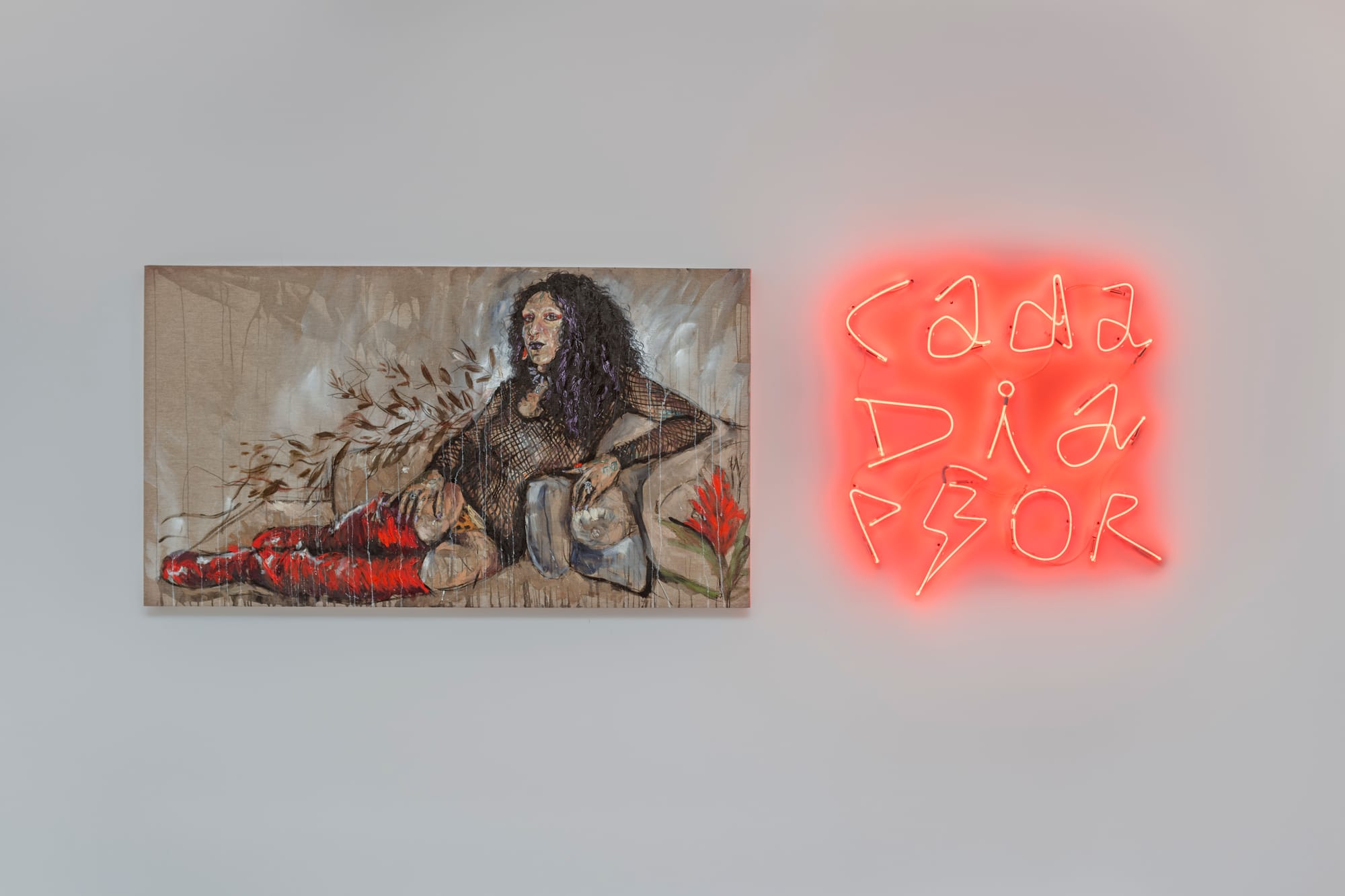
Upon seeing Castro’s somber yet invigorating 2021–22 solo show at Galeria Luisa Strina in São Paulo, curated by Daniela Labra, I was immediately struck by its title: To Flaunt is to be alive. Here, flaunting didn’t mean flagging one’s status or possessions, but rather presenting one’s body candidly and intimately to affirm its resilience. In a series of nudes, Castro sometimes depicts a sitter twice, as if imagining her own painting already hanging on the sitter’s wall. Such doubling brought to mind the paucity of institutional archive imagery that preserves the memories of Black-Brazilian communities — the fact that representation, or lack of it, is always a political act.
Castro conveys grit in works including a neon sign that reads “Cada Día Peor” (Worse Every Day) (“Vulcanica Pokaropa,” from the Vigil series, 2021) and a three-dimensional text-based sculpture that reads “Eu Sobrevivi” (I survived), from the Residency series (2021). Psychological and physical pain recur in Castro’s works, where the act of commemoration through portraiture or a self-reflexive testimonial gesture toward symbolic recovery.