A Living Memorial to Palestinian Activist Alex Odeh Takes Flight
"The Stolen Dove" is a participatory project that turns a decades-old monument into an artwork to keep the scholar and civil rights leader’s memory alive.

One of the few monuments honoring an Arab-American in the United States is the subject of a new participatory art project that turns the decades-old sculpture of a slain Palestinian-American icon into an expansive, living artwork.
Outside the public library in Santa Ana stands a memorial statue to Alex Odeh, a Palestinian-American poet, civil rights leader, and scholar who was assassinated in 1985. Created by Algerian-American artist Khalil Bendib in 1994, it depicts Odeh holding a book in one hand and a dove in the other, symbolizing his work as a peace activist.
The bronze statue has been vandalized several times over the past three decades — it was splashed with red paint in 1996 and 1997, and in 2020, the dove was stolen, though it was soon recovered and reattached. Last December, the dove was removed again, but with the aim of keeping Odeh’s memory and legacy alive.
Artist Jon Rubin first encountered the statue of Odeh in the spring of 2023, during his residency at the Grand Central Art Center (GCAC) in Santa Ana. It had recently been vandalized, and remnants of a brick lay strewn on and about the sculpture. He was struck by the animosity directed at the memorial, but also by the fact that many people were not familiar with Odeh’s life and work, as a librarian informed him.
“That combination stayed with me,” Rubin told Hyperallergic. “Here was a monument that was simultaneously being attacked and overlooked: a work that remained politically charged enough to attract repeated acts of vandalism, yet had become somewhat invisible to the public around it.”

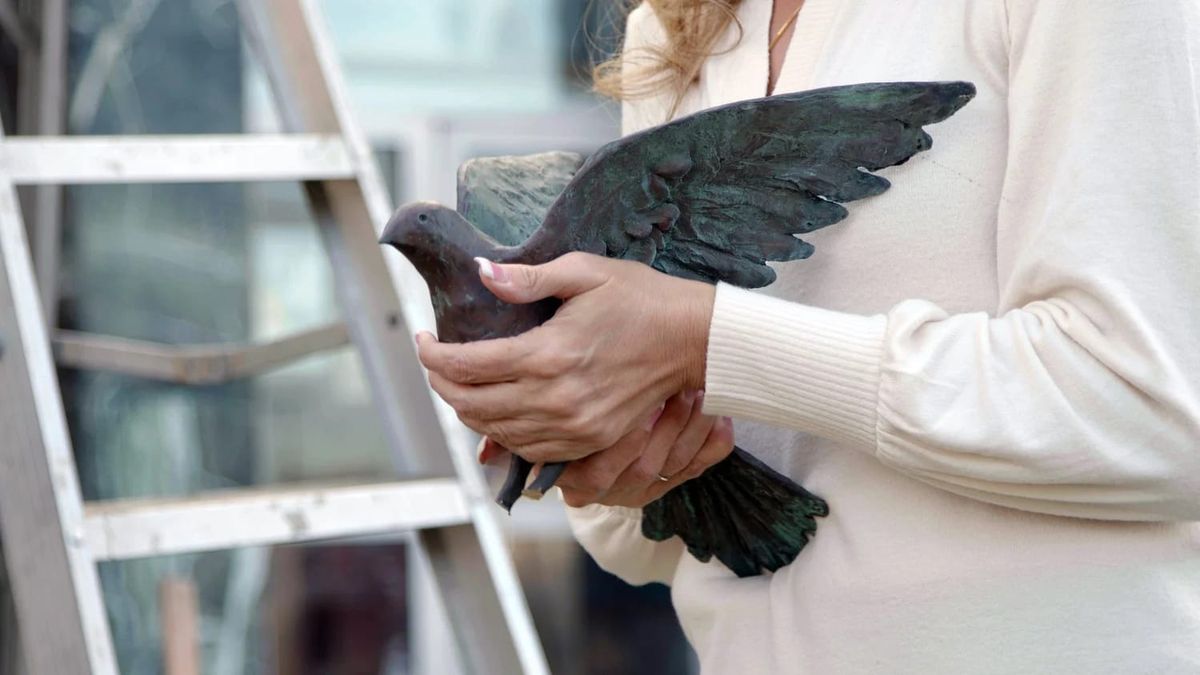
After consulting with Bendib and Odeh’s eldest daughter Helena, Rubin received their blessing to remove the dove once more, “this time with intention and care,” for the creation of a new, participatory artwork, “The Stolen Dove.” Over the course of several months, various individuals and organizations can host the dove for events, dinners, and performances.
“Instead of remaining fixed in a public square, the dove would become a living, decentralized monument, gathering people around Alex [Odeh]'s life and legacy through conversation, hospitality, and shared responsibility,” Rubin explained.
Each participant who hosts the dove will receive a replica of the statue, “a growing flock dispersed across homes and institutions, creating a network of monuments and storytellers.”
Alex Odeh was born into a Catholic family in Jifna, Palestine, in 1944. He experienced the Nakba as a child, and later the Israeli occupation of the West Bank in 1967. Odeh immigrated to the US in 1972, receiving a Master’s degree in political science from California State University, Fullerton, where he also taught Arabic and Middle East history. In the early 1980s, he became the West Coast regional director of the American-Arab Anti-Discrimination Committee (ADC), a civil rights organization dedicated to fighting anti-Arab stereotypes, discrimination, and hate crimes. As part of his commitment to peace and justice, Odeh was also invested in promoting inter-community dialogue between Muslims, Jews, and Christians.

On October 11, 1985, Odeh was killed when a pipe bomb exploded at the offices of the ADC in Santa Ana. Later that day, he was scheduled to speak at a local synagogue during Friday prayer services. Although the FBI and investigative journalists identified members of the Jewish Defense League, a right-wing terrorist group, as possibly responsible for the bombing, no one has ever been arrested for his murder, and the case remains officially unsolved.
“The Stolen Dove” made its debut at the Sundance Film Festival in January for the screening of the documentary film Who Killed Alex Odeh?, before traveling to several events in Southern California, beginning with a dinner hosted by Odeh’s daughter Helena and his widow Norma. The dove visited the home of Julie Kasem, daughter of legendary radio personality Casey Kasem, who helped fund the original statue; the residence of artist elin o'Hara slavick; and a Passover seder held by Rabbi Arnold Rachlis, who spoke at the dedication of Bendib’s memorial sculpture in 1994.
“We passed around the dove, let people hold it. I didn’t realize how powerful that would be, these feelings of despair and hope,” Rachlis told Hyperallergic.

This Saturday, July 18, the dove will be hosted at the 839 house gallery in Hollywood for an evening of music, readings, and food.
“The project feels urgent because it brings renewed attention to Odeh’s life and legacy, and to the longer history of anti-Arab violence in this country that his assassination has come to symbolize,” Liz Hirsch, co-founder of 839, told Hyperallergic. “It reminds us that occupation and genocide in Palestine are not just things happening ‘over there,’ but are structurally connected to conditions here in the US and beyond.”
Artist and curator Joshua Oduga will perform ambient musical pieces, including a reworking of Sabreen’s 1994 song “Jayy al-Hamam (جاي الحمام)” (“The Doves Are Coming”), which borrows text from a poem by Palestinian poet Hussein Barghouti. “I’m interested in what happens when the dove becomes sound,” Oduga told Hyperallergic.
There will also be a reading from Odeh’s 1983 book of poems and essays, Whispers in Exile (Hamasat fil Ghurba), newly translated by Emily Drumsta.
Rubin will then take the dove to the Bay Area and later to Pittsburgh, where he lives and teaches. A public event in Santa Ana organized by the GCAC is also in the works, according to John Spiak, director of the GCAC. When asked if he had any trepidations about safety, Spiak replied: “There are always concerns, but Alex was a peace activist, and his life was taken. There’s no security with any project you do.”

The dove is scheduled to be reunited with the statue in the fall of 2027, to commemorate the 42nd anniversary of Odeh’s murder. Helena said she hopes the dove can visit her father’s hometown of Jifna in Palestine before that.
Rubin hopes that little by little, house by house, hand by hand, the Stolen Dove will reinvigorate and restore Odeh’s legacy once it is returned to its official perch outside the Santa Ana library.
“When the dove eventually returns to the monument, hundreds of people will be able to say, ‘I once held that dove,’” Rubin said. “The hope is that the monument returns carrying the memory of all of those encounters, and that the community around it will never see it in quite the same way again.”