Diaries of a Chairwoman
Juliette Lewis turns into a chair in a film that critiques mass culture’s conflation of femininity with consumerism and envy.

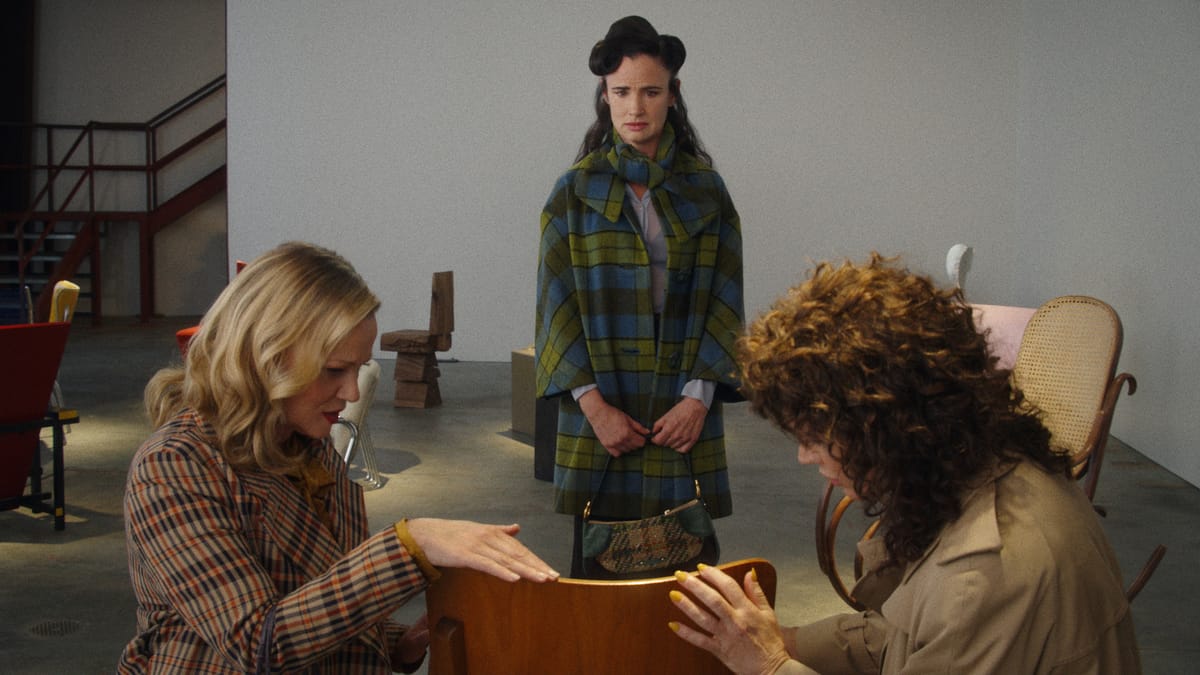
“My goodness, that chair is gorgeous. Look at its body, its material, its design. Must be expensive … what a stunner.” So gushes an unseen woman in the first shot of By Design, Amanda Kramer’s zany film about the pleasures (and perils) of aesthetic obsession. In the center of the frame, a wooden Baumann beckons our gaze from a swanky showroom, to be replaced in the next shot with a woman (Juliette Lewis) crowned in retro bangs. Flanked by two materialistic friends on a bougie LA terrace, she occasionally offers aphorisms while poking at her parfait. Her name is Camille. And all she longs for, we learn from the narrator (Melanie Griffith), “is to be seen.”
During their ritual shopping trip to the nearby furniture studio — their mantra is “we never buy” — the trio comments on the merits and deficiencies of the objects on display. Then Camille sets her eyes on a side chair as elegant as it is unassuming. She becomes instantly, irrecoverably infatuated — and so do her friends, Lisa (Samantha Mathis) and Irene (Robin Tunney). Camille is the only one who genuinely needs a chair for her home — and the only one who absolutely can’t afford this one. Stricken by the “sold” tag tied to its back the next day, she clasps the chair and makes a wish. Then poof: her soul enters the chair’s body, with divine (mis)adventures in design and desire to follow.
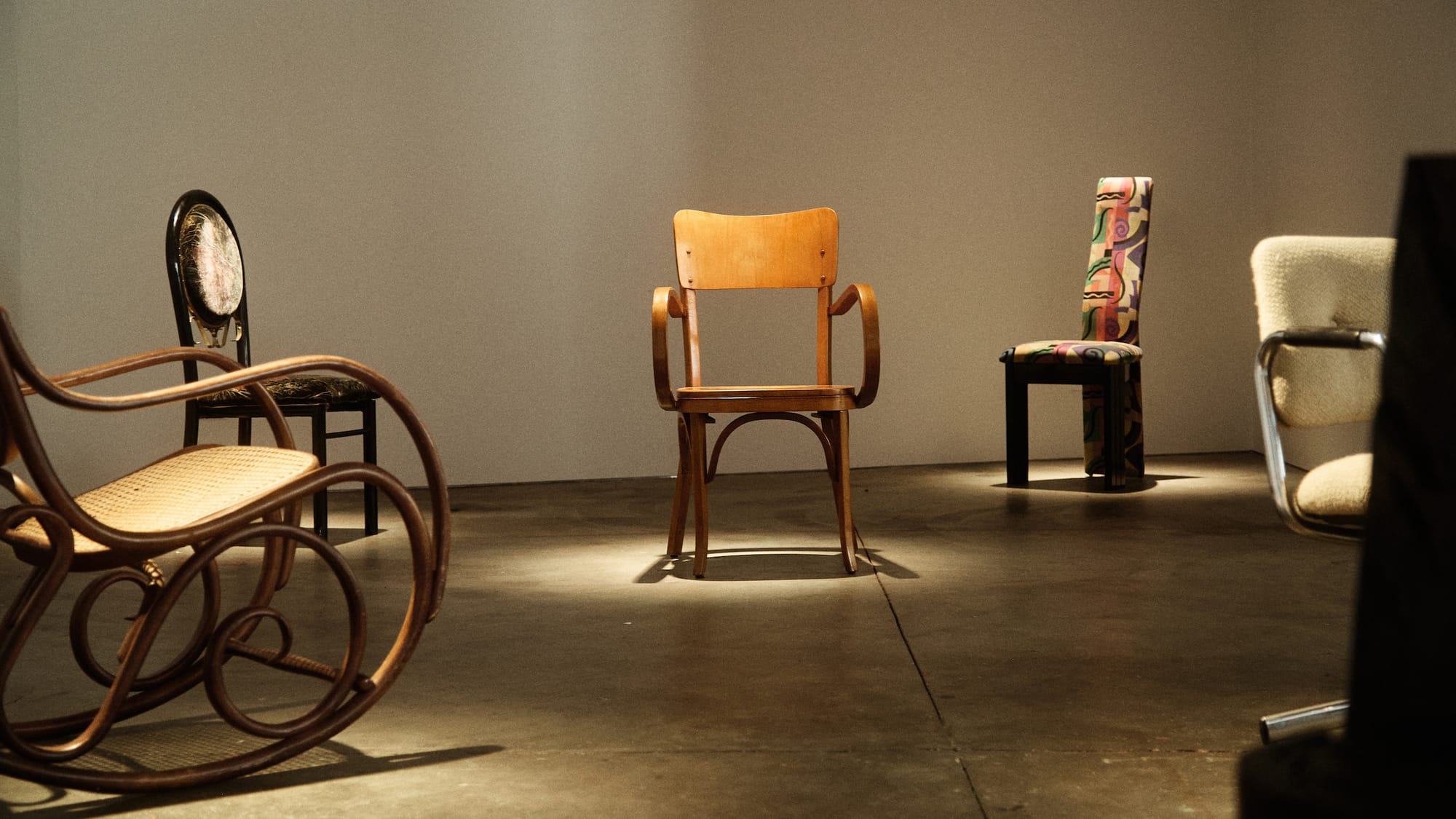
For fans of Lewis, her blend of slapstick and pathos is reason enough to see the film. But Grace Surnow’s whimsical sets and Sophie Hardeman’s vintage-inspired outfits equally anchor this surrealist take on a body-swap comedy that reveals itself to be equal parts dark and droll. From the copper eyeshadow on the haughty furniture dealer to Camille’s array of classic pumps scattered across her studio apartment, By Design honors the sumptuous pleasures of visual consumption. But it also slyly critiques mass culture’s pesky conflation of femininity with both consumerism and poisonous envy.
For Camille as Chair, life becomes simpler; she makes people happy just by exquisitely existing. She is gifted to a jilted pianist named Olivier (Mamoudou Athie) whose affection for his ex, Marta (Alisa Torres), is immediately replaced by an absurd devotion to Chair Camille. Meanwhile, her middle-aged corporeal body lists comatose at home, and her ostensive loved ones barely seem to notice.
From here, the movie gets weirder and weirder. Those seeking a “story” might be bemused, as some scenes are downright carnivalesque. A dinner party for Olivier, to which he brings Chair Camille, feels like Lewis Carroll meets Eyes Wide Shut. Udo Kier, an expert at playing eccentric characters, shows up in Western wear as the chair’s Italian designer, Aldo Fabbari.

Such silliness serves to magnify the real violence both directed toward and coming from female characters. When Camille’s manipulative mother (Betty Buckley) visits her flat, she sports a black eye that she unconvincingly insists is not from her husband. Later, a stalker (Clifton Collins, Jr.) spots Camille lying alone and breaks into her apartment, tying her senseless body in ribbon before tap dancing over her on the balcony. But more insidiously, perhaps, is how Camille’s petty besties betray a passive aggressiveness all too common in toxic friendship. At the film’s wacky climax, a motley ensemble of women in lace stockings and shiny corsets form an orgy of silk and twill, taking turns sitting on each other in a downtown alley.
How different is the fetishization of an object from that of another human — especially when women are often treated as objects in the first place? Can aesthetic longing ever be the same as erotic desire? By Design doesn’t exactly give us the answers, but beneath its velvet upholstery, uncomfortable truths swell at the seams.
By Design is currently screening in select theaters nationwide.