Congress Funds Institute of American Indian Arts
The Senate confirmed appropriations for the college and several other embattled cultural institutions following Trump's threats to defund them.

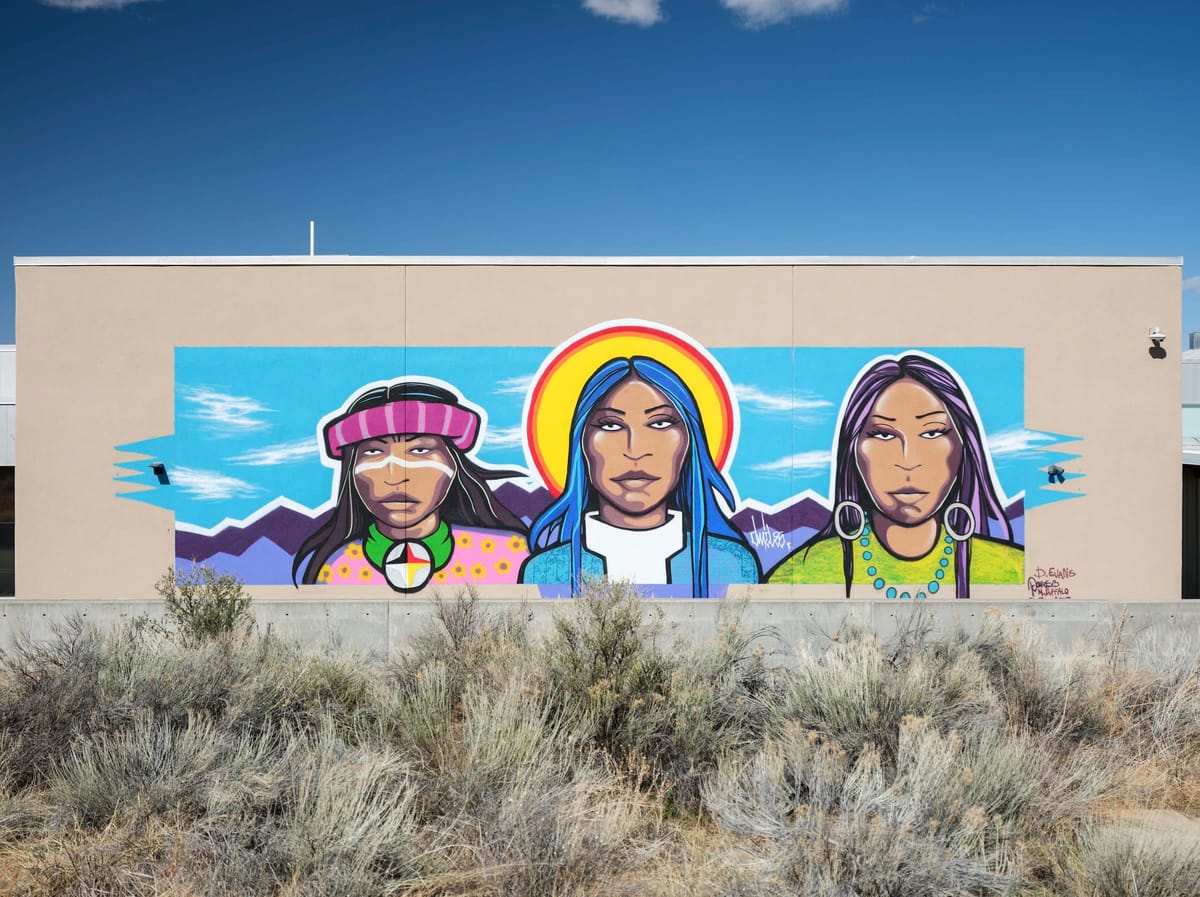
Following months of uncertainty, the Senate has confirmed full or near-full funding for cultural organizations, including the Institute of American Indian Arts (IAIA), the world’s only college dedicated to the study of contemporary Native American and Alaskan Native art.
The Republican-controlled Senate voted overwhelmingly last week to pass a funding bill that included appropriations for federally partnered cultural entities, including the IAIA, the National Endowment for the Arts (NEA), the National Endowment for the Humanities (NEH), the Smithsonian Institution, and the National Gallery of Art. The vote signals a defiance of Trump’s Fiscal Year 2026 budget proposal, which suggested eliminating the IAIA, NEH, the Smithsonian’s fledgling Latino museum, and the NEA.
The bill, which passed without amendment from an earlier approved package in the House of Representatives, covers funds from July 2026 through September 2027.
In a phone interview with Hyperallergic, newly appointed IAIA President Shelly C. Lowe described feeling “relief” upon receiving confirmation that the Santa Fe arts college would receive a $13.48 million appropriation. Lowe, a member of the Navajo Nation, became the institute’s president in August, after the Trump administration pushed her out of her post as chair of the NEH.
Lowe attributed the successful passage in part to media attention and advocacy from IAIA community members, including a Hyperallergic opinion piece by alum and artist Rose B. Simpson and a letter-writing campaign directed to local elected officials.
“That voice from our constituents and the people who really support us played a really big role,” Lowe told Hyperallergic.
The United States federal government chartered the IAIA, described as the "birthplace of contemporary Indigenous art," as a research, training, and scholarship institute for the study of Native arts in 1986. Decades before its government charter, the institute opened in as a high school in 1962 on the campus of a 19th-century federal boarding school, which attempted to forcibly assimilate Native children.
Today, with approximately 850 students enrolled across undergraduate and graduate programs, the institute relies on federal funding to cover 75% of its operating expenses.
“Our graduates really do bring Native arts and cultures to a national and international audience,” Lowe said. “They introduce what it means to be Native — our ways of knowing, of understanding — to audiences across the world.”
There are still obstacles ahead, though, Lowe said, noting that going forward, the institution will focus on communicating the importance of the IAIA to Congress.
In addition to funding the IAIA, the Senate approved $207 million for the NEH and NEA, following Trump’s requests to eliminate both agencies. The Smithsonian received $1.08 million, including $27 million for the National Museum of the American Latino. A separate bill determines funding for the Institute of Museum and Library Services (IMLS), which Trump has also sought to eliminate.
Even with successful passage, though, the Trump administration still retains influence over how these appropriations are actually spent.
The Office of Management and Budget (OMB) has threatened to withhold congressional appropriations from the Smithsonian if it does not comply with its ongoing content review, for instance. The OMB caused mass confusion last year when it withheld congressionally approved funds from agencies across the federal government until they agreed to comply with the administration’s anti-DEI and anti-trans executive actions. The president has also proposed repurposing funding from mass grant cancellations last year to fund his bizarre sculpture garden of so-called “American heroes.”
Some of this year's NEH grant allocations appear directed toward projects that may be palatable to conservative audiences, such as programs that encourage the study of Western civilizations. In cancellation emails to grant recipients last year, the NEA said the agency would focus on new objectives, including “skilled trade jobs” and “AI competency.”