David Driskell’s Gifts to Black Art
The artist and scholar spent decades championing Black artists through collecting, creating, and providing financial support through the Driskell Prize.

PORTLAND, Maine — David C. Driskell: Collector at the Portland Museum of Art is a compact tribute to an artist and scholar with deep ties to Maine, one who assembled one of the foremost collections of African-American art in the United States.
Driskell started collecting in 1955 after taking a position as an art professor at Talladega College. As he explained in a 2017 lecture at the Whitney Museum of American Art, he put aside a small budget for art each year from his beginning salary of $3,000.
Driskell began to focus on African-American artists in the 1960s, and in 1976, he curated the exhibition Two Centuries of Black American Art, establishing him as an authority on the subject. The landmark show, which originated at the Los Angeles County Museum of Art and traveled across the country, is just one part of his lifelong mission to establish Black artists’ rightful place in American art history.
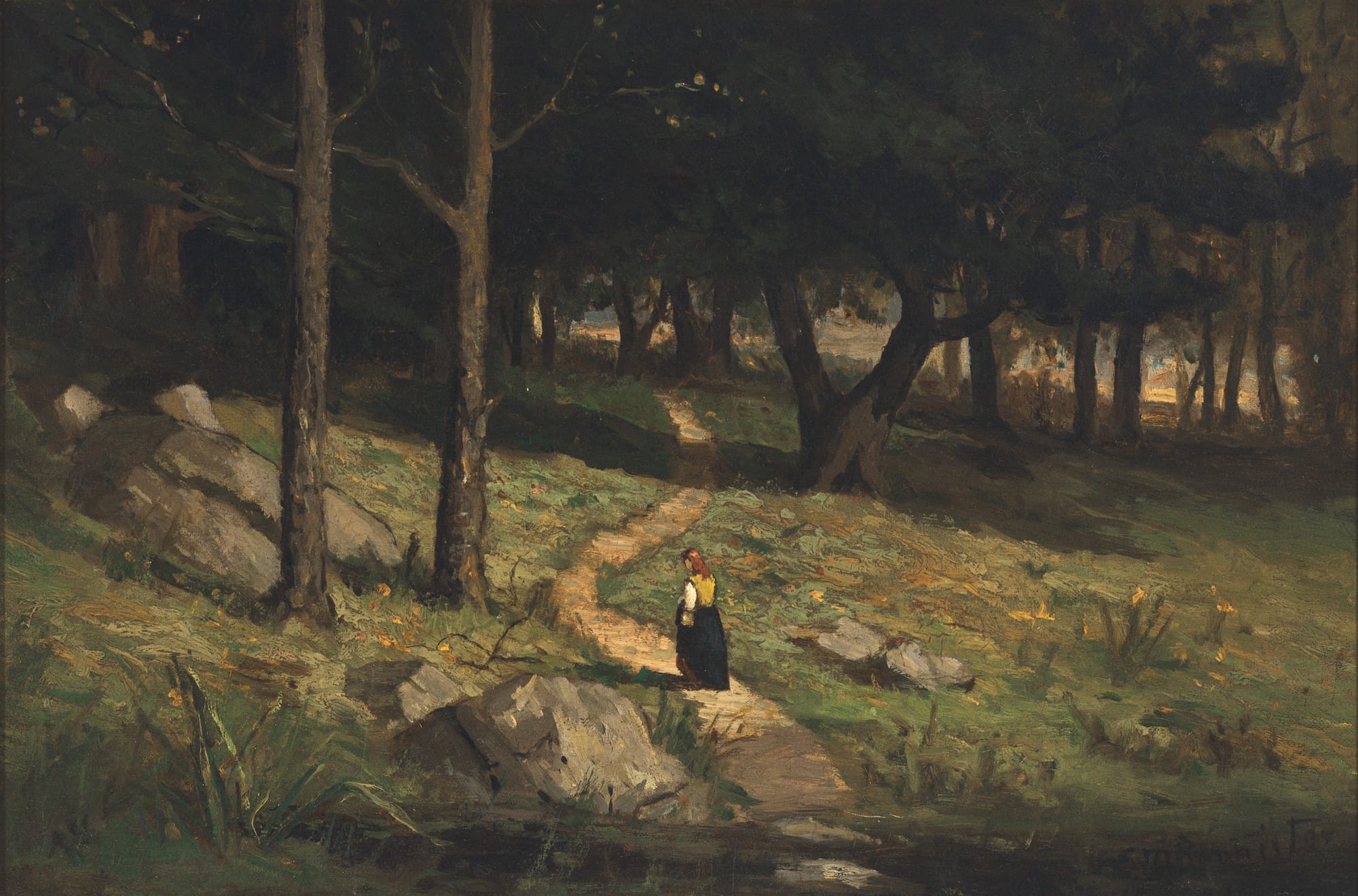
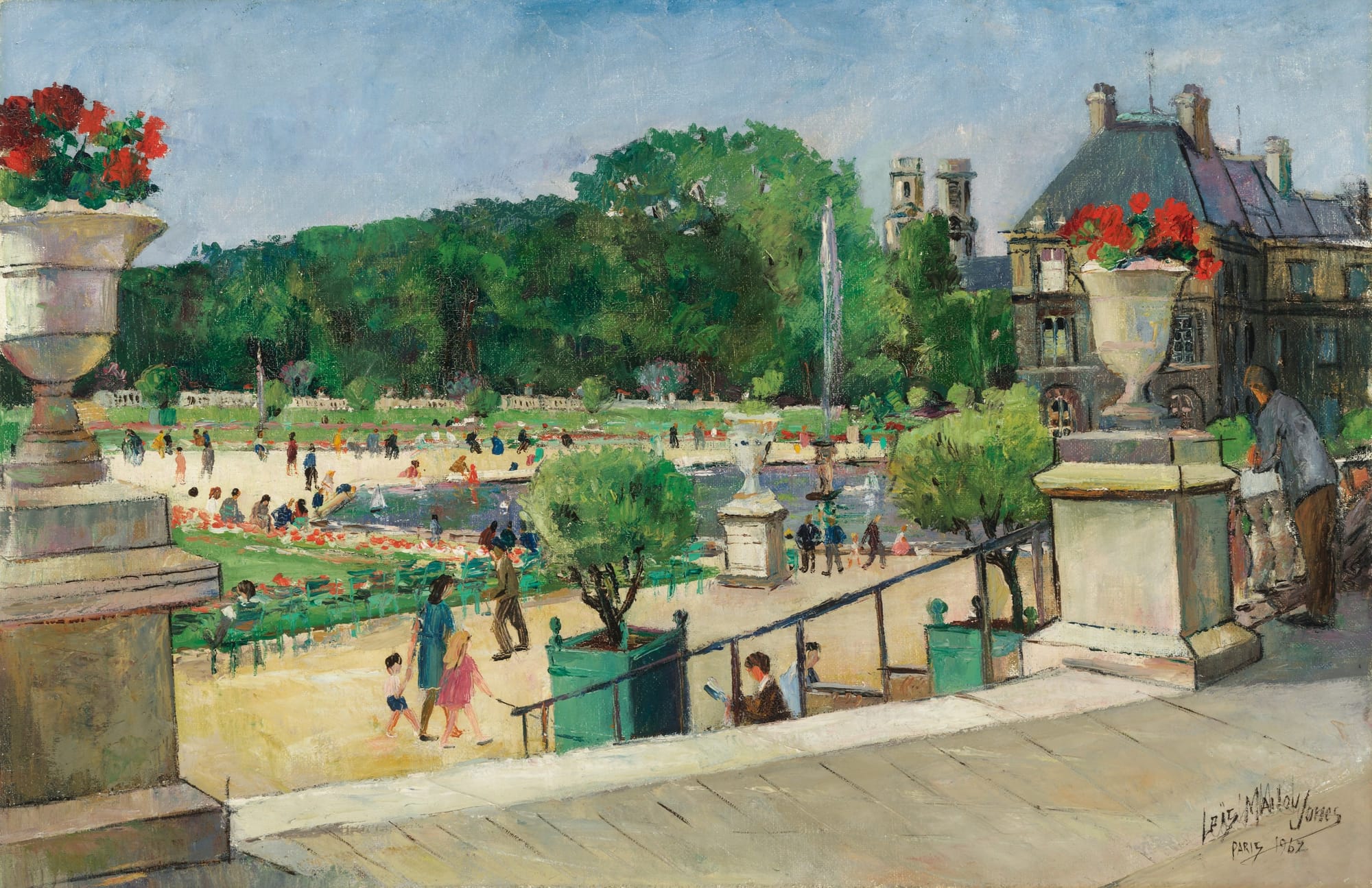
The works on view in Collector (some of which were gifted to the Portland Museum) convey the stylistic range of Driskell’s collection. Canadian-born artist Edward Mitchell Bannister’s painting “Untitled (Walking in the Woods)” (1880s), depicting a figure traversing a dark forest, reflects the turn toward Romanticism in 19th-century American art. Conversely, Loïs Mailou Jones’s “Paris” (1962), a view of the city’s Luxembourg Gardens rendered in vivid oils, summons the legacy of Impressionism.
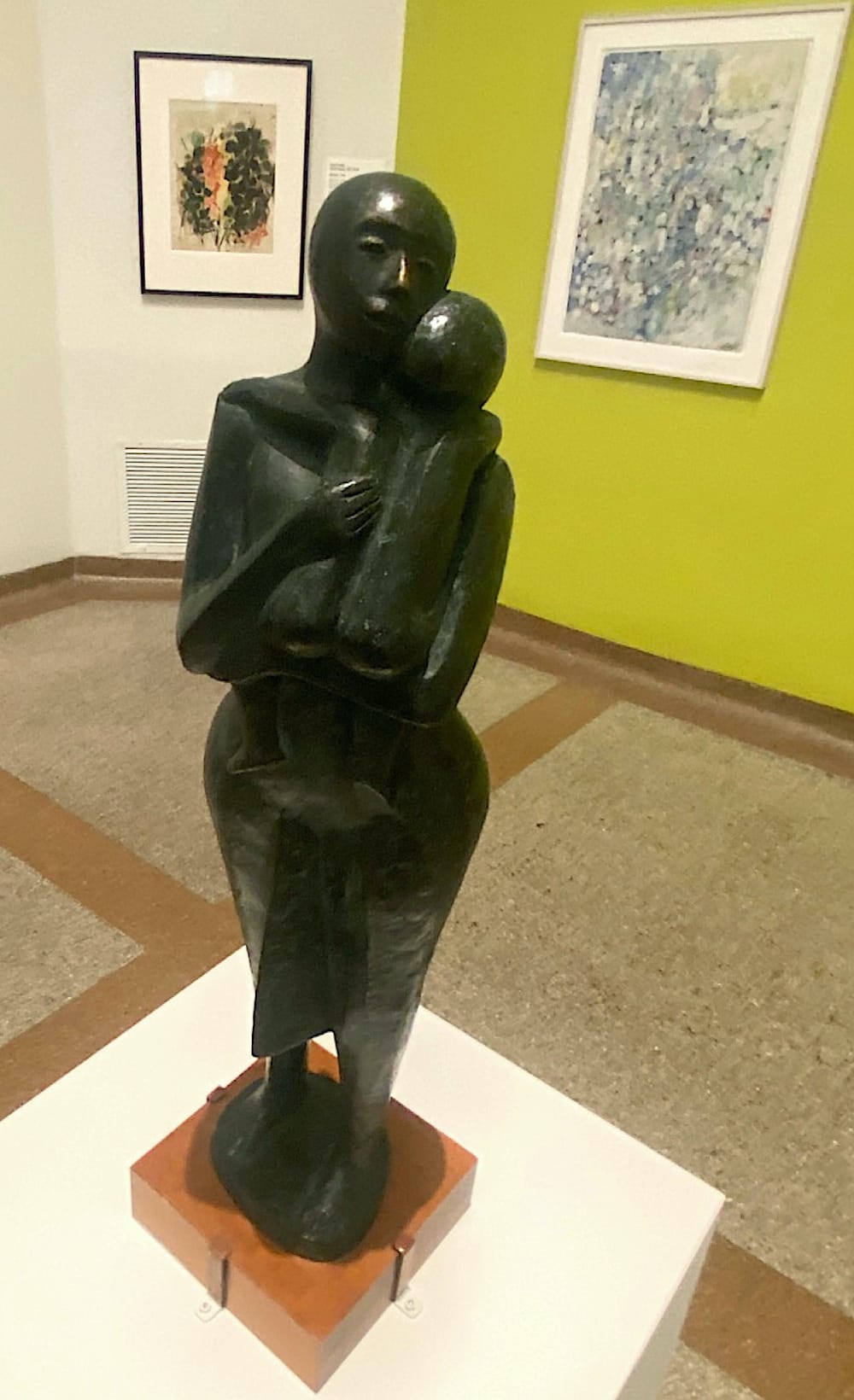
Some of the most compelling works in Driskell’s collection are sculptures. In Elizabeth Catlett’s stylized bronze “Mother and Child” (1977–78), the two figures are fused into a single stately form. By contrast, Meta Vaux Warrick Fuller’s bronze sculpture “Secret Sorrow (Mother and Child)” (c. 1914), shows the influence of Rodin, with whom the artist studied in 1899, in its expressive evocation of this timeless subject.
Driskell’s own art in the show reflects the same stylistic range as his collected works. The exhibition takes viewers from a 1953 social realist-style self-portrait to the organic abstraction “Night Vision” (2001), which features screen print, relief, etching, monoprint, and collage — and underscores his skill at mixing techniques.
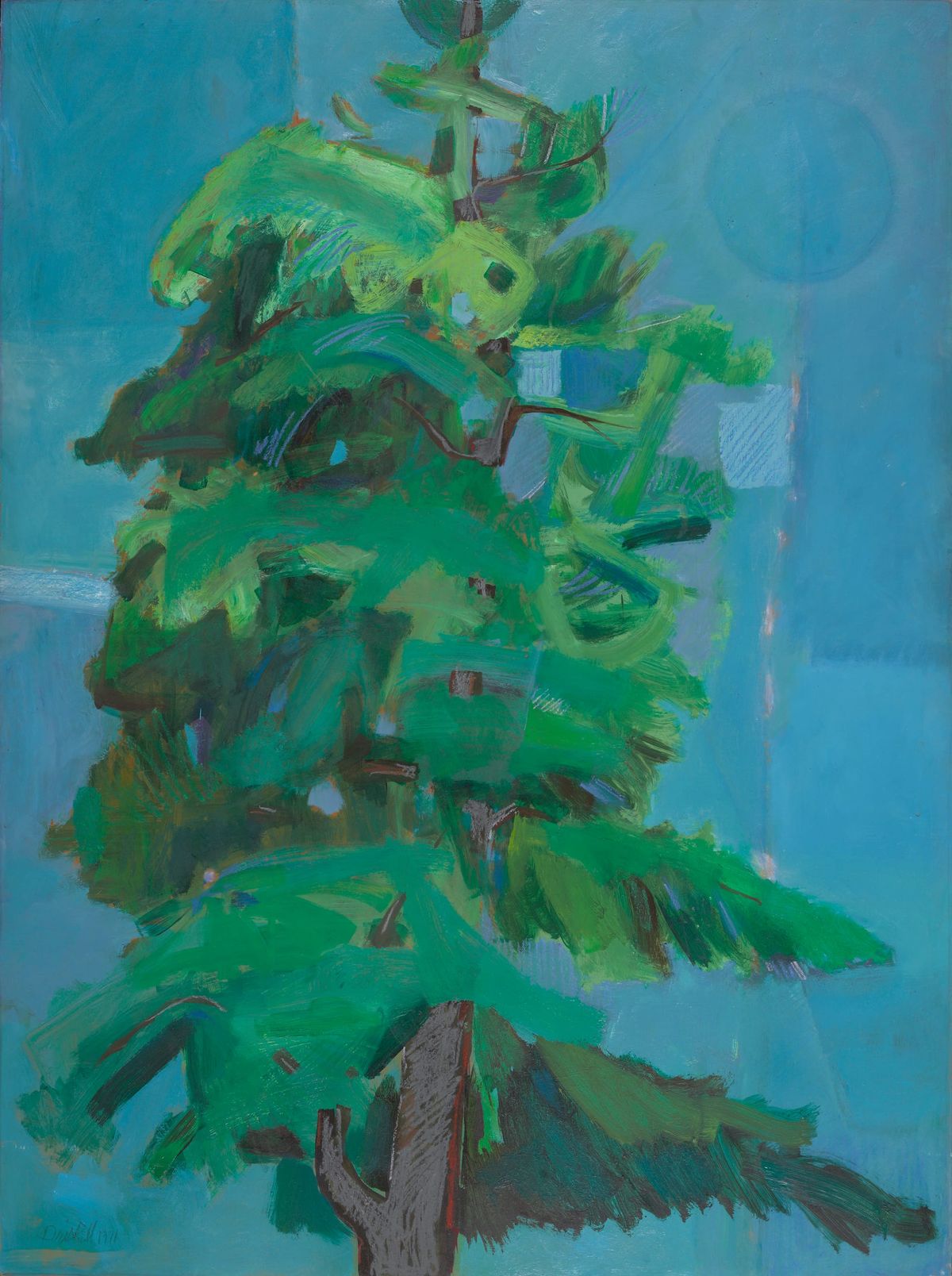
Driskell painted the self-portrait the same year that he attended the Skowhegan School of Painting and Sculpture, where Maine’s iconic pine trees prompted an extended study of the subject. “I looked at trees with a notion of trying to see segments of them,” he noted in a 2017 interview in Callaloo; “I wanted to take the viewer in all directions within the tree at one time.” The statement accompanies his painting “Pine and Moon” (1971), in which lively brushwork to transform the evergreen into a vibrant form.
One of the exhibition’s more engaging aspects is the visual conversations between works. Romare Bearden’s collage “Urban Street Scene” (1974) finds an echo in Driskell’s “Ghetto Wall #2” (1970). Where Bearden pairs Christian imagery with a police presence in his image of a Black neighborhood, Driskell’s painting, juxtaposing a dark silhouette with brightly colored symbols and a brick wall, invokes Malcolm X and the Civil Rights Movement along with the stars and stripes of the American flag.
Another exchange takes place between Driskell’s gouache and watercolor “Frost and Ice, Maine” (1977) and Alma Thomas’s untitled watercolor from 1964. Both paintings evoke natural phenomena through abstract means. The former is a shimmering expanse of wintry elements, while the latter suggests illuminated plant forms.
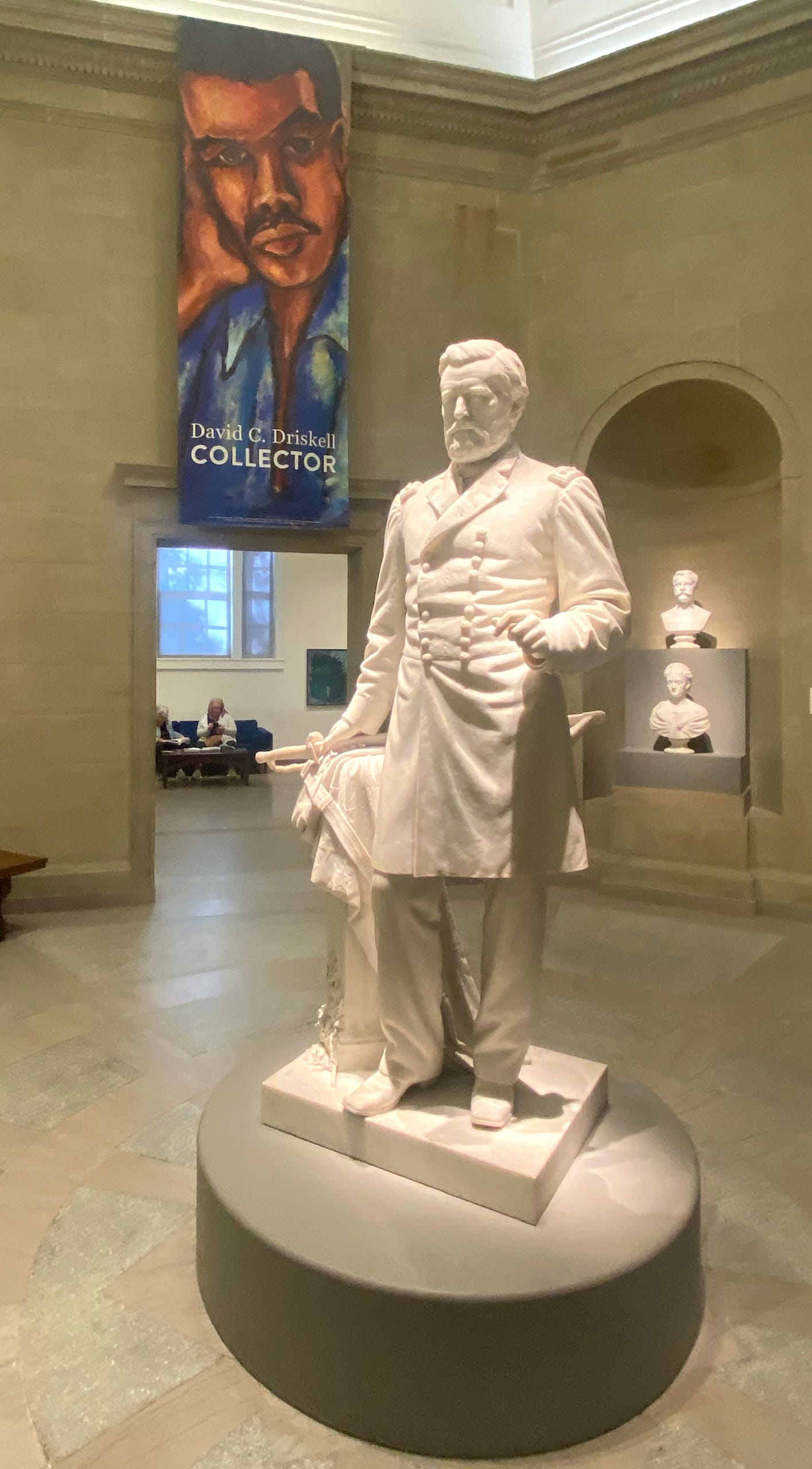
A different kind of dialogue occurs as visitors approach the exhibition. Driskell’s 1953 self-portrait, reproduced on a banner above the gallery entrance, gazes down on a life-sized white marble statue of General Ulysses S. Grant by Franklin Simmons. Resting his head in his hand, the painter looks unimpressed as he appears to study the Union Army commander.
Driskell’s legacy stretches beyond his gifts of art. Many contemporary Black artists have acknowledged his influence, and Atlanta’s High Museum of Art grants an annual David C. Driskell Prize in African American Art and Art History to artists and scholars who expand the canon of African-American art.
Alison Saar, who won the 2025 Driskell Prize, knew the artist personally. In an interview with Hyperallergic, she said of the prize, “It’s just really an amazing gift to the Black arts community.” The artworks that Driskell collected and created are gifts to all those who encounter them.
David C. Driskell: Collector continues at the Portland Museum of Art (7 Congress Square, Portland, Maine) through March 1. The exhibition was curated by Shalini Le Gall.