David Humphrey Is Allergic to Style
The artist challenges the status quo of postmodernism, not by knocking it over but by slyly subverting it.

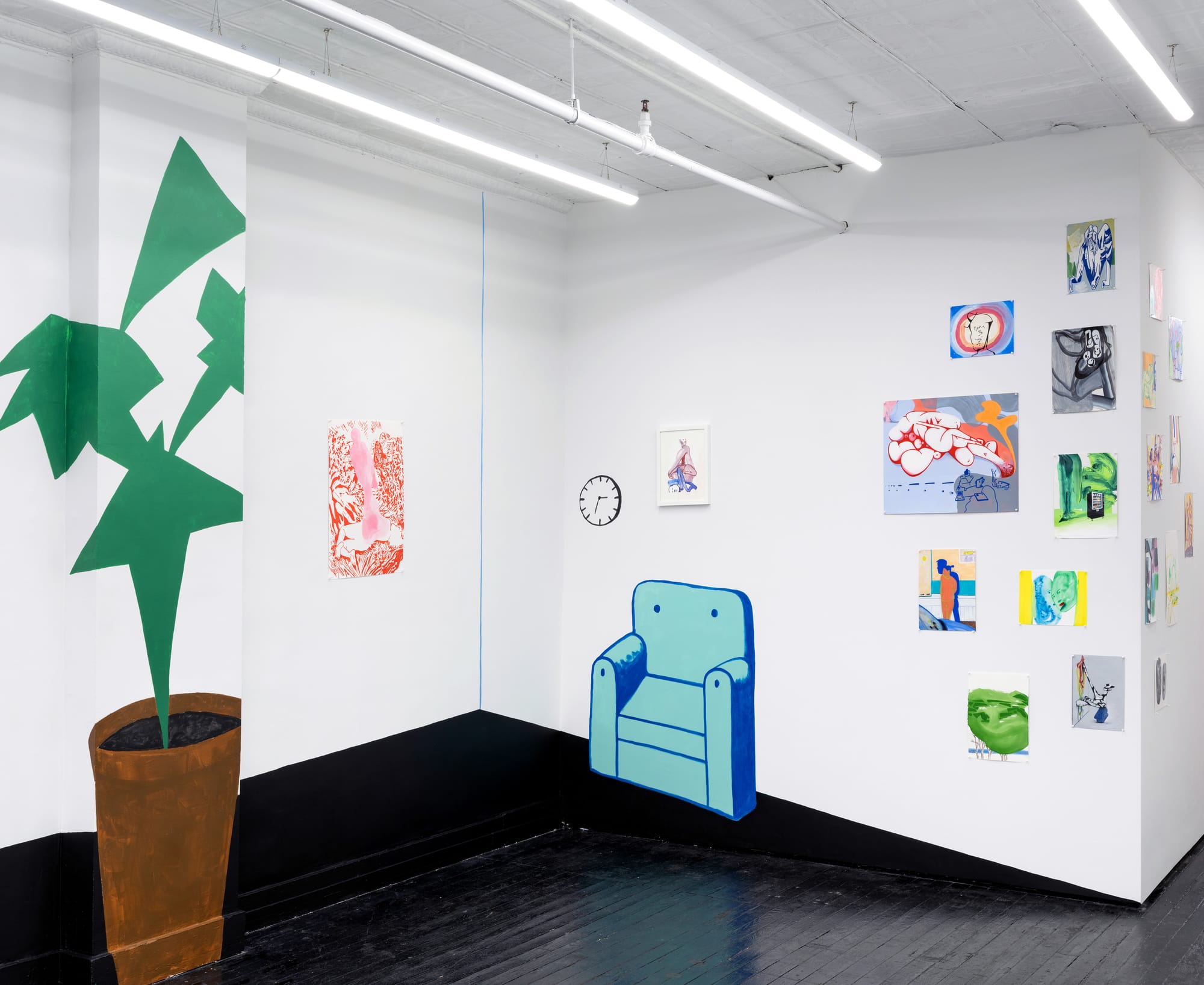
A few months ago, in the middle of a studio visit with the painter, sculptor, and critic David Humphrey, he showed me a plan on his computer for his upcoming exhibition of works on paper, Anecdote, at Kate Werble Gallery. He explained that he was going to transform the gallery into a room by painting a sofa, plant, cocktail table, standing lamp, and other pieces of furniture and decoration onto the walls.
While Humphrey’s casual, playful setting did not make the actual works on paper better or worse, it did do something unexpected: It made this viewer rethink the paintings I had looked at in his studio, the drawings I had previously seen, and his work as a whole. For most of his career, critics have been perplexed by Humphrey’s work, because here was a postmodern artist who did not fit into any of its well-documented categories. His art did not rely on appropriation, citation, parody, and irony. By focusing on how Humphrey fit into postmodernism, which had started to coalesce by the time he was beginning to exhibit in the late 1970s, critics overlooked that his skepticism, sense of the absurd, and criticism of well-known tropes such as the masculinity of painting, were essential to his approach to art.

His work is funny and absurd, and he neither takes himself too seriously nor pursues a signature style. Rather than narrowing down, he embraces the use of what he called, in an interview with Jennifer Samet in this magazine, “different pictorial languages that work with each other dynamically.” Free-floating collision and juxtaposition lie at the heart of his work, reflecting the exterior and interior cacophony of our daily lives under late-stage capitalism. What makes it endearing is his humor, which pulls us into a tumultuous world of consumer choices, fluid identities, strange geography, and feelings of dislocating futility, while never expressing superiority either between or over his male and female subjects. I now see Humphrey as a gadfly, quietly and insistently challenging the status quo not by trying to knock the train of postmodernism over, echoing the heroic mode, but by being slyly subversive, as if placing pennies on the track.
Within the uncluttered loft-like space full of generic furniture that Humphrey imagines for us, art and life are inseparable. Drawings are pinned to the wall in clusters, isolated as single examples, and equally spaced in a row. In one drawing, we see a fully dressed man sleeping on a couch. Is he a surrogate for the artist or a collector or, perhaps, both, since artists are collectors of images and things? How are we to see a group of drawings, pinned to a trompe l’oeil structure that recalls an empty billboard? Has the border between outside and inside dissolved? Are our apartments still sanctuaries? Or is that an illusion?

Many of the drawings are gems. Within the black, outlined body of a horse whose legs are open tubes, we see a crouching hunter shooting a rifle, the trajectory of the bullet culminating at the animal’s asshole. Meanwhile, the horse is looking down at what appears to be a red molecular structure. Another drawing actually consists of two drawings Humphrey has pinned together. On the left, a shapeless woman in a matching floral bathing cap and bathing suit points at a realistically drawn young woman, who occupies the other sheet. That woman is sitting on a board, with her clawed hands and prehensile feet bound, looking disdainfully at the first open-mouthed woman. By abutting the two drawings, Humphrey makes the juxtaposition a visible, physical act. And in still another drawing, an outlined horse with a short black mane and orange erection stares into the open black window of a shed. If we take the horse as a substitute for the viewer, then Humphrey is bringing voyeurism and pornography to the act of looking.
There are many ways to look at and think about Humphrey’s open-ended exhibition, which includes both a multitude of drawings and multiple, shifting contexts in which to see them. But mostly, his work brings us back to the fundamental questions of art: What do we use it for? How is it part of our daily life?


Left: David Humphrey, "Peeping Horse" (2012); right: David Humphrey, "Hiker" (2024), acrylic on paper (both photos by and courtesy David Humphrey)


Installation views of David Humphrey, anecdote (photos Adam Reich, courtesy Kate Werble Gallery)
David Humphrey: Anecdote continues at Kate Werble Gallery (474 Broadway, 3rd Floor, Soho, Manhattan) through June 6. The exhibition was organized by the gallery.