Ellen Pau’s Elegy to a Vanishing Hong Kong
In the video art pioneer's first US exhibition, water’s changing states become a metaphor for the city.

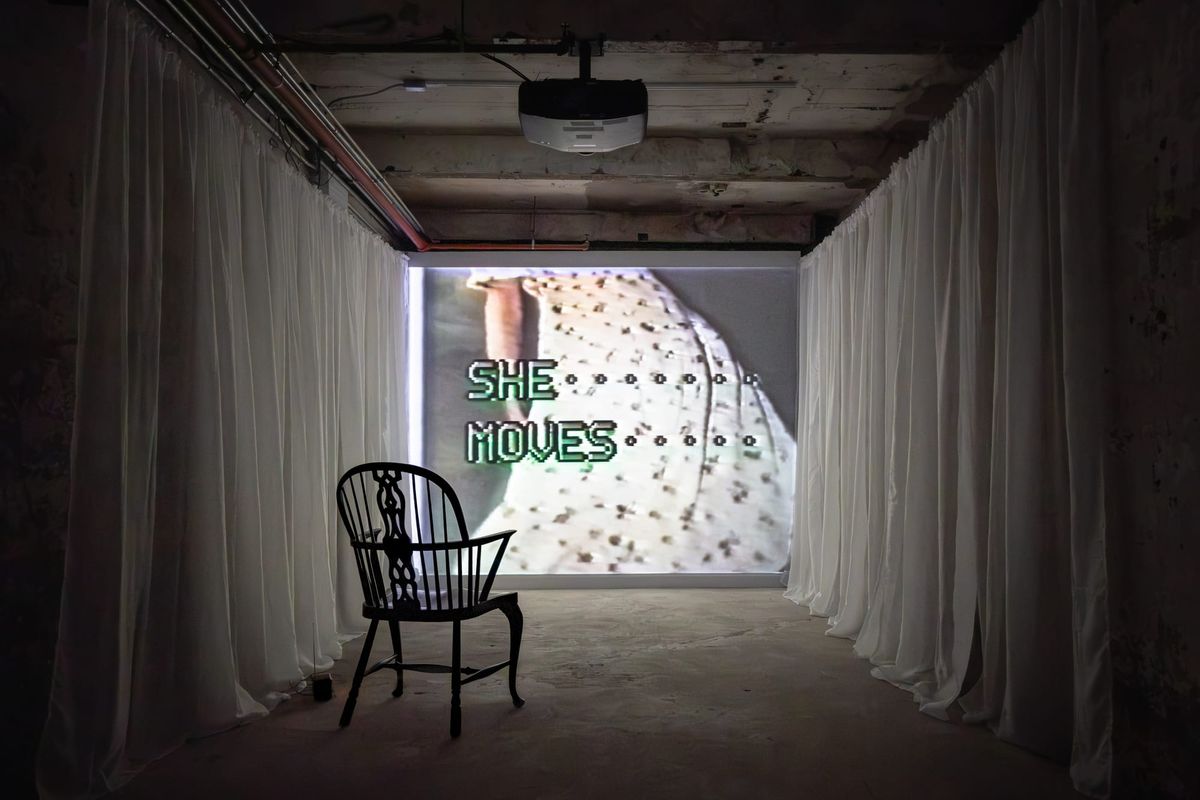
Drops of water trickle down a plain white wall under a heavenly light in Ellen Pau’s 1988 video installation “She Moves 她去.” Flanked by soft white veils and a nostalgic, wooden armchair, the work introduces water as a central motif in Pau’s long-standing interest in Hong Kong as a city in constant transition, moving through cycles of lost and found.
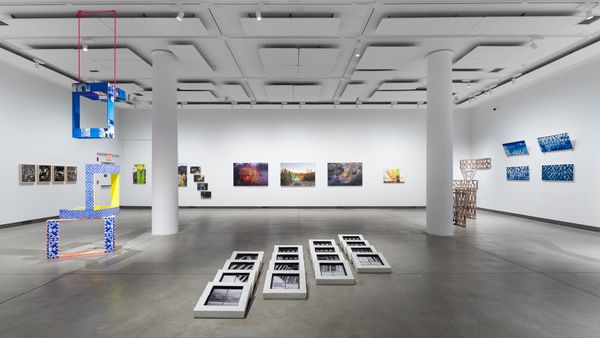
Ellen Pau: She Moves at SculptureCenter, curated by Freya Chou and designed by technical director Rain Chan, is the first United States survey exhibition of the woman widely regarded as Hong Kong’s video art pioneer. Across 15 videos and installations spanning the late 1980s to the present, water reappears in various forms: a crying wall, swimmers diving into Victoria Harbour, the scent of tear gas. Its changing states, from melting ice to evaporating mist, become a metaphor for Hong Kong herself — “always on the verge of disappearing,” as late cultural theorist Ackbar Abbas puts it — leaving little time for reflection before new changes arrive.
The city’s rapid transformation is reflected in the afterlife of “She Moves.” Over the years, the work has been transferred across formats — NTSC to PAL, VHS to DVD — remastered, and, most recently, restored with AI. With each iteration, something is lost, and something new is layered in. That state of flux is mirrored by the installation, an intimate space that invites viewers to take a seat, temporarily occupying the position of an absent subject. Who is the “she” in the title? Could it be Pau herself, who once rested in that very chair in her home; the woman in a floral dress, who appears briefly on screen; the visitors who enter and exit the space; or even Hong Kong herself?
Upon entering the underground, labyrinthine corridor, visitors encounter a work from Pau’s ongoing, multisensory Fl0ra Zero series (2016–ongoing), “Where Have All the Flowers Gone 冇花 冇假” (2026). It starts with burnt candles attached to the wall, collected by Pau and her friends over the years from the June 4 vigils commemorating the 1989 Tiananmen Square protests. On the opposite side, strips of film negatives hang from a rack, bearing ghostly silhouettes of these candles, preserving the outline of what once was. Translated into photographic images, the candles’ shifting forms draw a parallel to the making and preservation of historical records — just as light fixes a passing moment onto film, archives preserve ephemeral experiences as material records that outlast their original time. Close to the floor lie flesh-like lumps of melted wax, remnants of “Spectre of the Will” (2019), a single-channel video installation in which an infrared camera captured visitors standing before a heated wall, translating their body temperature into live heat maps. The surrounding wax slowly melted in response to the increasing energy, recalling the blood, sweat, and lives spent in collective resistance.
The smell of burnt bark and chemicals fills the air — intermittently released into the corridor is “Sublime,” a fragrance developed by Pau with scent specialist Xavier Tseng to recreate the smell of tear gas. Visitors may find their eyes watering as they move through the space, momentarily inhabiting the danger and vulnerability of participating in public protests. It’s a direct reference to recent protests in Hong Kong, where tear gas deployed by the police against protesters became sensory evidence of state violence and the suppression of civic expression.

Near the end of the tunnel, a holographic flame burns atop a bloodstained-looking structure resembling the torch of the Goddess of Democracy, a symbol during the Tiananmen Square protests. As viewers approach the work, motion sensors activate, switching the video feed from crackling fire to footage of burning film strips. On one hand, the work references the traditional Chinese practice of burning offerings for the dead; on the other, it comments on the altering and erasure of public records, both elegy and critique.
Since the 1984 Sino-British Joint Declaration set the terms for Hong Kong’s 1997 handover, questions around identity and autonomy have loomed over the consciousness of every local. In “She Moves,” Vera Lynn’s 1939 wartime anthem “We’ll Meet Again” plays, alluding to recent protests and migration waves in Hong Kong that split families and communities. Originally written for lovers separated by war, its promise of reunion captures the hope that, as Pau put it in her recent artist talk at the Asia Art Archives in New York, Hong Kongers will all meet again on a bright sunny day.


Left: Detail of Ellen Pau, "Where Have All the Flowers Gone 冇花 冇假" (2026), mixed media installation with multi-channel generative sound, video, acrylic, plywood box, wax, and objects (used candles, films, print on plates); right: Ellen Pau, "Diversion 兩頭唔到岸" (1990), 4K video (AI-upscaled; color, sound) (both photos Charles Benton, courtesy SculptureCenter)
Ellen Pau: She Moves continues at SculptureCenter (44-19 Purves Street, Long Island City, Queens) through August 16. The exhibition was curated by Freya Chou.