“Helter Skelter” Can’t Look America in the Eye
Nancy Spector’s curation cannot face the racial implications of Richard Prince and Arthur Jafa’s work.

VENICE — The buzz during the Venice Biennale opening week was that the real United States pavilion was not the banality cobbled together by Trump’s acolytes in the Giardini, but Helter Skelter, a show of Arthur Jafa and Richard Prince, sponsored by the Fondazione Prada and curated by Nancy Spector. That assessment is correct, for better and for worse. The show pairs two artists — one Black, one white — who have trained their vision for decades on both the US’s foundational violences and its rarer, complicated moments of beauty, through strategies of appropriation. Taken together, their work becomes a bracing indictment-slash-love letter to a deeply flawed nation.
But to my mind, what makes the exhibition even more quintessentially American is the fact that the curator seems — almost perversely — unable to face (or at least name) the racial implications of her own curatorial conceit. That conceit, in a nutshell, is that through a set of shared conceptual and formal strategies, Prince offers a portrait of (white) America and Jafa offers one of Black America. This results in a de facto segregation of their concerns in defiance of the way both artists reveal — in their individual practices, and in dialogue with each other — how Blackness and whiteness haunt each other in the American psyche.
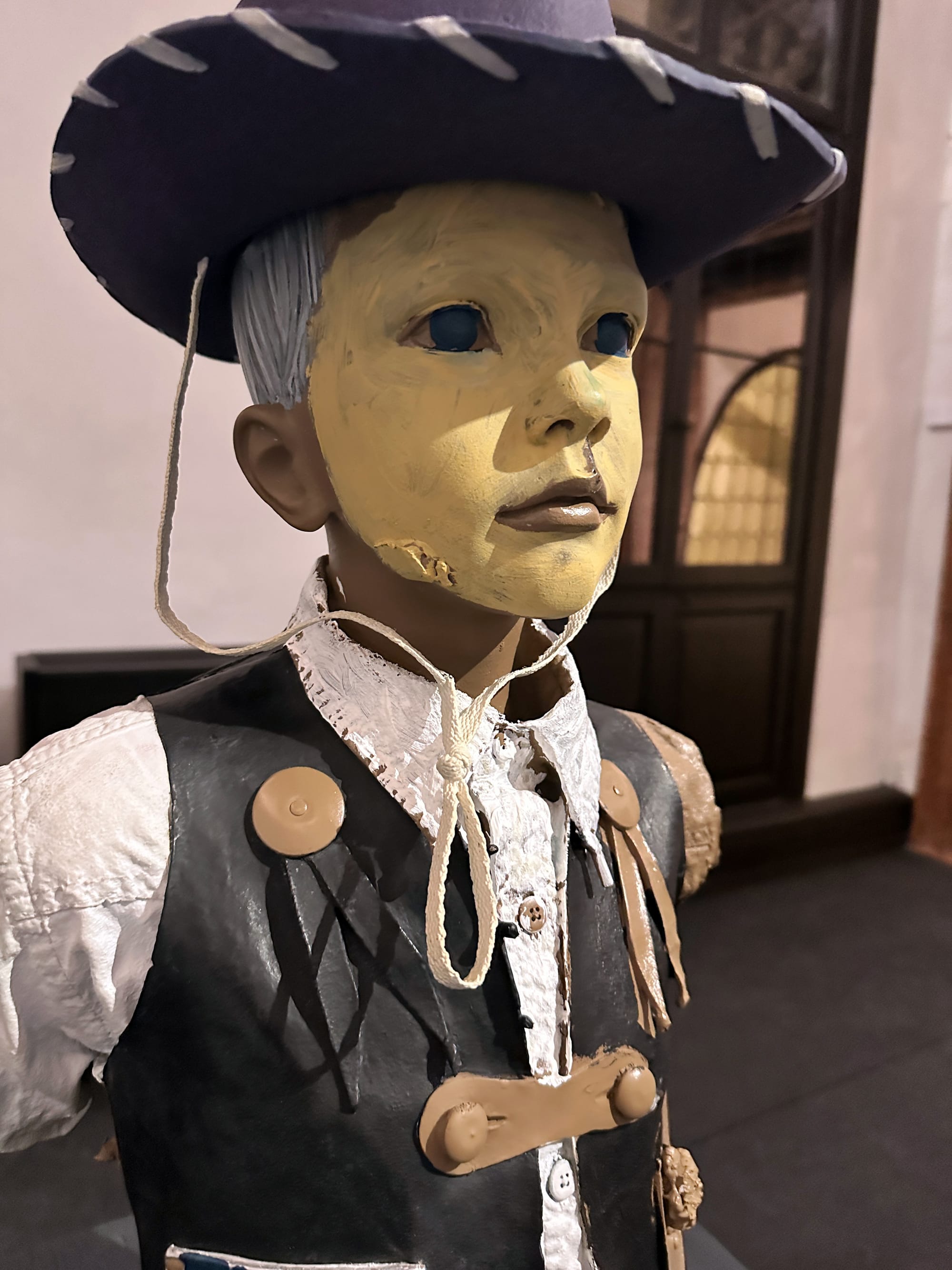
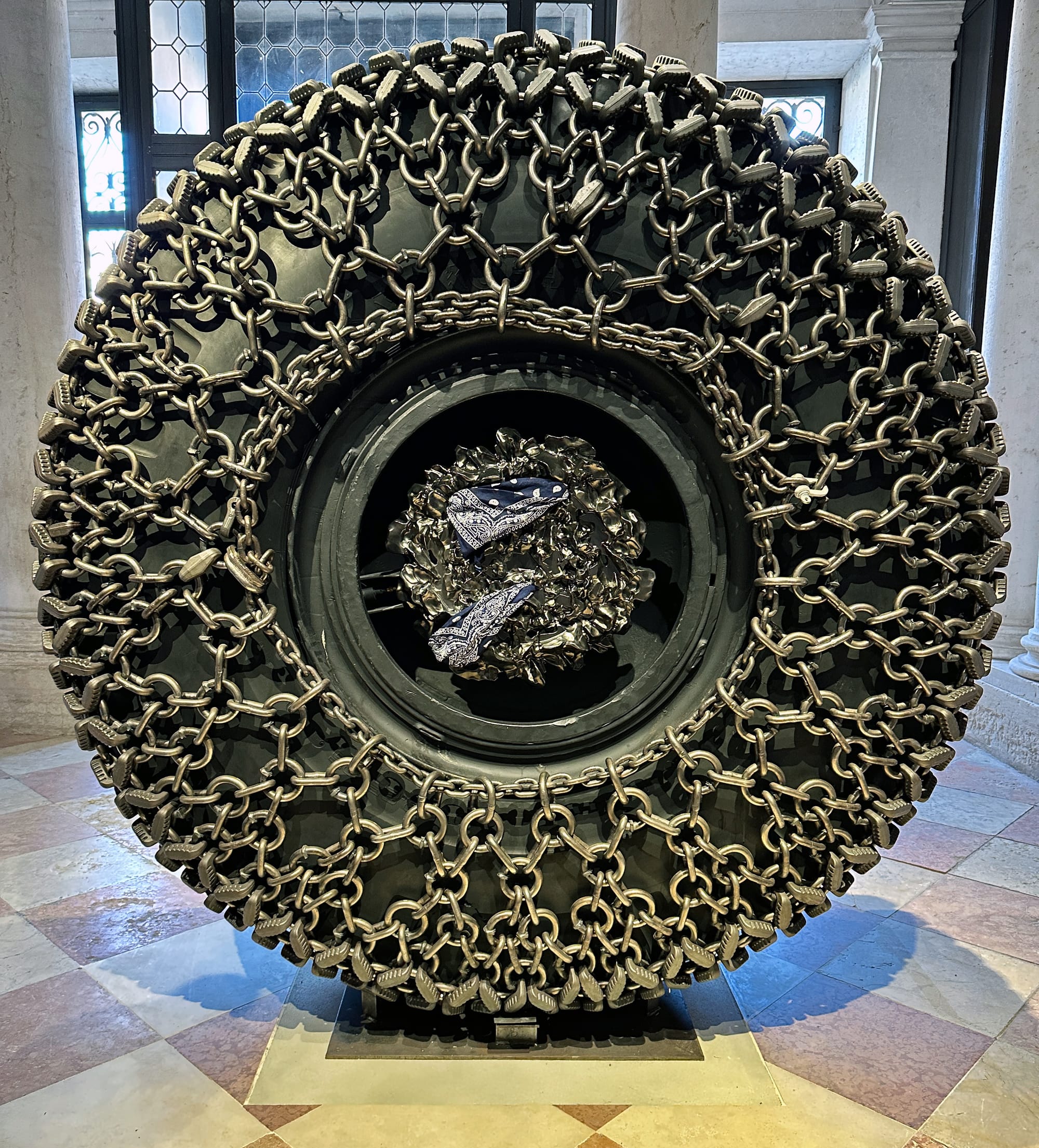
Left: Richard Prince, “Untitled (Cowboy)” (2016); right: Arthur Jafa, "Big Wheel II" (2018), chains, rim, hubcap, and tire
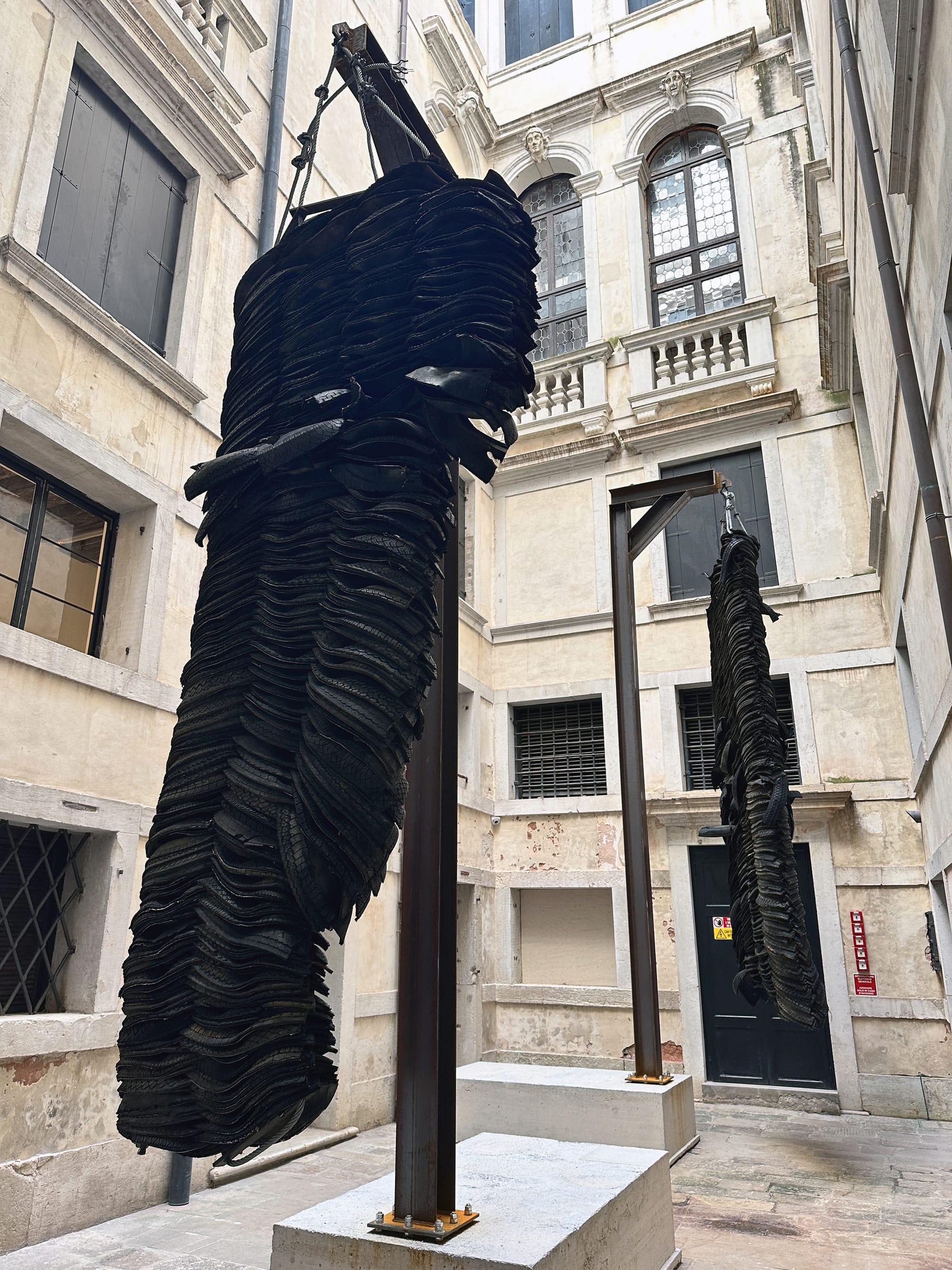
Spector’s avoidance is apparent in her framing of the otherwise rather brilliant pairing that opens the show: “Folk Songs” (2006) by Prince, composed of rubber blasting mats used to isolate explosives in highway construction, stacked tight and hung from two metal stanchions; and “Big Wheel II” (2018) by Jafa, a monster truck tire wrapped in metal chains. They are both about American car culture, and the aggressive masculinity that is its source and consequence, Spector tells us in the wall labels; Jafa’s sculpture is inflected as well by issues specific to Black experience (the auto industry and Black labor, the shackles of slavery, and so on).
What Spector doesn’t seem to acknowledge is that Prince’s “Folk Songs” evokes two hanging Black bodies. That reading may only have occurred to me thanks to the juxtaposition with Jafa’s work — props to the curator on that — but once I saw it, I couldn’t unsee it.