How to Tell the Story of Extraction in Appalachia
Fia Backström explores this nexus of environmental degradation, disaster capitalism, and intergenerational poverty through embodied, compassionate, and durational research.

The Swedish artist and writer Fia Backström began traveling to the Appalachian region of Buffalo Creek, West Virginia, in 2017. She returned yearly, and sometimes monthly, for nearly a decade. Backström was not only taken with the “incredibly friendly and welcoming” people she met there, and the strong labor history (“Blair Mountain is just up the mountain from the hollow of Buffalo Creek,” she tells me), but also with the area’s duskier history of mining and related ecological disasters. During one trip, she learned that on February 26, 1972, a coal slurry dam collapsed in the region and released an estimated 20-foot (~6 m) tidal wave of black sludge that swept down the 15-mile (~24 km) valley, killing 125 people and leaving 4,000 homeless. The mining company called it an “act of God,” and left the land toxic for decades. Each survivor received a $13,500 settlement, and some took part in long-term psychiatric studies on collective trauma and healing.
As Backström learned from her visits, this region is a nexus of environmental degradation, disaster capitalism, and intergenerational poverty. The resultant works from her years of field research — now on view in The Great Society at the Queens Museum through May 17 — make a compelling case for working-class solidarity through a multilayered overview.
Backström’s output is primarily photographic, but in this show, it evolves into other formats, including embroidery and docupoetry — a kind of fragmented storytelling (think Claudia Rankine’s 2014 Citizen). One of the first pieces on view, “Witness [According to Estimates]” (2025), is an around two-by-one-foot (~61 x 30.5 cm) docupoetic text that begins with the facts: “235 SLUDGE PONDS / 15 HIGH-RISK IMPOUNDMENTS,” and ends with “89 2021 – DEATH TOLL.” It takes inspiration from feminist poet and activist Muriel Rukeyser’s 1938 docupoetic masterpiece The Book of the Dead, which examines the sweeping lung disease that killed thousands of primarily Black miners in West Virginia after their exposure to silicate dust (and the refusal of their employer to protect them).
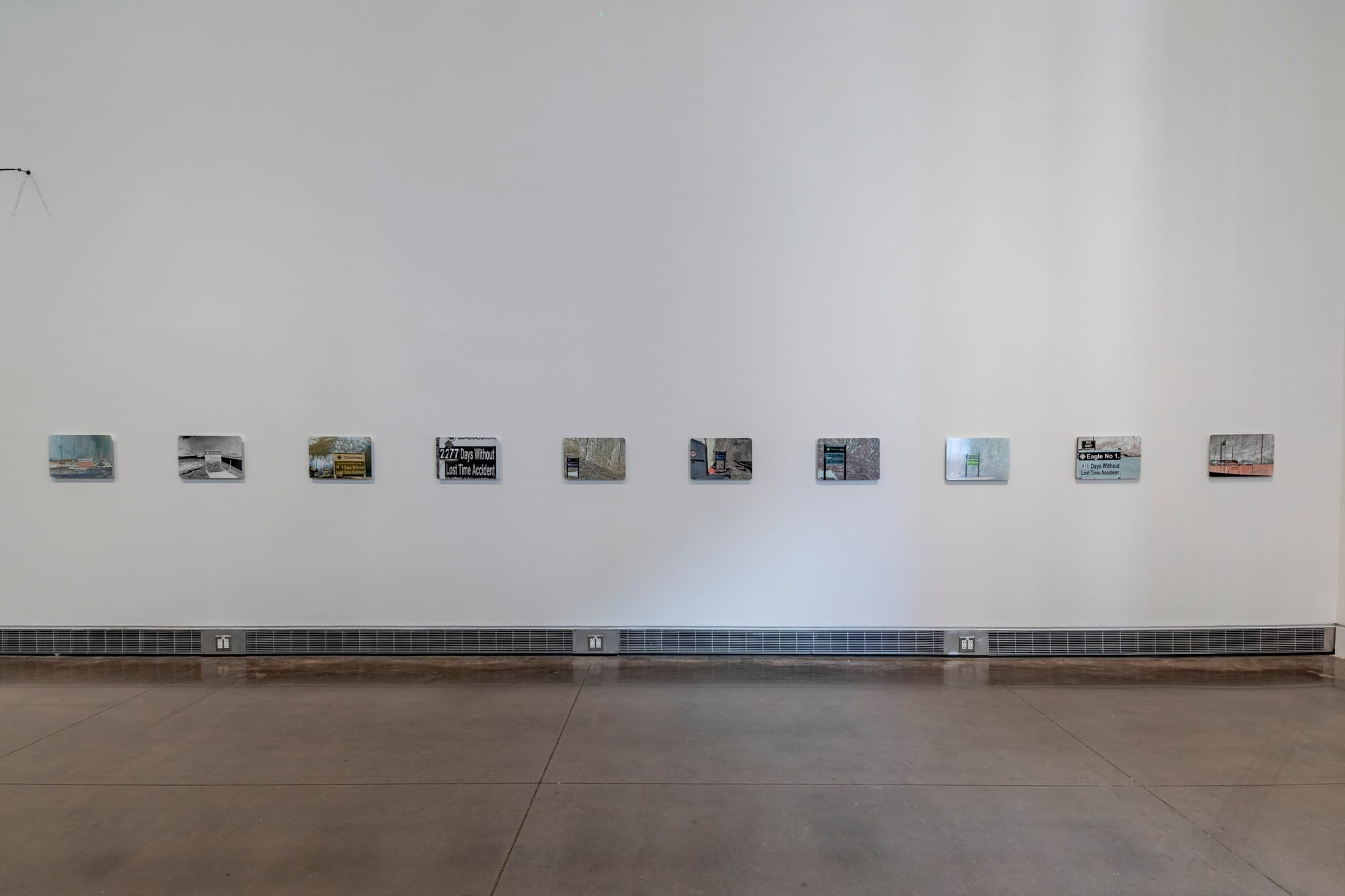
On a wall across from these first works, the artist installed Days Without Lost Time Accident (2024–25), a somber series that gathers images of the omnipresent signage found at mining sites that show how long it’s been since a worker has been injured while on the job. These photo-sculptures are printed, appropriately, on powder-coated steel, replicating the signs themselves at a smaller scale. The colors of each image have been inverted (an approach often used in scientific research), so that the language appears clear while everything else rests on the threshold of visibility. Alternate realities soon become a theme as the artist continues to blur lines between reality and surreality, testimony and docupoetry, and representation and abstraction.

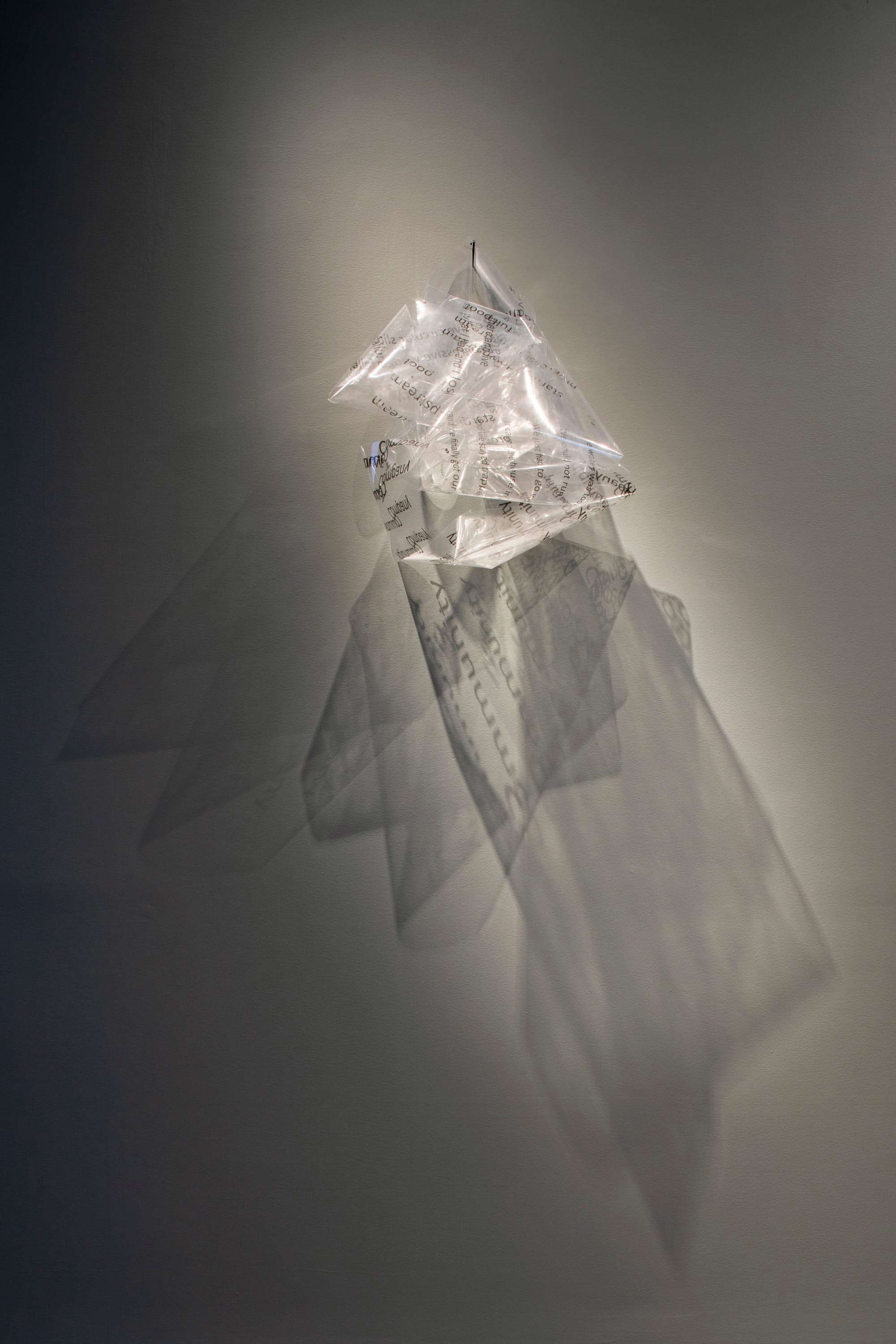
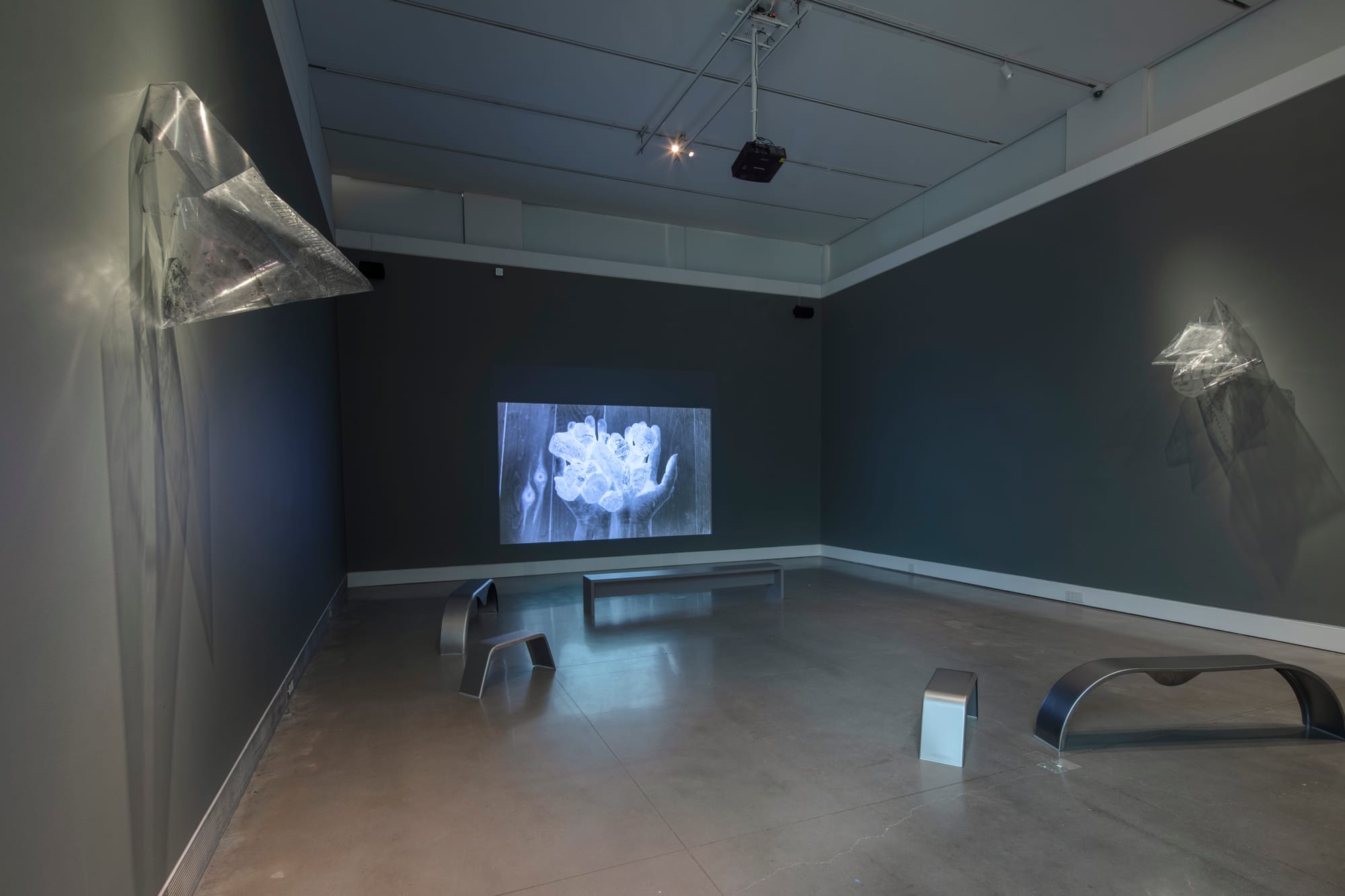
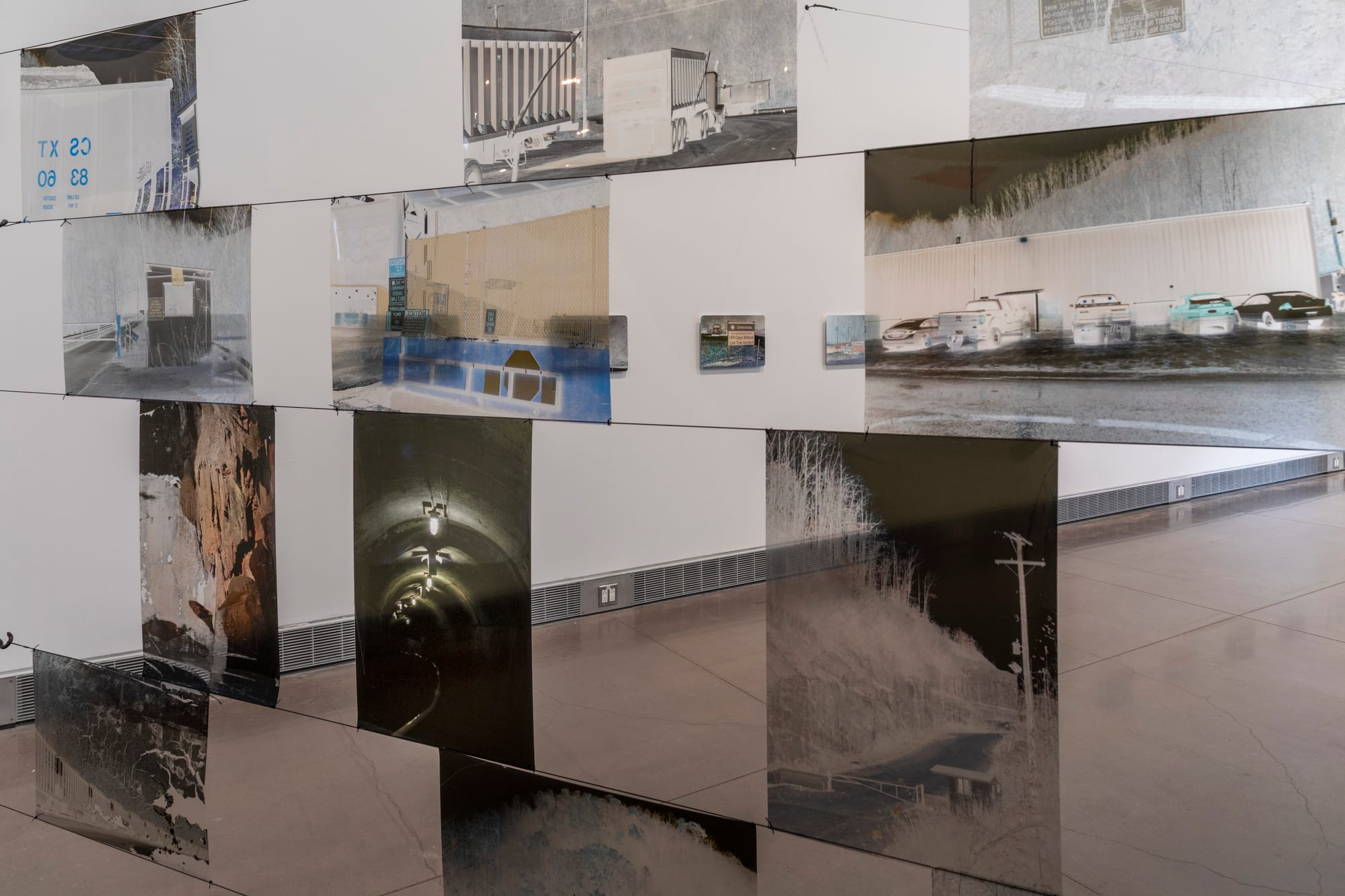
In the next gallery stands “Sacrifice Zone” (2025), a 63-foot-long, 8-foot-high (~19.2 x 2.4 m) display apparatus modeled in part on local powerlines. Tied onto its cables are over 80 pictures printed on transparent film — all images that Backström captured in the region, including forests, caves, and biomorphic mineral formations within them — which are also inverted and distressed to create a parallel dimension. The lack of bodies here, and throughout the show, is perhaps a response to the large and contentious amount of mass media images showing impoverished, rural Appalachian citizens made during the war on poverty as part of President Lyndon B. Johnson’s “Great Society” initiative between 1964 and '68.
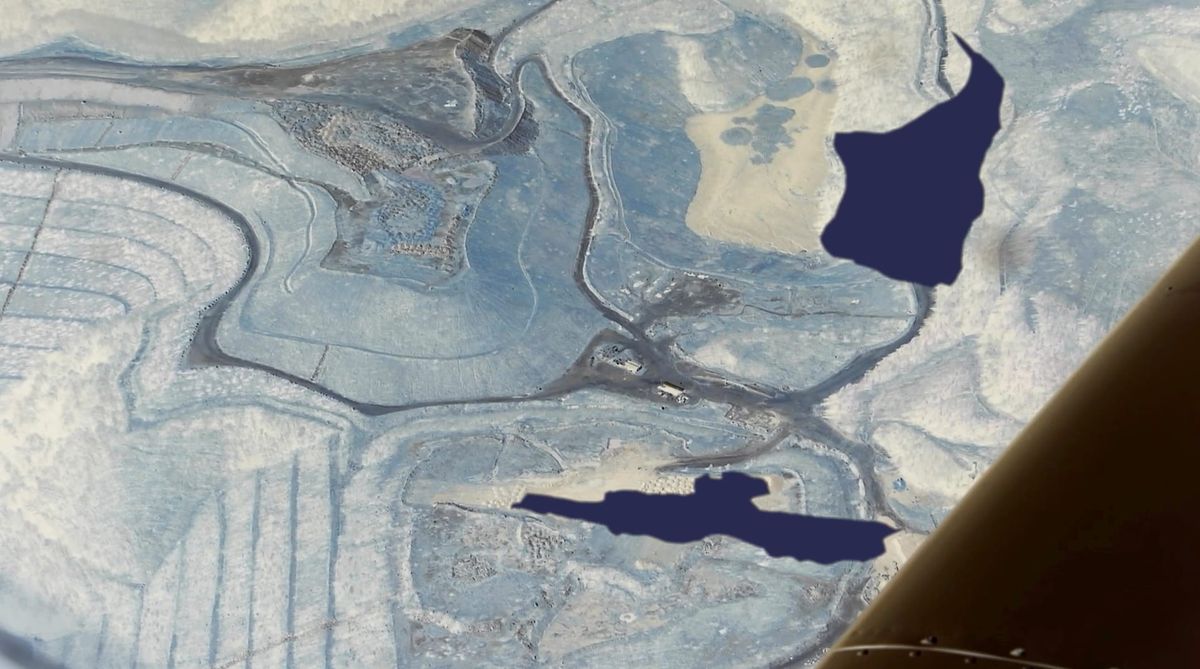
Several videos underscore Backström’s embodied, compassionate, and durational research. The nearly 15-minute video “Toxicology Report” (2025) features aerial footage of coal slurry dams and strip mines that she shot from a Cessna plane. In a voiceover, the artist offers abrupt docupoetic excerpts — “they blast off the mountain tops,” “strip mining,” “invasive” — from interviews she conducted with locals, including scholars and ginseng foragers, while longer quotations appear at the bottom of the screen. The effect is both jarring and moving — and also leaves one wanting to hear more from the locals, which thankfully occurs in the final gallery. There, we encounter more panels of docupoetry that Backström created with the testimony of West Virginians and the 30-minute travelog video “The Mud Wave” (2024).
This ending demonstrates how deeply Backström absorbed this first-hand knowledge of Buffalo Creek, and signals the key difference between search and research — that is, between simple data accumulation and posing difficult questions. Near the start of “The Mud Wave” the artist asks, “Why am I here? / I think I am here to “document” something / This place, this state, already overly photographed / What can photography do here?” Later, she wonders, “How to tell a story about a place that is not mine? / Not putting words in the mouths of others / How not to expose and exploit yet again.”
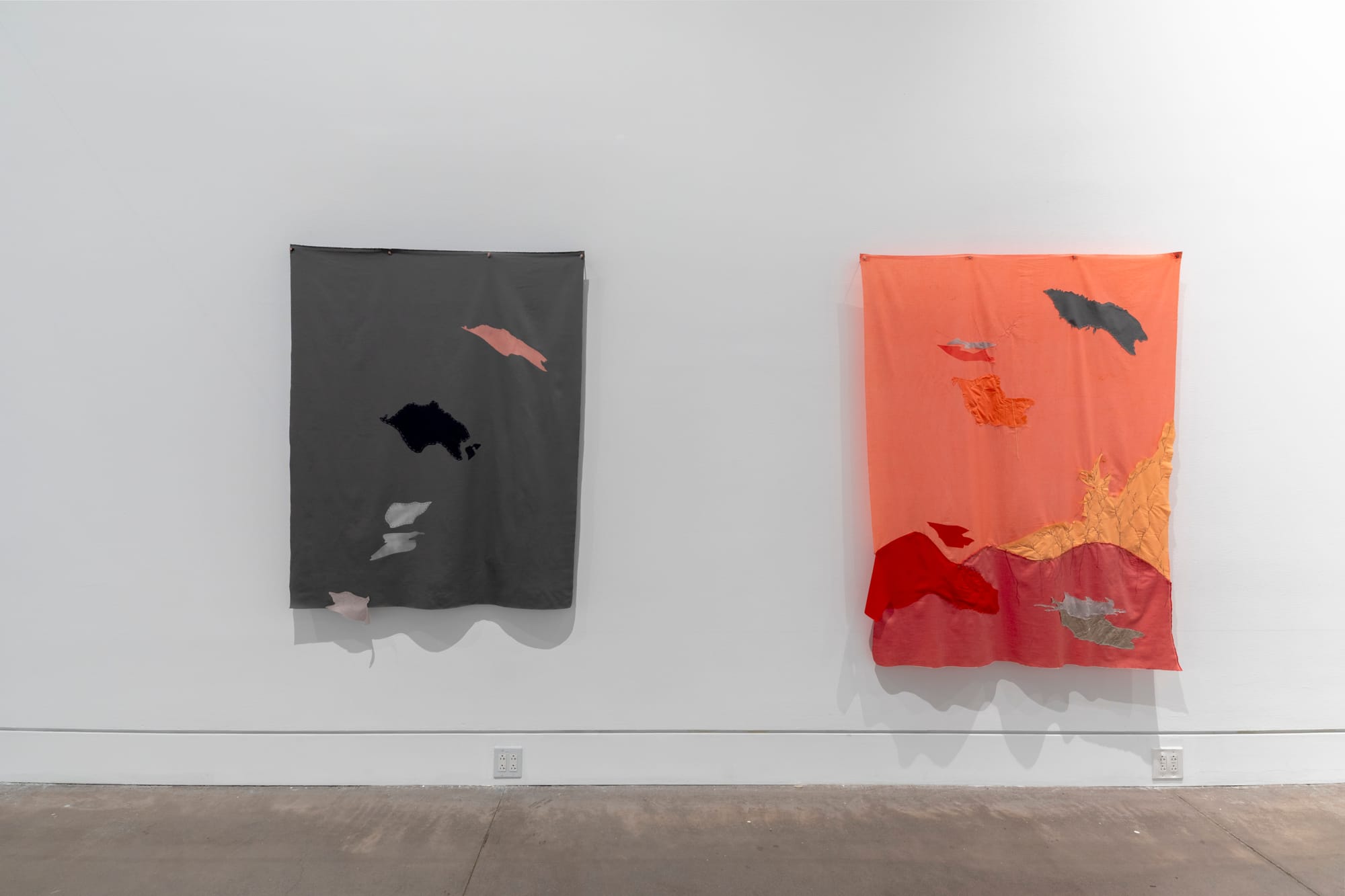
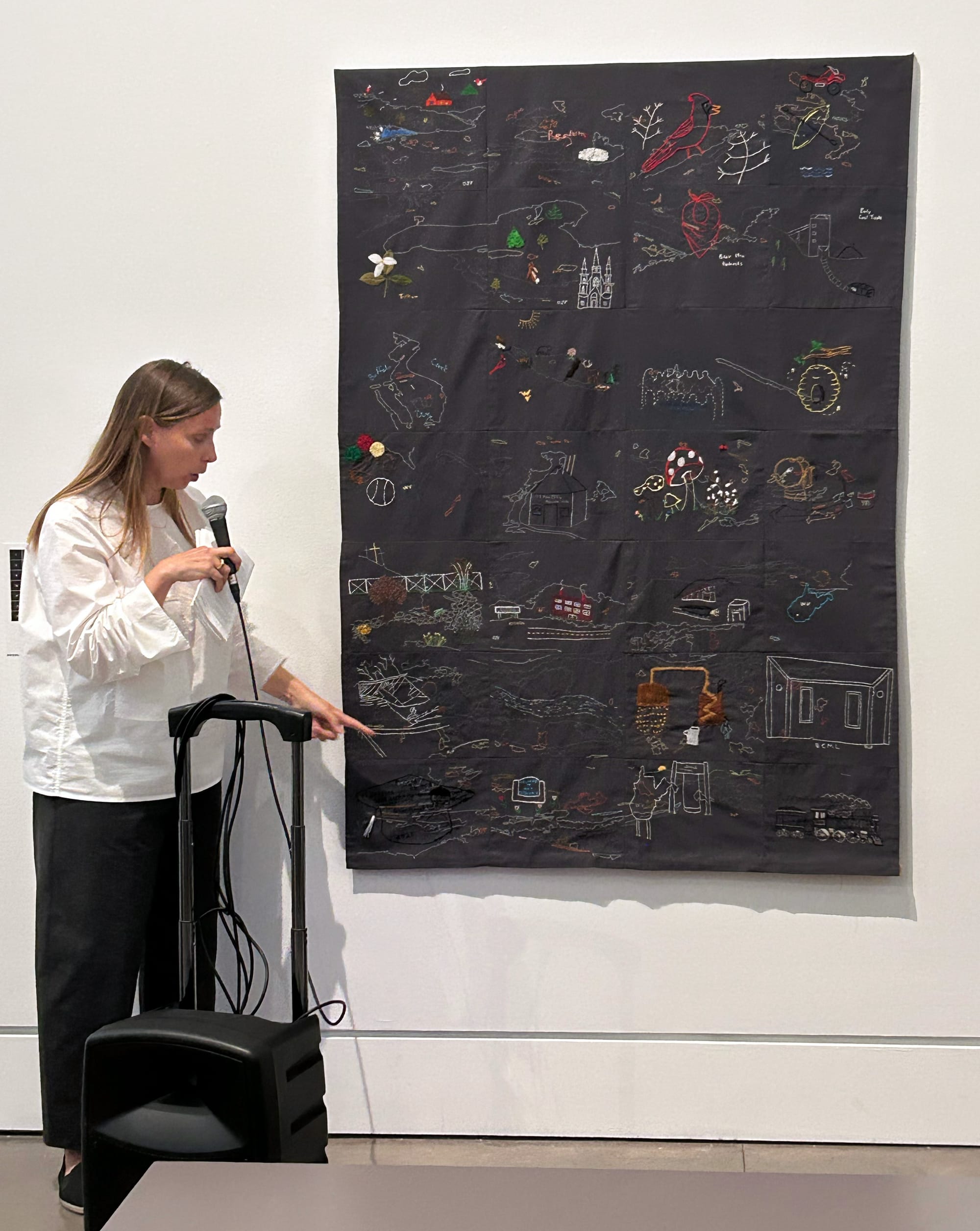
The textiles offer one way forward. “Buffalo Creek Therapy Quilt 2025” (2023–25), for example, was created with West Virginia residents Karen Arms, Doris Frazier, Crystal Hicks, Presleigh Mounts, Vicki Padgett, Joyce Perry, Barbara Smith, Liz Tackett, and Priscilla Thomas at the local library, where the artist offered embroidery workshops. It’s inspired by a quilt held in the West Virginia State Museum, which another group of women made shortly after the 1972 disaster. In it, each block portrays one of the 16 towns that were destroyed that year. The newer version references schools, landmarks, miners’ helmets, and aerial views of mines, among other images. While there is, of course, a long history of quilts that merge therapy and art and engage with craftivism, such as the AIDS Memorial Quilt, this piece functions slightly differently. As an echo of a previous community-led endeavor, it refuses historical amnesia by underscoring how the past repeats. A standout work in this judicious show, it becomes an emblem of West Virginia as well as a symbol of love, heartbreak, and, ultimately, survival.