“I Shot Andy Warhol” Upends the Myth of the Great Man
The radical feminist author of “SCUM Manifesto” and the bygone world of Warhol’s Factory come to life in the 1996 film, now restored to 4K.

Andy Warhol occupies a strange, almost mystical place in the cultural imagination. There is Warhol the man (“Andy” to his Factory acolytes) and Warhol the monolith. There is the painfully self-conscious Midwesterner and the turtlenecked Rumpelstiltskin, spinning ephemeral straw into art-market gold. There is the son who takes his mother to mass every week and the mop-headed libertine whose debauched parties are legendary. Has there ever been another figure at once so socially awkward and hungry for attention? Has there ever been another American so engrossingly contradictory?
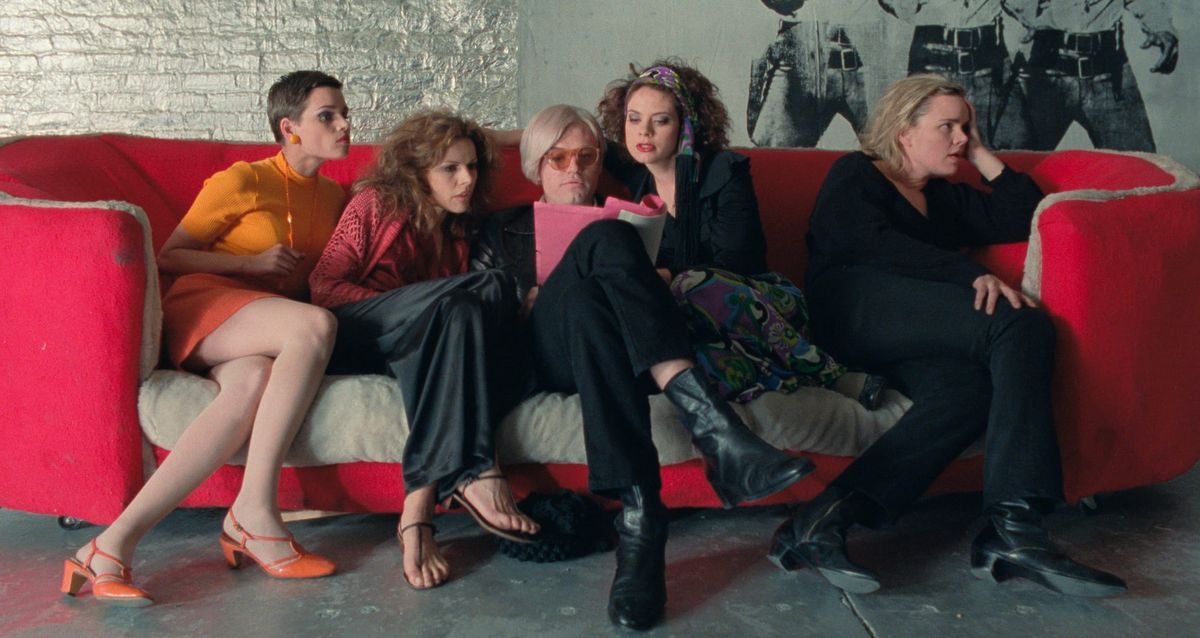
Meet radical feminist Valerie Solanas. Remembered for her 1967 “SCUM Manifesto,” a scathing call to arms for the “Society for Cutting Up Men,” the misandrist is also known for shooting one of the biggest icons of the 20th century. Mary Harron’s 1996 drama I Shot Andy Warhol — named for Solanas’s declaration immediately following the attempted murder in 1968 — dares to consider Warhol and Solanas as equals, both yearning for mass approval, both deeply misunderstood, both caught in the crosshairs of rapid social change. Now restored to 4K for its 30th anniversary, I Shot Andy Warhol is a film ahead of its time — one that resembles today more than the decade in which it was made.

Starring Lili Taylor as Solanas and Jared Harris as Warhol, Harron’s film is less a biopic than a seductive, if somewhat cynical, venture into downtown New York bohemia. In that bygone world, aristocrats rubbed shoulders with drug dealers, drag queens shared ash trays with debutantes, and an outsider like Valerie Solanas could ingratiate herself with the father of Pop art.
In the mid-’90s, New York was still gritty enough to look like it could be 1968; cinematographer Ellen Kuras captures the zeitgeist with slow, meandering tracking shots and elaborate long takes. In a pivotal 10-minute scene of a party at the Factory, the Velvet Underground plays for uptown heiresses and scenesters assemble a mosaic of uppers and downers on the floor. While the revelers get down, get it on, and pass out, Warhol and Solanas both loom in the background — somber, quiet, and totally alone. Even in the scene in which she fires at Warhol, she is quite the clumsy markswoman, utterly unprepared for what to do next.
“Why did you want to shoot Andy Warhol?” a detective asks Solanas. “It’s complicated,” she replies. Appearing more like a scrappy newsie than an aspiring assassin, Taylor endows her character with a chutzpah and vulnerability that make it hard not to root for her, even when she’s clearly lost her mind. Solanas’s 1967 manifesto was based on the assumption that men are inherently inferior biological beings. But as fiery as her principles were, so too, as the film reveals, was her desire to get famous. As a would-be revolutionary she was no less susceptible to the lure of celebrity than those in Warhol’s circle.

Harris plays Warhol skittish and aloof, as uncomfortable with his band of followers as he is talking to the press. And yet his magnetism is indisputable. “If anyone can make you a star, Andy can,” transgender actress Candy Darling (Stephen Dorff) whispers to Solanas — and for Candy, at least, this proved to be true. While Warhol’s entourage dismisses Solanas as a homely pariah, he himself is intrigued, inviting her to do a screen test when she badgers him about producing her vulgar play, Up Your Ass (1965). When her play is lost at the Factory and a publishing deal goes sour, Solanas becomes conspiratorial, blaming Warhol for her “being trapped” in a world in which she was never really free in the first place.
Perhaps most impressive today is how Harron’s film indicts the sexism and misogyny of the period while never presenting Solanas as a helpless victim or martyr. A film shot by a woman, directed by a woman, and starring a woman is rare enough in 2026, so all the more wild that this film ever came to be 30 years ago. Solanas’s vision of a “magic world” created by women may never come to fruition, but I Shot Andy Warhol offers a glimpse of what femme-forward cinema might look and sound like.
I Shot Andy Warhol (1996), directed by Mary Harron, screens today through June 18 at the IFC Center (323 Sixth Avenue, Greenwich, Manhattan) and at select theaters in Los Angeles.