Jule Korneffel Finds Meaning at the End of Light
Her paintings compress Roman mythology, Italian Renaissance paintings, color relationships, and that moment before disappearance.


Since I first saw Jule Korneffel’s acrylic and natural pigment paintings at her thesis exhibition at Hunter in 2018, I have watched an increasing gravitas enter her work in debut and subsequent exhibitions at Spencer Brownstone Gallery in 2019 and 2022, and a 2025 group exhibition I curated that included her work.
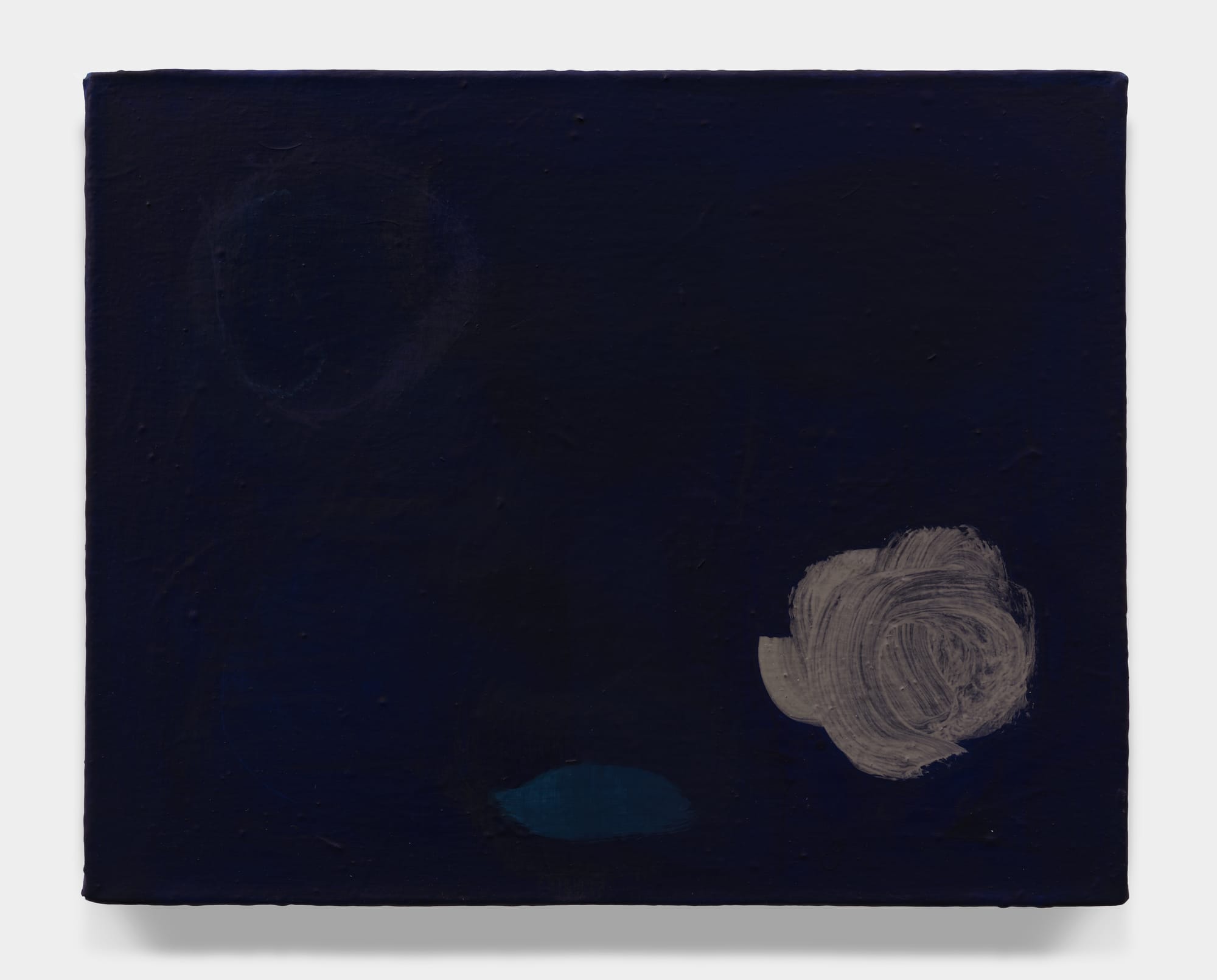
Korneffel develops a palette for each painting based on research and intuition. She pays particular attention to the paint’s viscosity and its capacity for making distinct kinds of marks. One of the engaging paradoxes of her work is the relationship between austerity and lushness, restraint and declaration. The marks — their shape and thickness — seem crucial and spontaneous, while carrying a trace of whimsy and vulnerability.
Korneffel’s work has become more exquisitely nuanced as she pursues her interest in light, from strong to fading. In her most recent exhibition, In Search of Lost Light, at Spencer Brownstone Gallery, on view through May 2, she started out wanting to make a group of blue paintings but ended up working on gray paintings. This was due to her circumstances — she spent the winter living in northeastern Germany and reading Marcel Proust, who (like Korneffel) was interested in Claude Monet. The winter sky of this region, where Berlin is situated and Korneffel’s family lives, is a dense fog in which the sun briefly appears, suspended like a pale yellow orb barely visible behind a dusky gray veil.
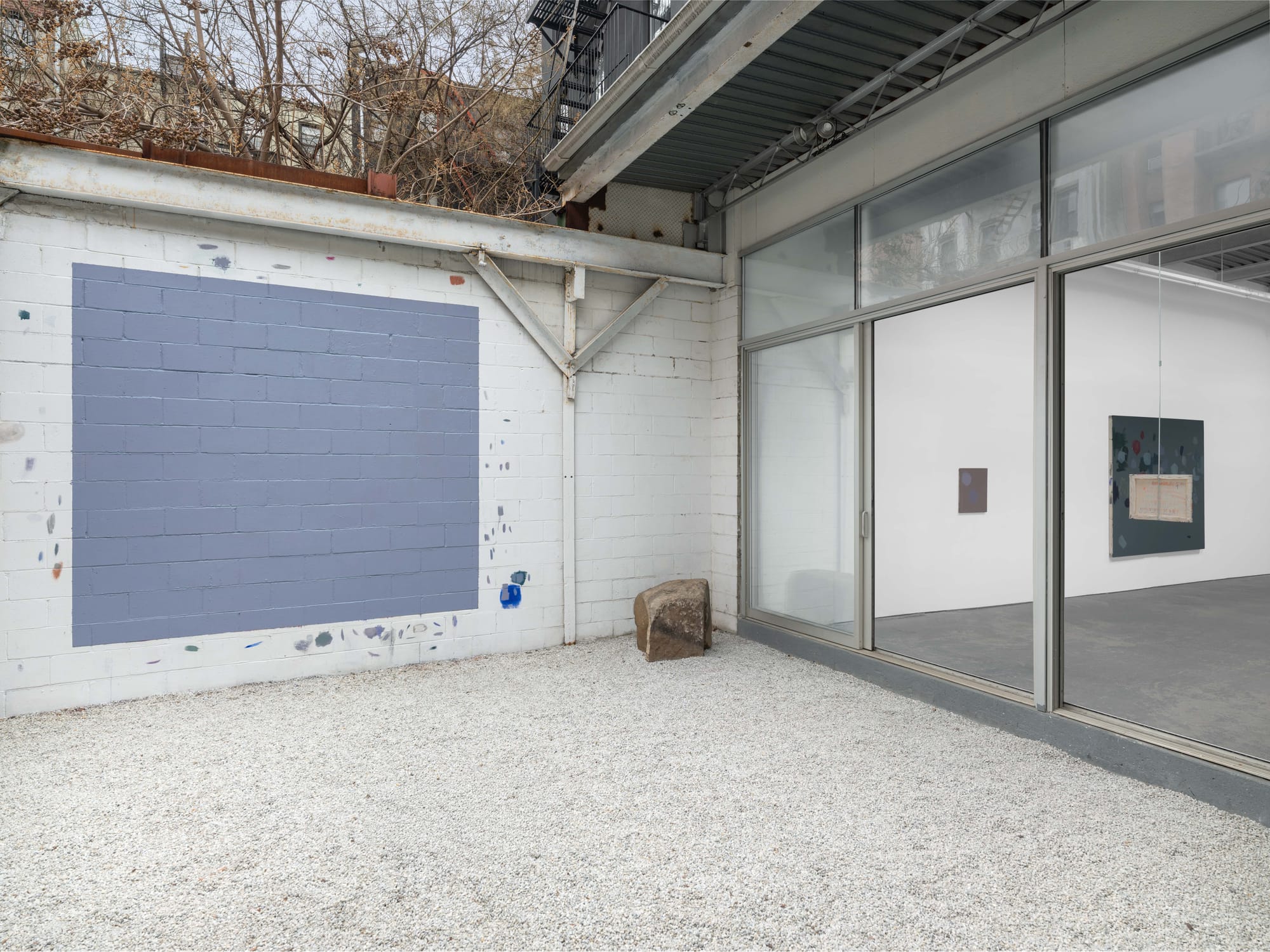
There are seven paintings ranging between 20 x 18 inches (~51 x 56 cm) and 80 x 96 inches (~2 x 2.4 m), dated between 2023 and this year, in the exhibition. Outside, on the white concrete wall, the artist has painted a large, layered blue square, “New York City Rising.” Around it, we see evidence of the colors she used in earlier layers. Sitting with it for a while, I watched the color change according to the ambient natural light and felt a connection between her work and that of James Turrell. Both are interested in light as a changing phenomenon, at once palpable and elusive.
“Aurora and her Siblings (Morgenröte)” (2024) refers to the Roman myth of Aurora, who is the goddess of dawn, and sister of Sol (the Sun) and Luna (the Moon). Aurora announces the beginning of a new day. Against a layered, matte, dusty rose ground, we see two orbs, one gray and the other a dusty blue-violet. The gray orb is in the upper left-hand corner and the dusty blue-violet is in the center of the nearly square rectangle. Meanwhile, the title’s parenthetical, "Morgenröte," is German for “morning red.” The painting compresses Roman mythology, Italian Renaissance paintings, color relationships, and that moment between appearance and disappearance. Looking at it, we see into the dense, layered, slightly textured surface and glimpse other colors which seem to fade before our eyes.
The title of “Withered Summer (Proust) / Giotto’s San Francis before restoration” (2023) establishes the field of research, connections, and memories that went into the making of the painting. The gray ground and gray-green orbs and marks refer to Giotto’s “Stories of St. Francis” (c. 1297–1300) frescoes in Florence’s Santa Croce (Bardi Chapel) and Assisi’s Basilica of St. Francis before their cloudy, badly damaged surfaces were cleaned, removing years of dirt and soot. Korneffel, who saw them before they were restored, connects her experience to Proust’s theme of the “withered summer” and fading, melancholic moments when autumn is approaching.
Melancholia is a theme running through these paintings, a feeling of time passing and darkness becoming unavoidable, and what that means. Instead of lamenting this state, Korneffel both memorializes and celebrates the fading of the light, the rising of each new day.
Jule Korneffel: In Search of Lost Light continues at Spencer Brownstone Gallery (70-A Suffolk Street, Lower East Side, Manhattan) through May 2. The exhibition was organized by the gallery.