Leonardo Madriz’s Monuments to the Precarity of Now
His sculptures are a striking metaphor for the fragile equilibrium of American life.

The totemic object was a source of intense interest among post-war artists like Louise Nevelson and Joan Miró, who created personages from found items, echoing the monuments of Indigenous groups. More recently, Simone Leigh has attempted to revisit these objects in a decolonial light, mining their symbolism to deconstruct imperialist histories.
The five sculptures in Do Not Be Afraid at Parent Company are Leonardo Madriz’s gangly, knotted additions to this legacy. Madriz anthropomorphizes each work as a sentinel, inscribing a role of protector into the assortments of rope, resin, and found items. Their identities are formed through poetic relationships between the objects that comprise the structures and the knots used to link them to each other. The gold-adorned spans of bent rebar in “Sentinel Adorned in the Leavers’ Wake” (2025), for instance, are attached to illuminated resin casts of street detritus with a variety of knots — manger’s hitch, surgeon’s loop, blood knot.
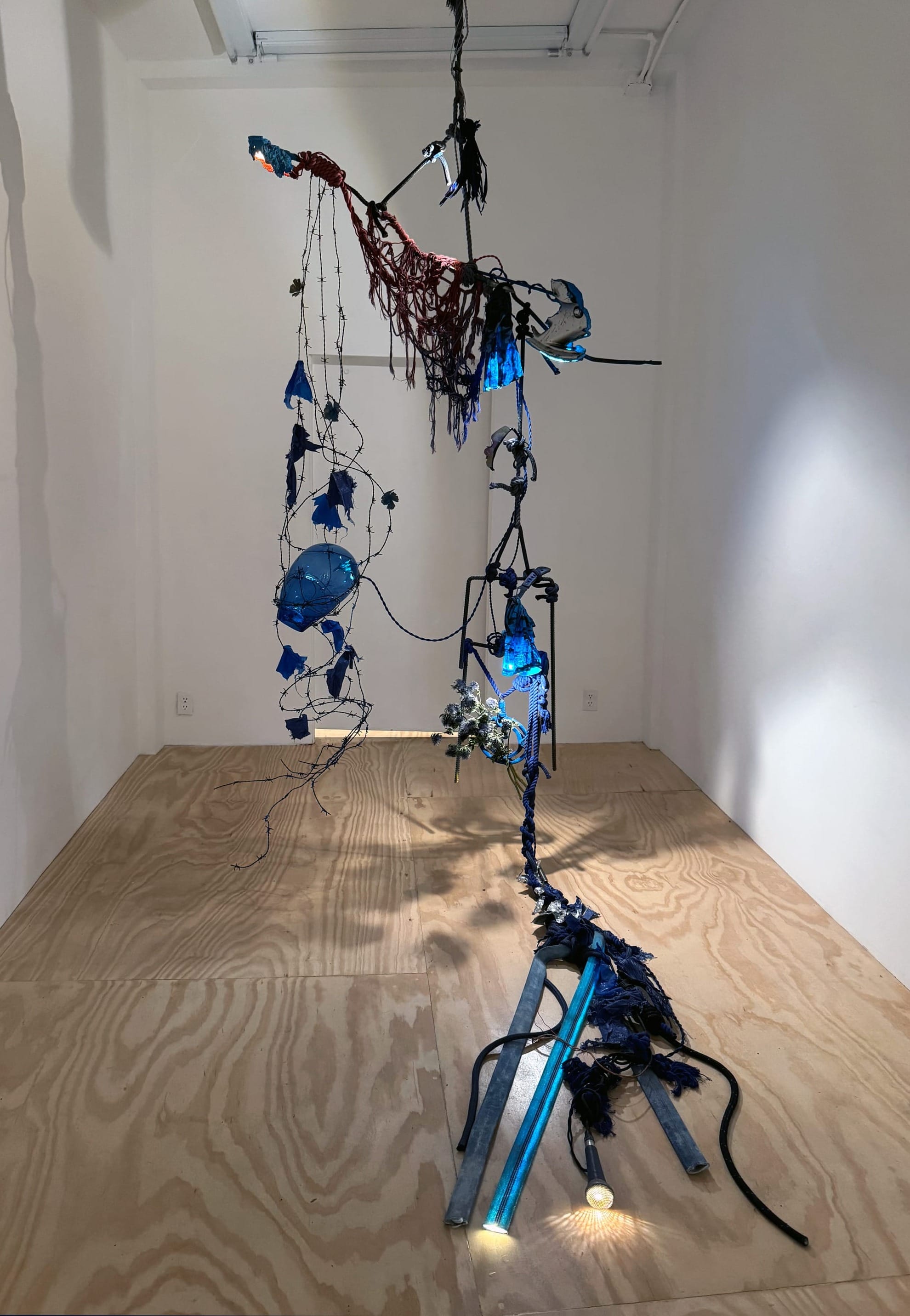
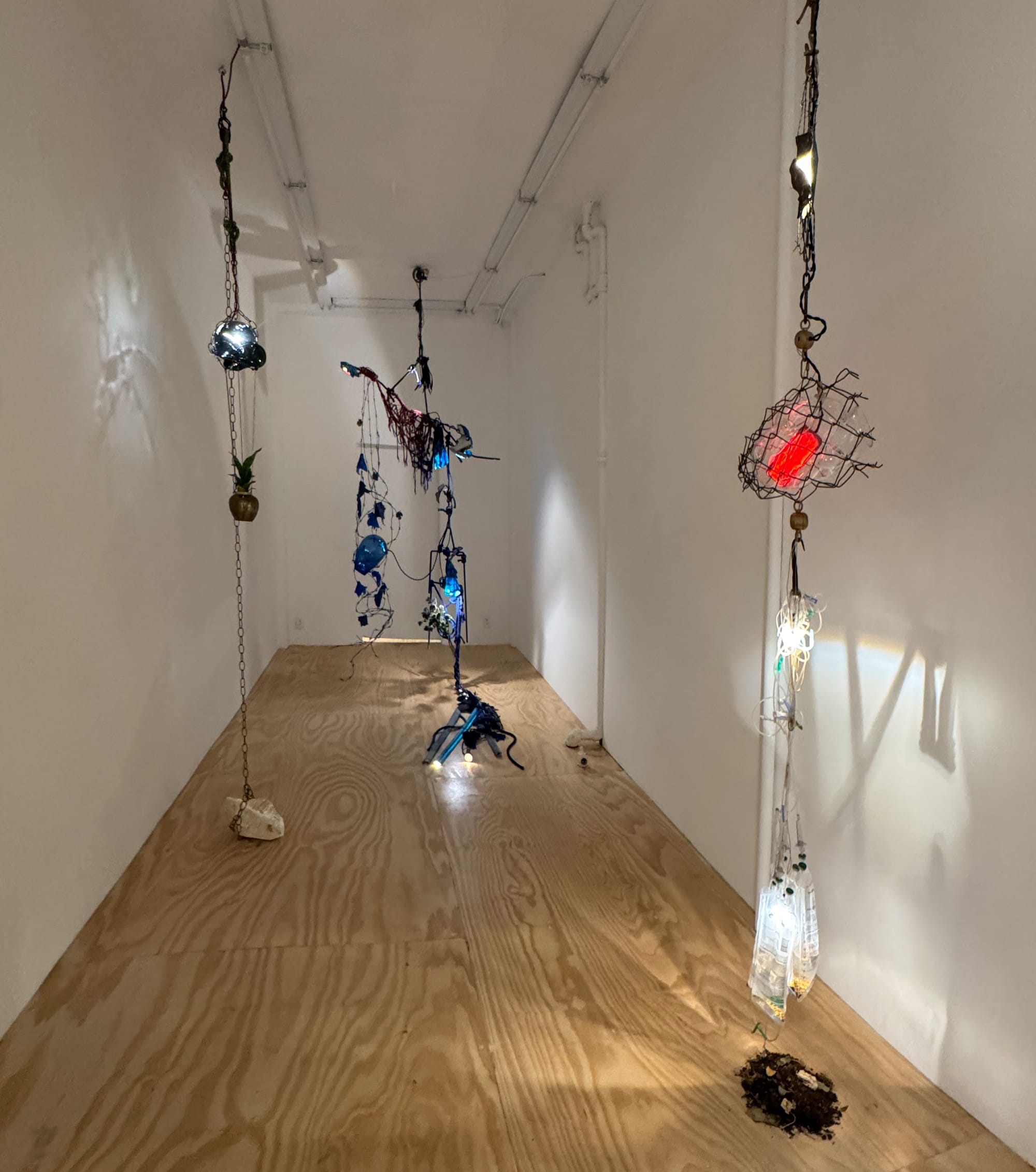
Left: Leonardo Madriz, “Sentinel of Lacrimosa Guerrero” (2026), Aqua Resin, epoxy clay, epoxy resin, paint, metal patina, brass, electrical components, rebar, barbed wire, credit card fragment from the first major debt I paid off, credit card fragment from a debt that still burdens, wrecked hubcap, knives, camo neck gaiters, sunglasses, shock absorber, blue bell thistles, tarp, emergency blanket, decommissioned firehose, xlr cable, corn stalks, microphone, rope tied in true lover’s knot, hunter’s bend, constrictor knots, uli knot, tumble hitch, double dragon loop, surgeon’s loop, prusik knot, and figure 8 loops; right: Installation view of Leonardo Madriz: Do Not Be Afraid
Madriz’s interest in the metaphorical weight of everyday objects (along with his penchant for knots) recalls Arthur Simms’s wire-and-rope sculptures. Simms’s assemblages combine objects such as toys, bottles, and chairs that reference his personal history. He often unites these objects by encasing them in a mesh of rope or wire, sometimes coated in resin. Simms has described this matrix of knots as a “see-through skin” for his sculptures — a protective layer that amalgamates these disparate objects. In Madriz’s sentinels, rope and wire are less a skin and more a spine. Whereas Simms’s skin contains these objects as organs of a single form, Madriz’s spine strings them together in a linear narrative that can be “read.”
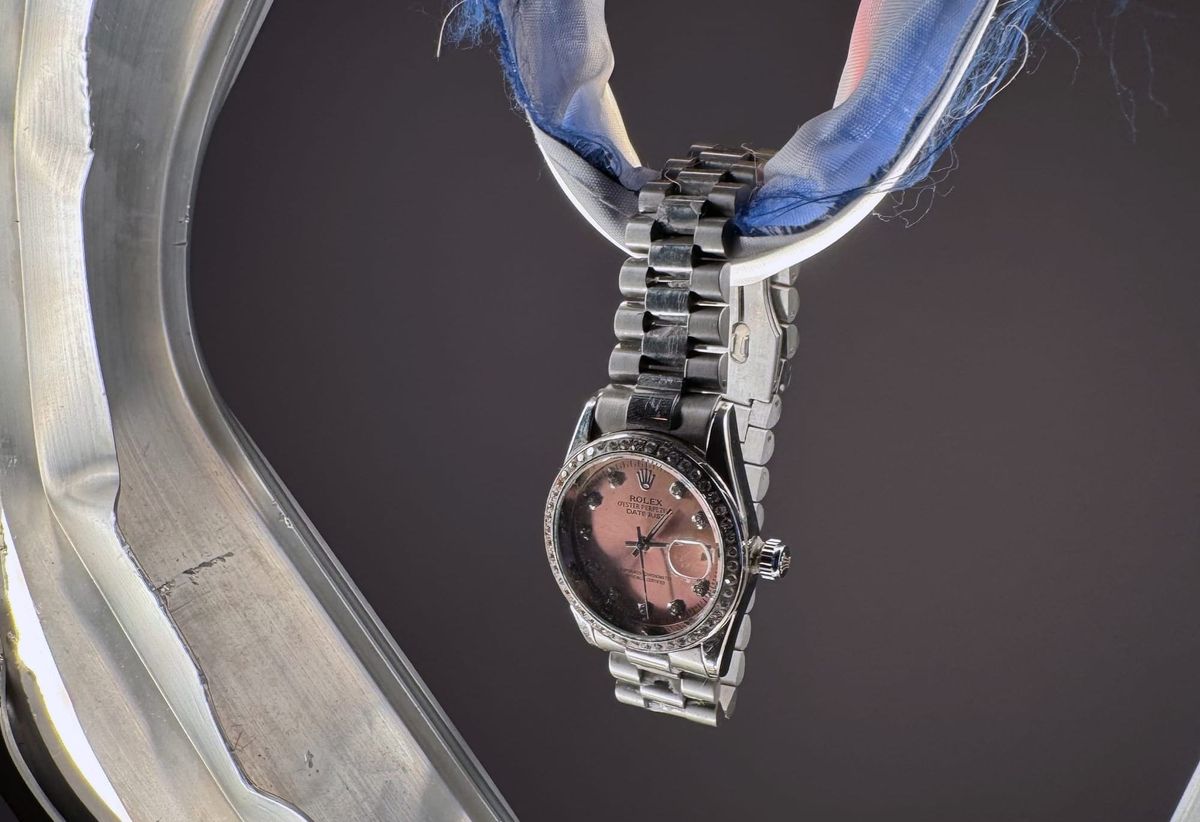
Madriz’s constructions read as weary. The source objects in Miró and Nevelson’s sculptures collaborate to build up; the resin casts and detritus on Madriz’s sculptures weigh the works down. In “Sentinel of Colloidal Gates” (2026), wire and rope stretch to support a clump of chain-link fence encasing, like a ribcage, a fleshy illuminated resin cast of an iPhone. A meat hook attached to the lower section of this enclosure holds a mass of used IV bags, which pull the sculpture into a pile of dirt on the ground below. “Down Is the New Up (Möbius Recalibrates)” (2025) alludes to this gravitational pull more directly, evoking the oddities of our flailing empire. Inside a twisted metal door threshold, a string of cold LED lights illuminates a counterfeit Rolex purchased in Chinatown, which in turn hangs on a fragment of a Vietnamese-made United States flag. It is a striking metaphor for the fragile equilibrium sustaining American life: an unending downward tug on the working class coupled with upward grasping toward wealth.
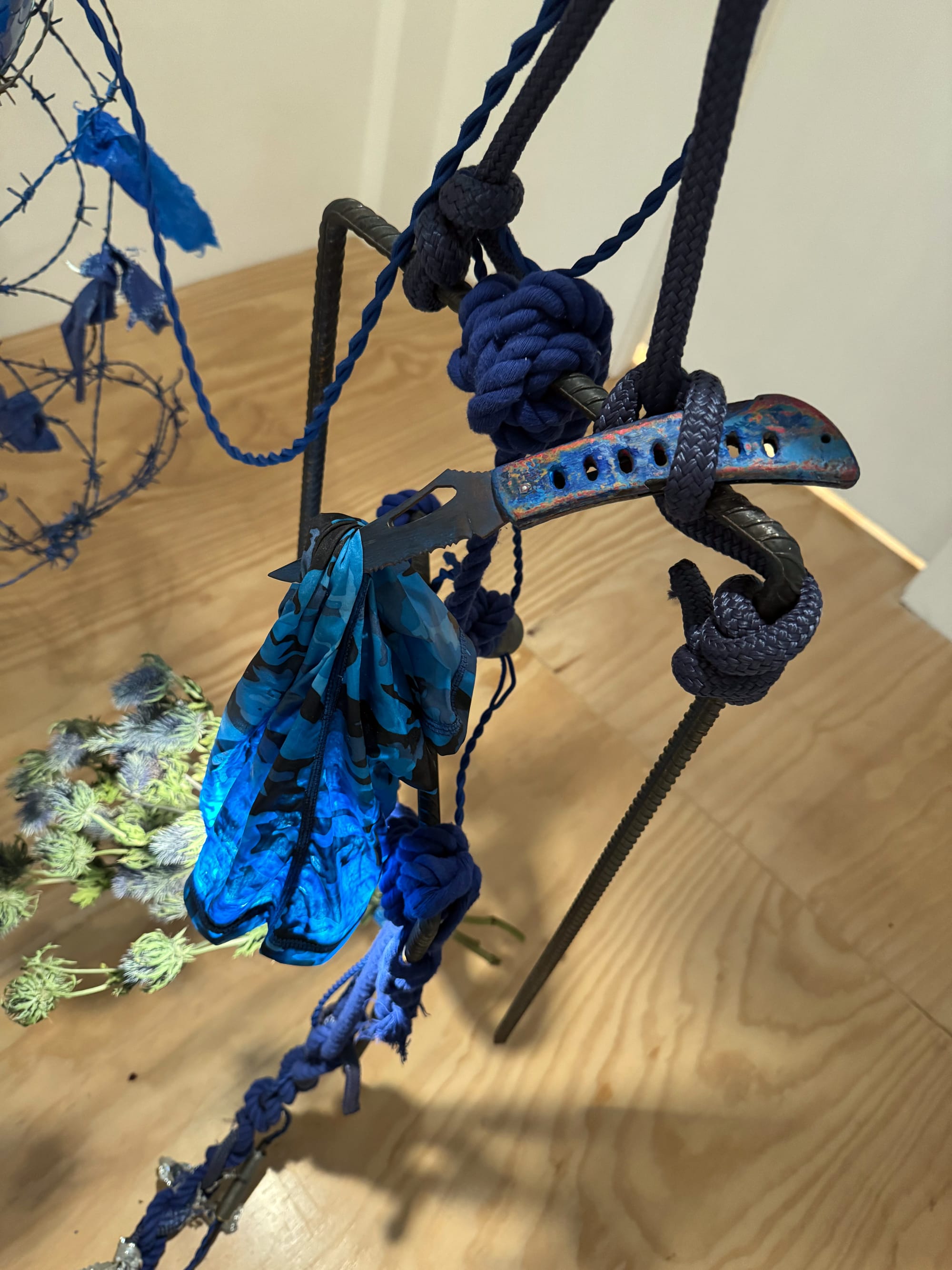
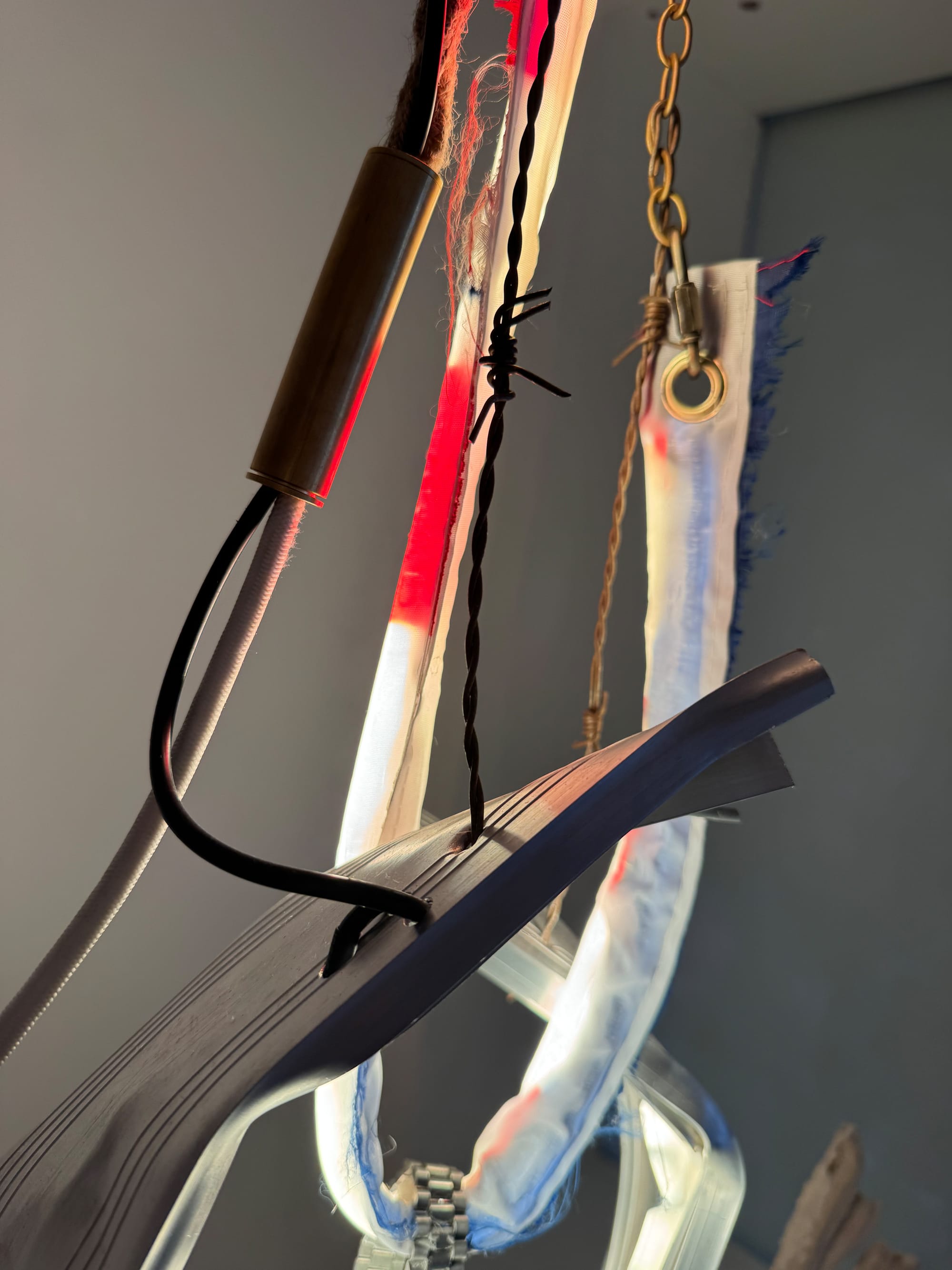
Left: detail of Leonardo Madriz, “Sentinel of Lacrimosa Guerrero” (2026); right: detail of Leonardo Madriz, “Down Is the New Up (Möbius Recalibrates)” (2025)
“Sentinel of Lacrimosa Guerrero” (2026), the largest and perhaps most ambitious sculpture in the exhibition, is a masterful assemblage of fragments from Madriz’s life. Some elements, such as the switchblade that holds a camo neck gaiter, an article of clothing that invokes the violent masked agents carrying out the Trump Administration’s immigration crackdown, appear to reference his family's experience migrating from Latin America to Louisiana and subsequent disillusionment with the American Dream. The poetic contrast between other objects (the material list includes “credit card fragment from the first major debt I paid off, credit card fragment from a debt that still burdens”) encapsulates the economic impossibility of living as an artist in New York. The totems of previous eras were often built to stand for millennia. Madriz’s reflect the precarity of the present moment: a tangle of wires and plastic delicately suspended, waiting to unravel.
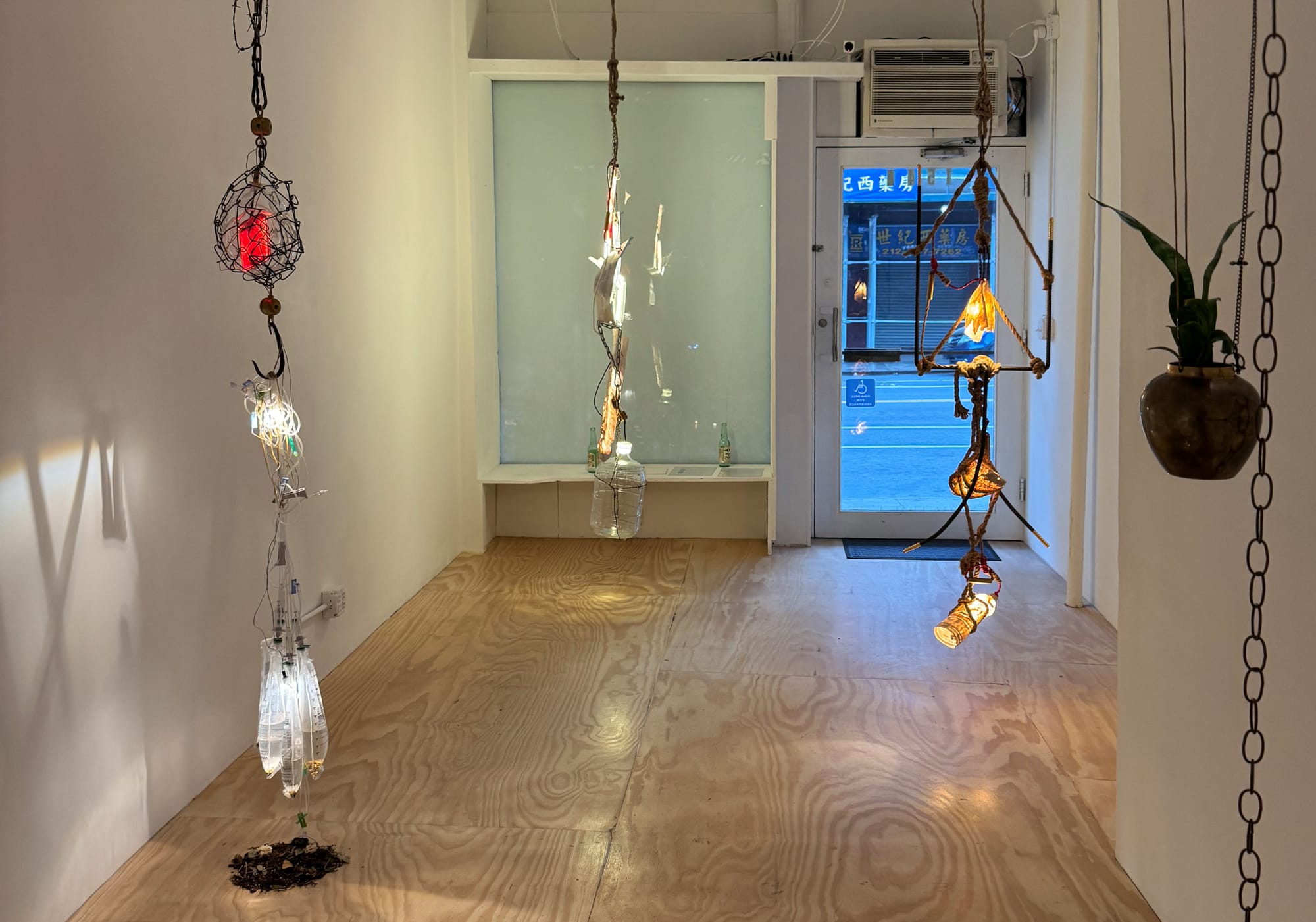
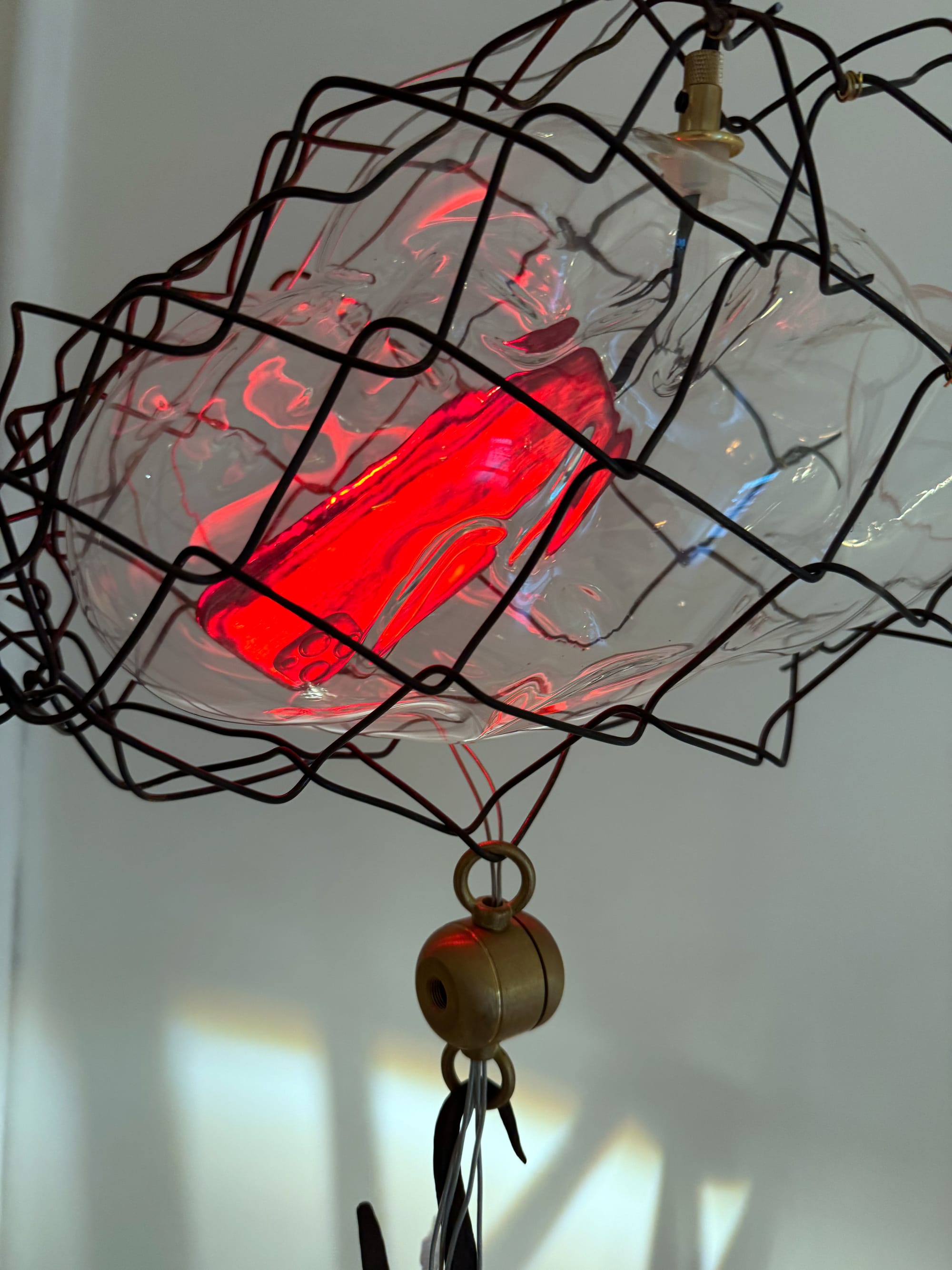
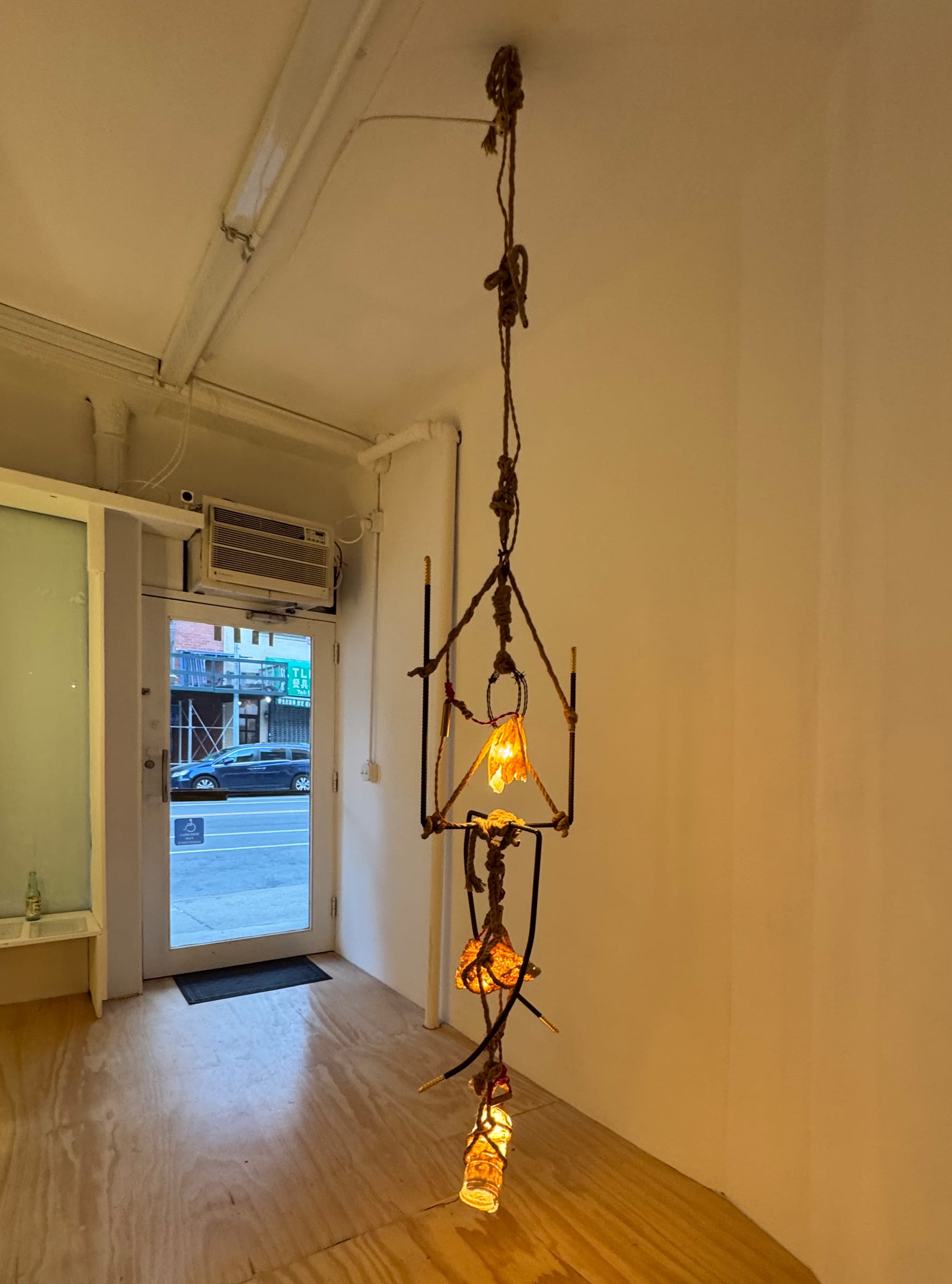
Left: detail of Leonardo Madriz, “Sentinel of Colloidal Gates” (2026), Aqua Resin, epoxy resin, glass, electrical components, hardware, metal patinas, discarded surgical masks, barbed wire, tow chain, snake chain, stolen chain-link fence, meat hook, used IV bags, water with genuine gold leaf, imitation gold leaf, and dirt; right: Leonardo Madriz, “Sentinel Adorned in the Leavers’ Wake” (2025), rebar, gold leaf, Aqua Resin, barbed wire, brass, electrical components, hardware, rope tied in manger’s hitch knot, trucker’s hitch knot, surgeon’s loop knot, handcuff knots, and blood knots
Leonardo Madriz: Do Not Be Afraid continues at Parent Company (154 East Broadway Store A, Lower East Side, Manhattan) through May 2. The exhibition was organized by the gallery.