Madelon Vriesendorp’s Subconscious Cities
An exhibition explores the creativity and imagination of an artist whose way of seeing influences architects and artists.

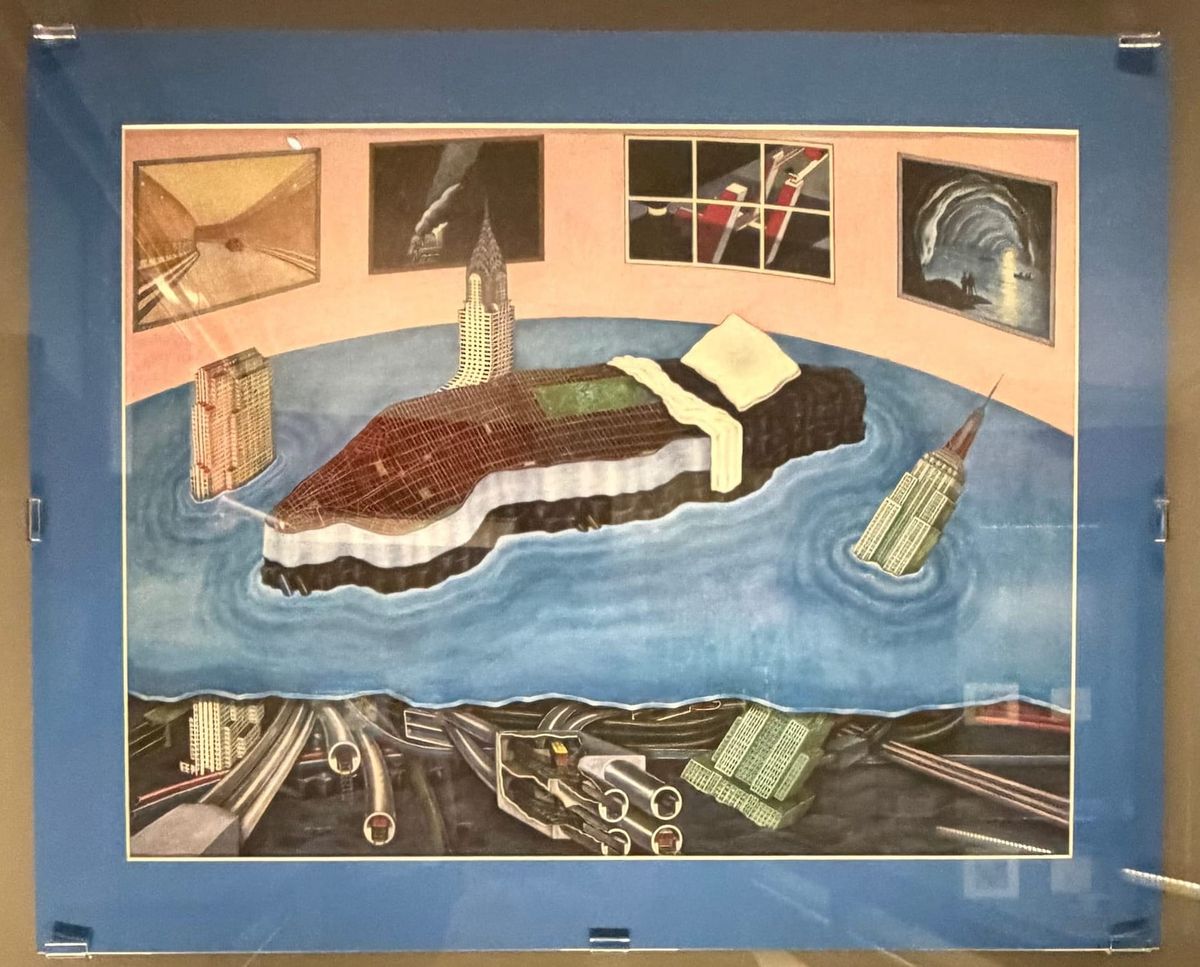
LONDON — The British architect Sir John Soane and the Dutch artist Madelon Vriesendorp were born nearly two centuries apart, but despite differences in history, culture, technology, nationality, and gender, they share an undeniable kinship — a deep engagement with architecture, an affinity for collecting, and a penchant for mischief. The current exhibition at Sir John Soane’s Museum, Madelon Vriesendorp: Mind Games, brings together more than 50 works from across the artist’s career, celebrating shared connections while offering a quietly playful rebuke to its host’s neoclassical sensibility.
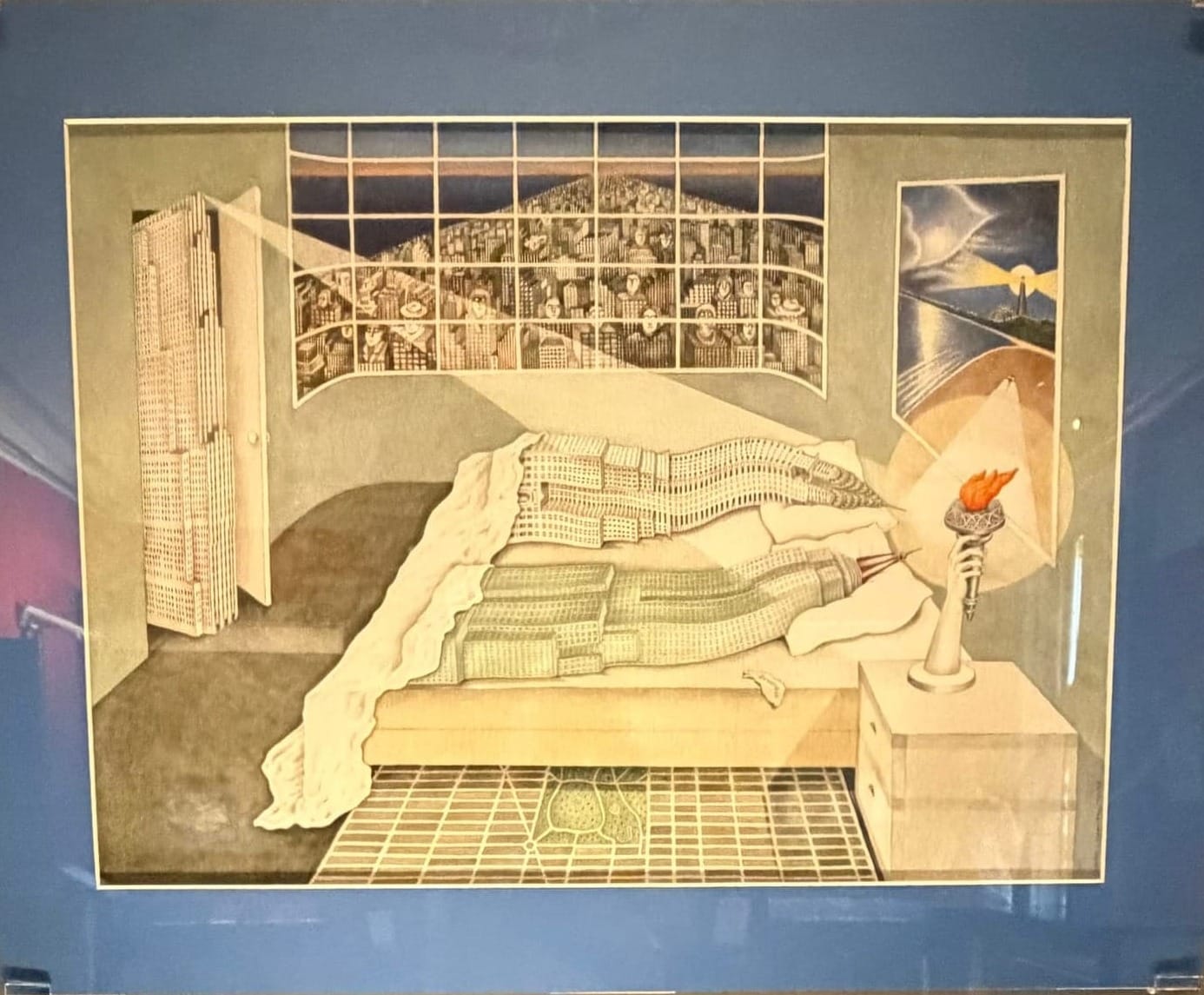
A significant portion of the exhibition centers around Vriesendorp’s best-known work, “Flagrant Délit” (1975), a delightfully surreal anthropomorphism of two iconic Manhattan skyscrapers caught in a post-coital moment by a spotlight atop the RCA Building. A few years later, Vriesendorp’s then-husband, architect Rem Koolhaas, chose the painting as the cover image for his Delirious New York (1978) — which he called, in the subtitle, a “retroactive manifesto” — helping secure its place in the iconography of the contemporary urban imagination. In fact, “Flagrant Délit” belongs to a larger series of paintings exploring the psychological and sexual aspects of contemporary architecture, several of which are on view, along with a 2026 cover commissioned by the New York Review of Architecture, testifying to the work’s ongoing influence.
Drawings of Soane’s own projects, along with architectural drawings by his teacher George Dance, are on display in adjacent rooms. When Soane was awarded a travel stipend as an architectural student at the Royal Academy in 1778, it was still custom for upper-class British men to embark on a Grand Tour of Europe. Soane was no exception, and the many drawings, paintings, sculptures, and antiquities he brought back from two years of travel through Italy formed the beginnings of his house-and-office-turned-museum.
Vriesendorp and Koolhaas moved to New York in 1972, first to Ithaca and then to New York City, where the artist “discovered bad taste in a big way” and began to collect objects seriously. Compared with Soane’s collection, Vriesendorp's is decidedly more diverse and proletarian, shaped by the dizzying compilation of styles she encountered in the United States, encompassing small toys, figurines, models, postcards, and sundry quotidian objects. Mind Games includes a handful of postcards with an architectural focus; however, her full collection, which numbers in the thousands, includes such unexpected categories as Luna Parks, lighthouses, bus terminals, penitentiaries, airplanes, disasters, and babies — or, as she saw it, simply “Americana.” Soane’s neoclassical reverence is replaced with a postmodern embrace of the banal, the camp, and the kitsch; the Enlightenment regard for knowledge is traded for a critical examination of the dominant culture.