Nathaniel Mary Quinn’s Fragments of Home
His fractured portraits at the National Public Housing Museum reckon with memory, family, and a childhood shaped by Chicago’s Robert Taylor Homes.

CHICAGO — More than 10 million people in the United States have called public housing home over the past century, yet the country boasts only one museum dedicated to the subject. The National Public Housing Museum (NPHM), after nearly two decades as a roving entity, opened a permanent home in Chicago in early 2025. It seeks to address one of the most intersectional of histories, connecting art, design, architecture, human rights, politics, social policy, the economy, systemic racism, immigration trends, policing practices, and more.
The museum occupies the sole remaining section of the Jane Addams Homes, constructed in 1938 on the southwest side of Chicago. It’s currently surrounded by an empty lot nearly the size of a city block, courtesy the Chicago Housing Authority’s Plan of Transformation, launched back in 1999 to solve the problem of deteriorating buildings, unsafe projects, and racial segregation with widescale demolition and the mostly unfulfilled promise of replacement mixed-income housing for all. That plan eventually amounted to the largest net loss of affordable housing in the country’s history. This story is just one of many told at the NPHM via an engaging combination of archival, experiential, historic, and artistic displays.
The day I visited, offerings included an exhibit devoted to personal objects lent by public housing residents across the country, from a hand-stitched wedding dress and a heavyweight championship belt to an item I found especially relatable, a rotary phone with an extra-long cord. A case study of a rare recent success story, the Millers River Apartments in Cambridge, Massachusetts, nearly broke my head with its meticulous dissection of the impossibly complicated American tax credit system. Especially generous are a pair of apartment units recreating the homes of specific families representative of particular eras: the Turovitzes, Jewish immigrants who were among the first to occupy the Jane Addams Homes, and the Hatches, an African-American couple with eight children who moved in in 1960. A third apartment, set in the 1950s, screens an immersive film explaining what happened in between from a policy perspective, including redlining and racist covenants, via the entrancing silhouette puppetry of the performance collective Manual Cinema.
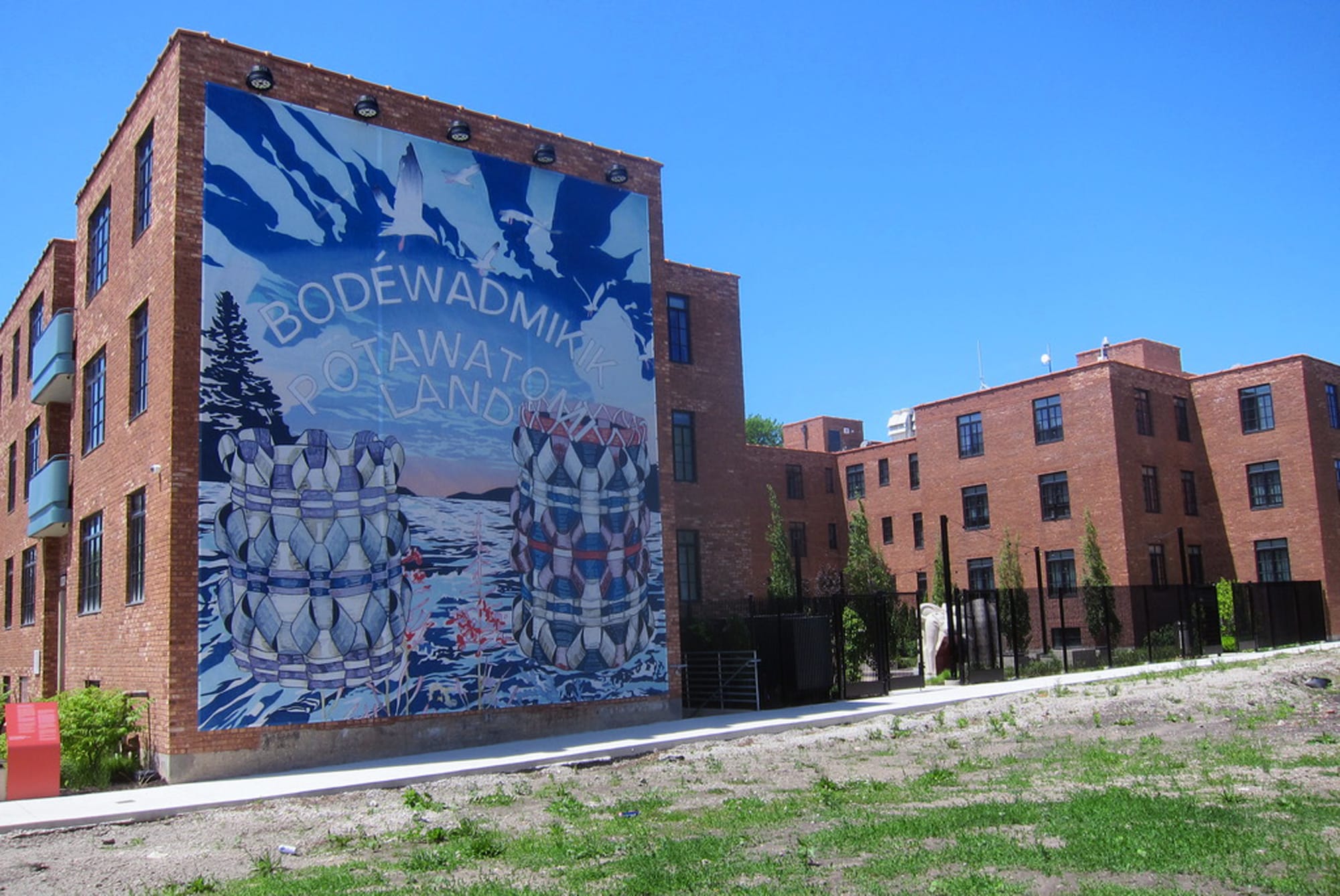
The museum’s courtyard delights with large limestone animal sculptures, designed by local polymath Edgar Miller for the Jane Addams Homes’ original outdoor play area, now beautifully restored. Also outside are three bang-up works of public art. “Still Here: Zhegagoynak,” a palimpsestic 40-foot-tall (~12.2m) mural by Andrea Carlson, acknowledges the land under the NPHM as being unceded by the Potawatomi. Amanda Williams and Olalekan Jeyifous fashioned an exuberant glass entry portico splashed with colors taken from paint chips left behind when the building’s final residents were forced to move out — vivid hues applied to apartment walls in defiance of Chicago Housing Authority rules mandating beige or light green. Over in the parking lot, Marisa Morán Jahn and Rafi Segal invented new ways to play basketball using a tricycle-mounted hoop system and a radically reimagined court design.
That the NPHM excels in bringing together advanced art and social history comes as no surprise given the credentials of its executive director, Lisa Yun Lee, who has helmed some of Chicago’s most important socially engaged art institutions, from the Hull-House Museum to Open Engagement to the UIC School of Art & Art History. Under her curation, this summer, the NPHM opened Nathaniel Mary Quinn: A Love Letter to My Mother, its first temporary exhibition dedicated to a single artist, also Quinn’s first solo institutional showing in his hometown. Represented by mega-gallery Gagosian and recently in the news for having illustrated the Rolling Stones’ latest album, Quinn grew up in the Robert Taylor Homes on Chicago’s South Side, a place he described as being “incredibly efficient at killing dreams.” His show includes a reading room detailing how the project, the largest in the city and at one point the world, went from Mayor Daley’s proud ribbon-cutting in 1962 to decades of systemic neglect, eroding services, and eventual demolition.
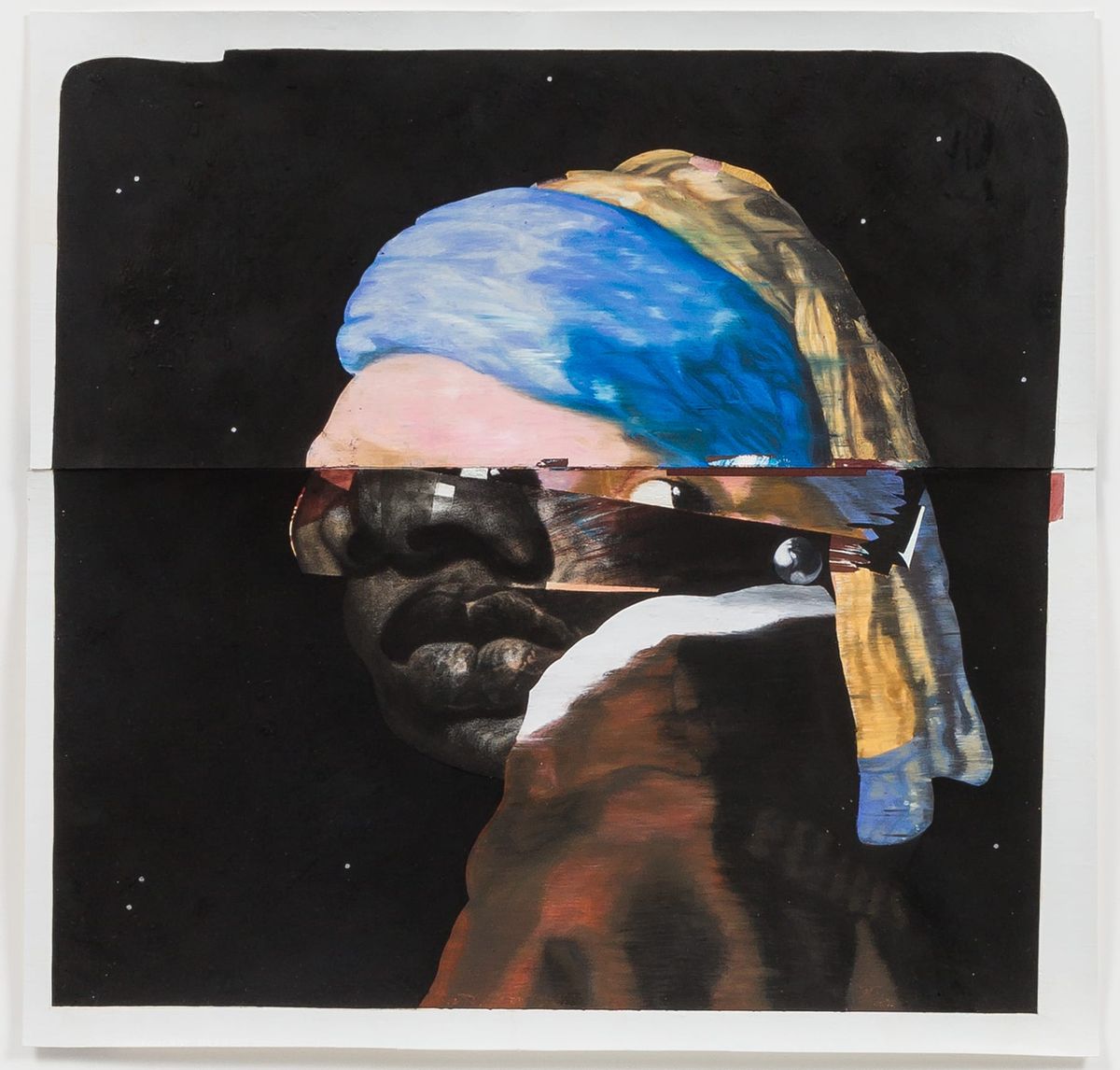
A Love Letter to My Mother is a spare show. Ten portraits on canvas and paper surround a living room meant to evoke Quinn’s family home circa 1984. It was the artist’s first studio, where he sketched directly on the walls; when he ran out of space, his mother washed the old drawings away so he could start anew. At NPHM, each artwork incarnates a person Quinn knew either during his early life or after he moved to Brooklyn as an adult. Extended captions include intimate recollections of his father, a family friend named Junebug, and two flashy guys from his block in Crown Heights. Every one of Quinn’s likenesses is lifelike and demanding of attention, but no one is easy to look at. Fragments of a young neighbor named Erika, her wide dark nose and full lips tenderly rendered, slice sharply into the pale forehead and velvety shoulder of a reproduction of Vermeer’s “Girl with a Pearl Earring” (1665). Each segment radiates beauty, but their collision partly blinds the girl, and the proportions fit grotesquely. “Charles: Re-visited," a large bust of the artist’s estranged brother, awkwardly pieces together the fragile mouth and ear of a little boy, the sharp eyes and fedora of a swaggering man, the nose of a bull, a sleeve of streetwear, and an unexpectedly feminine scarf, all in contradictory stylistic registers. The effect unsettles, one aspect obliterating another, the person violently incoherent.

Quinn presents each of his subjects likewise, channeling the critical media mashup of Hannah Höch, the psychological miasma of Francis Bacon, and the rhythmic vitality of Romare Bearden. Arranged from shards, in mismatched angles and aesthetics, their visages look at once battered and lovely, festive and bleak, a human emerging but only just. They hold together via a signature “paint-drawing” technique Quinn has been refining since 2013, resulting in composite portraits that look like collage, down to the edges of white left between what appear to be slices of 17th-century Dutch paintings intercut with slivers of Avedon photographs and bits of anonymous news footage and glossy magazine ads. But, crucially, are not collage, having been crafted seamlessly from a combination of oil paint, charcoal, gouache, paint stick, and pastel. Collage, made of stuck-together scraps originating somewhere else, communicates temporariness, incompleteness, dependence. Quinn’s people comprise multiple parts, under extreme duress, but that is their perennial state. They are not there to be rearranged.
The Robert Taylor Homes were demolished about two decades ago, long after Quinn left to attend an elite military academy in Indiana on full scholarship. His mother, Mary, died soon after. His family dispersed; he has remained estranged from them ever since. Before graduating, Quinn added Mary’s name to his own so that she, who never finished high school, would also be recognized on his diploma, as she has been on every diploma, honor, collection placard, museum label, gallery announcement, and magazine article — including this one — ever since. It’s a situation of consequent political and philosophical reordering — requiring consideration of a person otherwise relegated to the margins of public life — akin to the realignment aesthetically achieved by Quinn’s portraiture, from which it is equally impossible to turn away.


Nathaniel Mary Quinn: A Love Letter to My Mother continues at the National Public Housing Museum (919 South Ada Street, Chicago, Illinois) through August 23. The exhibition was curated by Lisa Yun Lee.