One Last Chance to See Dürer's Monumental Print in NYC
The "Triumphal Arch," one of the largest prints ever produced, will go into storage at the New York Public Library in the fall.

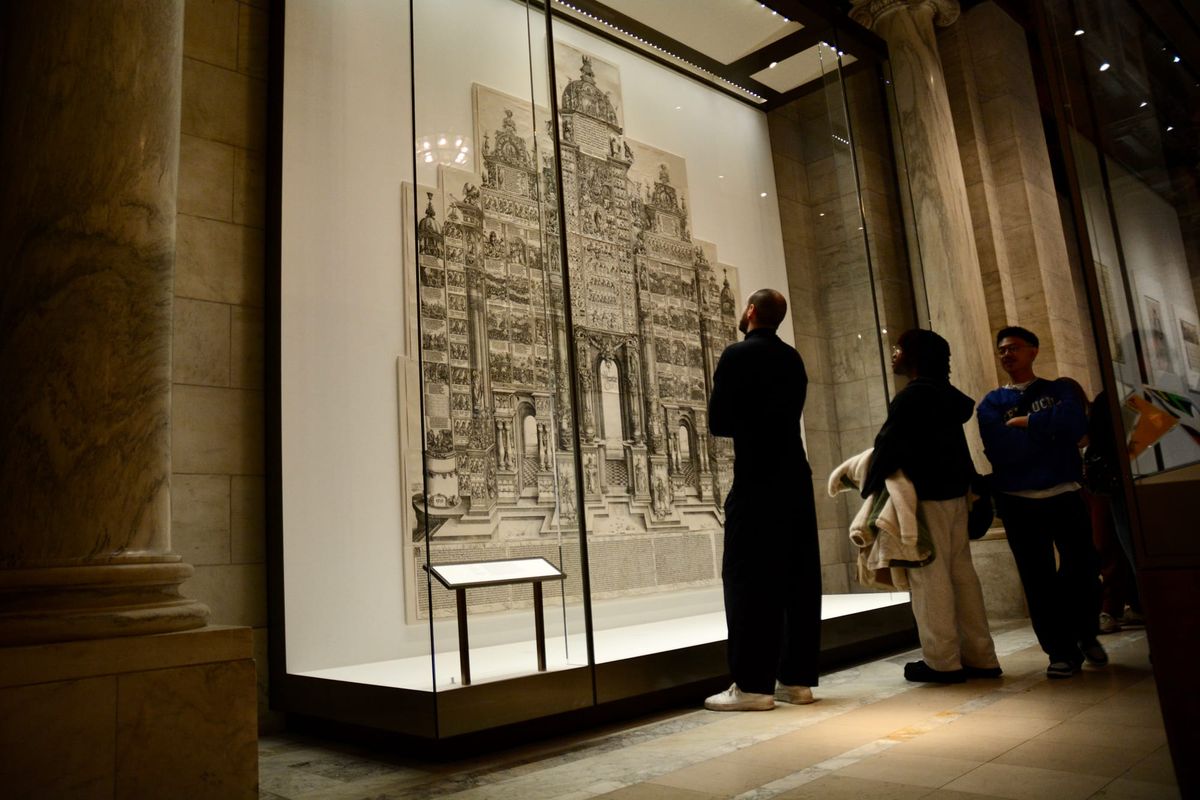
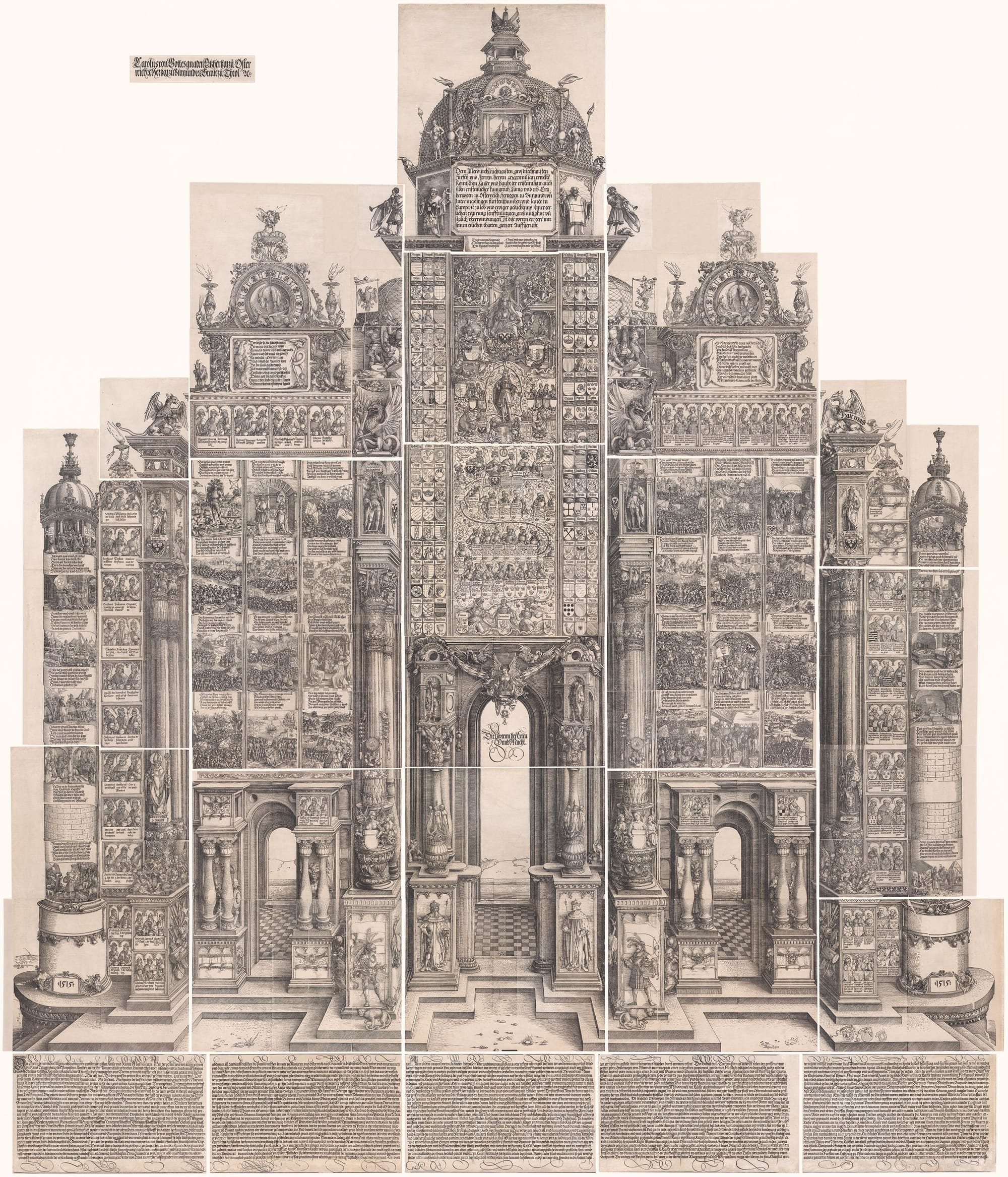
In 1512, Holy Roman Emperor Maximilian I commissioned German printmaker Albrecht Dürer to create a work of imperial propaganda for display on palace walls and city halls. Known in its time as Maximilian’s “Arch of Honor” and referred to now as the “Triumphal Arch,” the multi-paneled woodcut print, measuring approximately 13 feet (four meters) high, is one of the largest such works ever made. Dürer relied on an entire studio of assistants, students, carvers, and advisors to help him craft the work over a period of more than two years.
The New York Public Library (NYPL) possesses several panels of a 1515 first edition, which have been on view at the library since the Polonsky Treasures exhibition opened in 2021. But due to the work’s age and fragility, this fall, library staff will package it away into the reading room’s print vault for an indefinite period. Now might be the final opportunity to see the work in its entirety for quite some time.
According to Madeleine Viljoen, NYPL’s curator of Prints, the “Arch” was originally gifted to the library in 1903 by a donor named Atheron Curtis.
The library raised money to have the piece framed, after which it was installed in the Great Hall for nearly 50 years (“which is sort of insane,” Viljoen noted, considering the work’s delicateness). Around 1984, library workers “determined that it needed conservation, and it was basically put away and put into boxes,” Viljoen said.
In 2009, the print saw light again when the Philadelphia Museum of Art requested its presence for its Grand Scale exhibition. The work underwent a thorough restoration that included removing the antiquated linen backing and replacing it with sturdier materials. After briefly going on exhibit, it returned to the library and went back in the box for another 12 years.
Why does the “Arch” continue to mesmerize the public and experts alike? For answers, we might look to the symbols themselves, which tell the story of power, myth, and dynasty.
“The imagery is quite complicated,” said Viljoen of the piece. The print traces Maximilian’s lineage all the way back to Troy (“which of course is somewhat fictive,” Viljoen admitted), as well as shows his other family members who are more “securely known,” such as his father, Frederick III, and his wife, Mary of Burgundy.
“There’s a sense of predestination,” Viljoen said of the ancestral imagery, which also includes the golden fleece, the insignia of the imperial family. “This is a person who was meant to be in this role.”
In addition to bloodline, the print displays Maximilian’s military exploits. According to Viljoen, the form of the arch itself held special military significance in Ancient Rome; it was commonplace for emperors to erect triumphal arches upon their return from conquests.
But unlike these architectural structures, Dürer’s print for Maximilian “was ephemeral in a sense,” Viljoen said. “It wasn’t something that was permanent in the way that a marble sculpture would be.”
Commissioning a print rather than a permanent monument might have also been a more budget-friendly choice for the cash-conscious emperor. “As a print, its cost was obviously inexpensive in comparison with an actual stone monument,” said Jeffrey Smith, professor emeritus of Art History at the University of Texas at Austin, who has penned scores of articles about Dürer’s life and work. “Maximilian was ambitious but not a wealthy ruler.”
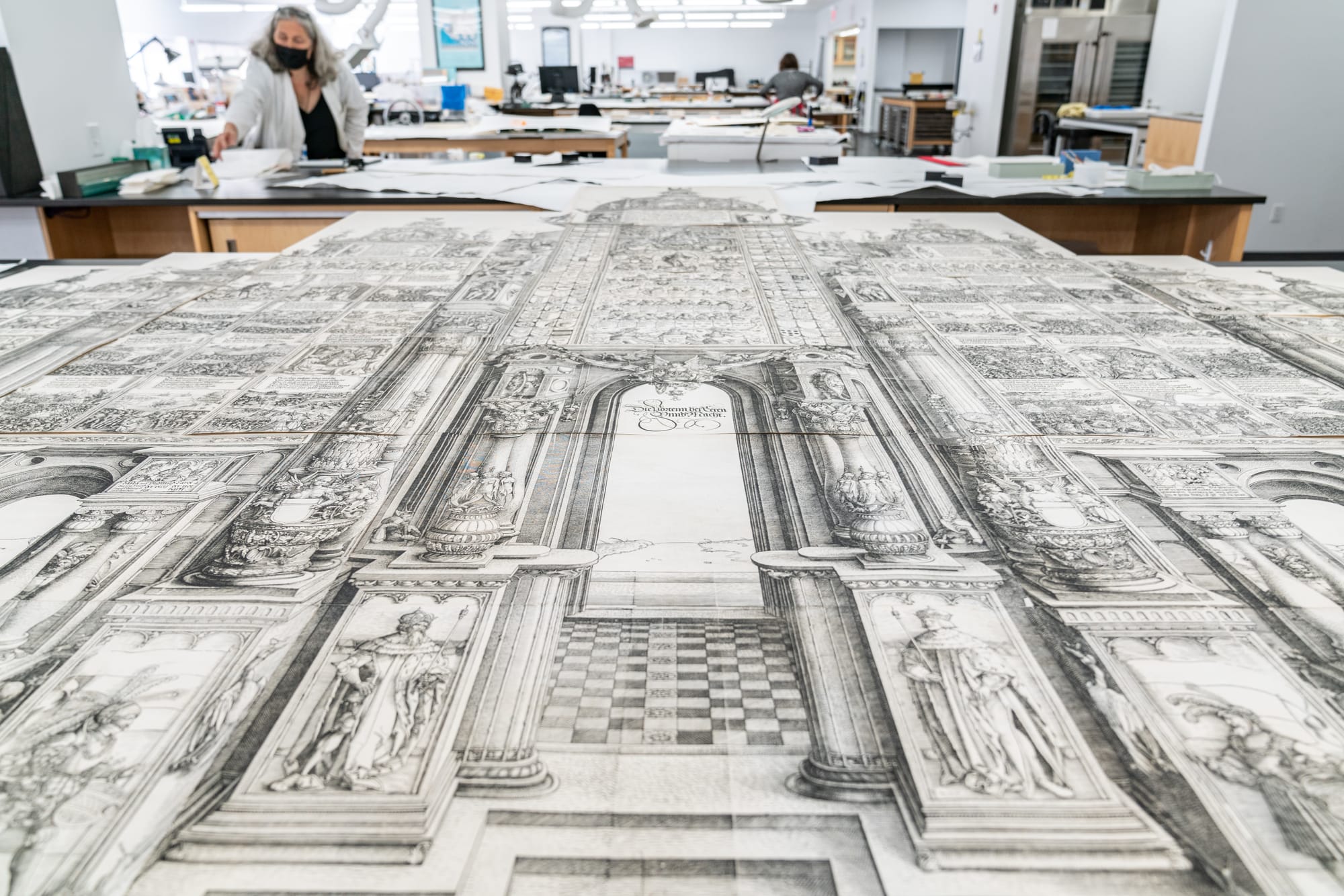
And unlike a physical arch, a print could be disseminated almost endlessly. The relatively new technology of modern printmaking, transformed by Gutenberg’s printing press around 1450, was revolutionary in that it could distribute propagandistic messaging en masse. The invention is also credited with initiating the Protestant Reformation by putting Bibles in the hands of ordinary people. “It was printed in hundreds of impressions,” Smith said of Dürer’s “Arch.” “A copy could be placed on the wall of a city hall, a palace, or other locations,” he added.
According to Viljoen, visitors are “always amazed” by the piece’s massive scale. She thinks it’s critical to note, however, that Dürer did not work alone — this print was only possible because it was made in tandem with carvers, advisors, architects, and assistants.
Nonetheless, “he’s such a refined printmaker,” Viljoen said, adding that some of the print’s imagery is surprisingly whimsical, featuring monkeys and dragons. “It’s imaginative and beautiful at the same time,” she said.
The print will go back into storage on October 18. After that point, library visitors will be able to schedule individual viewing appointments, but since the work is too large to fit on the library’s study room tables, staff can only bring out one piece at a time.