Required Reading
This week: artists’ antidote to AI slop, Kimberlé Crenshaw’s new memoir, New Orleans and climate change, an Art Deco train, and what do sex workers think about “Euphoria”?

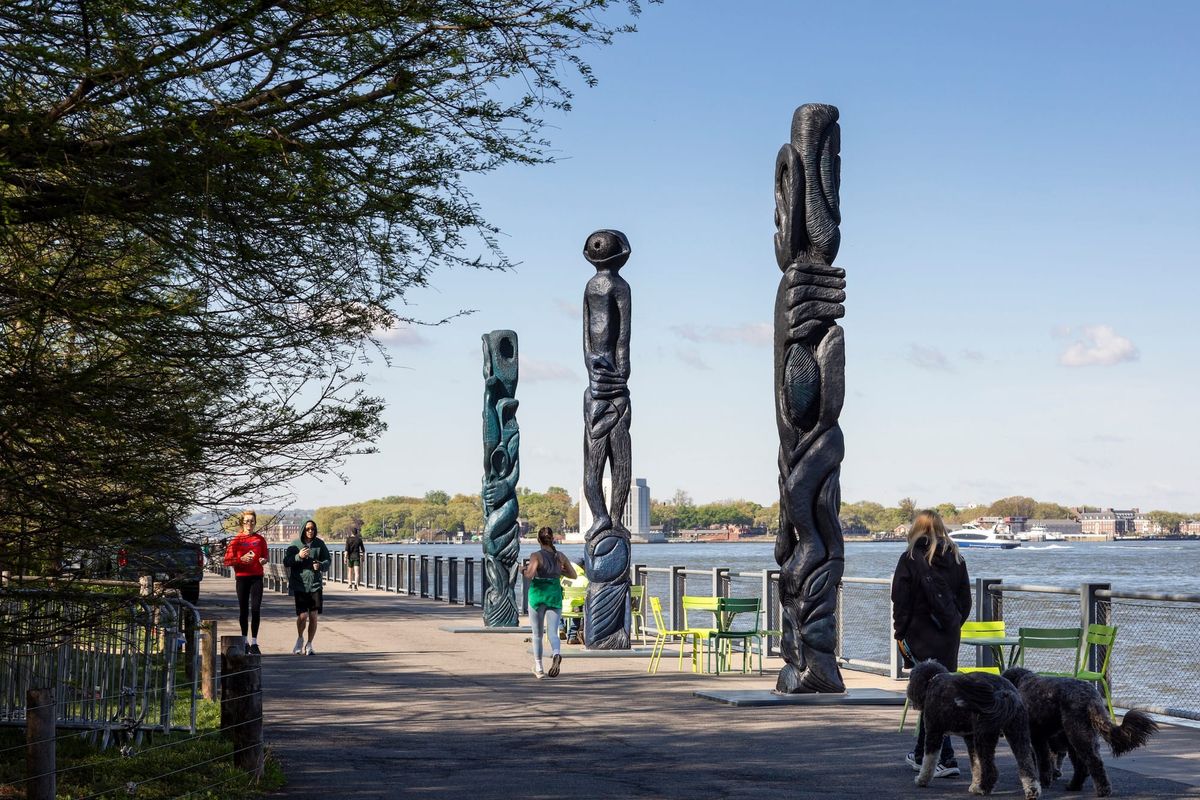
Author and activist Zoé Samudzi writes in ArtReview about an exhibition in Ohio that takes a refreshingly political stance on American surveillance and xenophobia:
In mid-March a show of paintings by Shiva Addanki and Nikholis Planck opened at No Place Gallery, an artist-run space in Columbus, Ohio. Deriving its title, American Inquisition, from lines written by the Popular Front for the Liberation of Palestine in solidarity with then-detained Algerian-Palestinian activist Mahmoud Khalil – ‘No to silence in the face of repression… Freedom for detainees… Down with the American Inquisition courts’ – and its critical nucleus from social theorist Mike Davis’s book Buda’s Wagon (2007), a global history of the car bomb and urban insurgencies, the exhibition contends with paranoic US security politics in which imperial identity is defined by obsessive identification, alienation and preemptive containment of often ambiguous enemies and security threats. The two artists here build out an architectonic intimacy of threat-countering infrastructure by deploying the spectacular déjà vu of imperial violence.
Is imperfection a secret weapon in an era of smooth-brain, AI art? Kyle Chayka considers this question in the New Yorker:
Visual perfection is easy to come by these days: just type whatever you’re envisioning into a text box on ChatGPT, Gemini, or Midjourney, and back comes a glossy, detailed digital rendering of, say, your living room with fancier furniture, an aspirational outfit, or a new company logo replicating mid-century-modern style. This instantaneous slickness—which the trend forecaster Emily Segal has labelled “tasteslop”—is easy and abundant, and the appearance of “good taste” is robotically ubiquitous. So it’s no wonder that the artists and designers whose livelihoods are threatened by it have begun moving aggressively in the opposite direction, toward the scrawled, the sloppy, the seemingly mistake-riddled. The poster for an upcoming Weezer festival at a Los Angeles arena looks like it was drawn in marker by a ten-year-old boy on a school desk, with misaligned handwriting, doodles of guitars, and a few iterations of the “cool S.” The publisher Picador recently released a line of reissued books by Roberto Bolaño with covers reminiscent of a prison-tattoo collection, with amateurish sketches of femmes fatales, knives, snakes, and sigils.
After eight decades, a Nazi-looted painting has resurfaced in the family home of a Dutch SS leader. BBC's Henry Moore has the story:
Brand then searched the archives of a 1940 auction where much of Goudstikker's looted collection was sold and discovered an item under the number 92 titled "Portrait of a Young Girl" by Toon Kelder.
Brand believes the painting had been plundered by Hermann Goering, one of the most powerful figures in the Nazi Party, when Goudstikker fled for Britain in 1940.
It was then sold to Seyffardt at auction before being handed down to his descendant, Brand says.
After launching his investigation, Brand contacted the lawyers of Goudstikker's heirs, who he said confirmed the collector had previously owned six paintings by Toon Kelder.
Harshini Varadarajan writes in a fascinating Substack essay about the colonial trade and enslaved labor in Tamil Nadu that funded Yale University, the ubiquity of Madras check, and an Indian clothing store's construction of national identity:
What the verified history does establish, without embellishment, is this: a Tamil port city was the source of wealth for one of America’s most prestigious universities. And by the mid-20th century, without Ogilvy’s help, the Madras check had become the defining fabric of American preppy culture, Ivy League campuses, Martha’s Vineyard summers, resort wear from the Caribbean to Connecticut. It is worth noting, additionally, that the fabric’s checked pattern long predates any Scottish tartan influence: the kattam tradition is documented in South Indian textiles centuries before King George IV’s famous visit to Scotland sparked a British imperial tartan revival.
These are three historically separate threads, the Elihu Yale donation, the colonial textile trade, the 1960s American fashion moment, that do not form a single causal chain so much as they form a convergent portrait. The connections are real. The circularity is real. But it is a portrait, not a mechanism: the Madras check did not travel from Tamil Nadu to Yale to Blair Waldorf’s school uniform in a single, tidy arc. It traveled in fragments, through trade routes and slave ships and advertising campaigns and sportswear catalogues, gathering meaning as it went, losing its origin story along the way.
Brilliant lawyer and critical race theory scholar Kimberlé Crenshaw, who has a new memoir out, talks with the Cut's Andrea González-Ramírez:
Both intersectionality and critical race theory have become incredibly maligned terms in recent years, thanks to how the right wing has weaponized them. Can you walk us through the experience of seeing your life’s work distorted?
It’s not an accidental distortion. This last round has declared itself to be an intentional effort to weaponize ideas that the broader public hasn’t heard of and then fill it with meaning that they get to define. Then we become the subjects of the media debate, and that makes it harder for us to actually engage in it because then suddenly we are the topic. We can’t speak anymore because there’s no answer that allows you to disrupt the frame. Either you confirm the frame or you deny the frame, but you can’t contest what the frame is actually doing.
I would say I thought it was primarily a media problem until I saw other institutions falling in line.
We've all seen the Guardian's recent story about the fate of New Orleans. But for the Lens, scholar Christopher Ard explains why the national conversation about the city's future amid climate disaster risks further marginalizing its inhabitants:
If there’s one thing I learned after Katrina, it’s that there is no such thing as “rebuild.” You might build new, nice things, but it’s never the same. You can relocate to Covington and call your new street Rue Bourbon, but it’s not Bourbon Street. You can move Frenchmen Street to downtown Baton Rouge and I guarantee you it will not be the same for many, many reasons. Just stop with the “relocation” talk. If people want to move, they will. Maybe try words like “abandon” or “give up on” or maybe even “find somewhere new.” But relocate just sounds silly.
With that said, I guess once again, I’m suggesting, maybe talk about how cities can’t be relocated. Understand how that term hits when you use it for those of us who have made lives here. We can’t be relocated, just like any other city can’t be relocated.
Of course, I mean no illwill to the writer or researcher who put this story together. I imagine they, too, love New Orleans. However, I see a story like this as being more damaging than helpful — a modern day redlining of an entire city; a scarlet letter upon the breasts of our downtown to scare away new businesses; shackles around the necks of those of us that choose to remain here; and, a death sentence for those without the means to leave.
Yashica Dutt writes for PrismReports about an urgent bill addressing caste discrimination in New York, contextualizing it within a broader movement to combat casteism in the US — and the right-wing pushback it's faced:
“Caste discrimination is happening every single day, not just in India and broader South Asia, but here in America, from the East Coast to the West Coast,” Shekar Krishnan, the first Indian and Hindu elected to the New York City Council, said at the press conference. “We have to be very honest about this issue in our communities.”
Last year, Assemblymember Steven Raga introduced the bill, along with state Sen. James Sanders. Unlike similar bills in California and Seattle, New York’s caste discrimination bill has the support of several state and city lawmakers, including Zohran Mamdani, who as an assemblymember had been a co-sponsor before becoming mayor of New York City in January.
Fans of Braiding Sweetgrass already know that Potawatomi botanist Robin Wall Kimmerer's writing is transformative. But for Atmos, science journalist Isobel Whitcomb reports on her new community gardening initiative:
The movement is building its platform through “Blooms,” planting events like the one at the University of Portland. These gatherings are meant to get people’s hands in the dirt. Attendees take part in workshops, meet Kimmerer in person, and encounter local grassroots organizations with information booths set up alongside the planting.
In an era of mass extinction, rampant oil extraction on public lands, and the hottest decade in recorded history, gardening and tabling might seem painfully modest. Kimmerer and her team are well aware of the critique. “I don’t want us to be in the kind of disingenuous position of claiming that backyard gardens will cancel out the ravages of the fossil fuel-based economy,” said Brian Ratcliffe, executive director of Plant Baby Plant and a former graduate student of Kimmerer.
For Dazed, Megan Wallace asked sex workers what they think of the infamously problematic depictions of the industry in Euphoria (which I've managed to successfully avoid watching):
Brittney Kade, Adult Performer:
“From my perspective, Euphoria dramatises the adult industry in a way that’s visually compelling but not always grounded in reality. It leans into shock value and aesthetic over accuracy, which can blur the line between performance and real-life experience.
“While I appreciate the conversation it sparks, the industry is far more nuanced; there’s autonomy, business strategy, and professionalism that often go unseen. I think it’s important people understand that what’s portrayed is entertainment, not a full reflection of the diverse experiences of performers actually working in the space.”
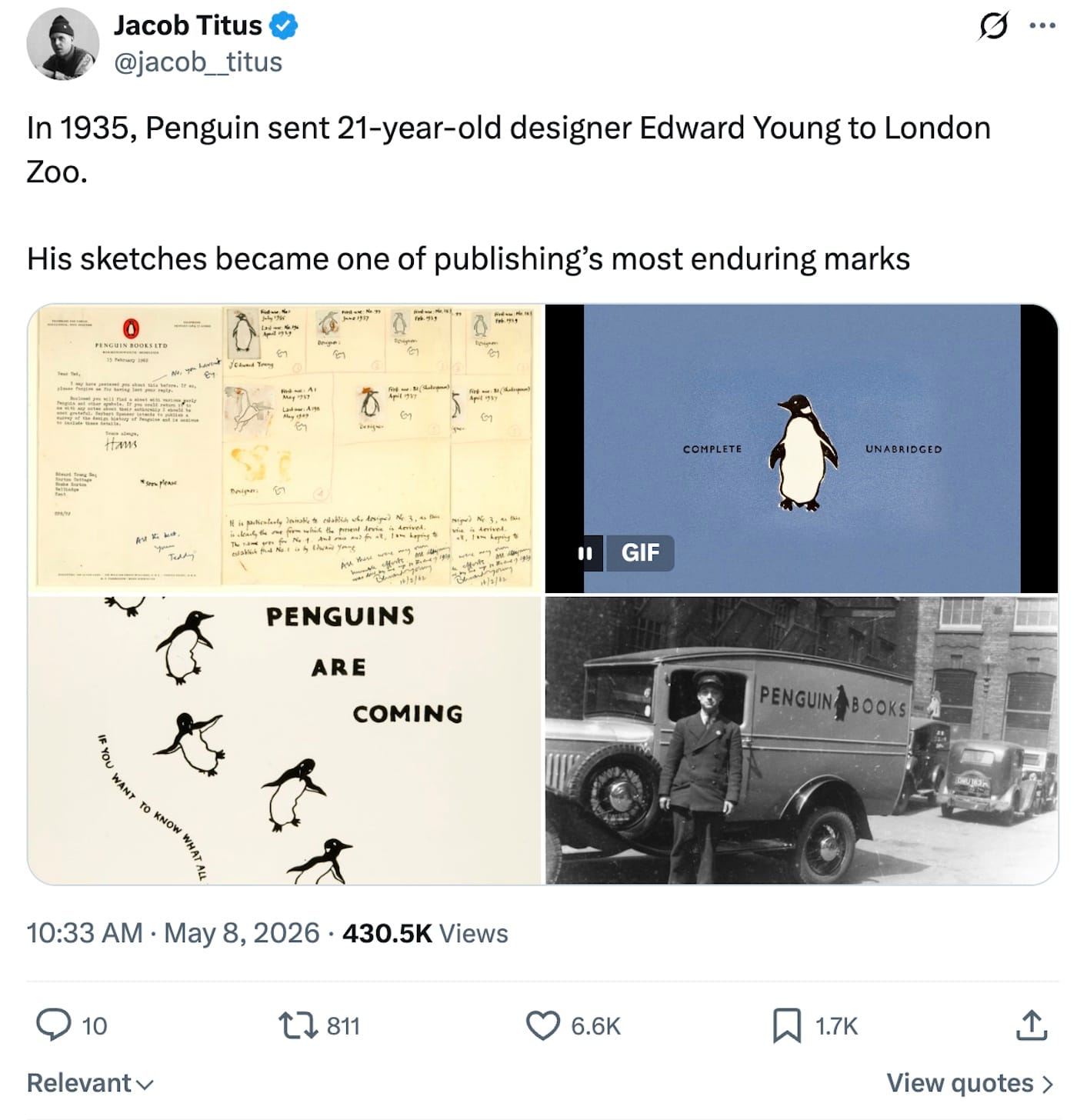
The sweet story of how Penguin got its mascot:
Get in, loser, we're going for a ride on the Baz Luhrmann art deco train:
Required Reading is published every Thursday afternoon and comprises a short list of art-related links to long-form articles, videos, blog posts, or photo essays worth a second look.