Required Reading
This week: Jean Shin’s memorial to the trees of Greenwood Cemetery, the 250th anniversary nobody wants, Pride bar-hopping, and more.

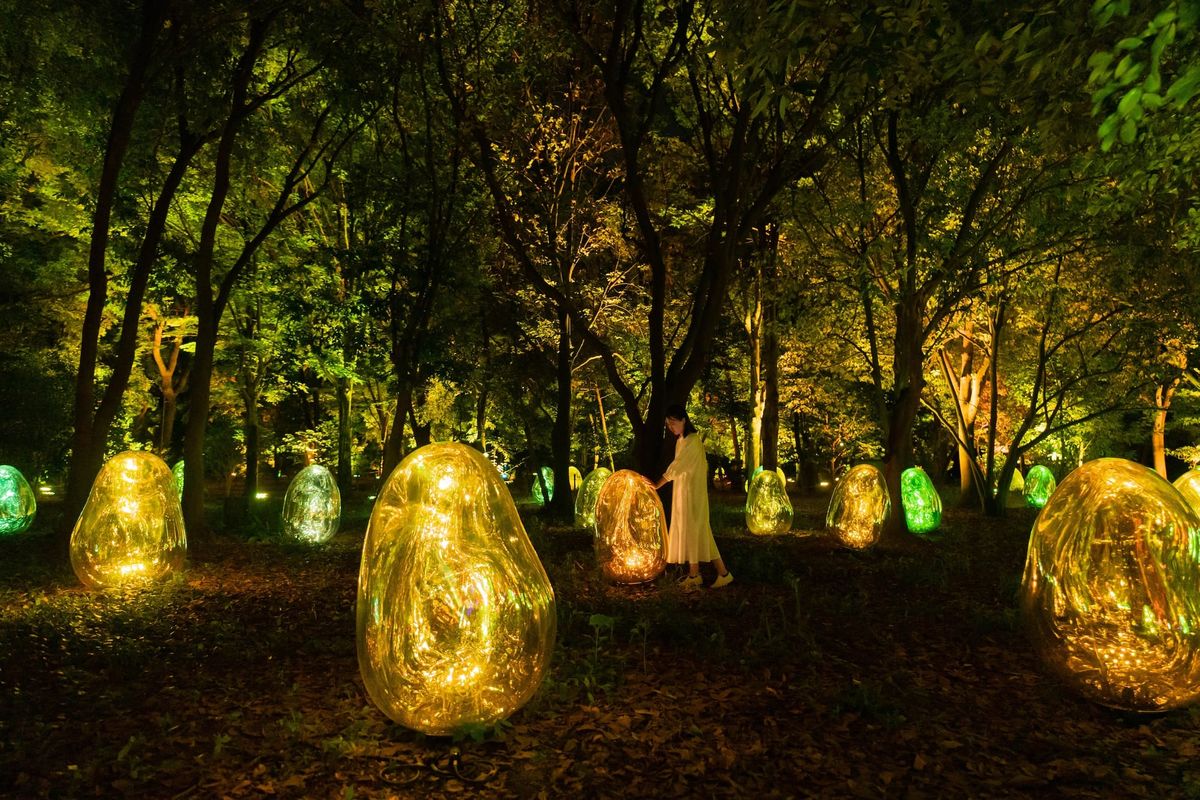
Jean Shin, whose artworks are ecosystems in themselves, recently unveiled a memorial to two fallen trees in a Brooklyn cemetery. For the Amp, run by the Asian American Arts Alliance, Mimi Wong reports:
Shin proposed Offering (2026) as a way to give the elderly trees a proper burial and honor the history of where they were rooted. In the winter, the grave was dug. Along with Dannielle Tegeder from the feminist artist collective Hilma’s Ghost, Shin led a procession to the open grave ringing bells. In the spring, the site was transformed into a Korean-inspired tumuli mound planted with native wildflowers. Mudang Jenn, a Korean shaman, blessed water with mugwort, a traditional medicinal herb, which was then ceremonially poured onto the mound. Both occasions were open to the public, and those in attendance participated in the rituals.
“I was wanting to continue my practice and projects of mourning trees,” Shin told me, as we circled the buried oaks.
Penguin Random House India canceled its distribution of journalist-cartoonist Joe Sacco's latest book, which investigates violent religious riots in 2013, due in part to unspecified "content questions." Ritu Sarin has the story for the Indian Express:
The book is available in India on some online platforms which source copies from UK-based wholesalers — a parallel distribution channel that PRH India has no control over. Some South Delhi bookstores, tired of waiting, have imported copies directly from the UK.
Sacco, who dedicated the book to India’s “hardworking rural journalists” — several assisted him as translators and researchers and also feature in its pages — visited Muzaffarnagar a year after the riots. In a recent interview for Prism magazine, he reflected on what drew him to the story. “It’s a question of looking at the lies and presenting them as lies,” he said. “‘She said, he said’ is not journalism. That’s just quoting people. In this case, it was possible to make an effort to find out what actually happened.”
Jesse Weaver Shipley writes for the Brooklyn Rail about the late Koyo Kouoh's revolutionary curatorial approach in the international exhibition at the Venice Biennale:
Koyo Kouoh, as the first woman of African descent to curate the Venice Biennale, did not assemble a set of African and Global South star artists as was perhaps expected. She did not include African and diasporic artists that the art establishment might have expected, especially as she curated a major show on Black figuration. Instead, she has done something revolutionary. Kouoh focused on form, moving the center and curating from a critical African stance. She convened an eclectic group of co-creators who constructed a show around an African-centered philosophy built on cosmopolitan mobility and an ontology of eclectic, multivocal creativity. The artists neither focus on craft nor conceptualism, nor do they constitute a literal political or identity-based project. The show is not a celebration of art as commodity nor a simplistic critique of it. It is not an orgy of presentist pleasure or pain. Instead, it is about process and embodiment, archiving and reimagining. It imagines art practice as a dialogue about aesthetics and power; art is not something made and contemplated but an ontology, an attitude, a mode of discernment, a way of moving in the world. The show asks: how do we look, listen, and act if we do not take the stance of most curators and critics but curate from the perspective of a critical cosmopolitan Africanity?
For the London Review of Books, novelist J. Robert Lennon considers a new biography of Larry McMurtry, whose stories drew on his upbringing amid waning White settler culture in rural Texas and reveal a complex legacy:
I came of age as a writer in the 1990s, in Montana, where I moved to attend graduate school, and cut my teeth on the literature of the contemporary American West: writers such as James Welch, Leslie Marmon Silko, Donald Barthelme, Pam Houston and Rick Bass, some of whom counted McMurtry as a friend. But I must have regarded the ubiquity of his paperbacks in second-hand bookshops as reason to dismiss him. I had developed a taste for literature that undermined the myth of the cowboy, with his ambition, rugged individualism and bravery. My favourite Western writers embraced style over melodrama, foregrounded Native American culture and explored the lives of women. Surely McMurtry wasn’t for me.
As it happens, this misapprehension plagued McMurtry for his whole career. In Tracy Daugherty’s often absorbing and sometimes vexing new biography, McMurtry bemoans the fact that readers take his characters at face value and misidentify cowboy selfishness as heroism. ‘I don’t think these myths do justice to the richness and fullness of human possibility,’ he said. Traditional gender roles don’t make ‘for the best sort of domestic life’. McMurtry’s own domestic life, in both his childhood and adulthood, suggests a kind, sensitive, ambivalent man in perpetual conflict with responsibility and desire, tradition and contemporary morality.
On the 37th anniversary of the Tiananmen Square Massacre, Gu Yuan reports for Radio Free Asia, victims' families were banned from visiting their loved ones' graves:
Members of the Tiananmen Mothers group that represents the families said they received notice from the Beijing Municipal Security Bureau that for the first time in more than 30 years, they will not be permitted on the premises of Wanan Cemetery, the final resting place of many of the victims, nor would they be allowed to hold their annual post-funerary rites ceremonies.
“They won’t let us go to Wan’an Cemetery now, nor will they let us read sacrificial texts or eulogies,” Zhang Xianling, a member of Tiananmen Mothers, told RFA Tuesday. “These actions, which used to be routine, are no longer permitted. Now we aren’t even allowed to go there, which is something that has never happened before.”
Just our luck that the 250th anniversary of the United States would coincide with "Trump 2.0." Samuel Moyn opines about "the birthday party no one wants" in the Yale Review:
This is in stark contrast with the bicentennial—the country’s last major birthday. 1976 was not an obvious time for patriotic celebration. Richard Nixon’s executive malfeasance and the failed militarism of the Vietnam War were fresh in memory. The generational revolt that dominated the sixties had ebbed, and the country was stuck in an interregnum—between the end of the New Deal order and the start of the neoliberal era. Yet back then, nostalgia seemed capable of meeting the moment: Americans observing the 200th anniversary turned enthusiastically to the founding. As the legal scholar Aziz Rana has noted, there was a “widespread public desire to close the book on the recent past and on critical interrogations of the actual national experience.” In 1976, celebrations of the deeper past were everywhere, from arts and educational programming to pure pageantry; virtually no American could have escaped them. And even many critics of the country seemed to share a hankering for an American consensus grounded in origins. In her censorious bicentennial address, the philosopher Hannah Arendt dwelled on the breakdown of recent years but implored Americans to live up to their “glorious beginnings two hundred years ago.”
Speaking of which, Trump's government has subjected the Iranian national soccer team to a host of restrictions ahead of their World Cup games, including revoking their ticket allocation. Shireen Akram-Boshar writes in Truthout:
While it is unclear who made the decision to revoke the Iranian team’s ability to issue tickets, the U.S. has already created obstacles for Iran’s soccer team. For months, it was unclear if the team would be able to participate at all, as the U.S. and Israel’s unprovoked war against Iran has dragged on since February.
Iran’s soccer players only received their visas to play in the U.S. last week, just 10 days before the start of the tournament. But more than a dozen members of the team’s support staff had their visa applications rejected.
And, as ever, Mamdanistan offers a glimmer of hope. GQ's Yang-Yi Goh reports on the affordable NYC jerseys the mayor is offering during the World Cup this month:
“Jerseys represent more than just the team you support,” Mayor Mamdani exclusively tells GQ. “They are about pride in where you come from and who you are. With this limited run, we are offering New Yorkers an affordable jersey made for New Yorkers, by New Yorkers. I want to thank Mazzi for partnering with us to make sure that nobody is priced out of showing pride for our city.”
Mazzi was founded by Alexander Campaz, who began making jerseys in Colombia in the 1970s before emigrating with his family to New York in 1983. Over the decades, Mazzi’s production facility has moved across the boroughs, from Jackson Heights in Queens to Midtown Manhattan to East New York, Brooklyn, before settling in Bed-Stuy in 2020. That same year, during the COVID-19 pandemic, the factory pivoted to making medical gowns for the city, producing about 20,000 a week and keeping over 100 people employed—many of whom also worked on the mayor’s jersey initiative. Campaz is nearly 90 and still connected to the work, though his son Alex now leads the business.
Pride month bar-hopping:
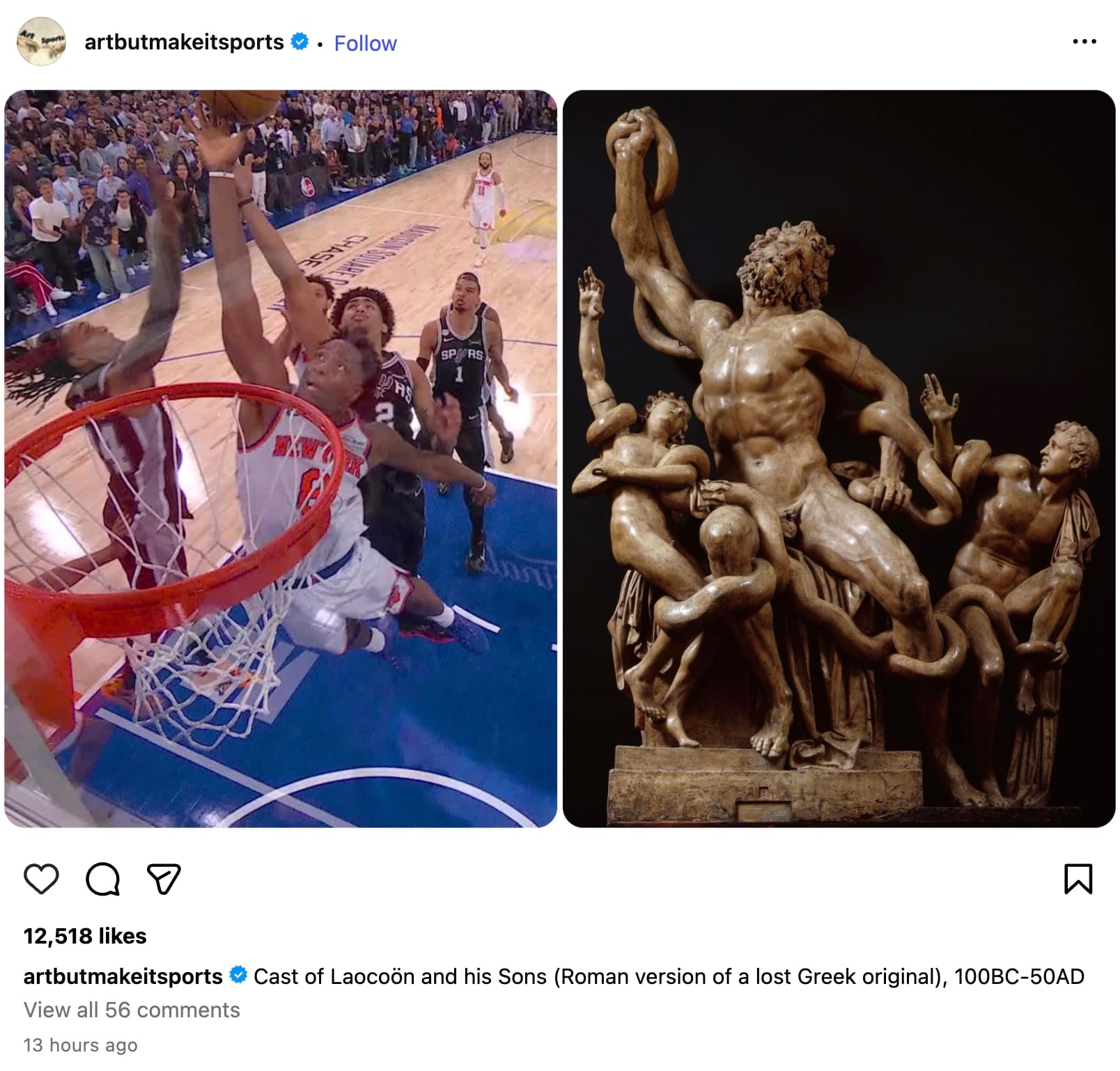
Art But Make It Sports never misses ... Knicks in 5:
Required Reading is published every Thursday afternoon and comprises a short list of art-related links to long-form articles, videos, blog posts, or photo essays worth a second look.