Required Reading
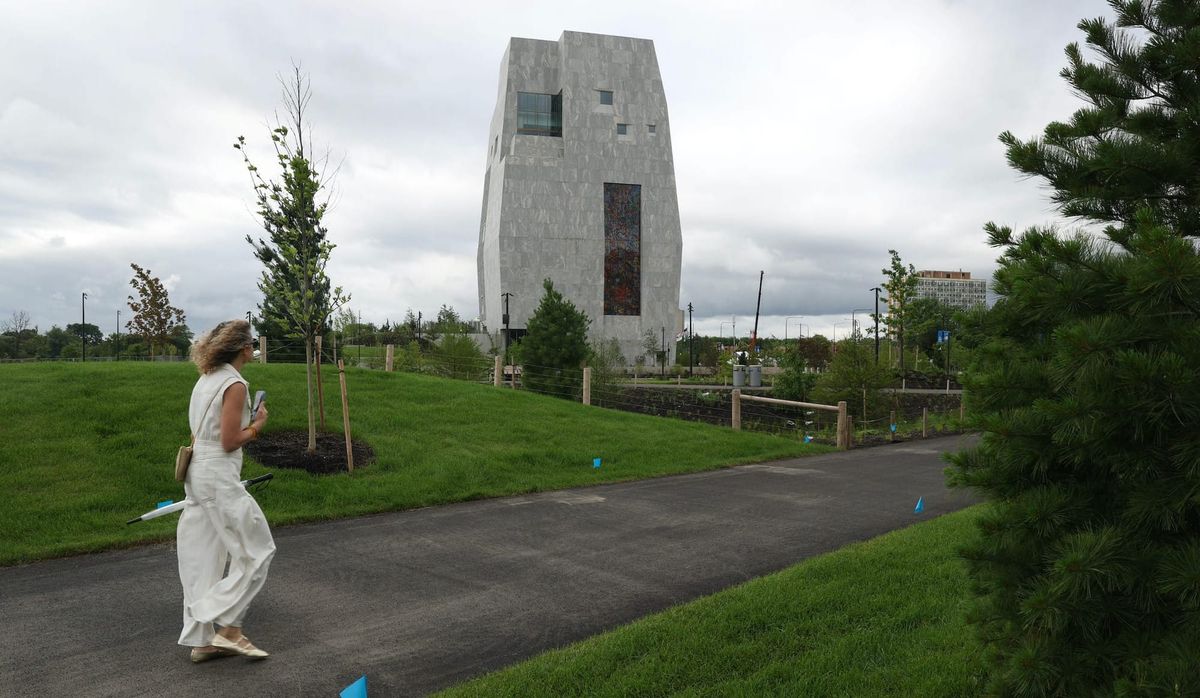
This week: the Obama Center opens in Chicago, painting with Urdu script, glamour as protest, the woman who popularized astrology, an artist’s ode to pigeons, and more.
Critic Eileen G'Sell hasn't forgotten about the iconic anti-red carpet staged by Amazon workers to protest the Met Gala, and neither should you. For the Conversation, she writes about the complex history of glamour as resistance:
The antipathy of left-wing movements toward glamour usually stems from justified concerns over the harms of what Karl Marx dubbed “commodity fetishism.” When a satin skirt or silk scarf is valued primarily for the status endowed upon its wearer – rather than its functionality as clothing – products take on a mystical status. This can obscure economic realities, including the all-too-common exploitation of the workers who made the clothing.
In his seminal 1972 book, “Ways of Seeing,” art critic and socialist John Berger argued that glamour was merely the “happiness of being envied” and that people were trying to transform themselves through buying more and more products they didn’t really need.
So it’s no wonder that anyone wary of misogyny and capitalism might also be wary of fashion and beauty culture – which, at least superficially, augurs only the transient thrill of surface-level gratification.
Contemporary painters in India are incorporating Urdu script into their art as widespread Islamophobia threatens its rich history, Shweta Upadhyay writes for the Scroll:
In Hyderabad-based artist Faiza Hasan’s work, Urdu is used both as annotations in her figurative drawings, and also as what she claims is the “lover’s eye.” Drawing from a form of jewelry used to contain images of a lover or loved ones, Faiza employs the outline of an Urdu word as a container to contour images.
For example, in one work, the word “gulshan” frames the eye of her maternal grandmother, while “lekin kahan” outlines the image of the terrazzo floor of her grandmother’s house. This usage of her mother tongue Dakhni is enmeshed in the archival register of her artistic practice that involves mining family albums and re-drawing scenes, objects, and figures of personal history to create a catalogue of absences.
Mohammed Ahmed Wad Al Sak reports for In These Times on the young Sudanese women who are documenting and filming the ongoing violence in their homeland:
Dr. Eithar Khairy, 29, traded her stethoscope for a smartphone when displacement made practicing medicine impossible. Her film I Am Here follows Randa, a deaf mother of five who became a disability rights activist.
“Randa faces injustice every day, but she’s unbreakable,” Khairy explains. “I chose that title because sometimes just existing, just being present and refusing to disappear, is its own form of resistance.”
Thirty-year-old Ikram Mohammed has been displaced three times since the war began. For a recent documentary project, she spent three days living alongside the women she was filming.
Reporter DaLyah Jones, an eighth-generation Black Texan, interviews landscape architect Diane Jones Allen for the Texas Observer about environmental justice and Black marronage in the state:
Why is it that we do hear about maroon communities in places like Florida, Louisiana, and Mississippi, but we don’t hear a lot about Black marronage and sovereignty here in Texas?
If you’re just looking at maroons in the U.S., you’re right; Florida comes up and Louisiana, and there’s a lot of stuff on the Great Dismal Swamp, the sea islands, but you can’t find Texas.
So complicated, right? Because Texas was really Mexico. And then there was this war in 1836 where a group said we’re not going to have slavery anymore, and then some other people said we want to have slavery, and they had a war and they created Texas. And then, you know, Texas tried to be its own state … then Texas became part of the United States. So I think the true history of Texas, especially in terms of Black people, is very complicated and has been submerged. I mean, that’s why I think [Director of The Texas Freedom Colonies Project] Andrea Roberts is so great… finding all those Freedom Colonies and enlightening people.
This 40-foot-tall effigy of Elon Musk is somehow more grotesque than the original. Activists raised the massive balloon over Times Square in a demonstration against Grok, Vittoria Elliott reports for Wired:
“It's really easy to get distracted by the shiny IPO news. And I think that's what they're kind of hoping will happen,” the SAIN representative says. “But there's real harm, real risk. I think if we are normalizing everywhere—from the banks that are underwriting it to the NASDAQ that's listing it to the shareholders who are buying into it—a company that has this really toxic platform in Grok, normalizing that type of explicit imagery, there’s a real problem.”
Most people passing by seemed unfazed by the massive, shirtless image of Musk, which sported a shoulder tattoo shaped like a heart and reading “ketamine” and another showing an image of the billionaire’s Nazi-like salute shortly after President Donald Trump’s inauguration in 2025, with a few stopping to take photos before moving on.
The Nation's John Nichols writes about Claire Valdez, a New York State Assembly member, union organizer, and artist — as Hyperallergic Editor-in-Chief Hakim Bishara discovered — who's running for a seat in Congress on progressive values:
Look at the polls. People in New York and nationwide actually like human rights. They don’t want immigrants to be targeted by ICE. They know that major steps must be taken to deliver quality healthcare and housing. And they love strong unions.
Perhaps those are radical ideas.
But they are also radically popular – so much so that Justice Democrats, the group that helped elect Alexandria Ocasio-Cortez, Rashida Tlaib and Summer Lee to the US House, and that now hopes to elect Valdez, reposted the RNC’s fearmongering with a reminder that the candidate’s platform is “just that good.” Valdez also boosted the RNC message, gleefully adding, “I’m ready!.”
For the New Yorker, Rachel Syme reads a new biography of Linda Goodman, who popularized astrology in the United States (she walked so Co-Star could run):
It would be easy to think of Goodman, who lived out her last years as a recluse in the Colorado mountains, as just another caftaned kook who’d spent too much time at altitude. Or, less kindly, to paint her as a savvy opportunist who made millions from hawking a woo-woo fad, and whose teachings, once fairly benign, became increasingly dangerous over time. But Goodman’s story is far stranger, and more significant, than that of a dippy mystic or a metaphysical scam artist. Born in a humble West Virginia mining town, she helped to push astrology, once a niche interest, into the center of the Zeitgeist. Her books sold upward of thirty million copies while she was alive, becoming fixtures on coffee tables and nightstands. Before “Linda Goodman’s Sun Signs” emerged, discussions of the zodiac were confined to fringe scenes and scant newspaper columns; by the mid-seventies, a person might casually bring up her sign during a first date or a dinner party. Goodman, with her friendly, approachable writing style, demystified what had previously been a wonky, mathematical discipline, allowing even casual readers to feel a newfound connection with the tides of the universe. The cost was that she became trapped in a bizarre private cosmos of her own making.
Dr. Nasser Mohamed, the first Qatari man to publicly come out as gay, hosted a night of queer joy and music for Pride on June 13, the same day Qatar played its first World Cup match. Love Is You welcomed revelers to the San Francisco Mint, whose steps were emblazoned with the phrase in different languages:
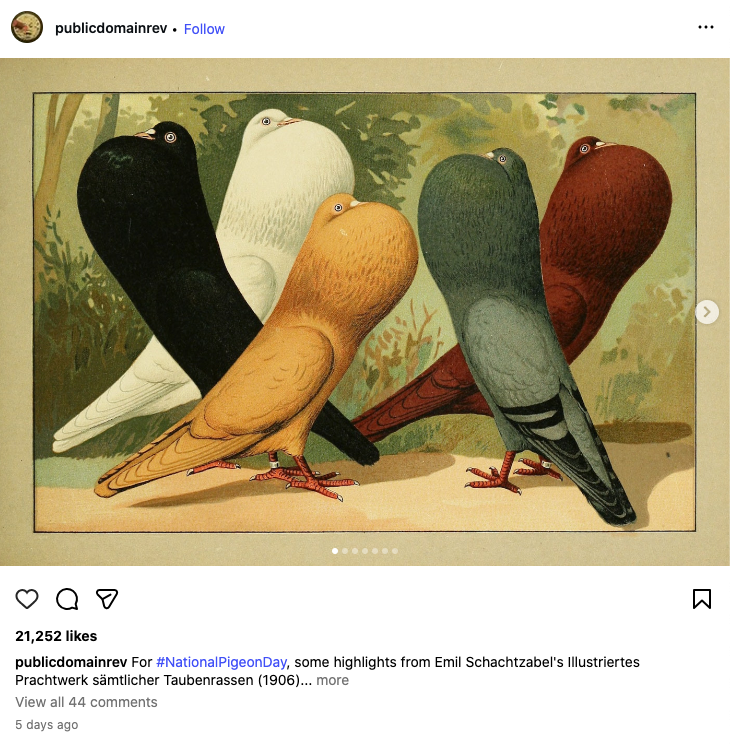
Happy belated National Pigeon Day to all those who observe, myself included! The Public Domain Review shares a batch of Emil Schachtzabel's paintings of our feathered friends for the occasion:
Fake AI tech ads to add some humor to your subway commute:
Required Reading is published every Thursday afternoon and comprises a short list of art-related links to long-form articles, videos, blog posts, or photo essays worth a second look.